
Popular Courses

Brand
Awarding body image

The Functional Skills Maths Level 2 course is designed to help learners develop the essential numeracy skills needed for work, further study, and everyday life. It focuses on practical mathematical understanding, covering core topics such as numbers, fractions, percentages, ratios, and problem-solving techniques used in real-world situations.

This online course is suitable for adults returning to learning, jobseekers, and learners who need a Level 2 maths qualification equivalent for progression or entry requirements. The flexible study format allows you to learn at your own pace, making it easier to fit learning around work or personal commitments.

By completing this course, learners build confidence in applying maths accurately and efficiently, while also earning a CPD-accredited certificate and the option to obtain a QLS-endorsed certificate of achievement, providing recognised evidence of skills development.

Functional Skills Maths Level 2 Course Overview and Purpose

Functional Skills Maths Level 2 is a UK-recognised level of maths training that focuses on practical numeracy skills used in everyday life, the workplace, and further learning. It is designed to help learners apply mathematical methods confidently rather than memorising abstract theory.

This level covers the core areas of mathematics expected at Level 2, including numbers and calculations, fractions and percentages, ratios and proportions, and problem-solving techniques. Learners are taught how to interpret numerical information, make accurate calculations, and use maths to solve real-world problems such as budgeting, estimating costs, understanding data, and working with measurements.

Functional Skills Maths Level 2 is often used by adults who need to strengthen their maths ability for employment, meet entry requirements for further education, or improve confidence with numeracy after time away from formal study. The focus is on clarity, accuracy, and practical application rather than academic complexity.

This course provides structured online learning that supports the development of these skills through guided lessons, examples, and practice tasks. It is suitable for learners who want a flexible way to improve their maths knowledge while gaining recognised evidence of continued professional development.

Sneak Peek

Accreditation & Complementary Gifts 🎁

  • CPDQS-accredited proficiency
  • Free Enrollment Letter
  • Free Course 01: An Introduction to Discrete Maths
  • Free Course 02: Diploma in Effective Writing Skills

What You Will Learn in This Functional Skills Maths Level 2 Course

In this Functional Skills Maths Level 2 course, learners build a strong, practical foundation in Level 2 mathematics, with a clear focus on real-world application. The course is structured progressively, allowing learners to move from core number skills to more applied mathematical problem-solving used in work and everyday situations.

You will develop confidence in the following key areas:

  • Working with integers and directed numbers, including ordering, calculations, and powers
  • Understanding factors and multiples, including prime factorisation, HCF, and LCM for efficient problem-solving
  • Using fractions accurately, including conversion between mixed and improper fractions, comparison, and calculations
  • Applying decimals and percentages, with confidence in conversions and real-life numerical comparisons
  • Using the BODMAS rule to simplify expressions correctly and avoid common calculation errors

The course also strengthens applied maths skills through:

  • Ratio, proportion, and unitary methods, supporting everyday calculations involving quantities and comparisons
  • Estimation and approximation, including rounding and significant figures for sensible numerical judgement
  • Scientific notation (standard form) for managing very large or very small numbers

To support workplace and personal finance tasks, you will learn how to calculate:

  • Profit, loss, discount, and tax, using structured examples and practice questions

By the end of the course, learners are equipped with functional maths skills at Level 2 standard that support employment, further study, and confident everyday decision-making.

Course Curriculum: Module-by-Module Breakdown

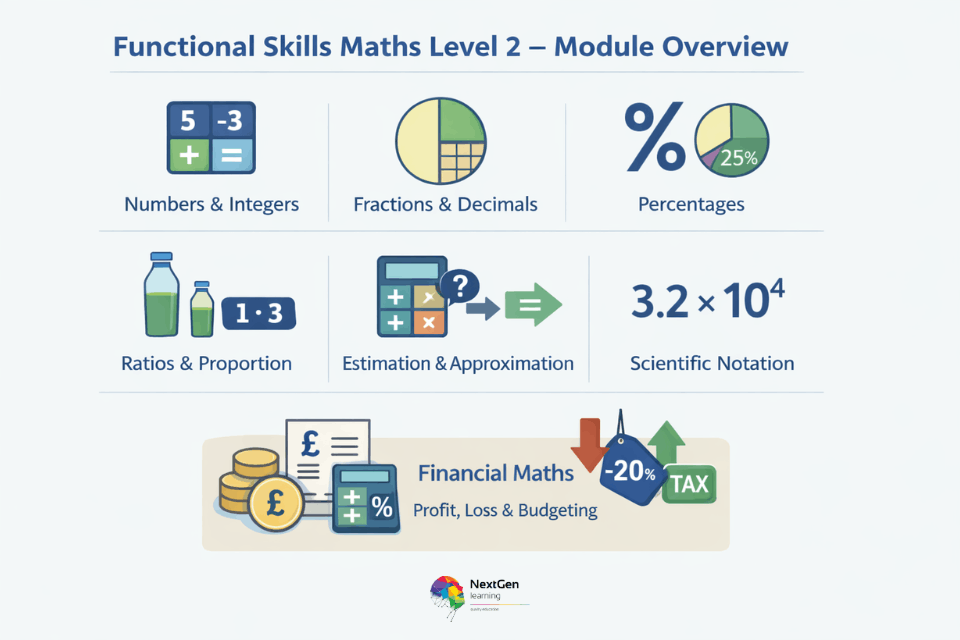
Functional Skills Maths Level 2 module overview including numbers, fractions, percentages, ratios, estimation, and financial maths

This Functional Skills Maths Level 2 curriculum is organised into clear topic areas, each designed to build practical numeracy skills progressively. Every module focuses on accuracy, understanding, and real-world application, supporting learners at Level 2.

Integers (Directed Numbers)

This module introduces positive and negative numbers, ordering integers, and core operations. Learners develop confidence in addition, subtraction, multiplication, division, and powers of integers—skills commonly used in finance, measurements, and data interpretation.

Factors and Multiples

You will learn how to identify factors and multiples, apply divisibility rules, and use prime factorisation. This module also covers HCF and LCM, which are essential for simplifying calculations and solving practical numerical problems efficiently.

Fractions

This section develops a thorough understanding of fractions, including classification, equivalence, comparison, and simplification. Learners practise all four operations with fractions and apply their knowledge through structured word problems.

Simplification Using BODMAS

Learners are guided through the correct order of operations using BODMAS. This module focuses on simplifying expressions accurately, including those involving fractions and brackets.

Decimal Numbers

This module explains the relationship between decimals and fractions. You will practise ordering decimals and performing calculations involving addition, subtraction, multiplication, and division of decimal numbers.

Rational Numbers

You will learn how rational numbers are represented and how to identify terminating and non-terminating decimals. The module also introduces efficient methods for converting fractions into decimal form.

Approximation

This section focuses on rounding to whole numbers, decimal places, and significant figures. Learners practise selecting appropriate rounding methods for different contexts.

Estimation and Scientific Notation

You will learn how to estimate values sensibly and express numbers using standard (scientific) form, including operations involving numbers written in this format.

Percentages

This module covers conversions between percentages, fractions, and decimals, calculating percentages of quantities, and solving increase and decrease problems through applied examples.

Ratio and Proportion

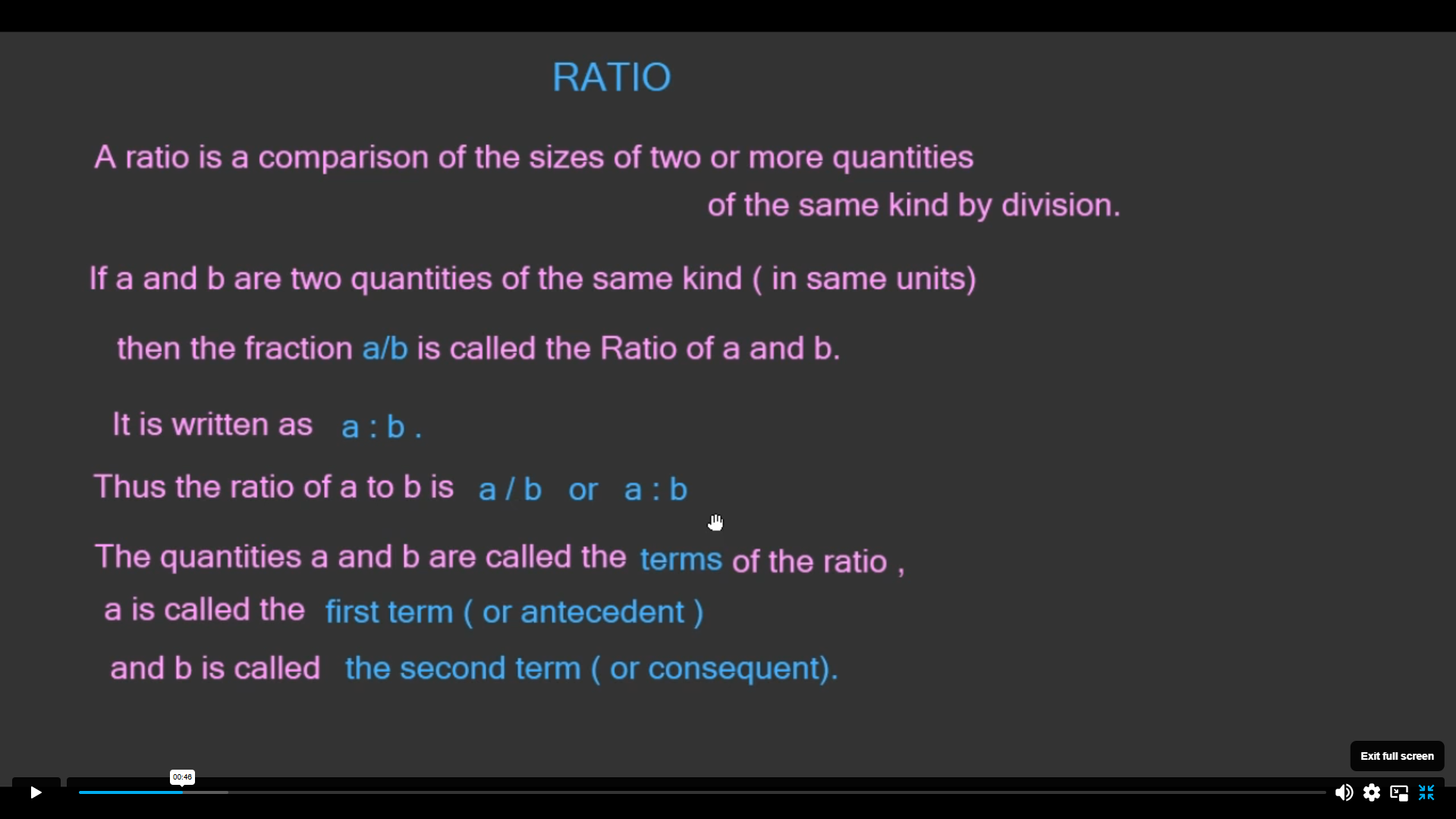
Learners develop skills in expressing, comparing, and dividing ratios, as well as solving proportion-based problems, including continued proportion.

Unitary Method and Its Applications

This section focuses on direct and inverse proportion and solving real-life problems using the unitary method and multiple ratios.

Profit, Loss, Discount, and Tax

The final module introduces key financial calculations, including profit and loss formulas, discounts, and tax. Learners apply these concepts through progressively challenging practice problems.

Mock Exam

A final mock exam allows learners to test their understanding across all topics and prepare for assessment-style questions.

Why Study Functional Skills Maths Level 2 With Us

This course is designed to provide clarity, structure, and flexibility, without unnecessary complexity or misleading claims.

What sets this course apart:

  • Clear focus on practical, applied maths skills

  • Moreover, CPD-accredited learning for professional development

  • Additionally, an Optional QLS-endorsed certification for additional recognition

  • Importantly, the self-paced online format is suitable for adult learners

  • Furthermore, Transparent course positioning as non-regulated training

The emphasis is on helping learners understand maths clearly and apply it accurately, rather than rushing through content.

Get UK and Internationally-recognised CPD Certificate & Transcripts

Upon successful completion of the course and final assessment, learners are eligible to receive a CPD-accredited certificate. This certificate confirms that the course meets recognised Continuing Professional Development (CPD) standards and demonstrates commitment to maintaining and improving professional skills.

The CPD certificate is suitable for:

  • Personal development records

  • Workplace learning evidence

  • CV and portfolio enhancement

Both digital (PDF) and hard copy options are available.

Nextgen Certificate

QLS Endorsed Certificate of Achievement

Upon successful completion of the course, you will be eligible to order a QLS Endorsed HardCopy Certificate titled ‘Diploma in Functional Skills – Maths and English at QLS Level 4’, providing tangible proof of your newly acquired skills. These certificates are not just tokens; they can be a valuable addition to your CV, enhancing your employability and opening doors to a myriad of career opportunities in Supply Chain Management, Purchasing & Procurement.

  • £89 for addresses within the UK. Please note that delivery within the UK is free of charge.

Please Note: NextGen Learning is a Compliance Central approved resale partner for Quality Licence Scheme Endorsed courses.

Endorsement

The Quality Licence Scheme (QLS) has endorsed this course for its high-quality, non-regulated provision and training programmes. The QLS is a UK-based organisation that sets standards for non-regulated training and learning. This endorsement means that the course has been reviewed and approved by the QLS and meets the highest quality standards.

Who This Functional Skills Maths Level 2 Course Is For

This Functional Skills Maths Level 2 course is designed for learners who want to strengthen practical maths skills in a clear, structured, and flexible way.

It is particularly suitable for:

  • Adults returning to education after a break

  • Jobseekers who need Level 2 maths skills for employment

  • Learners preparing for Functional Skills Maths assessments

  • Individuals who want to improve confidence with everyday numeracy

  • Professionals seeking CPD-recognised maths training

The course is suitable for learners at different confidence levels, as it focuses on progressive learning and real-world application, rather than academic theory.

Creative collage featuring mathematical symbols, skill tags, and learning visuals representing Functional Skills Maths Level 2, Maths Genie, and online math courses.

Entry Requirements and Eligibility

There are no formal entry requirements for this course.

To enrol, learners should have:

  • Basic numeracy and English comprehension

  • Access to a computer, tablet, or smartphone

  • A stable internet connection

No prior qualifications, degrees, or professional experience are required. This makes the course accessible to learners who may not have succeeded in traditional classroom-based maths education.

How the Online Course Works

This Functional Skills Maths Level 2 online course is delivered through a self-paced digital learning platform, allowing learners to study around existing commitments.

Key features include:

  • Structured video-based lessons

  • Topic-based progression aligned to Level 2 standards

  • Practice activities and examples

  • A final mock exam to support revision

  • Online access available 24/7

Learners can pause, revisit, and review lessons at any time, making it easier to build understanding gradually and confidently.

Career Path​

Adult professionals using maths skills in office, retail, and finance roles relevant to Functional Skills Maths Level 2

Completing the Functional Skills Maths Level 2 course helps learners demonstrate practical numeracy skills that are valued across a wide range of UK job roles. While this course is a non-regulated training programme, the skills developed are directly applicable to everyday workplace tasks and can support career progression, job applications, and further learning.

Below are common roles where Level 2 maths skills are relevant.

Administrative Assistant

Strong numeracy skills are used for handling records, invoices, schedules, and basic financial data. Functional maths supports accuracy and confidence in routine office tasks.
Typical UK salary: £20,000 – £28,000

Office Administrator

This role involves data entry, reporting, and managing numerical information. Functional Skills Maths Level 2 helps improve precision when working with figures and documentation.
Typical UK salary: £21,000 – £30,000

Retail Supervisor

Retail roles rely heavily on percentages, ratios, and financial calculations for pricing, stock control, and sales analysis. Level 2 maths skills support daily decision-making.
Typical UK salary: £23,000 – £33,000

Accounts or Finance Assistant

Numeracy is essential for invoices, payments, and basic reconciliations. This course helps strengthen calculation accuracy and financial understanding.
Typical UK salary: £22,000 – £30,000

Supply Chain or Logistics Assistant

Maths skills are used to track quantities, manage deliveries, and interpret data. Functional maths supports planning and problem-solving in logistics environments.
Typical UK salary: £24,000 – £32,000

Teaching or Learning Support Roles

Numeracy skills are useful when supporting learners with basic maths concepts or assisting with classroom activities that involve measurements and data.
Typical UK salary: £19,000 – £26,000

Important note:
Salary ranges are indicative and vary based on experience, location, and employer requirements. This course supports skill development but does not guarantee employment or promotion.

Enrol on the Functional Skills Maths Level 2 Course

If you are looking to improve your maths confidence, support your career development, or prepare for further learning, this Functional Skills Maths Level 2 course offers a flexible and structured learning option.

You can enrol online and begin studying immediately, with the freedom to progress at your own pace and revisit topics whenever needed.

Order Your Certificate

To order QLS endorsed Certificate, we kindly invite you to visit the following link:

FAQs About Level 2 Functional Skills Maths Course

Functional Skills Maths Level 2 is widely regarded as equivalent to GCSE Maths at Grade 4 (C) in terms of level. However, equivalency acceptance depends on employers, universities, or training providers, so requirements should always be checked individually.

No. Functional Skills Maths focuses on practical, real-life numeracy, while GCSE Maths includes broader academic content. Both are Level 2 qualifications, but they are designed for different learning and assessment purposes.

Many learners find Functional Skills Maths more accessible because it emphasises applied maths rather than theory. Difficulty depends on individual strengths, but it is often preferred by adults returning to learning or those needing practical numeracy skills.

Yes, many UK employers accept Functional Skills Maths Level 2 as evidence of workplace numeracy, especially for roles requiring practical maths skills. Acceptance can vary by sector, so it’s advisable to confirm with the employer.

Some universities accept Functional Skills Maths Level 2 for specific courses, while others require GCSE Maths. Entry requirements vary by institution and programme, so learners should always check with their chosen university before applying.

Yes. Functional Skills Maths Level 2 can be studied online through structured training courses that support skills development and exam preparation. Online study offers flexibility and allows learners to progress at their own pace.

In some cases, funded options may be available through colleges or government schemes. However, availability depends on eligibility criteria. Many learners choose paid online courses for flexibility, support, and structured learning resources.

Completion time varies. Some learners finish within a few weeks, while others take several months. Self-paced online courses allow learners to progress according to their confidence level and availability.

The level of difficulty depends on prior maths experience and preparation. With structured learning, practice questions, and revision, many learners successfully pass by focusing on applied problem-solving rather than complex theory.

Pass marks are set by the awarding organisation for regulated exams and may vary slightly. Typically, assessments are graded as Pass or Fail, rather than using percentage scores like GCSEs.

Yes. Learners are usually allowed to retake the Functional Skills Maths Level 2 exam if they do not pass on the first attempt. Retake policies depend on the exam centre and awarding body.

Yes. Functional Skills qualifications are generally graded as Pass or Fail, rather than using letter or number grades. This approach focuses on demonstrating competency in required skills.

Functional Skills Maths Level 2 supports employability by demonstrating practical numeracy skills used in everyday work tasks. It is particularly relevant for administrative, retail, logistics, and support roles that rely on accurate calculations.

Functional Skills do not replace GCSEs, but Level 2 Functional Skills Maths is often accepted as an alternative by employers and some education providers. Acceptance depends on the organisation’s specific entry criteria.

Preparation usually involves revising core topics such as numbers, fractions, percentages, and ratios, alongside practising exam-style questions. Structured online training courses can help learners build confidence before assessment.

Some learners choose structured CPD-accredited training, such as the Functional Skills Maths Level 2 course by NextGen Learning, to support revision and skills development alongside exam preparation.

Course Curriculum

Integers ( Directed Numbers)
Lecture 1 Introduction 00:02:00
Lecture 2 Multiplying any digit number by 11, 22, and 33 00:09:00
Lecture 3 Integers and ordering of integers 00:06:00
Lecture 4 Addition and Subtractions of Integers 00:07:00
Lecture 5 Operations on Integers 00:04:00
Lecture 6 Multiplication and Division of Integers 00:04:00
Lecture 7 Powers of Integers (Exponents) 00:04:00
Factors and Multiples
Lecture 8 Complete knowledge about factors and multiples 00:06:00
Lecture 9 Divisibility tests for 2,3,4,5,6 00:07:00
Lecture 10 Divisibility rules 7,8,9,10,11 00:06:00
Lecture 11 Prime Factorization 00:06:00
Lecture 12 Highest Common Factor HCF 00:10:00
Lecture 13 Least Common Multiple LCM 00:16:00
Lecture 14 Relation between LCM and HCF 00:04:00
Fractions
Lecture 15 Classification of Fractions 00:04:00
Lecture 16 Convert mixed to improper and improper to mixed fractions 00:03:00
Lecture 17 Equivalent Fractions 00:04:00
Lecture 18 Comparing Fractions after converting to like fractions 00:09:00
Lecture 19 Reducing a fraction to lowest term 00:04:00
Lecture 20 Addition and subtraction OF fractions 00:08:00
Lecture 21 Multiplication and division of fractions 00:11:00
Lecture 22 Word problems on fractions 00:16:00
Simplification Rule : BODMAS
Lecture 23 BODMAS and rules to remove brackets 00:03:00
Lecture 24 Simplify expressions using BODMAS rules 00:05:00
Lecture 25 Simplify expressions involving fractions using BODMAS 00:07:00
Decimal numbers
Lecture 26 Decimal numbers in relation to fractions 00:08:00
Lecture 27 Like and unlike Decimals 00:05:00
Lecture 28 Ordering of Decimal numbers 00:10:00
Lecture 29 Addition and subtraction of Decimal 00:07:00
Lecture 30 Multiplication of Decimal 00:03:00
Lecture 31 Division of Decimal 00:05:00
Rational Numbers
Lecture 32 Rational number 00:02:00
Lecture 33 Representation of Rational Numbers on Number line 00:04:00
Lecture 34 Determining which fraction is terminating or non terminating 00:05:00
Lecture 35 shortcut method of writing decimal expansion of fraction to decimal 00:08:00
Approximation
Lecture 36 Rounding to whole number 00:06:00
Lecture 37 Rounding to required number of decimals (1 d.p. ) 00:05:00
Lecture 38 rounding to significant digits 00:07:00
Lecture 39 Practice question on three methods of approximation 00:05:00
Estimation and Scientific Notation or Standard form
Lecture 40 Estimation 00:05:00
Lecture 41 Scientific Notation 00:07:00
Lecture 42 Operation on numbers when they are in scientific notation 00:06:00
Percentage
Lecture 43 Percentage to fraction and fraction to percentage 00:06:00
Lecture 44 Percentage of a quantity and conversation to decimal 00:06:00
Lecture 45 Expressing one quantity as percentage of another quantity 00:06:00
Lecture 46 Finding increase decrease percent 00:05:00
Lecture 47 Uses of percentages-Word Problems 00:09:00
Ratio and Proportion
Lecture 48 Ratio- How to express as simple ratio 00:09:00
Lecture 49 How to compare Ratios 00:04:00
Lecture 50 Word problems on finding ratios 00:07:00
Lecture 51 To divide a given quantity into a given Ratio 00:11:00
Lecture 52 Proportion 00:04:00
Lecture 53 Practice problems on Proportion 00:06:00
Lecture 54 Continued proportion 00:06:00
Unitary Method and its Applications
Lecture 55 Direct Variation ( or proportion) 00:04:00
Lecture 56 Problems based on Direct proportion 00:10:00
Lecture 57 Inverse Variation ( or proportion) 00:10:00
Lecture 58 Multiple Ratios 00:10:00
Profit , Loss, discount and Tax
Lecture 59 Basics – Profit and Loss 00:04:00
Lecture 60 More practice problems on Profit & Loss 00:06:00
Lecture 61 Selling price formula and Problems 00:04:00
Lecture 62 Cost price formula and Problems 00:03:00
Lecture 63 Higher problems on Profit and Loss 00:08:00
Lecture 64 Basics – Discount.mp4 00:05:00
Lecture 65 Practice problems on Discount 00:04:00
Lecture 66 Tax 00:06:00
Mock Exam
Mock Exam – Functional Skills Maths 00:20:00
Final Exam
Final Exam – Functional Skills Maths 00:20:00
Order Your CPD Certificate
Order Your Certificate 00:00:00
Order Your QLS Certificate
Order Your QLS Certificate 00:00:00
Thank You for Choosing NextGen Learning
Thank You For Choosing NextGen Learning 00:00:00

Related Courses

A product of

© 2026 NextGen Learning. All rights reserved

Home Search Cart Offers
Select your currency
GBP Pound sterling