
Popular Courses

Brand Brand Brand Brand
Awarding body image

Overview Of Process Improvement: How to Reduce Waste Course

process improvement course | reduce waste course

The Process Improvement: How to Reduce Waste course teaches learners the essential tools and methods used to optimise workflows, remove inefficiencies and improve organisational performance. This process improvement course explains how waste occurs, how Lean principles reduce unnecessary activities and how value-adding steps can be identified within any process.

Moreover, global demand for process improvement continues to rise as organisations worldwide lose over $10 trillion annually to operational inefficiencies, making waste reduction a critical skill for teams and businesses. Furthermore, this reduce-waste course explores the 8 wastes, mapping tools, value analysis and strategies for process refinement. Consequently, learners gain the confidence to analyse, map and improve processes using proven Lean methodologies.


What You’ll Learn

✅ Understand the fundamentals of process improvement and waste reduction.
✅ Learn the 8 wastes and why they affect performance.
✅ Understand how to differentiate value-adding vs non-value-adding activities.
✅ Learn to use process mapping tools such as SIPOC, VSM and swim lane maps.
✅ Discover how to analyse workflows and identify improvement opportunities.
✅ Gain insight into Lean principles and how they support waste reduction.


Course Features

📉 Covers key concepts in waste reduction and Lean thinking.
📊 Includes demonstrations of process mapping tools and techniques.
🗂️ Explores value analysis methods for workflow optimisation.
🧭 Provides step-by-step mapping examples from real scenarios.
📘 Contains case study insights that reinforce learning.
🌍 Suitable for operational, administrative and quality-focused learners.

Moreover, this course is designed to guide learners step by step. In addition, the lessons are organised in a logical flow, ensuring that each concept builds smoothly on the previous one. Consequently, learners gain confidence as they progress. Furthermore, the content connects theory with practical examples, making the learning experience more engaging. Similarly, complex topics are simplified so that beginners can understand them easily. As a result, learners can apply the knowledge in real situations. On the other hand, those with prior experience can refine their existing skills. Therefore, the course supports continuous improvement for all learners. Ultimately, it provides a structured pathway that helps students achieve their learning goals effectively.online communication skills

Description of Process Improvement: How to Reduce Waste Course

process improvement course

This course offers an engaging and comprehensive introduction to process improvement. Moreover, it explains how waste forms within workflows and how Lean techniques are used to evaluate and eliminate inefficiencies. Therefore, learners gain clarity on improving processes through structured analysis.

In addition, the course explores the 8 wastes, value-adding concepts and mapping tools such as SIPOC, value stream maps and spaghetti diagrams. Furthermore, it highlights how to use these tools to redesign workflows, reduce delays and strengthen productivity. Consequently, learners complete this process improvement training with actionable skills to enhance efficiency in any environment.


Curriculum Overview:

  • Module 1 – Introduction to Process Improvement
    Learn the purpose of the course and the foundational concepts of improvement and waste reduction.
  • Module 2 – Fundamentals of Waste and Lean Thinking
    Understand what constitutes waste and how Lean principles identify and eliminate inefficiencies.
  • Module 3 – The 8 Wastes Framework
    Explore each of the 8 wastes including defects, over-production, transport, waiting, inventory, motion, extra-processing and skill underutilisation.
  • Module 4 – Value-Adding (VA) vs Non-Value-Adding (NVA)
    Learn how to distinguish between VA and NVA work and how value is created within processes.
  • Module 5 – Process Mapping Tools
    Study swim lane maps, SIPOC diagrams, value stream maps, time value maps, spaghetti diagrams and value-add charts.
  • Module 6 – Demonstrations of Mapping Tools
    Follow detailed demonstrations showing how each mapping tool is constructed and analysed.
  • Module 7 – Case Study
    Review a real scenario demonstrating how process improvement principles are applied.
  • Module 8 – Course Closeout and Key Takeaways
    Summarise learning points and apply them to organisational improvement efforts.

Why Choose Us?

Certificate of Achievement

Upon successful completion of this course, learners will receive a CPD-certified PDF certificate for £9.99 or a hard copy for £14.99.

Moreover, this course is designed to guide learners step by step. In addition, the lessons are organised in a logical flow, ensuring that each concept builds smoothly on the previous one. Consequently, learners gain confidence as they progress. Furthermore, the content connects theory with practical examples, making the learning experience more engaging. Similarly, complex topics are simplified so that beginners can understand them easily. As a result, learners can apply the knowledge in real situations. On the other hand, those with prior experience can refine their existing skills. Therefore, the course supports continuous improvement for all learners. Ultimately, it provides a structured pathway that helps students achieve their learning goals effectively.online communication skills

Who Is This Process Improvement: How to Reduce Waste Course For ?

Process Improvement Course | Reduce Waste Course

  • Professionals seeking to improve workflow efficiency.

  • Employees in operations, quality, logistics or administration.

  • Individuals learning Lean methods for the first time.

  • Managers wanting to reduce waste in their teams.

  • Anyone interested in process improvement or business optimisation.

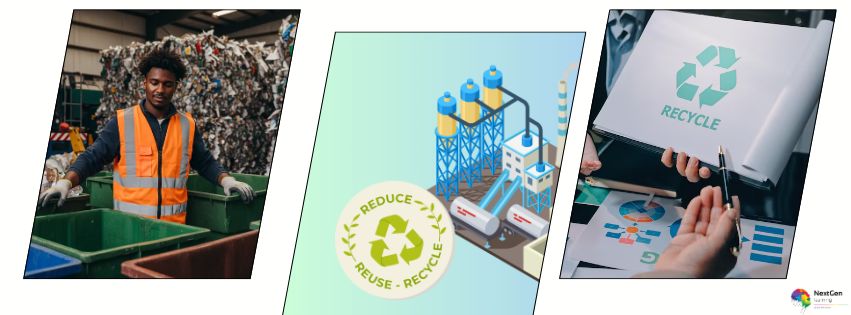
This image represents the process improvement course focused on reducing waste using Lean methods and workflow analysis. It visually highlights key tools such as process mapping and waste identification.

Requirements of Process Improvement: How to Reduce Waste Course

Process Improvement Course | Reduce Waste Course

The Process Improvement: How to Reduce Waste Course requires no prior degree or experience. Therefore, all you require is English proficiency, numeracy literacy, and a gadget with a stable internet connection. Consequently, you can learn and train for a prosperous career in the thriving and fast-growing industry, without any fuss.

Moreover, this course is designed to guide learners step by step. In addition, the lessons are organised in a logical flow, ensuring that each concept builds smoothly on the previous one. Consequently, learners gain confidence as they progress. Furthermore, the content connects theory with practical examples, making the learning experience more engaging. Similarly, complex topics are simplified so that beginners can understand them easily. As a result, learners can apply the knowledge in real situations. On the other hand, those with prior experience can refine their existing skills. Therefore, the course supports continuous improvement for all learners. Ultimately, it provides a structured pathway that helps students achieve their learning goals effectively.online communication skills

Career Path​

  • Process Improvement Assistant — support workflow analysis and mapping.

  • Lean Coordinator — help reduce waste using Lean tools.

  • Quality Technician — ensure processes meet efficiency standards.

  • Operations Analyst — evaluate performance and improve systems.

  • Continuous Improvement Trainee — support long-term optimisation projects.

Order Your Certificate

To order CPD Quality Standard Certificate, we kindly invite you to visit the following link:

FAQs -

Waste reduction targets non-value-adding activities (NVA) so more time and resources flow to value-adding (VA) work. You’ll learn to identify the 8 wastes, separate VA vs NVA, and redesign steps using mapping tools to shorten lead time and improve quality (Sections 02–04).

Standardise work, set clear CTQs (critical-to-quality), remove duplicate checks, right-size approvals, and design reports/forms once. Use SIPOC to define requirements up-front and Value Stream Maps to spot redundant steps; then validate with a pilot and control plan (Sections 03–05).

Map the current state, quantify delays (Time Value Map), rebalance tasks, reduce batching, co-locate handoffs (Spaghetti Diagram), and set WIP limits. Convert to a pull/just-in-time cadence where possible and track gains with a Value-Add Chart (Section 05).

Define (scope with SIPOC), Measure (baseline defects, queues, motion), Analyse (find root causes per each waste), Improve/Control (run trials, standardise, monitor with simple KPIs). The case study demonstrates this end-to-end (Sections 05–06).

Yes. On completion, you can order a CPD-certified PDF certificate (£9.99) or a hard copy (£14.99).

Course Curriculum

Section 01: Introduction
Introduction 00:02:00
What is the purpose of this course? 00:02:00
Section 02: Fundamentals of Waste
What constitutes waste? 00:02:00
What is Lean? 00:02:00
Section 03: The 8 Wastes
Introduction to the 8 wastes 00:01:00
Defects 00:02:00
Over-production 00:02:00
Waiting 00:02:00
Non-utilisation of skills 00:03:00
Transport 00:02:00
Inventory 00:02:00
Motion 00:02:00
Extra-processing 00:02:00
Section 04: VA vs. NVA
Process 00:02:00
VA vs. NVA 00:04:00
Creating Value 00:03:00
Section 05: Process Mapping Tools
Scenario to be used 00:01:00
Introduction to process mapping tools 00:03:00
Swim Lane Map 00:04:00
Swim Lane Map: Demonstration 00:07:00
Value Stream Map 00:05:00
Value Stream Map: Demonstration 00:07:00
SIPOC 00:03:00
SIPOC: Demonstration 00:04:00
Time Value Map 00:03:00
Time Value Map: Demonstration 00:03:00
Value Add Chart 00:04:00
Value Add Chart: Demonstration 00:02:00
Spaghetti Diagram 00:04:00
Spaghetti Diagram: Demonstration 00:05:00
Section 06: Case Study
Case study 00:05:00
Section 07: Close Out
Close out 00:03:00
Order Your Certificate
Order Your Certificate 00:00:00

Related Courses

A product of

© 2025 NextGen Learning. All rights reserved

Home Search Cart Offers
Select your currency
GBP Pound sterling