
Popular Courses

Brand Brand Brand Brand
Awarding body image

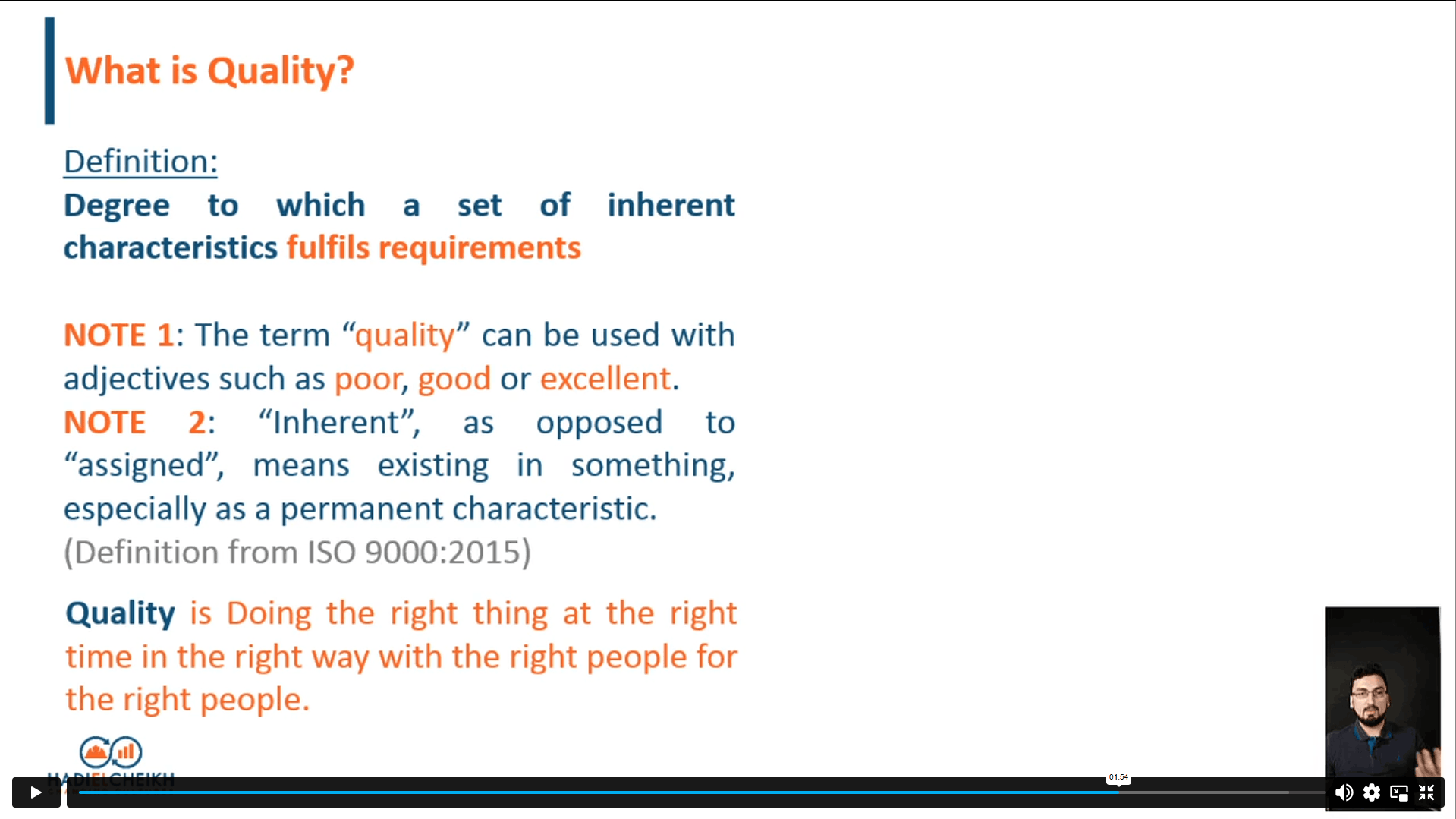
This Quality Management Training Course provides a structured introduction to the principles and systems that support effective quality management in organisations. The course focuses on how quality management frameworks are used to plan, monitor, and improve processes, services, and organisational performance.

Aligned with recognised quality management standards, including ISO 9001:2015, the training explains how quality objectives, process approaches, performance evaluation, and continual improvement operate in practice. It is designed for learners seeking a clear and practical understanding of quality management concepts without prior experience or technical background.

Delivered through flexible online learning, this Quality Management Course supports professional development across a wide range of industries and roles, with learning outcomes aligned to best-practice quality management principles.

Quality Management Training – Course Overview

This Quality Management Training Course provides a structured introduction to the principles, systems, and practices that support effective quality management in organisations. The course is designed to explain how quality management frameworks operate in practice, how they support strategic decision-making, and how they contribute to consistent products, services, and processes.

The training draws on widely recognised quality management concepts and aligns them with the structure and intent of ISO 9001:2015, including areas such as process management, risk-based thinking, performance evaluation, and continual improvement. Rather than focusing on compliance alone, the course emphasises how quality management systems are used as management tools to support organisational objectives and customer expectations.

This Quality Management Course is suitable for learners seeking a clear and logical understanding of quality management systems, regardless of sector or organisation size. It explains key terminology, roles, responsibilities, and system components in a way that supports both learning and professional application, without assuming prior technical knowledge or experience in quality standards.

The course is delivered entirely online and is structured to allow learners to progress at their own pace. Content is organised into short, focused lessons that build from foundational concepts through to strategic quality planning, monitoring, evaluation, and improvement. On completion, learners gain a CPD-recognised Certificate of Achievement, evidencing their professional development in quality management principles.

What You Will Learn in This Quality Management Training

This Quality Management Training provides a comprehensive introduction to the concepts, terminology, and system elements used in effective quality management. The course is structured to build knowledge progressively, starting with foundational principles and moving towards strategic planning, performance evaluation, and improvement.

By completing this Quality Management Course, you will gain knowledge and understanding of:

  • Core quality management concepts, including quality definitions, systems, policies, and organisational roles

  • Quality management principles and how they support consistent performance and customer satisfaction

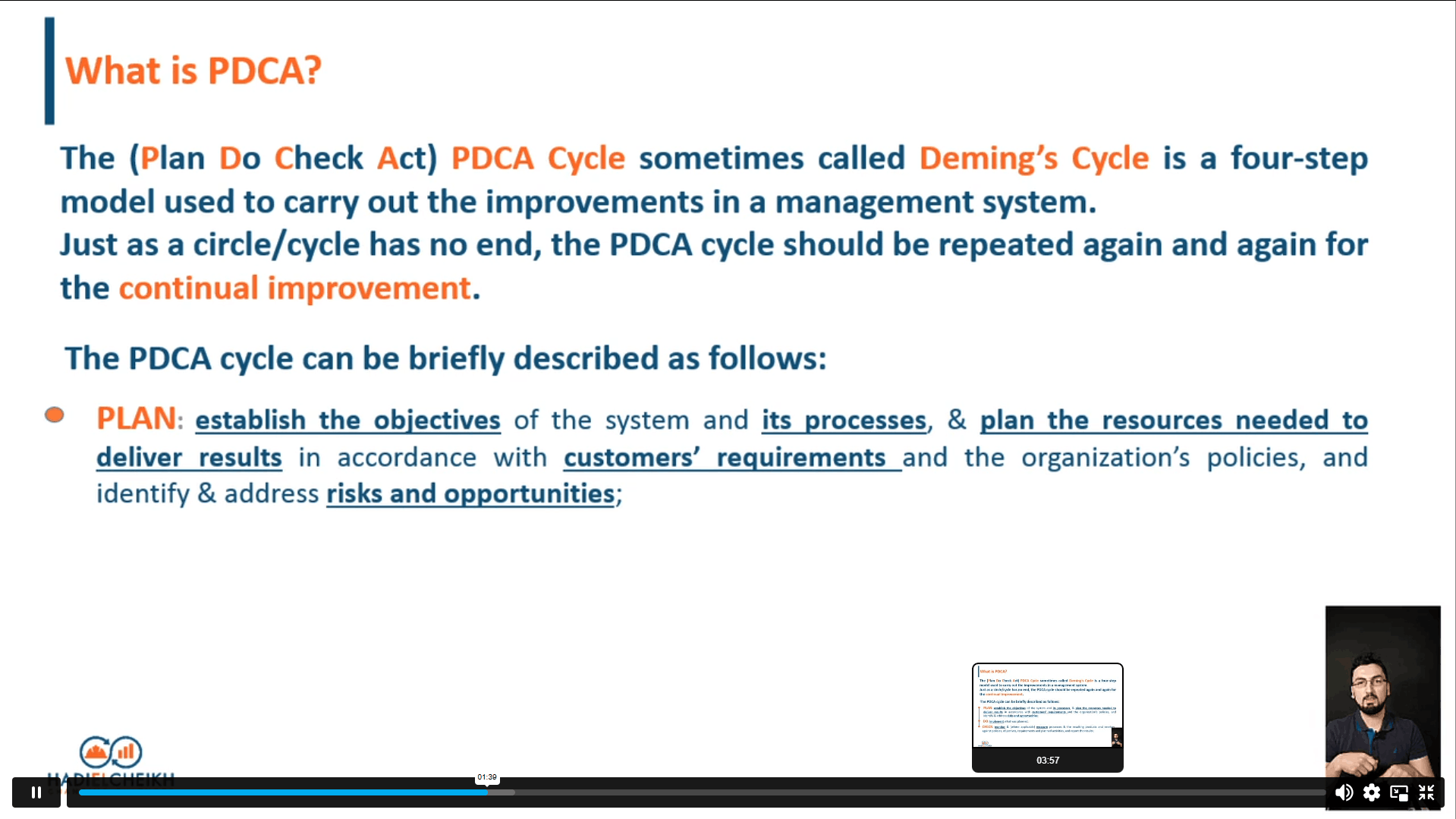
  • Process-based management, including the PDCA cycle and its application within quality systems

  • Risk-based thinking and its role in planning, preventive action, and decision-making

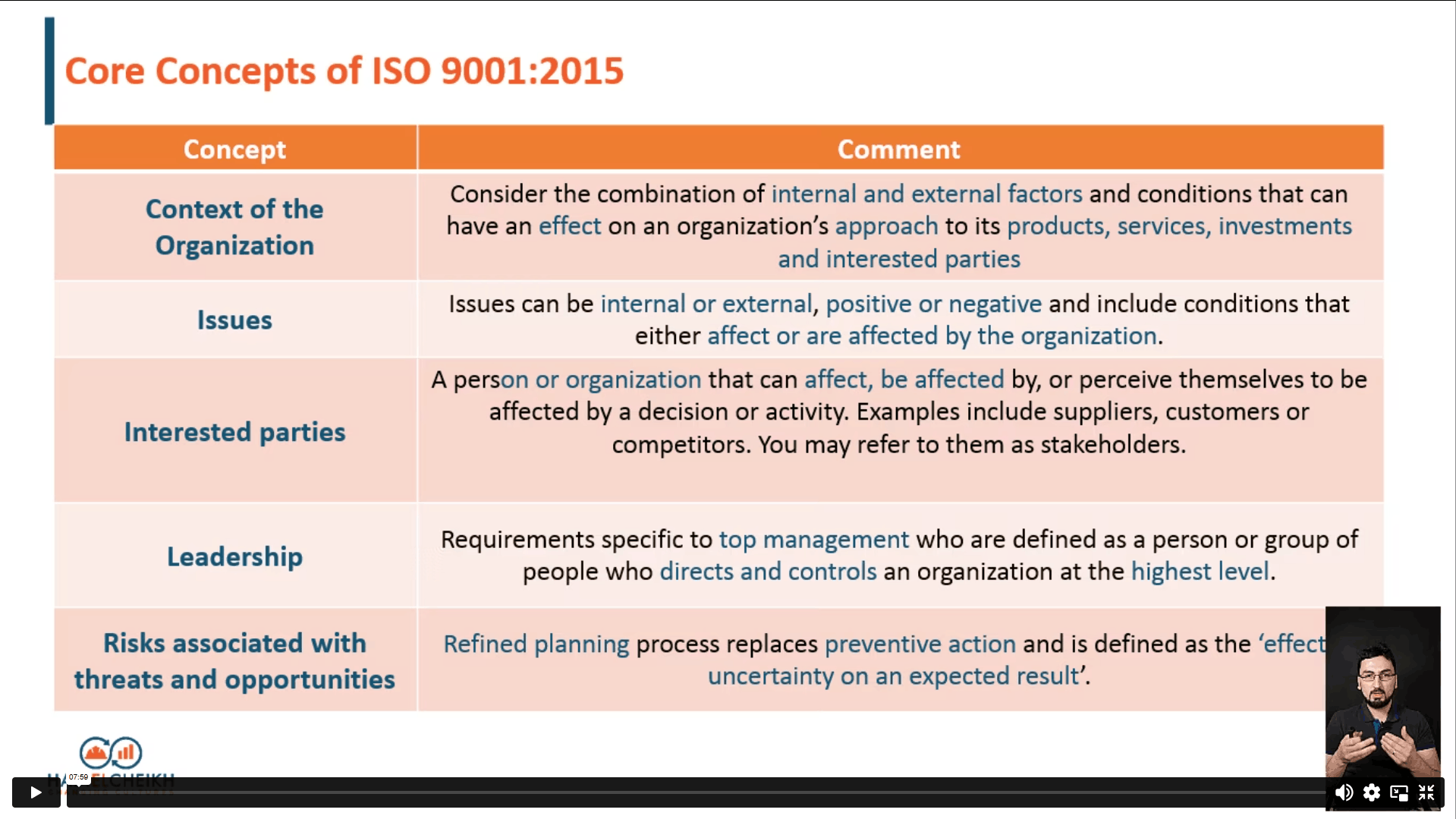
  • Context of the organisation, including internal and external issues and interested parties

  • Quality objectives and planning, including the use of SMART goals and performance indicators

  • Performance evaluation techniques, such as monitoring, measurement, analysis, and management review

  • Nonconformity management and corrective action, supporting continual improvement

  • Quality tools and techniques, including process mapping, root cause analysis, and performance dashboards

The learning outcomes are aligned with recognised quality management frameworks, including ISO 9001:2015, and are designed to support professional development rather than formal certification or audit authorisation.

Quality Management Course Curriculum Overview

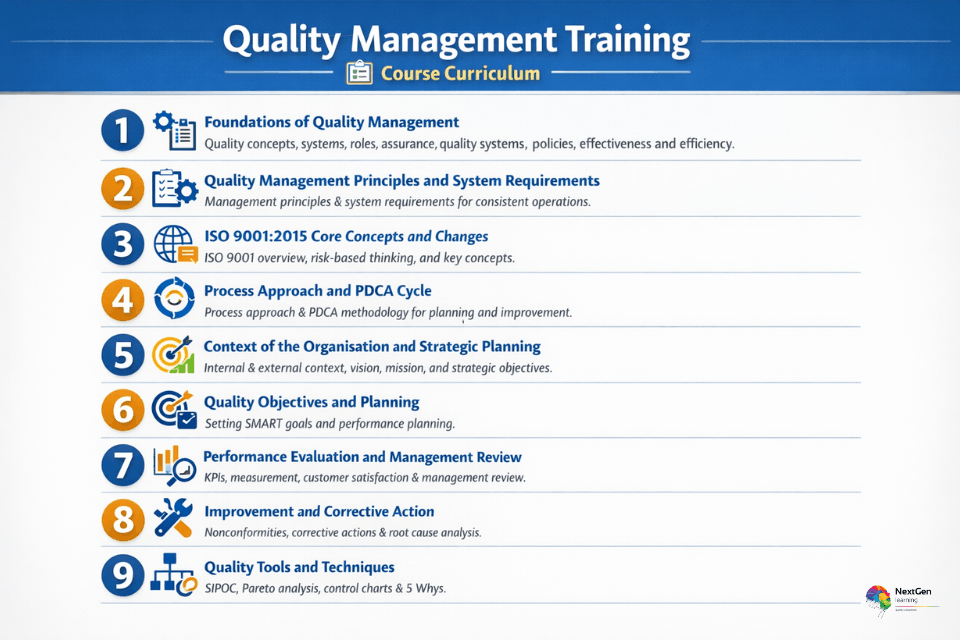
This Quality Management Course is structured into clear learning sections that progress from foundational concepts through to strategic quality planning, performance evaluation, and continual improvement. The curriculum reflects how quality management systems operate in practice and aligns with recognised frameworks, including ISO 9001:2015.

The course content covers the following key areas:

  • Foundations of Quality Management
    Introduction to quality concepts, definitions, systems, policies, roles, and responsibilities, including distinctions between quality assurance, quality control, effectiveness, and efficiency.
  • Quality Management Principles and System Requirements
    Exploration of quality management principles and how management system requirements support consistent and controlled operations.
  • ISO 9001:2015 Core Concepts and Changes
    Overview of ISO 9001 terminology, documented information, organisational knowledge, and risk-based thinking, focusing on understanding rather than certification.
  • Process Approach and PDCA Cycle
    Application of the process approach, PDCA methodology, and process interaction to support structured planning, control, and improvement.
  • Context of the Organisation and Strategic Planning
    Understanding internal and external issues, interested parties, organisational context, vision, mission, strategy, and strategic objective setting.
  • Quality Objectives and Planning
    Development of quality objectives using SMART principles, goal alignment, and performance planning.
  • Performance Evaluation and Management Review
    Monitoring, measurement, analysis, KPIs, dashboards, customer satisfaction evaluation, and management review processes.
  • Improvement and Corrective Action
    Nonconformity management, corrective actions, root cause analysis, and continual improvement approaches.
  • Quality Tools and Techniques
    Practical tools include SIPOC, flowcharts, control charts, cause-and-effect diagrams, Pareto analysis, and the 5 Whys.

Each section is designed to explain why the topic matters professionally, supporting learners in applying quality management principles within organisational environments across different sectors.

Strategic Quality Management & Organisational Context Covered

This Quality Management Course is structured into clear learning sections that progress from foundational concepts through to strategic quality planning, performance evaluation, and continual improvement. The curriculum reflects how quality management systems operate in practice and aligns with recognised frameworks, including ISO 9001:2015.

The course content covers the following key areas:

  • Foundations of Quality Management
    Introduction to quality concepts, definitions, systems, policies, roles, and responsibilities, including distinctions between quality assurance, quality control, effectiveness, and efficiency.
  • Quality Management Principles and System Requirements
    Exploration of quality management principles and how management system requirements support consistent and controlled operations.
  • ISO 9001:2015 Core Concepts and Changes
    Overview of ISO 9001 terminology, documented information, organisational knowledge, and risk-based thinking, focusing on understanding rather than certification.
  • Process Approach and PDCA Cycle
    Application of the process approach, PDCA methodology, and process interaction to support structured planning, control, and improvement.
  • Context of the Organisation and Strategic Planning
    Understanding internal and external issues, interested parties, organisational context, vision, mission, strategy, and strategic objective setting.
  • Quality Objectives and Planning
    Development of quality objectives using SMART principles, goal alignment, and performance planning.
  • Performance Evaluation and Management Review
    Monitoring, measurement, analysis, KPIs, dashboards, customer satisfaction evaluation, and management review processes.
  • Improvement and Corrective Action
    Nonconformity management, corrective actions, root cause analysis, and continual improvement approaches.
  • Quality Tools and Techniques
    Practical tools including SIPOC, flowcharts, control charts, cause-and-effect diagrams, Pareto analysis, and the 5 Whys.

Each section is designed to explain why the topic matters professionally, supporting learners in applying quality management principles within organisational environments across different sectors.

Quality Objectives, Performance Evaluation & Improvement

Quality objectives and performance evaluation are essential components of an effective quality management system. They provide a structured way to measure progress, identify issues, and support informed decision-making across an organisation.

This Quality Management Course explains how quality objectives are planned, monitored, and reviewed in alignment with organisational priorities. Learners explore how performance data is used to evaluate effectiveness, support management review, and drive continual improvement.

This section covers:

  • Establishing quality objectives aligned with organisational strategy and customer requirements
  • Applying SMART principles to ensure objectives are measurable, realistic, and time-bound
  • Monitoring and measurement activities, including the use of key performance indicators (KPIs)
  • Performance analysis and evaluation, supporting evidence-based decision-making
  • Customer satisfaction monitoring and feedback analysis
  • Management review processes, including inputs, outputs, and improvement actions
  • Nonconformity management and corrective action, addressing root causes rather than symptoms
  • Continual improvement approaches, supported by data, analysis, and structured review

By understanding how objectives, performance evaluation, and improvement activities work together, learners can contribute to more consistent outcomes, reduced risk, and sustained organisational performance within a quality management framework.

Practical Quality Tools & Techniques Covered

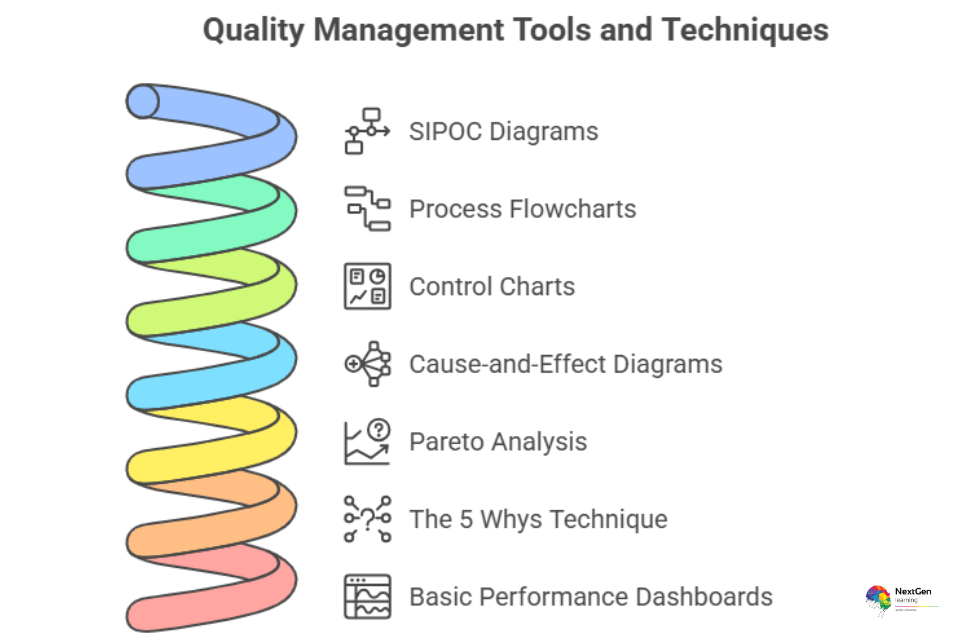
Quality management tools and techniques including SIPOC diagrams, process flowcharts, control charts, Pareto analysis, and the 5 Whys technique.

Effective quality management relies on the use of practical tools and techniques to analyse processes, identify issues, and support improvement activities. This Quality Management Training introduces commonly used quality tools that help organisations understand performance, control variation, and address root causes in a structured way.

Within this Quality Management Course, learners are introduced to tools and techniques including:

  • SIPOC diagrams, used to define suppliers, inputs, processes, outputs, and customers
  • Process flowcharts, supporting process understanding and standardisation
  • Control charts, used to monitor process performance and identify variation
  • Cause-and-effect diagrams, supporting structured root cause analysis
  • Pareto analysis, helping prioritise issues based on impact and frequency
  • The 5 Whys technique, used to explore underlying causes of nonconformities
  • Basic performance dashboards, supporting monitoring and reporting

These tools are presented in a practical, conceptual manner to support understanding and professional application. The focus is on how and when to use each tool within a quality management system, rather than on complex statistical analysis, making the content accessible while remaining relevant to workplace quality improvement activities.

Who This Quality Management Course Is For

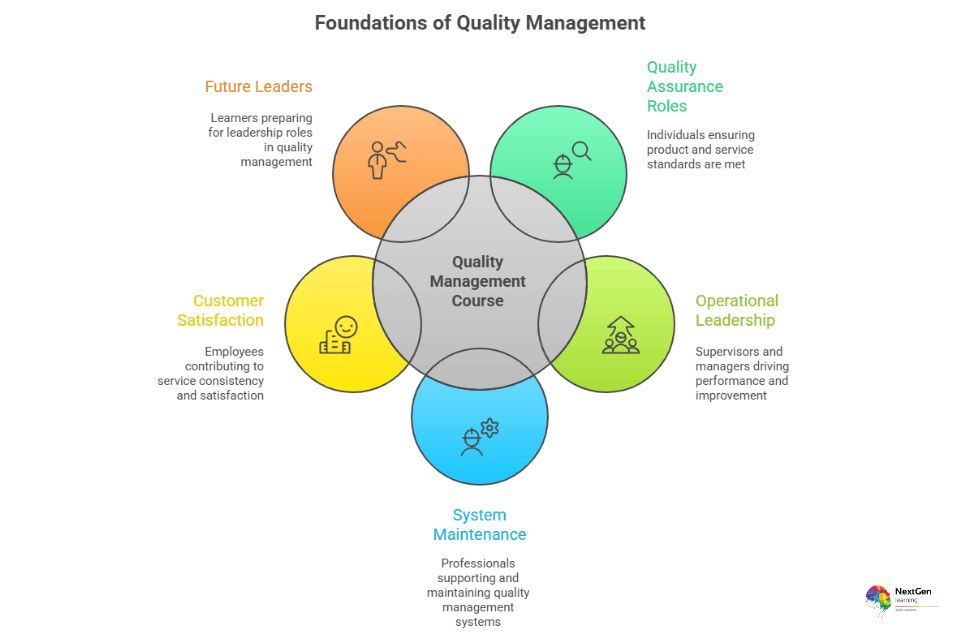
Foundations of quality management showing roles including quality assurance, operational leadership, system maintenance, customer satisfaction, and future leadership.

This Quality Management Course is designed for individuals who want a clear and structured understanding of quality management principles and how they are applied within organisations. It supports learners at different stages of their professional development, from those new to quality management to professionals seeking to strengthen or formalise their knowledge.

This course is particularly suitable for:

  • Individuals working in quality assurance, quality control, or process improvement roles
  • Supervisors, team leaders, and managers involved in operational planning, performance monitoring, or improvement activities
  • Professionals responsible for maintaining or supporting quality management systems within their organisation
  • Employees contributing to customer satisfaction, service consistency, and organisational performance
  • Learners preparing for future roles in quality management or operational leadership

This Quality Management Training is applicable across a wide range of sectors, including manufacturing, services, healthcare, construction, logistics, and administration. No prior experience or formal qualifications in quality management or standards are required, making the course accessible while remaining relevant to experienced professionals.

Certification, CPD & Professional Recognition

On successful completion of this Quality Management Training Course, learners receive a Certificate of Achievement recognising their participation and learning. The certificate is CPD-recognised, supporting ongoing professional development in quality management and related disciplines.

This course provides structured, non-regulated professional training. It is designed to develop knowledge and understanding of quality management principles and systems, including alignment with ISO 9001:2015 frameworks, but it does not constitute ISO certification, auditor qualification, or regulatory accreditation.

Key certification details include:

  • CPD-recognised Certificate of Achievement, suitable for professional development records
  • Digital PDF certificate available for £9.99
  • Optional hard copy certificate available for £19.99
  • Certificate issued upon successful course completion
  • Suitable for UK and international learners

The certification demonstrates engagement with quality management training and can be used to evidence learning for CPD logs, internal development records, or professional portfolios. It does not replace formal qualifications or organisational ISO certification requirements.

Nextgen Certificate

Entry Requirements & Course Access

This Quality Management Course is designed to be accessible to a wide range of learners and does not require any prior qualifications or experience in quality management or related standards. The course is suitable for individuals at different stages of their professional development.

To enrol in this Quality Management Training, learners should have:

  • Basic English proficiency, sufficient to understand course materials and assessments
  • Basic numeracy and literacy skills, to support performance evaluation and analysis topics
  • Access to a computer, tablet, or smartphone with a stable internet connection

The course is delivered entirely online, allowing learners to access content from any location and progress at their own pace. There are no fixed schedules or deadlines, making it suitable for those balancing study with work or other commitments.

How This Quality Management Course Works

This Quality Management Course is delivered through a flexible online learning platform, allowing learners to study at their own pace and fit training around professional or personal commitments. The course structure is designed to support progressive learning, with content organised into short, focused lessons that build understanding step by step.

Key features of how the course works include:

  • Fully online access, available 24/7 from any internet-enabled device
  • Self-paced learning, with no fixed start dates or deadlines
  • Structured lesson format, progressing from foundational concepts to strategic quality management topics
  • Clear explanations and examples, supporting understanding of quality systems and principles
  • Assessment-based completion, confirming engagement with course content

Once all required learning activities are completed, learners can order their CPD-recognised Certificate of Achievement in digital or printed format. This approach ensures learners can progress confidently while developing recognised professional knowledge in quality management.

Career Outcomes in Quality Management

Quality management career roles including quality officer, QA coordinator, quality manager, and process improvement positions with indicative UK salary ranges.

This Quality Management Training supports professional development for individuals working in, or aspiring to work in, roles that involve quality assurance, process improvement, performance evaluation, and operational management. The knowledge gained through this course is applicable across a wide range of industries where structured quality management systems are used.

Common career pathways supported by this Quality Management Course include:

  • Quality Officer / Quality Administrator
    Supporting quality documentation, monitoring activities, and internal processes.
    Indicative UK salary range: £24,000–£32,000
  • Quality Assurance (QA) Executive or Coordinator
    Assisting with quality checks, audits, corrective actions, and performance monitoring.
    Indicative UK salary range: £26,000–£35,000
  • Quality Manager (Entry to Mid-Level)
    Contributing to the planning, maintenance, and improvement of quality management systems.
    Indicative UK salary range: £35,000–£50,000
  • Operations or Process Improvement Roles
    Applying quality principles to improve efficiency, consistency, and customer satisfaction.
    Indicative UK salary range: £30,000–£45,000
  • Supervisory or Team Leadership Roles
    Supporting quality objectives, monitoring performance, and implementing improvement actions.
    Indicative UK salary range: £28,000–£40,000

Salary figures are indicative and may vary based on sector, experience, location, and organisational size. This course supports knowledge development and professional competence but does not guarantee employment or promotion.

Why Quality Management Matters in Modern Organisations

Quality management plays a critical role in helping organisations operate consistently, manage risk, and meet customer expectations. Rather than being limited to inspection or compliance activities, effective quality management supports how organisations plan, deliver, monitor, and improve their products, services, and processes.

In modern organisations, quality management helps to:

  • Establish consistent processes that reduce variation and improve reliability
  • Support customer satisfaction by ensuring requirements are clearly defined and met
  • Identify and manage risks that could affect performance, safety, or service delivery
  • Improve decision-making through performance monitoring, analysis, and evaluation
  • Support continual improvement by identifying root causes and corrective actions
  • Align operational activities with organisational objectives and strategic priorities

A structured approach to quality management enables organisations to move beyond reactive problem-solving and adopt a more proactive, system-based way of working. By understanding quality principles and management system concepts, professionals are better equipped to contribute to long-term organisational performance, compliance, and improvement initiatives.

How ISO 9001 Supports Effective Quality Management

ISO 9001 provides a widely recognised framework for designing, implementing, and maintaining effective quality management systems. Rather than prescribing how an organisation must operate, the standard outlines a structured approach that helps organisations manage quality in a consistent, measurable, and improvement-focused way.

Within quality management training, ISO 9001 supports good practice by:

  • Promoting a process-based approach, ensuring activities are planned, controlled, and reviewed systematically
  • Encouraging risk-based thinking, helping organisations identify potential issues before they affect performance or customer satisfaction
  • Emphasising leadership and accountability, clarifying roles, responsibilities, and management commitment
  • Focusing on customer requirements, ensuring needs and expectations are understood and met consistently
  • Supporting performance evaluation, including monitoring, measurement, analysis, and management review
  • Embedding continual improvement, using nonconformities, corrective actions, and data-driven insights

This Quality Management Course uses ISO 9001:2015 as a reference framework to explain how quality management systems operate in practice. The training develops understanding of key concepts and principles without presenting the course as an ISO certification, auditor qualification, or regulatory approval. Instead, it supports professional competence by explaining how ISO 9001-based systems are applied within real organisational contexts.

Order Your Certificate

To order your Certificate, we kindly invite you to visit the following link

Frequently Asked Questions (FAQs)

Quality management training explains how organisations plan, control, monitor, and improve processes to meet customer and business requirements. It focuses on quality principles, systems, performance evaluation, and continual improvement rather than inspection alone.

The best quality management course depends on your goals. Courses that explain quality management principles, systems, and recognised frameworks such as ISO 9001 are suitable for professional development without requiring prior experience or regulatory certification.

Quality management training focuses on building an understanding of structured quality systems, process-based working, risk awareness, performance measurement, and improvement. The aim is to support consistent outcomes and informed decision-making across organisations.

Quality management is about making sure work is done consistently, problems are identified early, and improvements are made over time so that products or services meet customer expectations.

An example of quality management is setting quality objectives, monitoring performance using KPIs, reviewing results in management meetings, and taking corrective action when targets are not met to improve future outcomes.

A quality manager typically needs analytical thinking, attention to detail, communication skills, problem-solving ability, and an understanding of quality systems, performance evaluation, and improvement methods.

Becoming a good quality manager involves developing knowledge of quality principles, gaining experience with quality systems, understanding organisational processes, and building skills in analysis, communication, and continuous improvement.

Effective training for quality managers covers quality management principles, systems, performance evaluation, and recognised frameworks such as ISO 9001. Structured courses help formalise knowledge and support professional development alongside workplace experience.

The seven principles are customer focus, leadership, engagement of people, process approach, improvement, evidence-based decision-making, and relationship management. These principles underpin most modern quality management systems.

Quality management is commonly described through four areas: quality planning, quality assurance, quality control, and quality improvement. Together, these support consistent performance and continual enhancement.

The four main components are planning quality activities, controlling processes, evaluating performance, and implementing improvement actions. These components work together to support effective quality systems.

The four pillars are process management, customer focus, continuous improvement, and leadership commitment. These elements help organisations maintain consistent standards and improve over time.

There is no single mandatory qualification for QA managers. Many professionals combine workplace experience with quality management training and CPD-recognised courses to develop knowledge and demonstrate competence.

A degree is not always required to become a QA manager. Many employers value practical experience and structured quality management training alongside transferable skills and professional development.

Yes, many people enter QA roles without a degree by gaining experience in operational or quality-related positions and completing professional training in quality management systems and principles.

QA salaries in the UK vary by role and experience. Entry-level roles may start around £25,000, while experienced QA or quality management professionals may earn £35,000–£50,000 or more.

Course Curriculum

Course Structure
Course Structure 00:07:00
Critical Definitions
What is Quality 00:00:00
What is ISO 00:08:00
What is a System – Management System 00:02:00
What is Policy – Quality Policy 00:06:00
What is Vision, Mission & Strategy 00:03:00
QA Vs QC 00:06:00
Effectiveness Vs Efficiency 00:06:00
Verification Vs Validation 00:11:00
Conformity Vs Nonconformity Vs Defect 00:04:00
Correction Vs Corrective Action Vs Preventive Action 00:08:00
Risk & Preventive Action 00:06:00
What is Competence 00:03:00
What is the Context of the Organization 00:05:00
Who are the Interested parties 00:03:00
What are the Needs & expectations 00:05:00
Management System Requirements 00:01:00
Who is a customer 00:02:00
What is Customer Satisfaction 00:06:00
Product Vs Service Vs Process 00:05:00
Document Vs Record 00:06:00
What is Customer Complaint 00:02:00
Measuring Vs Monitoring Vs Performance 00:02:00
Who is Responsible
Who is Responsible 00:12:00
Responsibility Vs Accountability 00:02:00
Quality Management Principles
Quality Management Principles 00:17:00
Major Changes
ISO 9001:2015 Core Concepts 00:08:00
Major terminology Differences 00:04:00
Documented Information 00:07:00
Major changes – Organizational Knowledge 00:05:00
Major changes – Risk Based Thinking 00:06:00
Process Approach
Process Approach Concept-1 00:04:00
What is PDCA 00:05:00
Process Approach Concept-2 00:03:00
Process Approach in ISO 9001:2015 00:04:00
Key Benefits 00:07:00
PDCA in ISO 9001 2015 00:10:00
Context of the Organization
Understanding the Organization and its Context 00:08:00
Internal & External issues 00:03:00
SWOT Analysis 00:06:00
Interested Parties & their Needs & Expectations 00:03:00
KANO Model 00:10:00
Understanding the context – Summary 00:08:00
Choosing your Strategic Objective 00:05:00
Strategic Map Examples-1 00:03:00
Strategic Planning Process 00:06:00
What is a Vision 00:06:00
How to Create a Vision Statement 00:08:00
What is a Mission 00:06:00
SMART GOAL 00:06:00
SMART Goal Example 00:04:00
Strategic Map Examples-2 00:10:00
Context Chapter Summary 00:07:00
Quality Objectives
Quality Objectives & Planning 00:05:00
ISO & SMART 00:02:00
Objectives Origin 00:06:00
Objectives Examples 00:07:00
Goal Vs Objective-1 00:07:00
Goal Vs Objective Example 00:02:00
Goal Vs Objective-2 00:10:00
Performance Evaluation
Performance Evaluation in ISO 9001:2015 00:10:00
Customer Satisfaction 00:06:00
Analysis & Evaluation 00:12:00
Key Performance Indicators 00:08:00
Dashboard Examples 00:07:00
Management Review Meetings 00:11:00
Improvement 00:16:00
Nonconformity & Corrective Action 00:06:00
Nonconformity & Corrective Action Example 00:06:00
Nonconformity & Corrective Action Origin 00:06:00
Continual Improvement 00:01:00
Analysis Mindset 00:09:00
Quantitative Vs Qualitative 00:16:00
Now What
Now What? 00:11:00
Course Summary 00:10:00
Helpful Tools
SIPOC 00:06:00
Flowcharts 00:04:00
Control Charts 00:04:00
Cause and Effect Diagram 00:06:00
Pareto Chart 00:07:00
5 WHYs 00:03:00
Other Tools 00:08:00
Finally! 00:01:00
See you soon
Bonus Lecture 00:02:00
Assignment
Assignment – Quality Management and Strategic Training – ISO 9001 00:00:00
Order Your Certificate
Order Your Certificate 00:00:00

Related Courses

A product of

© 2026 NextGen Learning. All rights reserved

Home Search Cart Offers
Select your currency
GBP Pound sterling