




A nurse practitioner is an experienced registered nurse with advanced training who can assess patients, diagnose illnesses, prescribe medication, and manage treatment plans. Moreover, they often work similarly to GPs in many healthcare settings.
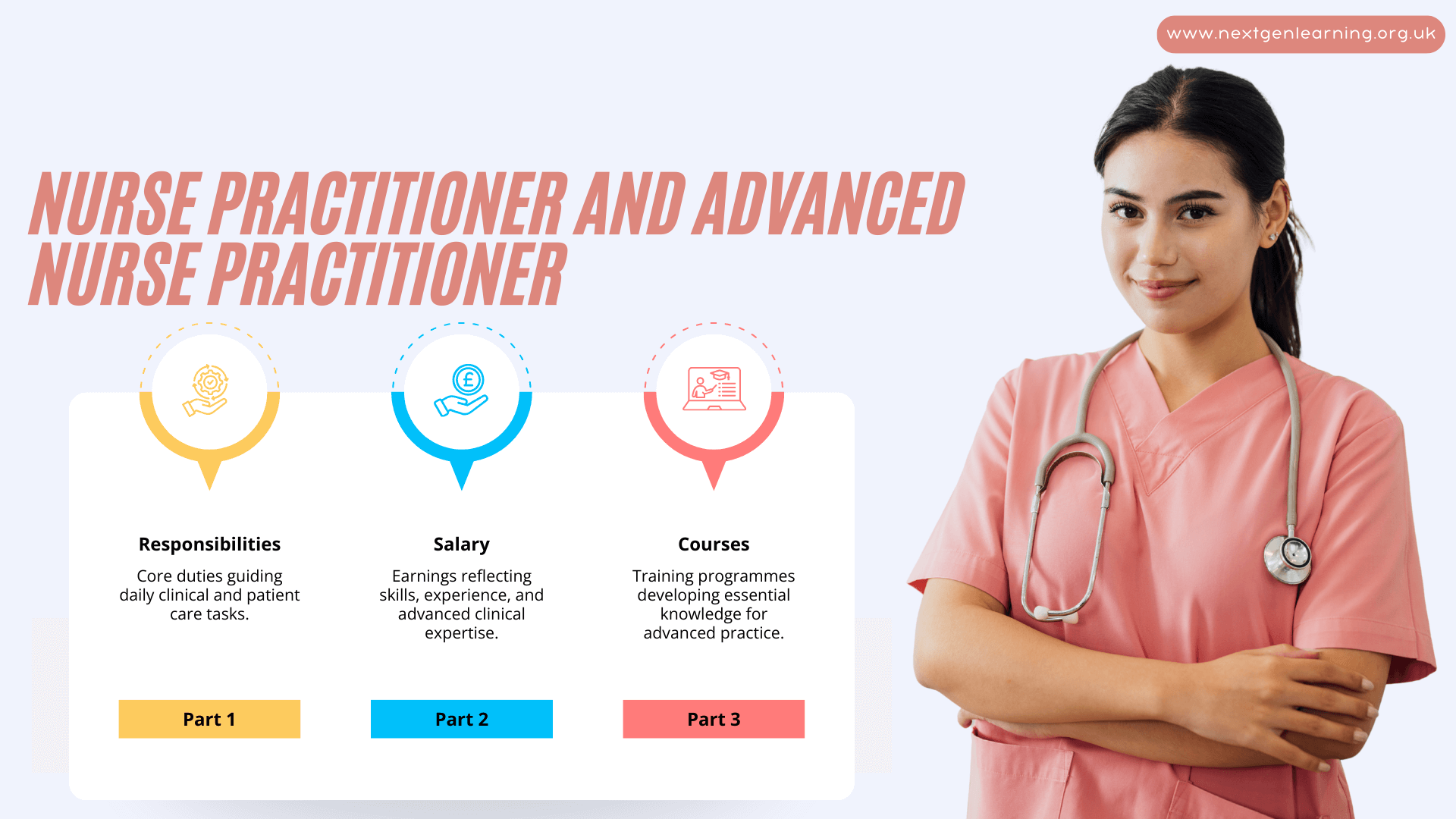
Nurse Practitioner and Advanced Nurse Practitioner: Responsibilities, Salary & Courses
Nurse practitioners (NPs) and advanced nurse practitioners (ANPs) are highly trained nurses with advanced education and skills. Additionally, they play a vital role in the UK healthcare system by bridging the gap between traditional nursing and medical care. Furthermore, in this blog, we will introduce what nurse practitioners are, define the advanced nurse practitioner role, outline their duties and responsibilities, compare their salaries in the UK, discuss the recommended courses to become an NP or ANP, explore career opportunities, and finally offer some conclusions on these growing professions.
Table of Contents
Nurse Practitioner
A Nurse Practitioner (NP) is a registered nurse who has undertaken additional training and education to practice at an advanced level. NPs are specialist nurses with advanced qualifications who can perform many tasks traditionally done by doctors. For example, they are highly experienced nurses who have completed additional medical education to provide advanced care and even prescribe medication. NPs have the knowledge and training to assess patients, make diagnoses, initiate treatment, and make referrals independently.
Moreover, they can provide a wide range of acute, primary, and specialty care services on their own or in collaboration with a doctor. This means an NP can function much like a GP (General Practitioner) for many common health issues, while still rooted in the nursing model of care. In the UK, the nurse practitioner role is relatively new but is becoming increasingly important in delivering timely patient care. Many NPs begin their healthcare journey in supportive roles such as a Nursing Assistant, which provides essential hands-on experience and a strong foundation before progressing into advanced clinical training.
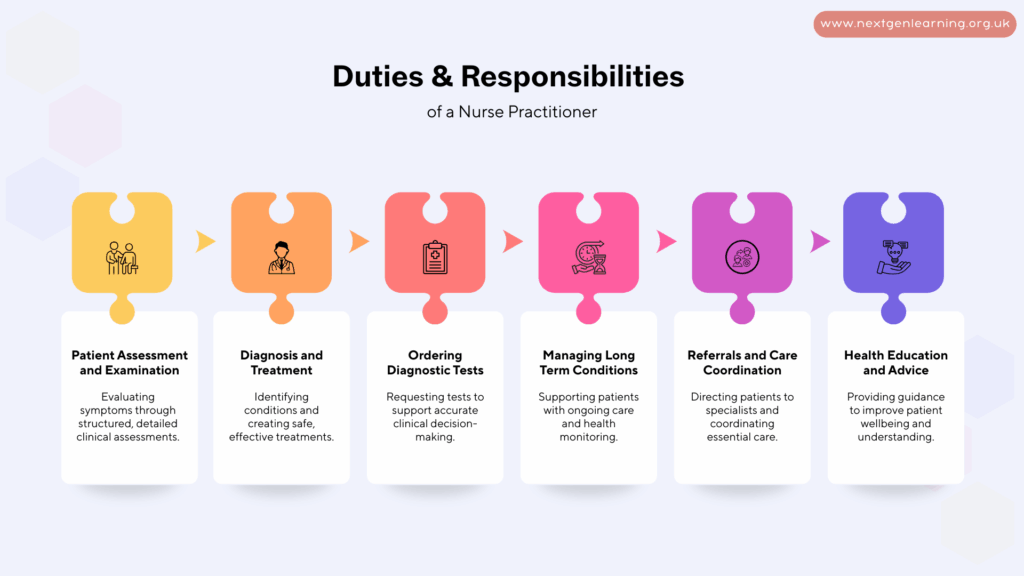
Duties & Responsibilities of a Nurse Practitioner
- Firstly, NPs begin with patient assessment and examination.
- Secondly, their key role is diagnosis and treatment.
- Additionally, their responsibility includes ordering diagnostic tests.
- Moreover, their work involves managing long-term conditions.
- Furthermore, their role requires referrals and care coordination.
- Finally, their duty includes providing health education and advice.
Advanced Nurse Practitioner
An Advanced Nurse Practitioner (ANP) is essentially a nurse practitioner who has achieved a higher level of qualification and expertise, typically at a master’s degree level or equivalent (Level 7). In the UK, an ANP is a highly trained registered nurse with extra training and credentials that enable them to practice with greater autonomy. Additionally, most ANPs hold a postgraduate Master’s degree in advanced practice and have several years of clinical experience.
For many, the pathway toward becoming an ANP starts in early roles such as Nursing Assistant work or Health and Social Care support, where they gain valuable experience that shapes their future clinical development. In practical terms, an ANP in the UK can perform the same clinical tasks as a NP but at a more senior level – they are often entrusted with complex cases and a broader scope of practice.
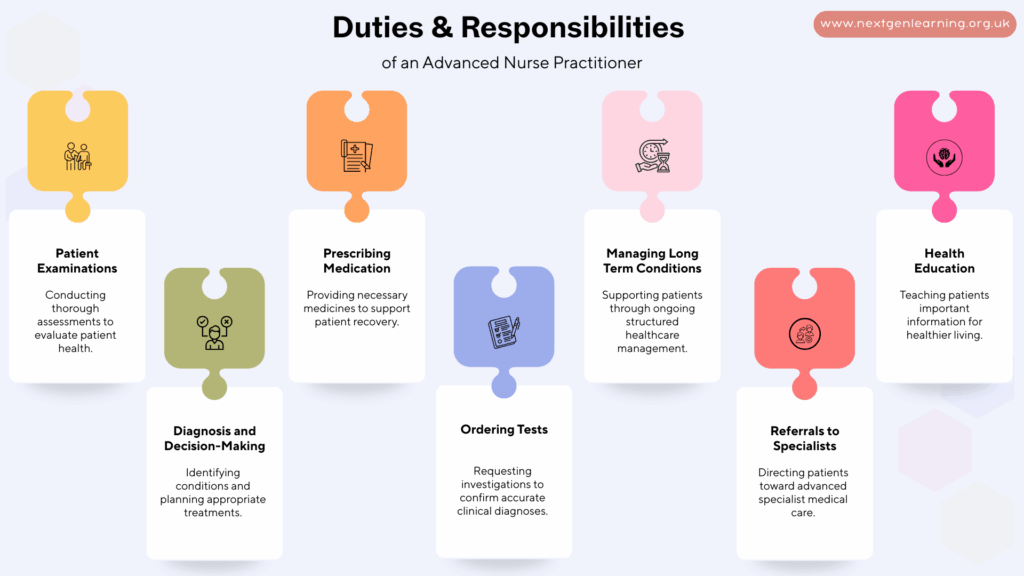
Duties & Responsibilities of an Advanced Nurse Practitioner
- Firstly, the role involves carrying out thorough patient examinations.
- Secondly, a major responsibility is diagnosis and clinical decision making.
- Additionally, an essential task includes prescribing appropriate medication.
- Moreover, the position requires ordering tests to support accurate diagnosis.
- Furthermore, the work includes managing long term health conditions.
- Next, the role involves making timely referrals to specialists when needed.
- Finally, an important duty includes providing clear health education.
Nurse Practitioner Salary in the UK
In the UK, the average Nurse Practitioner salary is approximately £35,000 to £40,000 per year, and this contributes to the overall Nurse Practitioner income across the country. Moreover, a newly qualified NP’s Nurse Practitioner starting pay often begins at the higher end of the nursing pay scale. In some cases, NPs start at Band 6 (around £33,706 per year), but more commonly Band 7 or above, with Band 7 Nurse Practitioner starting pay beginning around £41,659 per year. Many organisations use these figures when calculating the Nurse Practitioner np salary for new applicants.
Experienced NPs can earn significantly more. Moreover, it’s not uncommon for NP positions to be graded at Band 8A (which starts around £48,526), and senior Nurse Practitioner compensation can exceed £50,000 per year in the NHS. Moreover, this higher level of Nurse Practitioner income reflects both experience and specialist skills.
Outside the NHS, Nurse Practitioner pay rate can be influenced by private healthcare demand, clinics, or agency work. Furthermore, starting salaries in the private sector are often above £40,000, and with substantial experience, an NP’s income could be even higher.
Advanced Nurse Practitioner Salary in the UK
In 2025, the average salary for an ANP in England was about £53,665 per year. ANPs working in London tend to earn more – with averages around £59,000 per year, while other UK cities report typical ANP salaries of £52,000–£54,000. These salary variations often reflect experience, location, and completion of specialist training such as an Advanced Nurse Practitioner course, which can strengthen clinical capability and earning potential.
Most ANPs in the NHS are positioned at Band 8A or 8B, with Band 8A ranging roughly from £48k to £55k, and Band 8B offering even higher earning potential. Furthermore, ANPs benefit from the NHS pension, annual leave, and structured CPD opportunities. Additionally, senior ANPs or consultant-level nurses may earn £60k+.
Nurse Practitioner Recommended Course
To become a nurse practitioner in the UK, registered nurses must undertake significant additional training and education. Firstly, they must be a Registered Nurse (RN) with the NMC and usually gain clinical experience. They then pursue a Nurse Practitioner course, often a Master’s degree in Advanced Clinical Practice or a related field. Additionally, these programmes include modules like advanced health assessment, pathophysiology, pharmacology, and clinical decision-making.
The V300 independent prescribing Nurse Practitioner course is a vital part of training. Clinical placements and competency portfolios are also required. Moreover, many employers support NP students with funding or study leave. Furthermore, upon completion, nurses are fully prepared to work as NPs or progress towards ANP roles. Additionally, for individuals who are new to the sector or even those already working in care—starting with a Nursing Assistant course or a Health and Social Care course can significantly strengthen their foundation and accelerate their pathway into advanced nursing roles.
Advanced Nurse Practitioner – Recommended Course
ANPs typically complete a Master’s in Advanced Practice, built around the four pillars of advanced practice – clinical practice, leadership, education, and research. Training includes advanced diagnostics, prescribing qualifications, clinical reasoning, and supervised practice. Programmes generally take 2–3 years part-time.
Graduates are eligible to work as ANPs, and some employers also require professional credentialing.For those aiming to progress into advanced roles, starting with a strong foundation is essential, and completing courses such as a Nursing Assistant course or a Health and Social Care course can be a key step in standing out from other candidates.
Care Certificate (15 Standards)
Care Certificate – complete 15 standards to validate key skills for care support roles.
View CourseMental Health Nursing
Mental Health Nursing – gain specialist skills to support mental wellbeing and recovery.
View CourseLevel 3 Diploma in Nursing Assistant Complete Training
Learn key patient care skills and prepare for essential nursing assistant jobs.
View CourseHealthcare Assistant Training
Healthcare Assistant Training – build essential care skills for patient support roles.
View CourseLevel 3 Diploma in Health and Social Care
The Level 3 Diploma in Health and Social Care equips you with essential skills in communication, safeguarding, risk management.
Click Here
Career Opportunities for Nurse Practitioners and ANPs
NPs and ANPs can build strong careers across many sectors in UK healthcare. Below are the key career paths:
- Firstly, General Practice (GP Surgeries) offers broad clinical opportunities.
- Secondly, Hospital Roles provide varied experience across departments.
- Additionally, Urgent Care Centres & Walk-In Clinics offer fast-paced work.
- Moreover, Community Health Services support ongoing patient care.
- Furthermore, Specialist Advanced Practice Roles allow focused expertise.
- Next, Leadership & Management roles open senior career pathways.
- Also, Education & Training roles support developing new clinicians.
- In addition, Research & Clinical Development drives improved practice.
- Finally, Agency, Locum, or Private Sector Work offers flexible options.
Conclusion
NPs and ANPs are essential to modern healthcare in the UK. Moreover, these roles offer strong career progression, clinical autonomy, and competitive salaries, with many people attracted to the field after learning more about the typical Nurse Practitioner salary and the long term earning potential as they advance.
As the need for advanced clinical support continues to grow, NPs and ANPs will play an even more important role in improving patient care and supporting the NHS. Furthermore, for anyone considering this pathway, choosing the right Nurse Practitioner course is a crucial first step toward building a successful and rewarding career in advanced nursing.
Frequently Asked Questions
You must first qualify as a Registered Nurse (RN), gain clinical experience, and then complete a recognised Nurse Practitioner course. Furthermore, most pathways include Master’s-level study and independent prescribing training.
In the UK, you need NMC registration as a nurse, solid clinical experience, and completion of a Master’s-level Nurse Practitioner course. Moreover, many roles also require the V300 independent prescribing qualification.
The nurse practitioner is a highly trained clinician who provides advanced patient care, including examinations, diagnosis, and treatment. Additioanlly, they work autonomously across various healthcare settings.
An Advanced Nurse Practitioner (ANP) is a senior clinician with a Master’s degree and advanced skills in diagnosis, treatment, prescribing, and complex decision-making. Furthermore, they manage higher-level clinical responsibilities.
A nurse practitioner can assess patients, diagnose conditions, prescribe medication, order tests, and manage both acute and long-term care. Additionally, they work in GP practices, hospitals, community services, and urgent care.
They are qualified to examine patients, diagnose illnesses, prescribe treatments, order investigations, and provide ongoing clinical management. Futhermore, their scope of practice is significantly broader than standard nursing roles.
Yes. With the V300 independent prescribing qualification, nurse practitioners can safely prescribe drugs within their scope of practice.
Yes. In the UK, qualified nurse practitioners are authorised to prescribe medicine for acute and long term conditions once they complete prescribing training.
Yes, nurse practitioners with independent prescribing rights can prescribe a wide range of medication. Moreover, they follow strict prescribing standards to ensure safe patient care.


Level 3 Diploma in Health and Social Care
Certificate:
yes (Free)
Accreditation:
Level 3 CPD Certificate
Access:
Lifetime

0 responses on "Nurse Practitioner and Advanced Nurse Practitioner: Responsibilities, Salary & Courses"