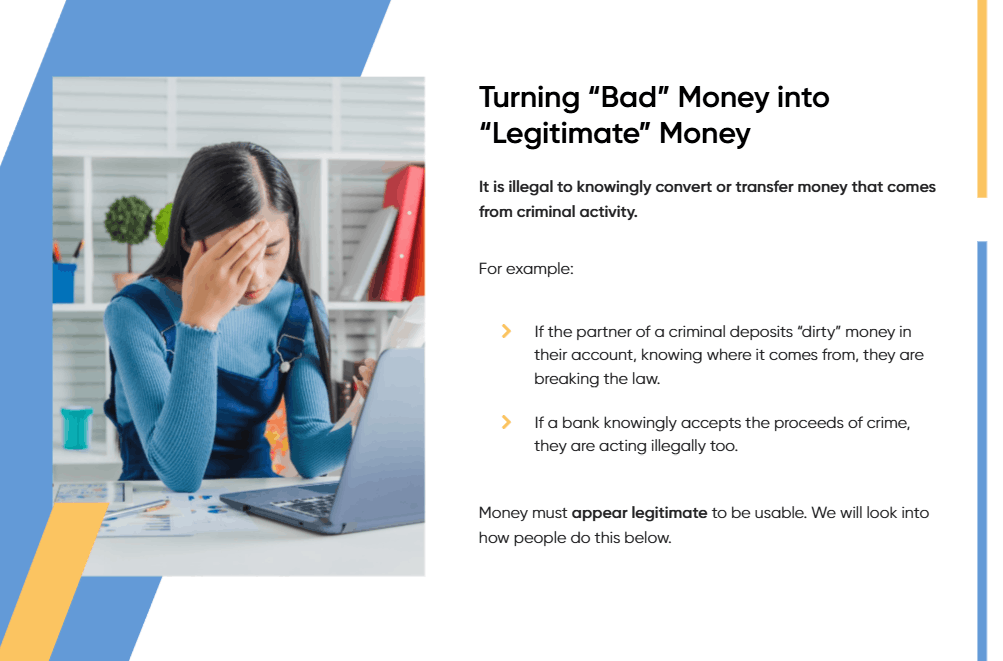

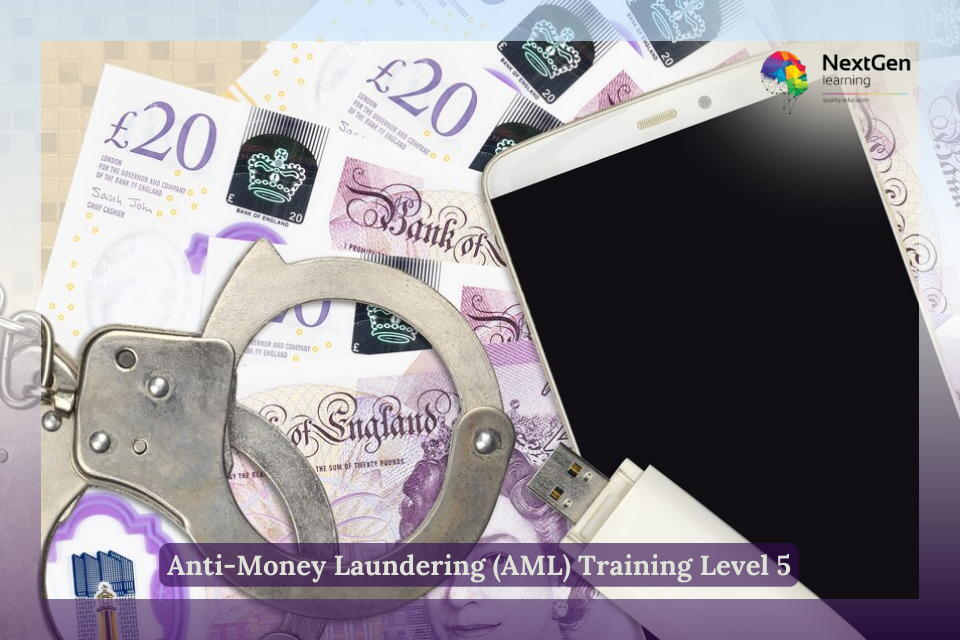
Money laundering is the process of concealing the origins of illegally obtained funds to make them appear legitimate. It poses a global risk because it enables organised crime, terrorism financing, and corruption, undermining financial systems and economic stability worldwide.

★★★★★ 4.7/5
Based on 115 enrolled learner reviews
Overview of AML Training
This anti-money laundering course is intended for quality professionals, financial services staff, law enforcement agents, and anybody who wants to protect financial systems from criminal activity. Moreover, AML training materials include in-depth analysis, examples, and real-world case studies to help you build a solid understanding of anti-money laundering techniques.
Furthermore, by studying these materials of this anti money laundering course, you will receive concrete techniques and insights that you can instantly apply in your professional or organizational setting. Consequently, this results in better risk management and AML compliance.
In addition, the AML training provides 24/7 student support, ensuring that you receive quick assistance whenever necessary. Additionally, learners will gain access to current AML insights, financial crime prevention tactics, and increased employability in highly regulated areas.
Exclusive Course Sneak Peek
Accreditation & Complementary Gifts 🎁
- CPDQS-accredited proficiency
- Free Enrollment Letter
- Free Course 01: Introduction to Banking
- Free Course 02: Digital Banking
Description of AML Training
This Anti-Money Laundering course is critical for protecting financial systems and ensuring compliance with international rules. Moreover, learners of AML training gain the knowledge required to properly recognise and respond to suspicious activity by examining nine meticulous modules, ranging from an introduction to money laundering and the Proceeds of Crime Act 2002 to a comprehension of the Money Laundering Reporting Office’s responsibilities.
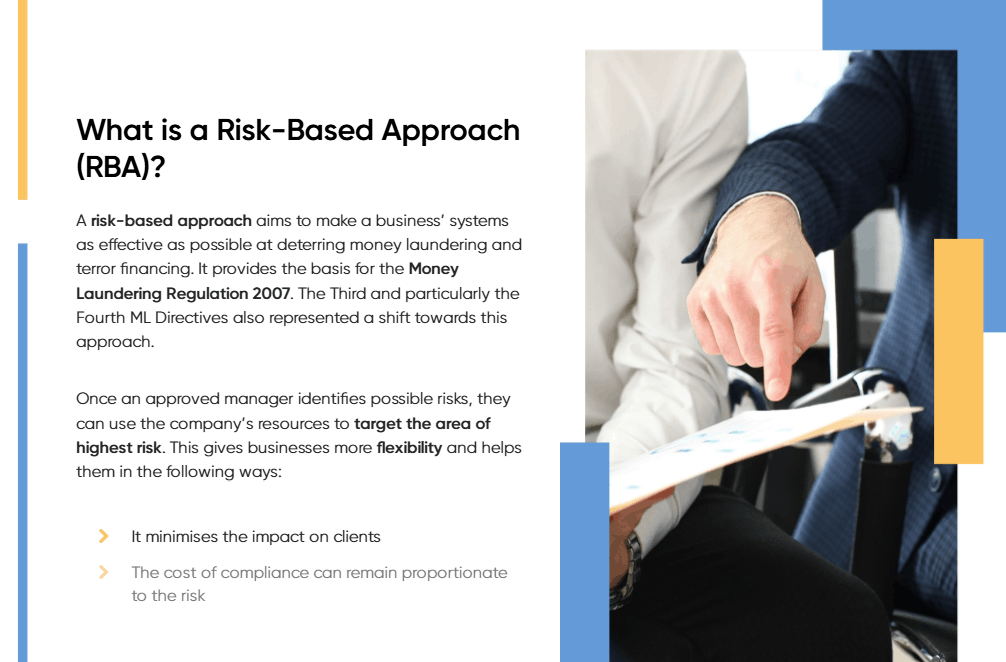
Furthermore, the Anti-Money Laundering course also covers the establishment of AML rules, using a risk-based approach, conducting thorough customer due diligence, and maintaining rigorous record-keeping procedures. In addition, the AML training emphasises the necessity of continual awareness and training, thereby enabling students to cultivate a proactive compliance culture and promote long-term financial integrity. Finally, this ensures that learners are well-equipped to meet evolving regulatory requirements.
Learning Outcomes:
After completing Anti-Money Laundering (AML) Training Level 5 course, you will:
- Develop a thorough knowledge of Anti-Money Laundering laws and practices.
- Furthermore, enhance skills in identifying and managing financial crime risks.
- Master customer due diligence and effective record-keeping methods.
- Moreover, apply risk-based strategies for stronger AML compliance.
- Excel in the responsibilities of a Money Laundering Reporting Officer.
Why Choose Us?
- Firstly, AML training course is accredited by the CPD Quality Standards.
- Additionally, you get lifetime access to the whole collection of the learning materials.
- Furthermore, there is an online test with immediate results.
- Moreover, enroling in the Anti-Money Laundering course has no additional cost.
- Hence, you can study and complete the course at your own pace.
- Finally, you can study for the course using any internet-connected device, such as a computer, tablet, or mobile device.
Certificate of Achievement
Upon successful completion, you will qualify for the UK and internationally-recognised CPD certificate. Furthermore, you can choose to formalize your achievement by obtaining a PDF Certificate for just £4.99. Alternatively, if you prefer, you can opt for a Hardcopy Certificate at a cost of £14.99.
QLS Endorsed Certificate of Achievement
Upon successful completion of the course, you will be eligible to order a QLS Endorsed HardCopy Certificate titled ‘Diploma in Anti Money Laundering (AML) at QLS Level 5’’, providing tangible proof of your newly acquired skills. These certificates are not just tokens; they can be a valuable addition to your CV, enhancing your employability and opening doors to a myriad of career opportunities in this field.
- £109 for addresses within the UK. Please note that delivery within the UK is free of charge.
Please Note: NextGen Learning is a Compliance Central approved resale partner for Quality Licence Scheme Endorsed courses.
Endorsement
The Quality Licence Scheme (QLS) has endorsed this AML training course for its high-quality, non-regulated provision and training programmes. In addition, the QLS is a UK-based organisation that sets standards for non-regulated training and learning. Therefore, this endorsement means that the course has been reviewed and approved by the QLS and, hence, meets the highest quality standards.
Who Is This AML Course For?
The Anti-Money Laundering (AML) Training Level 5 course is ideal for:
- Compliance Officers
- Banking & Finance Professionals
- Law Enforcement Personnel
- Risk Management Specialists
- Aspiring AML Practitioners
Requirements for this AML Course
The AML training course requires no prior degree or experience. Therefore, all you require is English proficiency, numeracy literacy, and a gadget with a stable internet connection. Consequently, you can learn and train for a prosperous career in the thriving and fast-growing industry, without any fuss.
Career Path
With the help of Anti-Money Laundering course, you can explore diverse career options, such as:
- AML Compliance Analyst
- Financial Crime Investigator
- AML Officer
- Risk Management Consultant
- Regulatory Specialist
- Forensic Accountant
Order Your Certificate
To order QLS endorsed Certificate, we kindly invite you to visit the following link:
FAQs of Anti-Money Laundering (AML)
The Proceeds of Crime Act 2002 (POCA) is the primary UK legislation addressing money laundering. It defines money laundering offences, enables the recovery of criminal assets, and requires organisations to report suspicious activities to the relevant authorities.
The MLRO is responsible for overseeing an organisation’s AML framework. Their duties include receiving Suspicious Activity Reports (SARs), assessing risk, escalating concerns to authorities when necessary, and ensuring compliance with AML regulations.
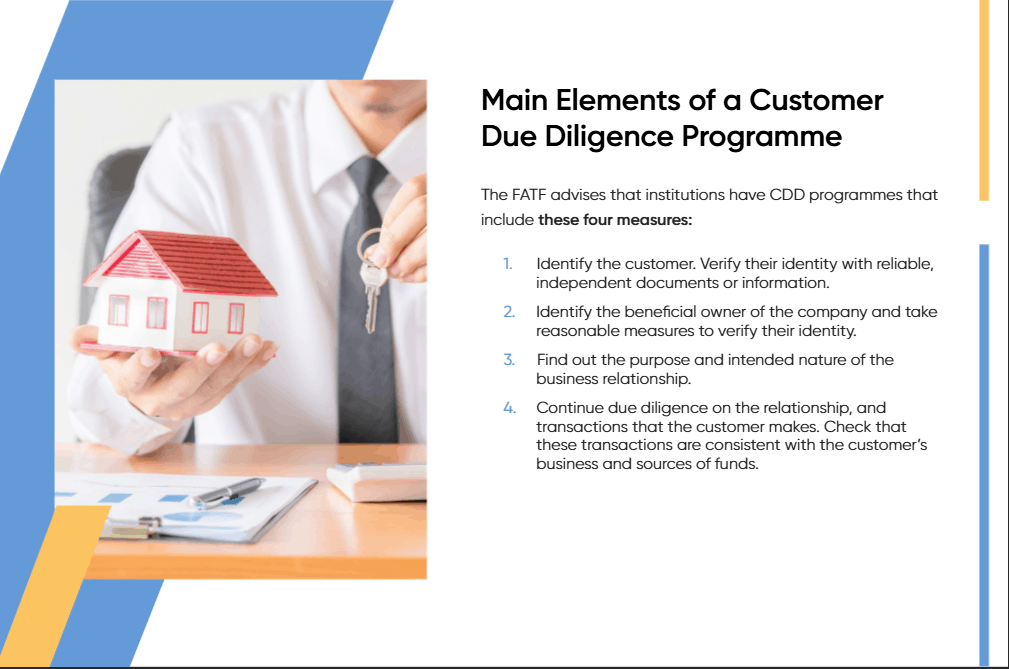
Customer Due Diligence involves verifying customer identity and assessing risk before establishing business relationships. It helps prevent criminals from exploiting financial systems and protects organisations from regulatory, financial, and reputational damage.
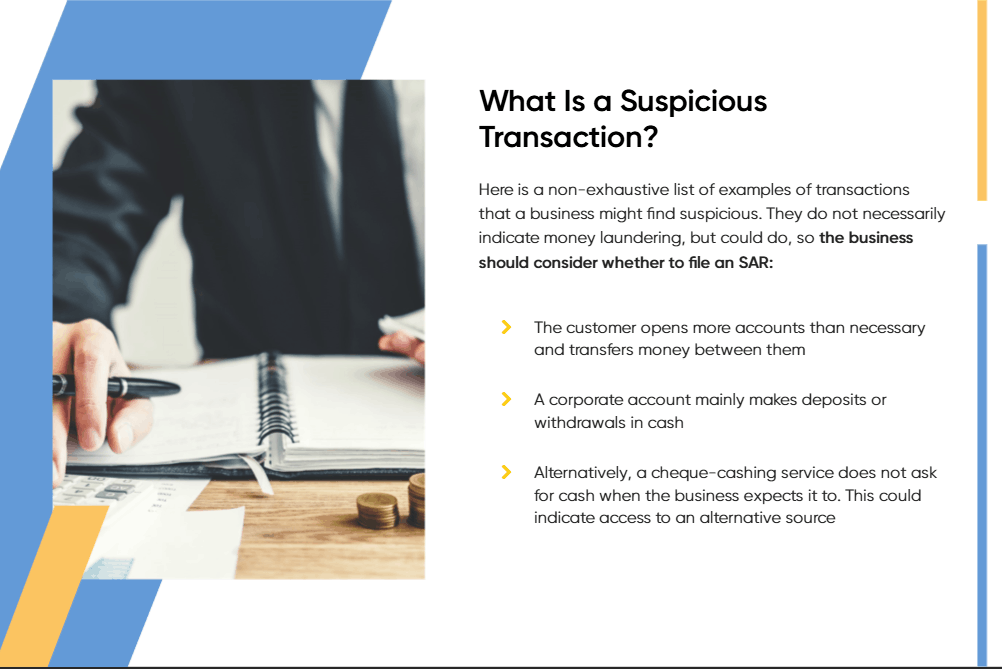
Staff must report concerns promptly to the MLRO using a Suspicious Activity Report. Timely reporting ensures legal compliance and supports the detection and prevention of financial crime.
Becoming AML certified typically involves completing structured AML training that covers financial crime risks, regulatory obligations, customer due diligence, and reporting requirements. Certification pathways vary depending on career goals and jurisdiction.
AML roles usually require knowledge of financial crime regulations, risk assessment, and compliance procedures. While a degree can be helpful, many employers prioritise AML training and regulatory understanding over formal academic qualifications.
Many entry-level AML roles are accessible to individuals without prior experience if they demonstrate regulatory awareness and analytical ability. Completing structured AML training helps build foundational knowledge of KYC, transaction monitoring, and risk-based compliance.
Beginners often start with structured programmes such as the AML Training Level 5 course from NextGen Learning, which introduces core AML concepts aligned with UK regulatory expectations.
Introductory AML training can often be completed within a few weeks, while advanced or professional certifications may take several months, depending on assessment requirements and study pace.
AML certification is not considered overly difficult, but it requires consistent study and understanding of regulations, money laundering typologies, and reporting obligations. Familiarity with compliance frameworks significantly reduces difficulty.
The best AML course depends on your experience level and career objectives. Beginners benefit from courses that explain AML principles clearly and focus on real-world compliance practices rather than exam-only preparation.
Highly regarded AML qualifications focus on regulatory compliance, risk-based approaches, and financial crime prevention. The most suitable qualification varies by role, industry, and geographic location.
Both ACAMS and ICA are respected AML qualification providers. ACAMS is widely recognised internationally, while ICA is particularly well regarded in the UK and Europe. Employer preference often determines which is more suitable.
ACAMS specialises in AML and compliance, whereas CFE focuses on fraud examination. Professionals working specifically in AML generally benefit more from ACAMS-aligned knowledge, while fraud specialists may prefer CFE.
Key AML skills include regulatory knowledge, analytical thinking, attention to detail, risk assessment, and the ability to document and report findings clearly.
AML certification costs vary widely depending on the provider and qualification level. International certifications are often expensive, while structured AML training courses provide a more accessible entry point.
Globally, ACAMS certifications are widely recognised, while UK-based roles may also value region-specific qualifications. Recognition typically depends on employer and regulatory context.
In the UK, AML documents are usually certified by regulated professionals such as solicitors, accountants, or authorised compliance officers, depending on the purpose and regulatory requirement.
The ACAMS exam is considered moderately challenging and requires strong understanding of AML regulations, typologies, and compliance frameworks. Adequate preparation is essential.
Order Your Certificate
To order CPD Quality Standard Certificate, we kindly invite you to visit the following link:
Course Curriculum
| Module 01: Introduction to Money Laundering | |||
| Module 01: Introduction to Money Laundering | 00:15:00 | ||
| Module 02: Proceeds of Crime Act 2002 | |||
| Module 02: Proceeds of Crime Act 2002 | 00:17:00 | ||
| Module 03: Development of Anti-Money Laundering Regulation | |||
| Module 03: Development of Anti-Money Laundering Regulation | 00:18:00 | ||
| Module 04: Responsibility of the Money Laundering Reporting Office | |||
| Module 04: Responsibility of the Money Laundering Reporting Office | 00:18:00 | ||
| Module 05: Risk-based Approach | |||
| Module 05: Risk-based Approach | 00:20:00 | ||
| Module 06: Customer Due Diligence | |||
| Module 06: Customer Due Diligence | 00:21:00 | ||
| Module 07: Record Keeping | |||
| Module 07: Record Keeping | 00:14:00 | ||
| Module 08: Suspicious Conduct and Transactions | |||
| Module 08: Suspicious Conduct and Transactions | 00:20:00 | ||
| Module 09: Awareness and Training | |||
| Module 09: Awareness and Training | 00:18:00 | ||
| Mock Exam | |||
| Mock Exam – Anti-Money Laundering (AML) Training | 00:20:00 | ||
| Final Exam | |||
| Final Exam – Anti-Money Laundering (AML) Training | 00:20:00 | ||
| (Optional) Assignment | |||
| Assignment – Anti-Money Laundering (AML) Training | 00:00:00 | ||
| Order Your QLS Certificate | |||
| Order Your QLS Certificate | 00:00:00 | ||
| Thank You for Choosing NextGen Learning | |||
| Thank You For Choosing NextGen Learning | 00:00:00 | ||
Related Courses

Level 3 Pharmacy Technician Course
Cyber Security Course for Healthcare
Level 3 Heating, Ventilation and Air Conditioning (HVAC) Technician


All Courses for £49