

Popular Courses

Brand
Awarding body image
★★★★★ 4.7/5
Based on 63 enrolled learner reviews

Overview of Clinical Coding course

Clinical coding is one of the most critical yet misunderstood functions within modern healthcare. Many people struggle to enter or progress in this field, not because they lack ability, but because they have never received structured training in how clinical information is classified, recorded, and governed within UK healthcare systems. Without a clear framework, terminology and coding standards can feel fragmented, technical, and difficult to apply with confidence.

Over time, this knowledge gap creates uncertainty. Professionals working with clinical records, health data, or administrative systems often rely on an incomplete understanding of ICD-10, OPCS-4, or SNOMED CT, which can lead to errors, reduced data quality, and hesitation in decision-making. Additionally, confidentiality obligations and legal responsibilities are frequently underestimated, increasing the risk of non-compliance and professional stress.

This Clinical Coding Course provides a structured, CPD-accredited pathway for understanding how clinical data is translated into standardised codes within UK healthcare environments. Rather than focusing on surface-level definitions, the course addresses the root causes of coding errors by building strong foundations in clinical terminology, classification systems, ethical responsibility, and record confidentiality. As a result, learners develop clarity, confidence, and professional awareness that supports accurate documentation and responsible data handling.

How This Course Helps You Build Professional Capability

  • Develop a clear understanding of clinical coding principles and UK healthcare standards
  • Apply ICD-10, OPCS-4, and SNOMED CT concepts with greater accuracy and confidence
  • Strengthen awareness of clinical records management and confidentiality obligations
  • Improve decision-making when interpreting clinical terminology and documentation
  • Build a credible foundation for progression into healthcare administration or data-focused roles

The Outcomes You Can Expect

By completing this course, you will gain structured knowledge of clinical coding systems used in the UK, improved confidence in handling clinical information, and stronger awareness of ethical and legal responsibilities. You will also be better prepared to support accurate healthcare records and pursue entry-level or progression opportunities within healthcare administration and coding-related roles.

How This Course Helps You Build Professional Capability

  • Develop a clear understanding of clinical coding principles and UK healthcare standards
  • Apply ICD-10, OPCS-4, and SNOMED CT concepts with greater accuracy and confidence
  • Strengthen awareness of clinical records management and confidentiality obligations
  • Improve decision-making when interpreting clinical terminology and documentation
  • Build a credible foundation for progression into healthcare administration or data-focused roles

The Outcomes You Can Expect

By completing this course, you will gain structured knowledge of clinical coding systems used in the UK, improved confidence in handling clinical information, and stronger awareness of ethical and legal responsibilities. You will also be better prepared to support accurate healthcare records and pursue entry-level or progression opportunities within healthcare administration and coding-related roles.

Exclusive Course Glimpse & Trailer

Why Choose this Clinical Coding Course?​

Following Level 4 Courses are Included With This Course (For Free) - Limited Time!

Description & What You Will Learn in This Clinical Coding Course

This Clinical Coding Course is structured to build knowledge progressively, helping learners develop clear, practical awareness of how clinical coding functions within UK healthcare environments. The course starts with core principles and gradually introduces recognised coding systems, professional standards, and ethical responsibilities, ensuring learning remains accessible and logically sequenced.

You will begin by understanding the purpose of clinical coding and its role in maintaining accurate healthcare records. The course then develops your ability to interpret clinical terminology, manage clinical records appropriately, and recognise the importance of confidentiality and data integrity when working with sensitive information.

As your knowledge develops, you will explore key UK coding systems, including ICD-10, OPCS-4, and SNOMED CT. Rather than focusing on memorisation, the course explains how these systems are structured, how they are used in practice, and how they work together to support consistent and reliable clinical data.

By the end of this course, you will be able to:

  • Explain the principles and purpose of clinical coding within healthcare environments
  • Interpret clinical terminology and medical documentation with greater accuracy
  • Apply ICD-10, OPCS-4, and SNOMED CT concepts within UK clinical coding contexts
  • Use general coding standards to support consistency and data quality
  • Handle clinical records in line with confidentiality, legal, and ethical requirements
  • Support accurate healthcare documentation and responsible information management

Overall, this course provides structured knowledge that supports professional confidence, improved decision-making, and responsible practice in clinical coding and healthcare administration contexts.

Below is a structured overview of the Clinical Coding Course curriculum. Each module is designed to build progressively, ensuring learners understand not only what clinical coding involves, but why each area matters within UK healthcare environments.

Module 01: Introduction to Clinical Coding

Introduces the purpose, scope, and structure of clinical coding within healthcare systems. Learners explore how coded data supports reporting, funding models, audit processes, and clinical governance.


Module 02: Introduction to Clinical Records and Confidentiality

Explains how clinical records are created, maintained, and protected. Emphasises confidentiality, information governance, and responsible data handling aligned with UK healthcare standards.


Module 03: Clinical Terminology and Jargons

Develops understanding of medical language, abbreviations, and clinical expressions. Accurate interpretation of terminology is essential for correct ICD-10 and OPCS-4 code assignment.


Module 04: Introduction to ICD-10 Coding

Introduces the structure, layout, and purpose of ICD-10 diagnostic coding. Learners understand how conditions are classified and why consistent diagnosis coding supports healthcare data integrity.


Module 05: General Coding Standards of ICD-10

Covers coding rules, conventions, and sequencing standards. This module strengthens consistency, reduces errors, and improves awareness of professional coding practices.


Module 06: ICD-10 5th Edition Codes (Chapters 1 to 4)

Explores selected ICD-10 chapters, helping learners understand how disease categories are grouped and structured.


Module 07: ICD-10 5th Edition Codes (Chapters 5 to 10)

Builds further familiarity with diagnostic classifications, reinforcing structured code navigation.


Module 08: ICD-10 5th Edition Codes (Chapters 11 to 15)

Expands diagnostic knowledge across additional body systems and clinical categories.


Module 09: ICD-10 5th Edition Codes (Chapters 16 to 22)

Completes exposure to the ICD-10 framework, supporting comprehensive understanding of diagnostic coding structure.


Module 10: Introduction to OPCS-4

Introduces procedural coding in the UK. Learners understand how OPCS-4 complements ICD-10 by classifying surgical and clinical procedures.


Module 11: Introduction to SNOMED CT

Explains the purpose of SNOMED CT as a structured clinical terminology system. Highlights its role in interoperability and digital health records.


Module 12: Other Types of Clinical Coding

Broadens awareness of additional coding systems and specialised classifications used in healthcare data management.


Module 13: Legal and Ethical Aspects of Working in a Clinical Environment

Focuses on data protection, professional responsibility, ethical decision-making, and compliance when handling clinical information.


Newly Added Practical Application Modules

These modules strengthen real-world relevance and distinguish this course from standard theoretical programmes.


Module 14: 3M Introduction

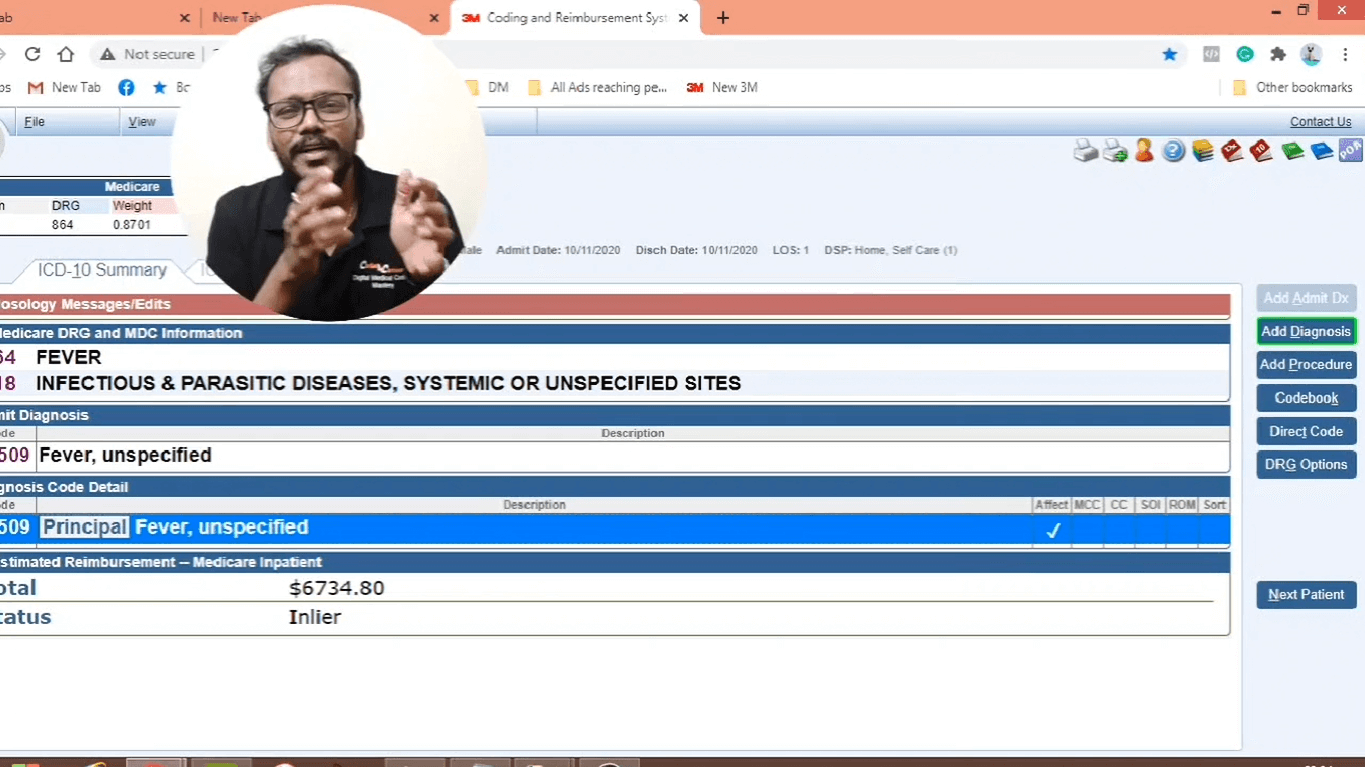
Introduces the 3M coding software environment commonly referenced in clinical coding settings. Learners explore how coding tools support structured code selection, documentation review, and classification logic.


Module 15: How to Assign ICD Codes Using 3M

Demonstrates how ICD-10 codes are identified and applied within a 3M system framework. This module connects theory to digital application, reinforcing structured diagnostic coding workflows.


Module 16: How to Assign Combination Codes

Explains how combination codes are selected when diagnoses or conditions are interrelated. Learners understand coding hierarchy, sequencing principles, and the impact of accurate code selection on data reporting.


Module 17: How DRG Changes While We Change Diagnosis or Procedure Using 3M

Introduces Diagnosis-Related Group (DRG) logic and demonstrates how coding adjustments influence classification outcomes. Learners gain awareness of how diagnostic and procedural changes can affect grouping and reporting structures.

Certificate of Achievement after Completing Clinical Coding Course

nextgen learning certificates

Upon successful completion of this Clinical Coding Course, learners will receive a CPD Accredited Certificate. This certificate confirms that the course meets recognised Continuing Professional Development (CPD) standards and supports ongoing skills development within healthcare-related and administrative roles.

CPD accreditation demonstrates that the learning content is structured, relevant, and appropriate for professional development. It is particularly valuable for individuals seeking to enhance their knowledge, strengthen their CV, or evidence continued learning when working in or transitioning into healthcare environments.

Ethical and Legal Integrity

The course content has been designed to reflect responsible and ethical training practices. All references to ICD-10, OPCS-4, and SNOMED CT are educational in nature and focus on understanding structure, purpose, and application rather than formal system certification. This approach ensures accuracy, transparency, and alignment with UK compliance expectations.

Who This Clinical Coding Course Is For

This Clinical Coding Course is designed for learners who want to develop a clear, structured understanding of clinical coding principles and healthcare data standards without requiring prior clinical experience. The course is suitable for individuals at different stages of their professional journey, particularly those seeking to build confidence and capability in healthcare-related administrative or data-focused roles.

It is well-suited to learners who work with, or plan to work with, clinical documentation, patient records, or healthcare information systems. By focusing on foundational knowledge, terminology, and ethical responsibility, the course supports informed participation in healthcare environments where accuracy and confidentiality are essential.

This course is particularly relevant for:

  • Individuals exploring entry-level opportunities in clinical coding or healthcare administration
  • Administrative or support staff working with clinical records or health data
  • Career changers seeking a structured introduction to healthcare information roles
  • Learners preparing for further training or formal qualifications in clinical coding
  • Professionals looking to strengthen their understanding of coding systems and data governance

The course is intentionally designed to be accessible while remaining professionally relevant, making it suitable for learners from a wide range of academic and employment backgrounds.

clinical terminology course UK online

Entry Requirements and Learner Eligibility

  • This Clinical Coding Course is designed to be simple to join, easy to follow, and accessible for learners who want to develop healthcare-related knowledge without unnecessary barriers. No previous clinical or coding experience is required, making this course suitable for beginners as well as career changers.

    To enrol on this course, you only need to meet a few basic requirements:

    • Be 16 years of age or older
    • Feel comfortable reading and understanding written English
    • Have basic numeracy skills (for working with healthcare information)
    • Be able to use a computer, tablet, or smartphone for online learning

    You do not need:

    • Any medical or healthcare background
    • Previous clinical coding knowledge

    Formal qualifications or certificates

CAREER OUTCOMES

Clinical coding career pathways

Completing this Clinical Coding Course can support progression into a range of entry-level and developing roles where accurate handling of clinical information, coding awareness, and data responsibility are essential. While this course does not qualify learners for regulated NHS clinical coding roles on its own, it provides valuable foundational knowledge that can support career development and further training.

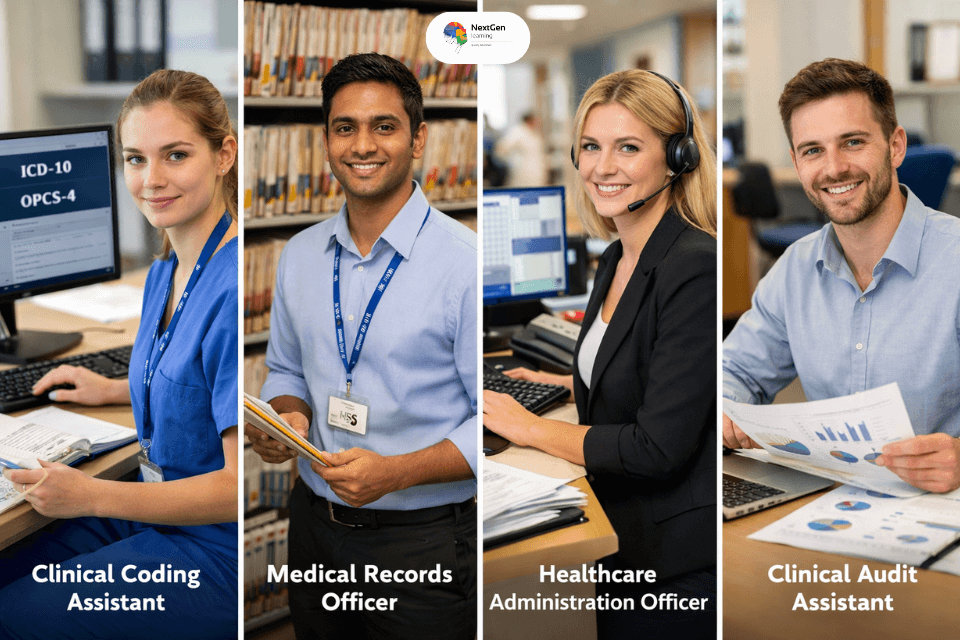
Clinical Coding Assistant / Trainee Clinical Coder

These roles support experienced clinical coders by assisting with documentation review, code verification, and data accuracy checks. This course helps build familiarity with ICD-10, OPCS-4, and clinical terminology, which is essential at entry level.
Average UK salary: £21,000 – £28,000 per year

Medical Records or Health Records Officer

Professionals in these roles manage patient records, ensure confidentiality, and support accurate information flow across healthcare services. Knowledge of clinical coding standards and records management strengthens performance and progression.
Average UK salary: £20,000 – £27,000 per year

Healthcare Administration Officer

Healthcare administrators work with clinical data, patient documentation, and reporting systems. An understanding of coding frameworks and data governance improves accuracy and professional confidence in these environments.
Average UK salary: £22,000 – £30,000 per year

Clinical Audit or Data Support Assistant

These roles assist with reviewing healthcare data, identifying inconsistencies, and supporting audit processes. Clinical coding knowledge contributes to stronger data interpretation and quality assurance.
Average UK salary: £24,000 – £32,000 per year

Progression and Further Development

For learners aiming to become fully qualified NHS clinical coders, this course can act as a preparatory foundation, supporting readiness for formal training programmes, supervised coding roles, or employer-led development pathways.

Order Your Certificate

To order CPD Quality Standard Certificate, we kindly invite you to visit the following link:

Frequently Asked Questions - Clinical Coding Course

Yes. It is fully CPD-accredited and recognised for professional development.

No. The course begins with core basics and builds gradually.

Most learners complete within a few weeks, with lifetime access for flexible study.

Yes. Learner support is available throughout the programme.

Most clinical coders start by developing foundational knowledge in clinical terminology, ICD-10, and healthcare data standards. Entry-level roles often combine on-the-job training with structured learning. Skills-based courses can help prepare learners before progressing to employer-led or NHS pathways.

Training time varies by pathway. Introductory clinical coding courses can take a few weeks to complete, while formal NHS training routes may take 12–24 months and include supervised workplace experience alongside assessments.

Foundational clinical coding concepts can usually be learned within a few weeks through structured online study. This includes understanding terminology, coding standards, and how systems like ICD-10 and OPCS-4 are used in healthcare settings.

Clinical coding can feel challenging at first due to medical terminology and classification rules. However, with structured learning and progressive explanations, most learners find it manageable. Difficulty often decreases as familiarity with terminology and coding logic improves.

There is no single mandatory qualification to start learning clinical coding. Entry-level roles often focus on aptitude and training, while NHS clinical coder positions require employer-led training and recognised professional standards. CPD courses support foundational knowledge but are not regulated qualifications.

Salaries vary by experience and employer. Entry-level clinical coding or assistant roles typically start around £21,000–£28,000 per year, while experienced NHS clinical coders and auditors can earn significantly more with progression and formal certification.

NHS clinical coders are usually employed under Agenda for Change pay bands. Entry-level roles often start at Band 3 or 4, with progression to Band 5 or higher as experience, responsibility, and coding accreditation increase.

Some NHS clinical coding roles offer remote or hybrid working, particularly for experienced coders. However, availability depends on employer policies, data security requirements, and role responsibilities. Entry-level positions are more likely to require on-site or supervised working.

An NHS clinical coder reviews patient records, interprets clinical documentation, and applies standardised codes using systems such as ICD-10 and OPCS-4. The role supports accurate reporting, audits, and healthcare data quality across services.

In the UK, clinical coding commonly involves diagnostic coding (ICD-10), procedural coding (OPCS-4), and clinical terminology systems such as SNOMED CT. Each serves a different purpose in recording, analysing, and sharing healthcare information.

ICD-10 classifies diagnoses, OPCS-4 classifies procedures, and SNOMED CT provides structured clinical terminology. Together, they support accurate clinical documentation, interoperability, and consistent healthcare data across UK systems.

Some entry-level or assistant roles do not require prior healthcare experience, focusing instead on aptitude and training. Completing a structured introductory course can help learners understand terminology and coding principles before applying. Courses offered by providers such as NextGen Learning are often used for foundational preparation.

CPD-accredited courses are recognised for professional development and skills building. They do not replace regulated NHS qualifications but are commonly used to demonstrate learning commitment and foundational knowledge. Platforms like NextGen Learning clearly position CPD courses as non-regulated training.

Yes. It is fully CPD-accredited and recognised for professional development.

What This Clinical Coding Course Is and How It Fits Within UK Healthcare

Clinical coding is the structured process of converting clinical information—such as diagnoses, symptoms, and medical procedures—into standardised classification codes. Within the UK healthcare system, this process supports accurate patient records, data consistency, service planning, audit activity, and national reporting. This Clinical Coding Course is designed to introduce learners to these principles in a clear, methodical, and professionally relevant way.

Unlike informal or fragmented learning, this course provides a comprehensive overview of how clinical coding operates across healthcare environments, including hospitals, clinics, and healthcare administration settings. It explains how clinical information flows from patient documentation into coded data and why accuracy, consistency, and ethical handling of information are essential throughout this lifecycle. As a result, learners gain clarity on the broader purpose of coding beyond technical code selection.

Furthermore, the course aligns with commonly used UK classification systems, including ICD-10, OPCS-4, and SNOMED CT. Rather than treating these systems as isolated topics, the training explains how they work together to support diagnosis recording, procedural classification, and structured clinical terminology. This integrated approach reflects real-world practice and helps learners understand how coding supports clinical communication and healthcare data quality.

Importantly, this Clinical Coding Course is positioned as skills-based, non-regulated training. It supports professional development and foundational knowledge but does not replace formal NHS clinical coding qualifications or supervised workplace training. This clear distinction ensures compliance, transparency, and realistic learner expectations while still delivering meaningful, career-relevant learning.

Why Clinical Coding Skills Matter in Modern Healthcare Environments

Clinical coding plays a central role in how healthcare systems function, yet its importance is often underestimated. Accurate coding ensures that clinical activity is recorded consistently, allowing healthcare organisations to analyse patient outcomes, allocate resources, and maintain reliable records. Without well-developed clinical coding skills, data integrity can weaken, affecting decision-making at both operational and organisational levels.

In modern healthcare environments, large volumes of clinical information are generated every day. Clinical coders and administrative staff must interpret complex terminology, apply standardised classification rules, and follow national coding standards with precision. As healthcare systems become increasingly data-driven, even minor inconsistencies in coding can influence reporting accuracy, audit outcomes, and service evaluation. Therefore, a structured understanding of coding principles is essential rather than optional.

Additionally, clinical coding is closely linked to confidentiality, ethical responsibility, and information governance. Healthcare professionals working with coded data must understand not only how to assign codes, but also how to manage sensitive information responsibly. A lack of awareness in these areas can increase compliance risks, undermine trust, and create uncertainty when handling clinical records.

This Clinical Coding Course addresses these challenges by developing both technical awareness and professional judgement. By strengthening knowledge of classification systems and ethical obligations, the course supports learners in contributing to reliable healthcare data, improved organisational performance, and safer information handling practices.

Course Curriculum

Module 01: Introduction to Clinical Coding
Introduction to Clinical Coding 00:44:00
Module 02: Introduction to Clinical Records Its Confidentiality
Introduction to Clinical Records and Its Confidentiality 00:51:00
Module 03: Clinical Terminology and Jargons
Clinical Terminology and Jargons 00:44:00
Module 04: Introduction to ICD-10 Coding
Introduction to ICD-10 Coding 00:34:00
Module 05: General Coding Standards of ICD-10
General Coding Standards of ICD-10 00:44:00
Module 06: ICD-10 5th Edition Codes (Chapter 1 to 4)
ICD-10 5th Edition Codes (Chapter 1 to 4) 00:46:00
Module 07: ICD-10 5th Edition Codes (Chapter 5 to 10)
ICD-10 5th Edition Codes (Chapter 5 to 10) 01:02:00
Module 08: ICD-10 5th Edition Codes (Chapter 11 to 15)
ICD-10 5th Edition Codes (Chapter 11 to 15) 01:00:00
Module 09: ICD-10 5th Edition Codes (Chapter 16 to 22)
ICD-10 5th Edition Codes (Chapter 16 to 22) 01:04:00
Module 10: Introduction to OPCS-4
Introduction to OPCS-4 00:48:00
Module 11: Introduction to SNOMED CT
Introduction to SNOMED CT 00:41:00
Module 12: Other types of Clinical Coding
Other types of Clinical Coding 00:34:00
Module 13: Legal and Ethical Aspects of Working in a Clinical Environment
Legal and Ethical Aspects of Working in a Clinical Environment 00:35:00
Module 14: 3M Introduction
3M Introduction 00:07:00
Basic 3M Usage Tabs File View and Option 00:11:00
Reference Tab in 3M Software 00:14:00
Reference usage with Addition Tips and shortcut 00:03:00
Module 15: How to Assign ICD Codes using 3M
How to Assign ICD Codes using 3M 00:08:00
Module 16: How to assign Combination codes
How to assign Combination codes Using 3M HTN, CKD, CHF 00:06:00
Digestive System Gastritis Duodenitis 00:13:00
How to Code Otitis Conditions 00:05:00
Obesity and Malnutrition with Tip BMI usage 00:12:00
Combinations with Sleep Apnea 00:05:00
DM Complications 00:11:00
CAD and related combinations using 3M 00:18:00
How to code COPD Bronchitis Pneumonia and Cystic fibrosis 00:18:00
Module 17: How DRG changes while we change Diagnosis or Procedure using 3M
How DRG changes while we change Diagnosis or Procedure using 3M 00:08:00
Order Your Certificate
Order Your Certificate 00:00:00
Assignment
Assignment – Clinical Terminology and Jargons 00:00:00

Related Courses

A product of

© 2026 NextGen Learning. All rights reserved

Select your currency
GBP Pound sterling