



 All Courses for £49
Overview of the Phlebotomy Training Course (CPD Accredited + Venepuncture Skills)
Blood testing plays a vital role in almost every area of healthcare — and trained phlebotomists are the professionals who make accurate diagnosis possible. The Phlebotomy Diploma is designed to help you build the knowledge, confidence, and clinical awareness needed to begin a career in blood collection and healthcare support.
This CPD-accredited phlebotomy course provides a clear, beginner-friendly introduction to venepuncture, infection control, specimen handling, and patient care. Whether you are starting from scratch or looking to strengthen your healthcare CV, the course gives you the theoretical foundation employers expect in NHS and private clinical settings.
With 100% online learning, lifetime access, and a recognised CPD certificate, this training fits around your schedule while preparing you for entry-level phlebotomy, healthcare assistant, and laboratory support roles across the UK.
Exclusive Course Glimpse


What Will You Gain from This Phlebotomy Training Course?
By completing this Phlebotomy Diploma, you will gain the essential knowledge needed to perform safe, accurate blood collection in professional healthcare environments. The course focuses on building confidence, clinical awareness, and job-ready understanding — without overwhelming you with unnecessary detail.
You will gain:
A clear understanding of phlebotomy and venepuncture procedures
Learn how blood is collected safely and correctly in NHS and private clinical settings.Confidence in patient preparation and communication
Understand how to approach patients professionally, reduce anxiety, and follow ethical care standards.Strong awareness of infection control and safety practices
Learn essential protocols such as PPE use, hand hygiene, sharps safety, and contamination prevention.Knowledge of specimen handling and laboratory processes
Understand correct labelling, storage, and transportation to support accurate diagnostic testing.Insight into common complications and accuracy factors
Recognise issues such as fainting, difficult veins, and pre-examination variables that affect results.

Why Choose This Phlebotomy Diploma?
Choosing the right phlebotomy course is about more than content — it’s about flexibility, recognition, and confidence that your learning will support real job opportunities. This Phlebotomy Diploma is designed to be accessible, supportive, and aligned with employer expectations across the UK.
Why learners choose this course:
🏅CPD Accredited Qualification
Receive a recognised CPD certificate that demonstrates your commitment to professional development and healthcare standards.♾️100% Online with Lifetime Access
Study at your own pace, revisit lessons anytime, and learn on any device without deadlines or pressure.✅Beginner-Friendly Structure
No previous medical or clinical experience is required. All concepts are explained clearly and step by step.💬24/7 Tutor Support
Get help whenever you need it through email or online support — ideal for learners returning to study.⚡Instant Digital Certification
Download your CPD-accredited certificate immediately after passing the assessment.✅14-Day Money-Back Guarantee
If the course isn’t right for you, request a full refund within 14 days — no questions asked.
Key Topics Covered in This Phlebotomy Course
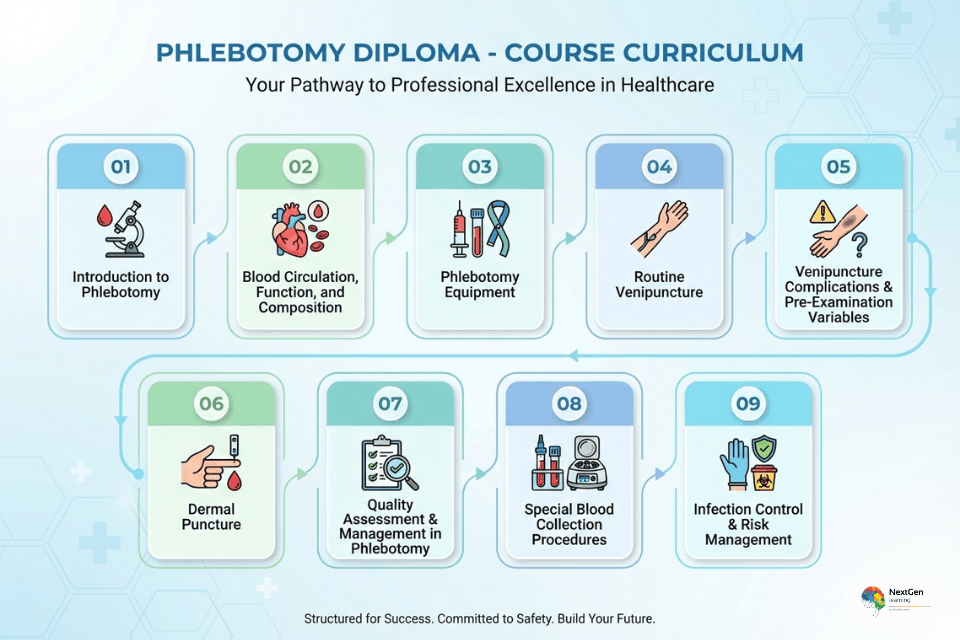
This Phlebotomy Diploma is structured into clear learning areas that build your knowledge step by step. Instead of overwhelming detail, the course focuses on the core skills and understanding employers expect from entry-level phlebotomy and healthcare support staff.
Key learning areas include:
Introduction to Phlebotomy Practice
Understand the role of a phlebotomist, professional responsibilities, and clinical standards used in UK healthcare settings.Venepuncture & Dermal Puncture Knowledge
Learn how routine blood collection works, including vein selection, order of draw, and safe blood sampling methods.Patient Care & Communication
Develop awareness of patient preparation, consent, comfort, dignity, and professional interaction during procedures.Infection Control & Clinical Safety
Learn essential aseptic techniques, PPE usage, sharps safety, and risk management protocols.Specimen Handling & Laboratory Awareness
Understand correct labelling, storage, transportation, and how blood samples support accurate diagnosis.Managing Complications & Accuracy Factors
Gain insight into common challenges such as fainting, difficult veins, and pre-examination variables.
Certificate & Accreditation
After successfully completing the assessment, you will receive a CPD-accredited digital certificate for this Phlebotomy Diploma. This certificate confirms your theoretical understanding of phlebotomy, venepuncture principles, infection control, and patient-care standards.
The certificate is recognised by healthcare employers across the UK and supports applications for entry-level roles in both NHS and private healthcare settings.
Your CPD Certificate Includes:
Course title and completion date
CPD accreditation details
Unique verification number
Digital format for immediate download
This qualification demonstrates your commitment to professional development and shows employers that you understand safe blood collection practices and clinical standards expected in healthcare environments.
While hands-on workplace training is required for practical blood collection, this course provides the essential theoretical foundation employers look for when considering candidates for phlebotomy-related roles.

Who This Phlebotomy Course Is For
This Phlebotomy Diploma is designed for learners who want to build a strong foundation in blood collection and healthcare support — without needing prior medical experience. The course is accessible, structured, and suitable for a wide range of learners at different career stages.
This course is ideal for:
Aspiring Phlebotomists
Individuals preparing for entry-level phlebotomy roles in hospitals, GP surgeries, diagnostic centres, or private clinics.Healthcare Assistants & Support Workers
Those looking to expand their responsibilities by gaining theoretical knowledge of venepuncture and specimen handling.Nursing Students & Healthcare Trainees
Learners who want to strengthen their clinical understanding before placements or employment.Laboratory Assistants & Technicians
Professionals seeking better insight into specimen collection, handling, and pre-analytical processes.Career Changers Entering Healthcare
Individuals exploring a new, stable, and rewarding pathway into the healthcare sector.Private Clinic & Wellness Centre Staff
Those working in private healthcare environments who require phlebotomy knowledge as part of their role.
No previous clinical background is required. All concepts are introduced clearly and explained step by step, making this course suitable for beginners, jobseekers, and developing healthcare professionals alike.
Entry Requirements & Assessment
This Phlebotomy Diploma is open to learners from all backgrounds. You do not need previous medical training, clinical experience, or healthcare qualifications to enrol. The course is designed to be accessible while still meeting professional learning standards.
Entry Requirements
No prior healthcare or phlebotomy experience required
Minimum age: 16 years
Basic English reading and writing skills recommended
Access to the internet via computer, tablet, or mobile device
These simple requirements make the course suitable for beginners, career changers, and healthcare assistants seeking formal theoretical training.
Assessment Method
Online multiple-choice assessment
Instant results upon completion
Free retakes available if needed
Accessible on any device
Once you pass the assessment, you can immediately download your CPD-accredited digital certificate.
Career Opportunities & Progression Pathways

Completing this Phlebotomy Diploma opens the door to a wide range of entry-level and developing roles across the UK’s healthcare and diagnostic sectors. Phlebotomy is a core clinical support skill used throughout the NHS and private healthcare, making it a common requirement in hospitals, GP surgeries, laboratories, and private clinics.
With this CPD-accredited qualification, learners gain the theoretical foundation needed to pursue patient-facing and laboratory support roles, while also creating clear pathways into further clinical training and healthcare careers.
Career Opportunities After Completing the Phlebotomy Diploma
Phlebotomist (NHS & Private Sector)
Carry out routine blood collection, support diagnostic testing, and assist clinical teams in hospitals, GP surgeries, and diagnostic centres.
💷 Typical salary: £20,000 – £24,000 (NHS Band 2–3)
Healthcare Assistant (HCA) with Phlebotomy Duties
Support patients with basic care tasks while assisting with blood collection and clinical observations (workplace training required for NHS roles).
💷 Typical salary: £20,300 – £24,300
Medical Laboratory Assistant
Support laboratory teams with specimen handling, preparation, and pre-analytical processes to ensure accurate test results.
💷 Typical salary: £19,000 – £24,000
Clinical Support Worker
Assist clinical staff in outpatient services, wards, or community healthcare settings, often including blood collection responsibilities.
💷 Typical salary: £22,000 – £24,000
Donor Care Assistant / Blood Collection Support
Work within blood donation or community health services, supporting donor care, consent, and safe blood collection.
💷 Typical salary: £20,500 – £26,000
Private Clinic or Diagnostic Centre Assistant
Support venepuncture, wellness testing, and patient care in private healthcare, aesthetic, or diagnostic clinics.
💷 Typical salary: £21,000 – £28,000 (varies by location and responsibilities)
Progression Routes After This Qualification
This Phlebotomy Diploma also supports progression into more advanced roles and further study, including:
Senior Phlebotomist roles (with experience)
Laboratory Technician or Biomedical Science pathways
Clinical Support Worker progression within the NHS
Nursing or Midwifery apprenticeships (with employer sponsorship)
Health science or healthcare practice degrees
Specialist blood collection or diagnostic services
With experience and additional training, learners can build long-term careers within clinical, laboratory, or patient-care settings across both public and private healthcare sectors.
Enrol in the Phlebotomy Diploma Today
The Phlebotomy Diploma (CPD Accredited) offers a clear, beginner-friendly learning pathway into one of the most essential clinical support roles in healthcare. Whether you’re starting a new career, building on your experience as a healthcare assistant, or looking to gain a recognised qualification to strengthen your CV, this course provides the theoretical knowledge needed to move confidently into phlebotomy-related roles.
Throughout the course, you’ll develop a strong understanding of venepuncture principles, dermal puncture awareness, specimen handling, infection control, patient communication, and clinical safety standards — all delivered through structured, easy-to-follow modules with lifetime access.
On successful completion, you’ll receive an instantly downloadable CPD-accredited certificate, demonstrating your theoretical competency and readiness for entry-level roles across NHS and private healthcare settings.
If you’re ready to take the first step toward a stable, in-demand healthcare career that supports patient care, diagnostics, and clinical decision-making, this Phlebotomy Diploma is the ideal place to begin. Enrol today and start building the knowledge employers look for in phlebotomy professionals.
Frequently Asked Questions - Phlebotomy Diploma
No. This Phlebotomy Diploma is designed for beginners and career changers. You do not need prior healthcare, medical, or phlebotomy experience. All topics are explained clearly from the basics.
Yes. The course is CPD accredited, and the certificate is recognised by employers across the UK as evidence of theoretical knowledge in phlebotomy and venepuncture principles.
This course provides the theoretical foundation employers expect. Practical blood collection must be completed through supervised workplace training, which is standard across the UK healthcare sector.
The NHS accepts CPD certificates as proof of theoretical training. Practical competence must be demonstrated through on-the-job training and supervision, particularly for NHS Band 2 and Band 3 roles.
As the course is 100% online with lifetime access, completion time varies. Many learners finish within a few weeks, while others study at a slower pace alongside work or other commitments.
The course is assessed through an online multiple-choice exam. You need a 60% pass mark, and results are provided instantly. Retakes are available if required.
Learners commonly apply for roles such as Phlebotomist, Healthcare Assistant (with phlebotomy duties), Medical Laboratory Assistant, and Clinical Support Worker, depending on workplace training and experience.
Entry-level NHS phlebotomists typically earn between £20,000 and £24,000 per year, with salaries varying by location, experience, and whether the role is NHS or private sector.
Yes. Phlebotomy is a stable and in-demand healthcare skill, with opportunities across hospitals, GP surgeries, laboratories, and private clinics. It also offers progression into wider healthcare careers.
Yes. The course is fully flexible, online, and self-paced, allowing you to study anytime, anywhere, on any device.
More Questions About Phlebotomy Training
To begin phlebotomy training, you do not need formal qualifications or previous medical experience. Most employers look for a recognised theoretical certificate (such as a CPD-accredited phlebotomy course) followed by supervised practical experience obtained in a clinical setting. Good communication skills, attention to detail, and safe practice are essential.
Yes. You do not need to be a nurse to become a phlebotomist. Many phlebotomists start as healthcare assistants, laboratory support staff, or career changers who complete theoretical training before gaining hands-on experience in the workplace.
Online phlebotomy courses are accepted by employers as evidence of theoretical knowledge. Practical blood collection skills must be developed through supervised training in a healthcare environment, which is standard across the UK.
There is no fixed timeframe. Theoretical training can be completed online at your own pace, while practical training is completed separately in a clinical setting. Many learners begin applying for roles once they secure supervised practice opportunities.
This course is fully online and self-paced, with lifetime access. Some learners complete it within a few weeks, while others study alongside work or other commitments.
Yes. Phlebotomy skills are in consistent demand across NHS hospitals, GP surgeries, diagnostic services, and private clinics due to the ongoing need for blood testing and patient monitoring.
A phlebotomist collects blood samples, prepares patients, follows infection control procedures, labels specimens correctly, and supports diagnostic testing within healthcare or laboratory settings.
The most direct route is to complete a recognised theoretical phlebotomy course, then secure supervised practical training in a healthcare setting. This combination meets employer expectations across the UK.
Phlebotomy focuses on blood collection and specimen handling rather than broader patient care responsibilities. While both roles require care and precision, phlebotomy training is more specialised and typically shorter in scope.
The fastest route is:
- Complete a CPD-accredited theoretical phlebotomy course
- Apply for NHS Band 2 or private clinic trainee phlebotomy roles
- Gain supervised practical experience on the job
Most people become job-ready within weeks to months. You can have a headstart by taking the Nextgen Learning course ‘Phlebotomy Diploma’
Phlebotomy requires technical skill and accuracy, but it is generally considered less broad and demanding than nursing. Many choose phlebotomy as a starting point to gain clinical exposure before progressing into nursing, midwifery, or other healthcare roles.
Daily tasks include:
- Performing venepuncture and dermal punctures
- Preparing and reassuring patients
- Labelling and transporting specimens
- Maintaining infection control standards
- Completing documentation
- Supporting nurses, doctors, and laboratory teams
It is a hands-on, patient-facing role with high responsibility for sample accuracy.
No. Phlebotomy courses are designed for beginners and healthcare workers with no prior blood-taking experience. Theoretical knowledge is taught from the basics, making it accessible to all learners.
You do not need formal qualifications or previous medical experience to begin phlebotomy training. Most employers look for a recognised theoretical phlebotomy course, followed by supervised practical training in a clinical setting.
Yes. Many phlebotomists begin with no healthcare experience. This course provides the theory, while on-the-job training develops your hands-on skills.
Yes. The NHS recognises CPD-certified phlebotomy courses for theoretical training. However, all phlebotomists must complete supervised practical experience before they can take blood from patients.
Absolutely. Phlebotomy offers job stability, competitive pay, clear progression routes, and daily interaction with patients. It is also a strong stepping stone into nursing, laboratory science, and other healthcare professions.
Course Curriculum
| Phlebotomy Diploma | |||
| Module 01: Introduction to Phlebotomy | 00:18:00 | ||
| Module 02: Blood Circulation, Function, and Composition | 00:28:00 | ||
| Module 03: Phlebotomy Equipment | 00:17:00 | ||
| Module 04: Routine Venipuncture | 00:25:00 | ||
| Module 05: Venipuncture Complications and Pre-Examination Variables | 00:27:00 | ||
| Module 06: Dermal Puncture | 00:15:00 | ||
| Module 07: Quality Assessment and Management in Phlebotomy | 00:20:00 | ||
| Module 08: Special Blood Collection Procedure | 00:16:00 | ||
| Module 09: Infection Control and Risk Management | 00:20:00 | ||
| Mock Exam | |||
| Mock Exam – Phlebotomy Diploma | 00:20:00 | ||
| Final Exam | |||
| Final Exam – Phlebotomy Diploma | 00:20:00 | ||
| Assessment | |||
| Assignment – Phlebotomy Diploma | 01:10:00 | ||
| Order Your Certificate | |||
| Order Your Certificate | 00:00:00 | ||
| Thank You For Choosing NextGen Learning | |||
| Thank You For Choosing NextGen Learning | 00:00:00 | ||
Related Courses
Pandemic Disease Awareness
Clinical Training for Nurses and Carers – Catheterisation

Diploma in Healthcare Administration and Management

Legionella Awareness Training