




What Is British Sign Language and Why Learn It?
British Sign Language, commonly known as BSL, is the preferred language of an estimated 150,000 deaf and hard of hearing people across the United Kingdom. It is a complete, fully expressive language in its own right — with its own grammar, syntax, and structure that differs significantly from spoken and written English. BSL is not simply a visual representation of English words. It is a rich, nuanced language shaped by centuries of deaf culture, community, and identity.
In 2022, BSL gained official recognition as a language of the United Kingdom under the British Sign Language Act. This was a landmark moment — one that reflected growing public awareness of the deaf community and the importance of genuine, accessible communication. As a result, demand for qualified BSL users has grown considerably, particularly in sectors such as healthcare, education, social care, and public services. So why should you learn it? The reasons are as varied as the people who choose to study BSL.
● Family and relationships: Many learners begin their BSL journey because a family member, partner, or close friend is deaf. Learning to sign transforms those relationships removing barriers and building deeper, more natural communication.
●Career development: Professionals working in healthcare, teaching, social work, or customer-facing roles increasingly value BSL as a skill that sets them apart and enables them to serve deaf clients and colleagues more effectively.
●Community and inclusion: Some learners are motivated simply by a desire to be more inclusive — to participate in their local deaf community and to break down communication barriers in everyday life.
● Personal enrichment: BSL is a visually beautiful and intellectually engaging language. For many, learning it is genuinely enjoyable — a creative, expressive, and deeply human skill to develop.
Importantly, BSL is not the same as Makaton, which is a communication programme using signs and symbols designed primarily to support people with learning difficulties. BSL is a distinct, standalone language used by the deaf community — and learning it properly requires structured teaching, cultural context, and guided practice with native signers.

Table of Contents
Why Choose an Accredited BSL Course?

When it comes to learning British Sign Language, the qualification you earn matters just as much as the skills you develop. An accredited BSL course means your learning has been assessed, verified, and recognised against a nationally approved standard. This is important for several reasons — both practical and professional.
For employers, an accredited BSL qualification carries real weight. It signals that you haven’t simply picked up a few signs from an app or a YouTube video. Instead, it demonstrates that you’ve completed a structured programme of study, been formally assessed, and achieved a recognised level of competency. Consequently, accredited qualifications are far more likely to support career progression, satisfy workplace training requirements, and be accepted by
professional bodies.
For learners, accreditation provides reassurance. You know exactly what standard you’re working towards, how you’ll be assessed, and what your qualification represents upon completion. Furthermore, accredited courses follow a consistent curriculum — so your learning is comprehensive, well-sequenced, and genuinely prepares you for real-world BSL use.
There are several key things to look for when choosing an accredited BSL course:
● Nationally recognised qualification: Your certificate should be awarded by a body whose BSL qualifications are respected across the UK — by employers, universities, and professional organisations alike.
● Qualified tutors: The best BSL courses are taught by deaf tutors who are native signers. This gives you direct, authentic exposure to BSL as it is actually used — not a hearing person’s interpretation of it.
● Structured progression: A quality-accredited course takes you through clearly defined levels, each building on the last, so your skills develop in a logical and sustainable way.
● Assessment transparency: You should know upfront how you’ll be assessed, what’s expected at each stage, and how results are determined.
At NextGen Learning, our BSL courses meet all of these criteria. Every course is fully accredited, delivered by qualified deaf tutors, and designed to give you a qualification that genuinely reflects your ability to communicate in BSL.

Why Learn BSL with NextGen Learning?
Choosing where to learn British Sign Language is one of the most important decisions you’ll make on your signing journey. The quality of your tuition, the authenticity of your learning environment, and the support you receive along the way all shape not just your qualification — but your genuine ability to communicate with the deaf community. At NextGen Learning, we’ve
built our BSL courses around everything that makes the difference between simply passing a test and truly learning a language.
Taught by Qualified Deaf Tutors
Perhaps the single most important factor in learning BSL well is learning directly from native signers. All of our BSL courses are delivered by qualified deaf tutors — people for whom BSL is their first language, and who bring lived experience of deaf culture into every lesson. This is not a small detail. It fundamentally changes the quality of your learning.
When you learn from a native signer, you absorb BSL as it is actually used — the natural rhythm, the expressive nuance, the cultural context that no textbook can fully capture. Moreover, our tutors use a range of visual teaching methods, including clear signing, gestures, interactive activities, and supported visual materials, so you are never left behind regardless of your starting point.
A Fully Supported Learning Experience
Learning a new language can feel daunting — particularly one that is entirely visual. At NextGen Learning, we design our courses so that every learner feels supported from day one. In fact, most of our students are genuinely surprised by how much they can understand and enjoy from their very first lesson.
Our support doesn’t stop when the class ends, either. As a NextGen Learning student, you gainfree access to our exclusive online learning platform, packed with:
● Video resources covering course content and key vocabulary
● Practice materials to reinforce what you’ve learned in class
● Self-study tools to help you build confidence between sessions
● Guided exercises designed to improve both your receptive and productive BSL skills
This means your learning continues outside the classroom — at your own pace, on your own schedule, and in a way that works best for you.
Flexible Learning to Suit Your Life
We understand that people come to BSL learning from all walks of life — busy professionals, parents, students, and career changers alike. That’s why NextGen Learning offers both in-person and online course options, giving you the freedom to choose the format that fits your lifestyle. Whether you prefer the energy of a classroom environment or the convenience of learning from home, you’ll receive the same high standard of tuition and the same fully accredited qualification at the end.
Learning with Purpose
At NextGen Learning, we believe that learning BSL goes beyond earning a certificate. It is about becoming part of something meaningful — contributing to a more inclusive society where deaf people are met with understanding, respect, and genuine communication. Every course we offer is designed with that purpose at its heart. Consequently, when you study with us, you’re not just
investing in yourself. You’re investing in the connections and communities that BSL makes possible.
BSL Level 1 Course — Full Overview
Who Is BSL Level 1 For?
Our BSL Level 1 course is designed for complete beginners. You do not need any prior knowledge of sign language to enrol — just curiosity, enthusiasm, and a willingness to learn. This course is ideal for anyone who wants to start communicating with deaf friends, family members, or colleagues, as well as professionals in healthcare, education, or social care who want to build inclusive communication skills in the workplace.
It is also a perfect starting point for anyone who simply wants to explore British Sign Language as a new skill. There are no entry requirements, no prior experience needed, and no pressure. You start from scratch, and we guide you every step of the way.
What Will You Learn?
BSL Level 1 at NextGen Learning covers a broad and practical range of everyday topics, carefully sequenced to build your confidence and vocabulary from the ground up. By the time you complete this course, you’ll be able to hold basic conversations, introduce yourself, discuss everyday situations, and communicate meaningfully with deaf people in a range of real-world
contexts.
The full Level 1 curriculum includes:
●Alphabet, fingerspelling and names — the essential foundation of BSL communication
● Greetings — how to introduce yourself and engage in basic social exchanges
● Family, question forms and family story — discussing relationships and asking
questions naturally
● Rooms in the house — everyday domestic vocabulary
● Colours — descriptive language for objects and environments
●Questions and statements about the home — building conversational fluency around familiar settings
● Animals — expanding descriptive vocabulary
● Numbers and money — practical skills for everyday transactions
● Time and months of the year — essential for scheduling and daily conversation
● Describing ages — discussing people and their characteristics
● Weather — a staple of everyday British conversation, in any language
● Transport — getting around and giving or following directions
● Directions — navigating and helping others navigate
● Hobbies — talking about interests and leisure activities
● Work — discussing jobs, roles, and professional contexts
● Food and drink — vocabulary for one of the most common conversational topics
In addition to the core curriculum, the course includes a rich selection of dialogue and story-based learning materials designed to bring your skills to life in context:
● Dialogues with no voice and no subtitles — to develop your receptive BSL skills and train your eye to read signing fluently
●Dialogues with voice and subtitles — for supported comprehension and confidence building
●Bonus: 5 stories with voice and subtitles — extended narrative content to broaden vocabulary and contextual understanding
● Bonus: 5 stories with no voice over — a more advanced receptive challenge tosharpen your visual comprehension
This combination of structured vocabulary learning and real dialogue practice is what sets NextGen Learning’s Level 1 course apart. You’re not just memorising signs — you’re learning to understand and use BSL in real, flowing conversation.
How Is the Course Delivered?
The course is delivered online, giving you the flexibility to learn at your own pace and revisit materials as many times as you need. All lessons are taught by qualified deaf tutors — native BSL signers who bring authentic language and cultural context to every session. Furthermore, as a NextGen Learning student, you’ll have full access to our online learning platform throughout your studies, giving you additional video resources, practice tools, and self-study materials to support your progress between lessons.
What’s Included?
● Full access to the accredited BSL Level 1 course curriculum
● All dialogue and story-based learning materials
● Lessons delivered by qualified deaf tutors
● Free access to the NextGen Learning online platform
● Dedicated support throughout your learning journey

BSL Level 2 Course — Full Overview
Who Is BSL Level 2 For?
BSL Level 2 is designed for learners who have already completed BSL Level 1 — or who can demonstrate an equivalent level of signing ability. At this stage, you move beyond the basics and begin developing genuinely fluent, confident communication across a much wider range of topics and contexts.
If you completed Level 1 and found yourself hungry to go further — to sign more naturally, understand more quickly, and engage with deaf people in richer, more varied conversations — then Level 2 is your next step. Additionally, if you are deaf, a Child of a Deaf Adult (CODA), or someone who lives or works closely within the deaf community, you may be eligible to join Level 2 directly following a short skills assessment.
What Will You Learn?
BSL Level 2 builds substantially on everything covered at Level 1. The curriculum is broader, the topics are more complex, and the expectations around fluency and expression are meaningfully higher. By the end of this course, you’ll be able to communicate confidently and effectively across a wide range of everyday and professional situations.
The full Level 2 curriculum includes:
● Family vocabulary — deeper and more nuanced discussion of relationships and family life
● Describing people and animals — detailed physical and character descriptions
● Activities at school — education-related vocabulary and conversation
●Jobs and activities at work — professional contexts and workplace communication
● Time — advanced time expressions and scheduling language
● Activities in the home — domestic routines and household discussions
● Leisure activities — hobbies, interests, and free time in greater depth
● Opinions, likes and dislikes — expressing personal views and preferences fluently
●Illnesses and health — essential vocabulary for healthcare and wellbeing conversations
● Eating and drinking — expanded food, drink, and dining vocabulary
● Shopping and spending — retail, transactions, and consumer contexts
●Travel and holidays — getting around, planning trips, and discussing travel experiences
As with Level 1, the course includes an extensive range of dialogue and story-based learning content to develop both your receptive and productive BSL skills:
● Level 2 dialogues without voice and subtitles — advanced receptive practice in authentic, unassisted BSL
● Level 2 dialogues with voice and subtitles — supported comprehension for reinforcing new vocabulary
● 5 stories with no voice over and no subtitles — challenging, immersive receptive content
●5 stories with voice over and subtitles — narrative learning with full comprehension support
● Level 2 BSL dialogues and stories — a consolidated resource bringing together the full range of Level 2 conversational content
This structured blend of topic-based learning and real dialogue practice ensures that by the time you complete Level 2, you’re not just signing — you’re conversing. You’re responding, expressing opinions, describing situations, and engaging with deaf people in a way that feels natural and confident.
How Is the Course Assessed?
BSL Level 2 is assessed across three distinct components, each designed to test a different dimension of your signing ability:
●Receptive assessment — you’ll watch a BSL clip and demonstrate your understanding of what has been signed
● Productive assessment — you’ll deliver a short presentation in BSL to your tutor, showcasing your expressive signing skills
● Conversational assessment — you’ll take part in a structured conversation with your BSL tutor, demonstrating your ability to sign fluently and responsively in a natural exchange
Together, these three assessments give a full and fair picture of your BSL ability — not just your ability to memorise signs, but your genuine capacity to communicate.
What’s Included?
● Full access to the accredited BSL Level 2 course curriculum
● All dialogue, story, and extended practice materials
● Lessons delivered by qualified deaf tutors
● Free access to the NextGen Learning online platform
● Dedicated support throughout your learning journey
● Volume pricing available for group or organisational enrolments
Online vs. In-Person BSL Learning — Which Is Right for You?

One of the most common questions people ask before enrolling on a BSL course is whether to learn online or in person. The honest answer is that both formats can be highly effective — what matters most is choosing the one that fits your lifestyle, your learning style, and your personal circumstances. At NextGen Learning, we offer both options, and both deliver the same fully accredited qualification with the same standard of tuition from qualified deaf tutors.
To help you decide, here’s a clear breakdown of what each format offers.
Online BSL Learning
Online BSL learning has grown enormously in popularity — and for good reason. It removes geographical barriers entirely, meaning you can access world-class BSL tuition regardless of where you live in the UK. Moreover, it gives you a level of flexibility that in-person learning simply cannot match.
With NextGen Learning’s online BSL courses, you can:
● Learn at your own pace — revisit lessons, pause, rewind, and practise as many times as you need
● Study around your schedule — no fixed commute, no rigid timetable, no pressure to keep up with a classroom
● Access everything in one place — your course materials, dialogue videos, and practice resources are all available through our online platform
● Learn from qualified deaf tutors — the same authentic, native-signer tuition you’d receive in person, delivered digitall
Online learning is particularly well suited to busy professionals, parents, people in rural areas, and anyone who values the freedom to learn on their own terms. Furthermore, the visual nature of BSL — a language expressed through movement, expression, and space — actually translates remarkably well to video-based learning when it is designed thoughtfully.
In-Person BSL Learning
In-person BSL classes offer a different kind of energy. There is something uniquely valuable about learning in a shared physical space — signing with classmates, receiving immediate feedback from your tutor, and experiencing the social dimension of BSL in real time. For many learners, the classroom environment provides motivation, accountability, and a sense of community that accelerates progress.
In-person learning is particularly beneficial for:
● Learners who thrive in structured, social environments
● Those who find it easier to stay motivated with a set schedule and regular face-to-face contact
● Students who want to practise conversational BSL with peers in real time
● Anyone who finds the physical, spatial nature of sign language easier to absorb when surrounded by other signers
Which Format Should You Choose?
Online BSL learning offers flexibility, allowing you to learn anytime and anywhere, whereas in-person learning follows a fixed schedule and location. In terms of pace, online courses are self-paced, while in-person classes are group-paced. Both formats maintain high tutor quality, as they are delivered by qualified deaf tutors, and both lead to fully accredited qualifications. When it comes to social practice, online learning provides platform-based resources, whereas in-person learning enables real-time peer interaction. Ultimately, online learning is best suited for busy schedules and remote learners, while in-person learning is ideal for structured learners who benefit from social interaction.
Importantly, whichever format you choose, your learning experience at NextGen Learning is underpinned by the same commitment to quality — the same qualified tutors, the same accredited curriculum, and the same access to our online learning platform with its full suite of video resources, practice materials, and self-study tools.
In short, there is no wrong choice. There is only one choice that works best for you.
Your BSL Learning Journey — From Level 1 to Fluency
Learning British Sign Language is not a single destination — it is a progressive journey. Each level you complete builds meaningfully on the last, deepening your vocabulary, sharpening your fluency, and expanding the range of situations in which you can communicate confidently and naturally. Understanding the full progression pathway before you begin helps you set realistic expectations, stay motivated, and plan your learning with purpose.
Here is how your BSL journey typically unfolds.
Stage 1: Building Your Foundation — BSL Level 1
Every BSL journey begins at Level 1. This is where you develop the essential building blocks of the language — fingerspelling, core vocabulary, basic grammar, and the visual attentiveness that signing requires. At this stage, the focus is on practical, everyday communication. You learn to greet people, discuss familiar topics, and begin to understand BSL as it flows naturally from a native signer.
Importantly, Level 1 is not just about memorising signs. It is about training your eyes and your hands to work together — to express meaning visually and to read it in others. Most learners are genuinely surprised by how quickly this starts to feel natural. Consequently, by the end of Level 1, you’ll be holding simple but meaningful conversations and experiencing the real satisfaction of communicating in a new language.
Stage 2: Developing Fluency — BSL Level 2
BSL Level 2 is where your signing begins to feel genuinely fluent. The vocabulary becomes richer, the topics become more varied, and the expectations around expression and comprehension rise meaningfully. At this level, you move from basic exchanges into real, flowing conversation — discussing opinions, describing people and situations in detail, and navigating complex everyday contexts such as health, work, travel, and leisure.
Level 2 also introduces formal assessment across three components — receptive, productive, and conversational — giving you a well-rounded qualification that reflects your true ability to communicate in BSL, not just your ability to recall vocabulary in isolation. As a result, completing Level 2 represents a significant and genuinely meaningful milestone in your BSL journey.
Stage 3: Advancing Your Skills — BSL Level 3 and Beyond
For those who wish to continue beyond Level 2, the pathway opens up considerably. BSL Level 3 is widely regarded as the threshold of professional BSL competency. At this level, you develop the ability to discuss abstract topics, engage in complex conversations, and use BSL with the kind of confidence and nuance that professional and community contexts demand.
Beyond Level 3, learners can progress towards interpreter training and other specialist qualifications — pathways that lead to careers as BSL interpreters, communication support workers, and deaf awareness trainers. Furthermore, a strong BSL qualification at Level 3 or above is increasingly sought after in sectors including healthcare, education, law, and public services.
How Long Does Each Level Take?
The time it takes to complete each BSL level varies depending on your learning format, study schedule, and individual pace. However, as a general guide:
● BSL Level 1 typically takes between 3 and 6 months for most learners studying regularly
● BSL Level 2 typically takes between 6 and 12 months, reflecting the greater depth and complexity of the curriculum
● BSL Level 3 is a more substantial commitment, often taking 12 months or more of consistent study
These timelines are flexible — particularly with online learning, where you control the pace entirely. What matters most is not how quickly you progress, but how consistently you practise and how deeply you engage with the language between lessons.
The Key to Progress: Consistent Practice
Every experienced language learner will tell you the same thing — consistent practice is everything. BSL is no different. In fact, because it is a visual and physical language, regular practice is even more important than it might be with a spoken language. Your hands, your facial expressions, and your visual memory all need regular engagement to develop and retain signing fluency.
At NextGen Learning, our online platform is designed with exactly this in mind. Between lessons, you can return to video resources, work through practice materials, and challenge yourself with dialogue and story content at progressively higher levels of difficulty. Moreover, even small amounts of daily practice — ten to fifteen minutes of reviewing vocabulary or watching dialogue videos — compound significantly over time.
The learners who progress fastest are not necessarily the most naturally gifted. They are the ones who show up consistently, practise deliberately, and embrace the occasional discomfort of not yet understanding everything they see. That discomfort, as any fluent signer will tell you, is exactly where the real learning happens.

Who Benefits Most from Learning BSL?
British Sign Language is a skill that enriches the lives of an extraordinarily wide range of people. While anyone can learn BSL and benefit from doing so, certain groups find that a BSL qualification makes a particularly meaningful difference — both professionally and personally. Understanding where BSL adds the most value can help you see not just what you’ll gain from learning it, but why it matters beyond the classroom.
Healthcare Professionals
For anyone working in healthcare — whether as a doctor, nurse, midwife, paramedic, or support worker — the ability to communicate directly with deaf patients is genuinely transformative. Deaf individuals frequently report feeling excluded, misunderstood, or inadequately supported in medical settings where BSL-competent staff are unavailable. Consequently, healthcare professionals who hold a BSL qualification are better equipped to deliver safe, person-centred care — and are increasingly valued by employers who recognise the importance of accessible communication.
Furthermore, in time-sensitive or emotionally sensitive situations, the ability to communicate directly — without relying on an interpreter or written notes — can make a profound difference to the quality of care a deaf patient receives.
Teachers and Educational Professionals
BSL is increasingly present in school environments. Deaf children and young people attend mainstream schools across the UK, and the educators who work with them benefit enormously from even a foundational level of BSL competency. Moreover, teaching assistants, special educational needs coordinators (SENCOs), and support staff who hold a BSL qualification are better positioned to support deaf pupils — and are often more competitive candidates in the job market as a result.
Beyond direct support for deaf pupils, teachers who learn BSL often find that it enriches their broader teaching practice — developing their use of visual communication, gesture, and non-verbal expression in ways that benefit all learners in the classroom.
Social Workers and Support Professionals
Social workers, community support workers, and those working in residential care settings regularly interact with deaf individuals and families. In these contexts, BSL is not simply a professional advantage — it is often a fundamental requirement for doing the job well. A BSL qualification demonstrates a commitment to inclusive practice and gives professionals the practical tools to engage with deaf service users directly, respectfully, and effectively.
Families and Friends of Deaf People
For many learners, the motivation to study BSL is deeply personal. Learning to sign with a deaf family member — a child, parent, sibling, or partner — is one of the most meaningful things a hearing person can do. It sends a powerful message: that the relationship matters enough to meet the other person in their own language, on their own terms.
For parents of deaf children in particular, BSL can be life-changing. Research consistently shows that deaf children with signing family members develop stronger communication skills, greater emotional wellbeing, and a more secure sense of identity. As a result, the decision to learn BSL as a parent is one of the most impactful investments a family can make.
Customer-Facing and Public Service Roles
Businesses and public sector organisations are increasingly recognising the value of BSL-competent staff in customer-facing roles. From retail and hospitality to banking, local government, and emergency services, organisations that employ BSL signers are better equipped to serve the estimated 12 million deaf and hard of hearing people in the UK. For individuals in these roles, a BSL qualification is a genuine differentiator — a skill that demonstrates both professional commitment and genuine human empathy.
Anyone Who Wants to Be More Inclusive
Finally — and perhaps most importantly — BSL is for anyone who simply wants to communicate more inclusively. You don’t need a professional reason to learn it. You don’t need a deaf family member or a workplace requirement. BSL is a language, and like any language, learning it broadens your world, challenges your mind, and connects you to people and communities you might otherwise never encounter.
In a society where deaf people are still too often excluded from everyday conversations, every new BSL learner matters. Each person who takes the time to learn — however imperfectly, however gradually — contributes to a more connected, more inclusive world. That, ultimately, is the most compelling reason of all to begin.

Ready to Start Your BSL Journey?
Learning British Sign Language is one of the most rewarding decisions you can make. It is a skill that stays with you for life — one that deepens relationships, opens professional doors, and connects you to a vibrant, welcoming community. Whether you are picking up BSL for personal reasons, professional development, or simply because you have always wanted to learn, the right moment to begin is now.
At NextGen Learning, we have designed our BSL courses to give every learner the best possible start. From our qualified deaf tutors and fully accredited curriculum to our flexible online format and comprehensive learning platform, everything we offer is built around one goal — helping you learn BSL properly, confidently, and enjoyably.
Here is a quick summary of what you get when you enrol with NextGen Learning:
● Fully accredited BSL qualifications — recognised across the UK
● Qualified deaf tutors — who are native BSL signers
● Flexible online learning — that fits around your life
● Comprehensive curriculum — covering everything from beginner foundations to confident, fluent conversation
● Free access to our online learning platform — with video resources, practice materials, and self-study tools
● Dedicated support from our team — throughout your entire learning journey
● A clear progression pathway — from Level 1 through to Level 2 and beyond
Whether you are starting from absolute zero or building on existing knowledge, there is a NextGen Learning BSL course designed for exactly where you are right now.
Take the first step today. Enrol in your BSL course with NextGen Learning and begin a journey that will change the way you communicate — for good.
Frequently Asked Questions About BSL Courses
No — none at all. Our BSL Level 1 course is designed specifically for complete beginners. You do not need any prior knowledge of sign language, deaf culture, or visual communication to enrol. All you need is a willingness to learn and the commitment to practise regularly. From your very first lesson, our qualified deaf tutors will guide you through everything step by step, ensuring you feel supported and confident from day one.
This depends largely on your chosen learning format and how frequently you study. For most learners studying consistently, BSL Level 1 takes between three and six months to complete. With NextGen Learning’s online format, however, you have the flexibility to work at your own pace — so if your schedule allows for more intensive study, you may progress more quickly. Equally, if life gets busy, you can take a little longer without any pressure.
No — BSL and Makaton are two distinct systems, and it is important to understand the difference. BSL is a complete, standalone language used by the deaf community in the UK, with its own grammar, syntax, and structure entirely separate from English. Makaton, on the other hand, is a communication programme that uses a combination of signs, symbols, and speech. It is designed primarily to support children and adults with learning or communication difficulties — not as a language of the deaf community. While some signs overlap, the two systems serve very different purposes, and learning one does not mean you have learned the other.
Absolutely. In fact, BSL lends itself particularly well to online learning when the course is designed thoughtfully — which ours is. Because BSL is a visual language, high-quality video content is one of the most effective ways to learn it. At NextGen Learning, our online courses are built around clear, professionally produced video lessons delivered by qualified deaf tutors, supported by extensive dialogue and story-based content that develops both your receptive and productive skills. Moreover, our online learning platform gives you the freedom to revisit materials as many times as you need — something that is simply not possible in a traditional classroom setting.
To enrol on our BSL Level 2 course, you will typically need to have completed BSL Level 1 or hold an equivalent qualification. However, if you are deaf, a Child of a Deaf Adult (CODA), or someone who lives or works closely within the deaf community, you may be eligible to join Level 2 directly — subject to a short assessment of your current signing ability. If you are unsure which level is right for you, our team is always happy to help you find the best starting point.
A BSL qualification opens doors in a wide range of personal and professional contexts. Professionally, it is highly valued in healthcare, education, social work, public services, and any customer-facing role where serving deaf individuals is important. Personally, it enables you to communicate directly with deaf friends, family members, and members of the broader deaf community. Furthermore, completing Level 1 and Level 2 creates a clear pathway towards BSL Level 3 — widely regarded as the threshold of professional BSL competency — and beyond that, towards careers in BSL interpretation, deaf support work, and specialist communication roles.
Yes. Upon successfully completing your BSL course and its associated assessments, you will receive a formally recognised, accredited BSL qualification. This certificate reflects a nationally approved standard of BSL competency and is recognised by employers, professional bodies, and educational institutions across the UK.
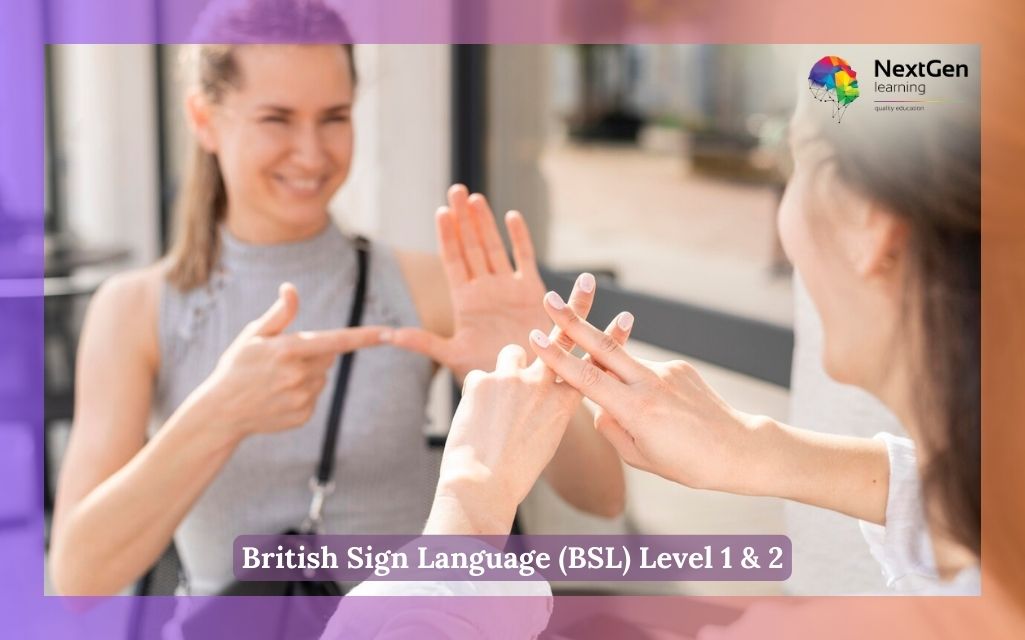
British Sign Language (BSL) Level 1 & 2 Course
0 responses on "What Is British Sign Language and Why Learn It?"