
Popular Courses

Brand
Awarding body image

Higher Level Teaching Assistant Course

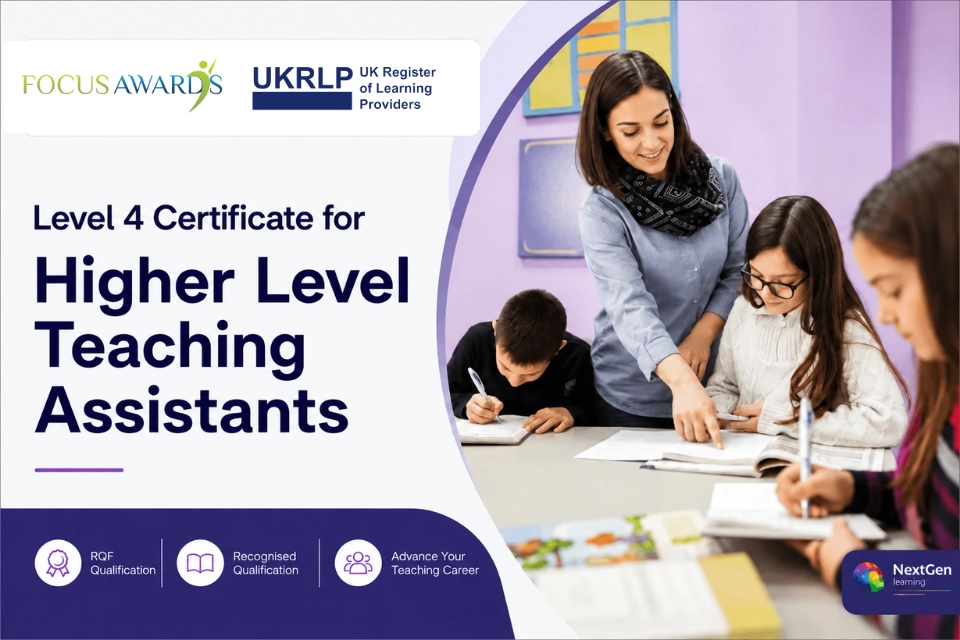
Focus Awards Level 4 Certificate for Higher Level Teaching Assistants (RQF)

Move forward in your teaching assistant career with a recognised, Ofqual-regulated Level 4 qualification.

The Focus Awards Level 4 Certificate for Higher Level Teaching Assistants (RQF) is designed for teaching assistants who are already working in a school and want to take on higher-level duties.

This regulated HLTA course helps you build the skills needed to lead learning activities, support pupils with special educational needs, manage behaviour and contribute to lesson planning and assessment.

You will also learn how to work closely with teachers, parents, carers and other education professionals.

The qualification is awarded by Focus Awards and regulated by Ofqual. This means it follows clear national standards for learning, assessment and quality.

Unlike a general attendance or CPD certificate, this is a formal RQF qualification. It can help you show employers that your knowledge and workplace skills have been assessed against recognised Level 4 standards.

The course learning is delivered online, allowing you to study around your school role. However, this is also a workplace-based qualification. You must be working as a teaching assistant in a suitable school setting and complete practical evidence and observations.

By completing this course, you can build a stronger CV, show your commitment to professional development and prepare for higher-level classroom support responsibilities.

Qualification highlights

  • Awarding organisation: Focus Awards
  • Regulated by: Ofqual
  • Qualification level: Level 4
  • Qualification number: 601/8533/8
  • Qualification credits: 36
  • Mandatory units: 7
  • Guided Learning Hours: 108 hours
  • Total Qualification Time: 360 hours
  • Assessment method: Portfolio of evidence
  • Learning format: Flexible online study with workplace assessment
  • Entry requirement: You must be working as a teaching assistant in a school

Enrol with NextGen Learning and work towards a regulated qualification that can support your professional growth and help you demonstrate higher-level teaching assistant skills to employers.

Why choose an Ofqual-regulated HLTA qualification?

Ofqual regulates qualifications in England. It makes sure that regulated qualifications meet clear standards for quality, assessment and learner achievement.

The Regulated Qualifications Framework, also known as the RQF, shows the level and size of a qualification.

This course is set at Level 4, which reflects advanced knowledge and practical skills within a teaching assistant role.

Completing an Ofqual-regulated qualification can help you:

  • Add a recognised Level 4 qualification to your CV
  • Show employers that your learning has been formally assessed
  • Provide evidence of your knowledge and classroom practice
  • Support applications for higher-level teaching assistant roles
  • Prepare for more responsibility within your school
  • Show your commitment to continued professional development

The qualification does not guarantee a job, promotion or formal HLTA appointment. Schools and employers may have their own recruitment and assessment requirements.

However, it can provide strong evidence that you have developed the knowledge and workplace skills linked to higher-level teaching assistant duties.

Who is this HLTA course for?

This course is suitable for experienced teaching assistants who want to develop their skills and progress towards higher-level responsibilities.

It may be suitable for:

  • Teaching assistants working in primary schools
  • Teaching assistants working in secondary schools
  • Support staff working in special schools
  • Learning support assistants
  • SEN teaching assistants
  • Behaviour support assistants
  • Classroom support staff
  • Teaching assistants who lead small-group activities
  • Staff preparing for higher-level teaching assistant opportunities

You must already be working as a teaching assistant in a suitable school.

Your workplace should give you access to pupils aged five or above who are studying at Key Stage 1 or higher. You will need opportunities to show your practical skills and complete workplace observations.

This course is not suitable for someone who has no access to a school placement or teaching assistant role.

Key benefits of the Higher Level Teaching Assistant Course

Gain a recognised Level 4 qualification

Complete a formal RQF qualification awarded by Focus Awards and regulated by Ofqual.

You can use the qualification to show employers that you have completed assessed learning at Level 4.

Prepare for higher-level classroom duties

Build the confidence to support teachers, lead planned activities and work with individuals, small groups and larger classes.

You will explore how to organise learning, adapt resources and support pupils with different needs.

Support pupils with SEND

Learn how to support children and young people with special educational needs and disabilities.

You will cover learning difficulties, sensory needs, physical needs and English as an Additional Language.

Improve behaviour support skills

Understand how school policies, clear rules and fair boundaries can promote positive behaviour.

You will also learn how to respond to challenging behaviour, bullying and other concerns.

Develop your professional practice

Explore teamwork, communication, feedback and continuing professional development.

These skills can help you work more effectively with teachers, support staff, parents and carers.

Study flexibly online

Access course materials online and study around your work and personal commitments.

You can work through the theory at a pace that suits you while using your school role to gather practical evidence.

What you will learn

The course includes seven mandatory units. Each unit focuses on an important part of the Higher Level Teaching Assistant role.

Unit 1: Professional Knowledge and Development for Higher Level Teaching Assistants

Understand the purpose and responsibilities of a Higher Level Teaching Assistant.

You will learn about professional standards, continuing professional development and the value of feedback.

You will also explore teamwork, workplace collaboration and supporting the development of colleagues where appropriate.

Unit 2: Child Development and Wellbeing

Learn about the physical, social, emotional and intellectual stages of child development.

You will explore the personal and outside factors that can affect a child’s development and wellbeing.

This unit also covers:

  • The role of parents and carers
  • Development and wellbeing frameworks
  • Safeguarding laws, policies and procedures
  • Online and mobile phone risks
  • Common childhood illnesses
  • Accidents, emergencies and health and safety procedures

Unit 3: Supporting Children and Young People with Special Educational Needs

Develop your understanding of the SEND Code of Practice and disability legislation.

You will learn how to support pupils with:

  • Learning difficulties
  • Sensory needs
  • Physical needs
  • Disabilities
  • English as an Additional Language

The unit also explores equality, diversity, inclusion, discrimination and the use of assistive technology.

Unit 4: Promoting Positive Behaviour

Learn how schools promote positive behaviour through policies, routines, boundaries and clear expectations.

You will explore ways to encourage positive attitudes and respond to inappropriate or challenging behaviour.

You will also learn how to recognise triggers, deal with bullying and contribute to reviews of behaviour policies.

This unit includes workplace observation evidence.

Unit 5: Working with Individuals and Groups of Learners

Learn how to prepare, adapt and use learning resources for individual pupils and groups.

You will explore how to:

  • Select suitable learning support strategies
  • Meet health, safety and access needs
  • Balance the needs of individuals and groups
  • Assess pupil participation and progress
  • Provide helpful feedback
  • Review your own knowledge and practice

Unit 6: Positive Working Relationships

Build effective and professional relationships with children, young people, colleagues, parents and carers.

You will learn how to communicate with care and respect while supporting collaborative working within the school.

This unit includes workplace observation evidence.

Unit 7: Curriculum Planning, Monitoring, Delivery and Assessment

Develop the skills needed to support well-organised and challenging learning activities.

You will learn how to:

  • Choose suitable teaching strategies
  • Support literacy and numeracy
  • Use ICT to improve learning
  • Set clear learning objectives
  • Adapt teaching to different ages and abilities
  • Manage individual, group and whole-class learning
  • Monitor progress and attainment
  • Provide constructive feedback
  • Maintain and review learner records

This unit also includes workplace observation evidence.

How is the qualification assessed?

There are no traditional classroom examinations listed for this qualification.

You will be assessed through a portfolio of evidence. Your portfolio must show that you have met the learning outcomes and assessment criteria for all seven units.

Your evidence may include:

  • Written assignments
  • Projects and reports
  • Worksheets
  • Assessor observations
  • Witness statements
  • Examples of work you have produced
  • Records of written or spoken questions
  • Learner and peer reports
  • Evidence from your current teaching assistant role
  • Recognition of Prior Learning, where suitable

Some units require observation of your workplace practice. You must therefore have access to a suitable school setting.

Your assessor will review your work and provide feedback. You may need to improve or resubmit evidence if it does not fully meet the required standard.

This assessment method allows you to connect your learning with real classroom practice.

Entry requirements

To enrol, you must:

  • Be aged 16 or above
  • Be working as a teaching assistant in a school
  • Work with pupils aged five or above
  • Have access to Key Stage 1 learners or above
  • Be able to complete workplace observations
  • Have suitable English skills for Level 4 study
  • Have access to the internet and a suitable device

Your school may be a primary, secondary or special school.

You should speak to NextGen Learning before enrolling if you are unsure whether your workplace meets the assessment requirements.

How this qualification can support your career

Schools need skilled support staff who can work with pupils, support teachers and help improve learning.

This qualification can help you show that you have developed advanced knowledge in areas that matter to education employers.

These include:

  • Supporting pupil progress
  • Leading planned learning activities
  • Supporting children with SEND
  • Promoting positive behaviour
  • Adapting classroom resources
  • Monitoring learning
  • Giving constructive feedback
  • Working with parents and professionals
  • Following safeguarding procedures
  • Supporting inclusive education

You can include the full qualification title and awarding organisation on your CV after successful completion.

You can also use your assessed portfolio and workplace experience to discuss your professional development with your current employer.

Pay and job titles vary between schools, local authorities and regions. Some positions are also advertised using term-time salaries rather than full-time annual figures.

The qualification can strengthen your evidence for progression, but employment and promotion decisions remain with individual schools.

Progression opportunities

After completing the Level 4 Certificate for Higher Level Teaching Assistants, you may wish to apply for higher-level support roles or continue your education.

Possible progression routes may include:

  • Higher Level Teaching Assistant roles
  • Senior teaching assistant positions
  • Specialist SEND support roles
  • Pastoral or behaviour support roles
  • Focus Awards Level 3 Award in Education and Training
  • Focus Awards Level 4 Certificate in Education and Training
  • Focus Awards Level 5 Diploma in Education and Training

The right route will depend on your experience, career plans and the entry requirements of the next qualification.

Study with NextGen Learning

NextGen Learning gives you the flexibility to complete the course alongside your school role.

You will receive access to structured learning materials that support all seven mandatory units.

Course resources include:

  • Detailed online lessons
  • Assignment preparation guidance
  • Referencing guidance
  • Observation guidance
  • Unit assignments
  • Observation checklists
  • Assignment submission support
  • Tutor and assessor guidance

You can apply what you learn directly within your workplace and build evidence of your professional practice.

Take the next step in your teaching assistant career

Turn your school experience into a recognised Level 4 achievement.

The Focus Awards Level 4 Certificate for Higher Level Teaching Assistants (RQF) can help you develop advanced classroom skills, demonstrate assessed learning and prepare for greater responsibility.

With Ofqual regulation, flexible online study and practical workplace assessment, this course gives you a clear route to professional growth.

Enrol with NextGen Learning today and start working towards a qualification that can strengthen your CV and support your next career step.

Order Your Certificate

To order your Certificate, we kindly invite you to visit the following link

Frequently Asked Questions

It is an Ofqual-regulated RQF qualification for people who already work as teaching assistants.

The course develops advanced skills in child development, SEND, behaviour support, group learning, professional relationships and curriculum delivery.

Yes. The Focus Awards Level 4 Certificate for Higher Level Teaching Assistants is listed on Ofqual’s Register of Regulated Qualifications.

Its qualification number is 601/8533/8. (find-a-qualification.services.ofqual.gov.uk)

Focus Awards is the awarding organisation.

After you meet all assessment requirements and complete the quality-assurance process, the regulated qualification is awarded through Focus Awards.

NextGen Learning is an affiliate partner of Apex Learning.

Under this partnership, Apex Learning delivers the programme and assesses your work. Focus Awards remains the awarding organisation.

No.

The Level 4 Certificate supports progression towards HLTA status, but it does not automatically award formal HLTA status. You may need to complete a separate HLTA assessment against the national standards. (Focus Awards)

Yes.

You must be working in a school as a teaching assistant. You need access to a suitable workplace because the assessment includes practical evidence and observations. (Focus Awards)

Not unless you are already working as a teaching assistant in a suitable school setting.

This is a workplace-based qualification. A beginner who does not have school access should consider a lower-level or introductory teaching assistant course first.

Focus Awards does not set a Level 3 qualification as a formal entry requirement.

However, you must work as a teaching assistant, and the training provider must be satisfied that the Level 4 programme is suitable for you.

The learning materials, assignments and tutor communication are provided online.

However, you must also complete observations and gather evidence in your school. It is therefore best described as online learning with workplace-based assessment.

You will build a portfolio of evidence across all seven units.

Evidence may include assignments, observations, witness testimony, reports, worksheets, professional discussions and workplace products.

The official assessment method is a portfolio of evidence rather than a final written examination.

You must meet every learning outcome and assessment criterion to pass. (find-a-qualification.services.ofqual.gov.uk)

The qualification has 360 hours of Total Qualification Time, including 108 Guided Learning Hours.

Your actual completion time will depend on your experience, study schedule, workplace access and how quickly you complete the required evidence. (find-a-qualification.services.ofqual.gov.uk)

The qualification includes seven mandatory units worth a total of 36 credits.

You must pass all seven units to achieve the full certificate.

You will learn about:

  • The role of an HLTA
  • Professional development
  • Child development
  • Safeguarding
  • SEND support
  • Positive behaviour
  • Individual and group learning
  • Communication
  • Curriculum planning
  • ICT in learning
  • Assessment and feedback
  • Progress monitoring

It can strengthen your CV and provide formal evidence of assessed Level 4 learning.

It may support applications for roles with greater classroom responsibility. However, each school sets its own entry requirements, and the qualification does not guarantee employment or formal HLTA status.

It may help you show your employer that you have developed advanced knowledge and workplace skills.

Promotion and pay decisions depend on your employer, role, experience, responsibilities and local pay arrangements. No course can guarantee a promotion or salary increase.

No.

The Level 4 Certificate is a teaching-support qualification. It does not provide Qualified Teacher Status and does not qualify you to work as a school teacher without the required teacher-training route.

After successfully passing all seven units and completing the required quality-assurance process, you will receive the Focus Awards Level 4 Certificate for Higher Level Teaching Assistants (RQF).

It is an Ofqual-regulated qualification listed on the official Register of Regulated Qualifications.

This allows employers to verify its level, awarding organisation, credit value and assessment method. Employers still decide which qualifications and experience they require for each vacancy.

Possible progression routes include regulated education and training qualifications at Levels 3, 4 and 5.

The best route will depend on whether you want to continue in teaching support, move into training or work towards a teaching role.

Course Curriculum

Getting Started with the Course
Getting Started With the Course 00:06:00
Induction Form
Induction Form 00:00:00
Registration Entry Form
Registration Entry Form 00:00:00
Qualifications Specifications
Focus Awards Level 4 Certificate for Higher Level Teaching Assistants (quals) 00:51:00
Assignment Preparation Guideline
Assignment Preparation Guideline 00:09:00
Beginners Guide to Referencing 00:15:00
Guideline for Observation
Guideline for the Observation Session 00:03:00
Unit 01: Professional Knowledge and Development for Higher Level Teaching Assistants
Study Materials
Lo1: Understand What a Higher Level Teaching Assistant Is and What Is Required of a Higher Level Teaching Assistant
1. Purpose of a Higher Level Teaching Assistant 00:12:00
2. Role of a Higher Level Teaching Assistant 00:21:00
Lo2: Understand the Continuing Professional Development (Cpd) Requirements for Higher Level Teaching Assistants
1. Purpose of CPD and How it Affects Practice 00:18:00
2. Use of Advice and Feedback to Improve Performance 00:15:00
Lo3: Understand How to Work as a Team Member and Identify Opportunities for Working With Colleagues, Managing Their Work Where Appropriate and Sharing the Development of Effective Practice With Them
1. Importance of Team Work and Identifying Different Team Roles 00:15:00
2. Workplace Collaboration 00:15:00
3. Managing and Developing the Effective Practice of Appropriate Team Members 00:21:00
Assignment
HLTA Unit 01 00:03:00
Unit 02: Child Development and Well-being
Study Materials
Lo1: Know the Different Stages of Child Development
1. Stages of Physical, Social and Intellectual Development 00:57:00
Lo2: Know the Factors That Can Influence and Affect Children’s Development and How These Practice
1.External and Personal Factors that Affect Child Development 00:18:00
2.Theories to Support Development 00:33:00
3. Types of Changes That Affect a Child’s Development or Wellbeing 00:27:00
4. Referral Assessment of Special Educational Needs 00:24:00
Lo3: Understand How to Recognise and Respect the Contribution That Parents and Carers Can Make to the Development and Wellbeing of Children and Young People
1. Parents and Carers Contributions for the Development and Well-being of Children and Young People 00:42:00
Lo4: Understand How Frameworks That Support the Development and Wellbeing of Children and Young People Impact Upon Their Practice
1. Frameworks That Support Development and Well-being of Children 00:57:00
Lo5: Understand how to safeguard the wellbeing of children and young people
1. Current Legislation, Guidelines, Policies, and Procedures Affecting Safeguarding 00:39:00
2. Protecting Children within the Concept of Safeguarding Children and Young People 00:36:00
3. National and Local Safeguarding Policies and Procedures Affecting Everyday Work 00:27:00
4. Importance of Safeguarding Children and Young People 00:24:00
5. Policies and Procedures to Protect Children and Young People and Adults Who Work with Them 00:24:00
6. How Concerns Regarding Poor Practice Can be Reported 00:21:00
7. Supporting the Self-confidence and Self-esteem of Children and Young People 00:24:00
8. Risks and Possible Consequences of being Online and Using a Mobile Phone 00:21:00
Lo6: Understand health and safety procedures
1. Signs and Symptoms that Occur with Common Childhood Illnesses 00:24:00
2. Policies and Procedures in Response to Accidents, Incidents, Emergencies, and Illness 00:24:00
Assignment
HLTA Unit 02 00:06:00
Unit 03: Supporting Children and Young People with Special Educational Needs
Study Materials
Lo1: Understand How to Support Learners in Accessing the Curriculum in Accordance With the Special Educational Needs (Sen) Code of Practice and Disabilities Legislation
1. Legal Entitlement of Children and Young People with Special Educational Needs 00:33:00
Lo2: Understand How to Promote Promote Equality, Diversity and Inclusion When Working With Children and Young People
1. Legislation and Codes of Practice to Promote Equality and Diversity 00:21:00
2. Experience and Impact of Prejudice and Discrimination and Applying Principles of Equality, Diversity and Inclusion 00:33:00
Lo3: Understand How to Support Children and Young People With Learning Difficulties
1. Types of Special Educational Needs and Ways of Supporting Children and Young People with Learning Difficulties 00:39:00
Lo4: Know and Understand the Special Educational Needs for Learners With Sensory and/or Physical Needs
1. Effects of a Disability on Children and Young People 00:36:00
2. Nature of Sensory or Physical Needs and Roles and Responsibilities of Others and Assistive Technology 00:30:00
Lo5: Understand How to Support Children and Young People With English as an Additional Language
1. Language and Vocabulary Appropriate to the Age of the Learner, Level of Understanding and Proficiency 00:33:00
2. Ways of Introducing Words and Language Structures 00:42:00
Assignment
HLTA Unit 03 00:06:00
Unit 04: Promoting Childen and Young Peoples Positive Behaviour
Study Materials
Lo1: Understand the Policies and Procedures for Promoting Positive Behaviour
1. Policies and Procedures to Promote Positive Behaviour 00:21:00
2. Importance of Consistency and Fairness When Applying Boundaries and Rules for Behaviour 00:09:00
Lo2: Be Able to Promote the Positive Values and Attitudes and Behaviour Expected From Children and Young People
1. Promoting Positive Values, Attitudes and Behaviour 00:12:00
2. Ways of Establishing Ground Rules 00:12:00
3. Effective Strategies to Promote Positive Values, Attitudes and Behaviour 00:15:00
Lo3: Be Able to Respond to Inappropriate and Challenging Behaviour From Children and Young People
1. Patterns and Triggers of Challenging behaviour and Actions 00:21:00
2. Inappropriate and Challenging Behaviour Management 00:15:00
3. Supporting Children and Young People to Identify and Avoid Inappropriate Behaviour 00:09:00
4. How to Deal with Bullying, Harassment or Oppressive Behaviour 00:15:00
Lo4: Be Able to Contribute to Reviews of Behaviour and Behaviour Policies
1. Contributing to Reviews of Behaviour and Behaviour Policies 00:15:00
Observation Checklist
Observation Report – Unit 4 00:06:00
Assignment
HLTA Unit 04 00:06:00
Unit 05: Working with Individual and Groups of Learners
Study Materials
Lo1: Understand Working With Individuals and With Small Groups
1. Preparing the Resources Required for Planned Learning Activities 00:30:00
2. Developing and Adapting Resources to Meet the Needs of Individuals and Group 00:18:00
3. Learning Support Strategies to Meet the Needs of Individuals and Group 00:21:00
4. Health, Safety, Security and Access Requirements of the Learning Environment 00:36:00
5. Giving Attention to Learners for Balancing the Needs of Individuals and Group 00:21:00
6. Assessing Learners’ Participation and Progress in Activities 00:18:00
7. How to Provide Feedback Effectively 00:09:00
8. Evaluating How Own Knowledge, Understanding and Skills Impact on Practice of Individuals and Group 00:39:00
Assignment
HLTA Unit 05 00:03:00
Unit 06: Positive Working Relationships
Study Materials
Lo1: Communicate Effectively and Sensitively With Children, Young People, Colleagues, Parents and Carers
1. Effective Communication with Children and Colleagues 00:24:00
2. Communicating Effectively with Parents and Carers 00:27:00
3. Commitment to Collaborative and Cooperative Working with Colleagues 00:21:00
Observation Checklist
Observation Report – Unit 6 00:03:00
Assignment
HLTA Unit 06 00:02:00
Unit 07: Curriculum Planning, Monitoring, Delivery and Assesment
Study Materials
Lo1: Be Able to Teach Challenging, Wellorganised Lessons Across the Age and Ability Range
1. Teaching Strategies 00:15:00
2. Designing Opportunities for Learners to Develop Their literacy, Numeracy, ICT and Thinking and Learning Skills 00:30:00
3. How Learners’ Prior Knowledge and Attainment Enables Them to Meet Learning Objectives 00:12:00
4. Appropriate Language to Suit the Age and Ability of Learners 00:15:00
5. Management of Individual, Group and Whole-Class Learning 00:12:00
6. Appropriate Teaching to Suit the Stage of the Lesson and the Needs of the Learners 00:12:00
Lo2: Be Able to Use Ict Skills to Advance Learning
1. Opportunities for Using ICT to Support Pupils’ Learning and Its Impact 00:27:00
2. Encouraging Pupils to Use ICT to Solve Problems, Work Collaboratively and Find Out New Information 00:39:00
Lo3: Be Able to Use an Appropriate Range of Strategies for Setting Learning Objectives and Monitoring Progress and Attainment
1. Providing Constructive Feedback 00:18:00
2. Supporting and Guiding Learners 00:21:00
3. Using Assessment to Diagnose Learner’s Needs 00:09:00
Lo4: Be Able to Maintain and Analyse Records of Learners’ Progress
1. Monitoring Learners’ Learning Progress 00:30:00
Observation Checklist
Observation Report – Unit 7 00:06:00
Assignment
HLTA Unit 07 00:05:00
Assignment Submission Checklist
Assignment Submission Checklist 00:03:00
Submit Your Assignments – Level 4 Certificate for Higher Level Teaching Assistants
RQF Submit Your Assignment 00:00:00
Order Your Certificate
Order Your Certificate 00:00:00
Thank You For Choosing NextGen Learning
Thank You For Choosing NextGen Learning 00:00:00

Related Courses

No course found

A product of

© 2026 NextGen Learning. All rights reserved

Home Search Cart Offers
Select your currency
GBP Pound sterling