




How to Become a Health and Social Worker UK (Guide)
If you want to make a meaningful difference in people’s lives, becoming a health and social worker in the UK can be a powerful career choice. However, many aspiring professionals feel confused about the exact steps, qualifications and career pathways involved.
In reality, the route is clearer than most people think. You do not always need a university degree to start. Instead, there are multiple entry pathways, including diplomas, apprenticeships and vocational qualifications. Moreover, the sector offers strong job security, clear progression routes and growing demand across the UK.
Because the UK’s ageing population continues to expand, the need for skilled health and social care workers is increasing every year. As a result, employers actively recruit trained professionals for roles in the NHS, private care settings, community services and social support organisations.
In this complete step-by-step guide, you will learn:
- What a health and social worker actually does
- The qualifications you need in the UK
- Whether you can start without a degree
- Salary expectations and NHS pay bands
- Career progression opportunities
- The fastest route into the profession
By the end of this guide, you will clearly understand how to become a health and social worker in the UK and which pathway suits your goals best.
Table of Contents
What Does a Health and Social Worker Do?

A health and social worker supports individuals who need practical, emotional, or medical assistance in their daily lives. Although many people assume the role is purely medical, it actually combines care, safeguarding, communication and advocacy.
In the UK, health and social care workers assist vulnerable adults, children, individuals with disabilities and people experiencing mental health challenges. Therefore, the role requires both compassion and professional judgement. Moreover, workers must follow strict safeguarding and care standards to protect those at risk.
Importantly, responsibilities vary depending on the setting. For example, someone working in a residential care home will have different duties from someone supporting families in the community. However, the core objective remains the same: improve wellbeing and promote independence.
Core Responsibilities of a Health and Social Care Worker
Health and social care worker responsibilities in the UK typically include:
- Assess clients’ needs through structured conversations and observation
- Create personalised care plans based on physical and emotional requirements
- Support daily living activities such as washing, dressing and mobility
- Administer or assist with medication under supervision
- Safeguard vulnerable individuals from neglect or abuse
- Liaise with NHS professionals, social workers and family members
- Maintain accurate records and follow CQC compliance standards
- Encourage independence rather than long-term dependency
However, beyond these duties, strong communication skills are essential. Workers must build trust quickly. In addition, they must remain calm under pressure, especially when dealing with challenging behaviour or crisis situations.
Where Do Health and Social Workers Work?
The work environment depends on the specific career path. Nevertheless, most professionals operate in one of the following settings:
- NHS hospitals and clinics
- Residential care homes
- Assisted living facilities
- Community health services
- Schools and special education environments
- Mental health support centres
- Rehabilitation or addiction recovery centres
Consequently, the role can be physically demanding in some settings and emotionally demanding in others. Yet, many professionals describe the work as highly rewarding because they directly impact people’s quality of life.
Understanding these responsibilities is crucial before choosing this career path. Next, it is important to clarify a common confusion — the difference between a health and social care worker and a registered social worker in the UK.
Health and Social Worker vs Social Worker – What’s the Difference?
Many people confuse a health and social care worker with a registered social worker. Although both roles support vulnerable individuals, their qualifications, responsibilities and regulatory requirements differ significantly.
Understanding this distinction is essential before choosing your career path. Otherwise, you may pursue the wrong qualification route.
Health and Social Care Worker
A health and social care worker typically provides practical, day-to-day support. These professionals focus on personal care, wellbeing and assisting individuals in maintaining independence.
In most cases, you can enter this field with:
- Level 2 or Level 3 Diploma in Health and Social Care
- NVQ qualifications
- A health and social care apprenticeship
- Relevant vocational training
Moreover, you do not always need a university degree to begin working in this role. Many employers prioritise practical skills, safeguarding knowledge and a DBS check.
Typical job titles include:
- Care Assistant
- Support Worker
- Healthcare Assistant
- Residential Care Worker
- Community Care Worker
Registered Social Worker
In contrast, a registered social worker holds a degree in social work and must register with Social Work England (or the relevant regulatory body in Scotland, Wales or Northern Ireland).
Registered social workers:
- Conduct statutory assessments
- Make legal safeguarding decisions
- Work within child protection frameworks
- Handle complex case management
- Enforce certain legal duties
Importantly, becoming a registered social worker requires:
- A BA or MA in Social Work
- Completion of supervised placements
- Registration with the regulatory body
- Continuous professional development
Key Differences at a Glance
Health and Social Care Worker:
- Focuses on direct care and support
- Can start with Level 2 or Level 3 qualification
- Works in care homes, NHS settings, community support
- Does not require mandatory university degree
Registered Social Worker:
- Focuses on statutory and legal casework
- Requires a recognised social work degree
- Must register with a regulatory body
- Handles complex safeguarding cases
Therefore, if your goal is to start working quickly in the sector, the health and social care worker route offers a faster and more flexible entry point. However, if you aim to work in child protection or statutory safeguarding, you will need to pursue the registered social worker pathway.
Now that the difference is clear, let’s explore exactly what qualifications you need to become a health and social worker in the UK.
What Qualifications Do You Need to Become a Health and Social Worker in the UK?
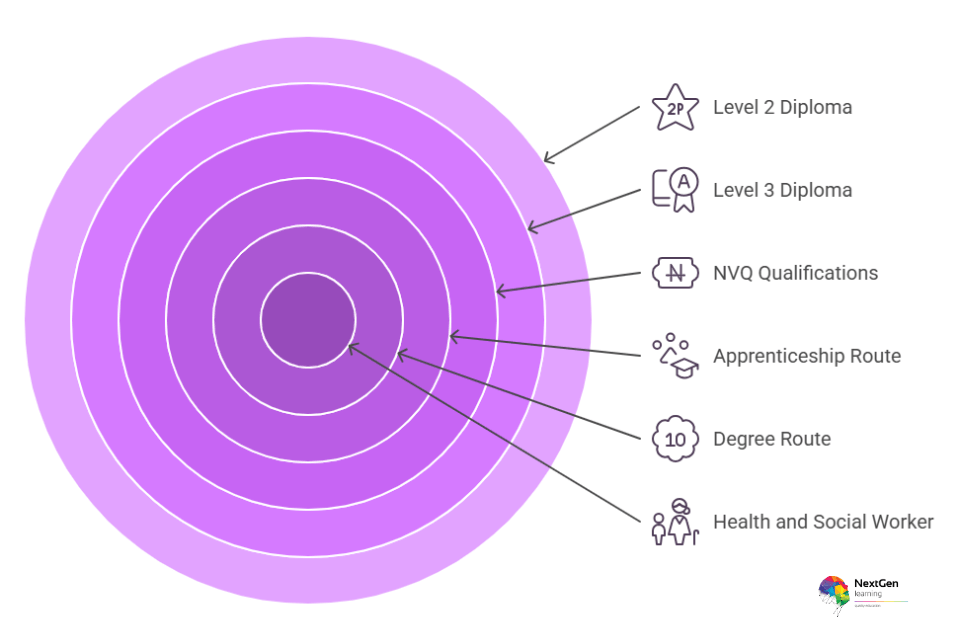
To become a health and social worker in the UK, you need recognised qualifications, practical training and essential safeguarding knowledge. However, the exact route depends on the level of responsibility you aim to take on.
Importantly, you do not always need a university degree. In fact, many professionals enter the sector through vocational pathways. Therefore, understanding your options will help you choose the fastest and most suitable route.
1️⃣ Level 2 Diploma in Health and Social Care
If you are new to the sector, the Level 2 Diploma in Health and Social Care provides a strong foundation. It introduces core principles, including safeguarding, duty of care, communication and equality legislation.
This qualification typically covers:
- Principles of care and support
- Safeguarding vulnerable adults and children
- Health and safety standards
- Infection prevention and control
- Communication in care settings
Consequently, Level 2 is ideal for entry-level roles such as Care Assistant or Support Worker.
2️⃣ Level 3 Diploma in Health and Social Care
If you want to progress faster or take on more responsibility, the Level 3 Diploma offers advanced knowledge. Moreover, many employers prefer Level 3 for senior care positions.
Level 3 usually includes:
- Risk assessment and care planning
- Mental health awareness
- Person-centred care approaches
- Understanding UK care legislation
- Supervisory responsibilities
As a result, this qualification improves your promotion prospects and earning potential.
3️⃣ NVQ Qualifications
NVQ Level 2 or Level 3 in Health and Social Care remains a recognised vocational route. These qualifications focus heavily on workplace assessment. Therefore, they suit individuals already employed in care roles.
4️⃣ Apprenticeship Route
A health and social care apprenticeship combines paid employment with structured learning. Importantly, this option allows you to gain experience while earning a salary.
Apprenticeships usually require:
- GCSEs in English and Maths (Grade 4/C or above)
- Commitment to both study and work
- Completion of on-the-job assessments
Because of this structure, apprenticeships are highly practical and employer-focused.
5️⃣ Degree Route (Optional for Care Workers)
If you aim to become a registered social worker or move into management, you may pursue a degree in social work or health and social care. However, for standard care worker roles, a degree is not mandatory.
Essential Additional Requirements
Regardless of your qualification route, most employers require:
- Enhanced DBS check
- Right to work in the UK
- Basic literacy and numeracy skills
- Understanding of UK safeguarding standards
- Completion of the Care Certificate during employment
The Care Certificate plays a crucial role in UK care settings. It ensures that new staff meet minimum safety and quality standards aligned with Care Quality Commission (CQC) requirements.
Therefore, choosing the right qualification depends on your career ambition. If you want quick entry, Level 2 or apprenticeship works well. However, if you aim for leadership or specialised roles, Level 3 or further study provides stronger progression.
Not Sure Which Care Training Route Fits You?
Different care courses serve different learning goals. Health and Social Care Level 3 focuses on broader care-sector knowledge, Nursing Assistant training is more patient-facing, while Care Certificate training focuses on the core standards used in care settings.
If you are still deciding which route matches your goals, compare the options in our Best Health and Social Care Courses UK guide before choosing your next step.
Step-by-Step: How to Become a Health and Social Worker in the UK
Now that you understand the qualification options, let’s break the process down clearly. Although the pathway may seem complex at first, it becomes straightforward when you follow structured steps.
Step 1: Choose Your Entry Route
First, decide how you want to enter the sector. Your choice will depend on your current education level, finances and career goals.
You can begin through:
- Level 2 Diploma in Health and Social Care
- Level 3 Diploma for faster progression
- Health and Social Care apprenticeship
- NVQ pathway if already employed
- Degree route (if aiming for registered social worker status)
If you want the fastest route into employment, Level 2 or an apprenticeship usually works best. However, if long-term progression matters to you, starting with Level 3 can give you an advantage.
Step 2: Complete Your Qualification
Once enrolled, focus on gaining both theoretical knowledge and practical understanding. Most recognised health and social care courses cover:
- Safeguarding legislation
- Health and Social Care Act principles
- Person-centred care planning
- Infection prevention
- Equality and diversity
- Communication skills
Importantly, employers value applied knowledge. Therefore, try to connect your coursework to real-life scenarios.
If your goal is to build broader knowledge across safeguarding, communication, person-centred care, equality, health and safety, and professional responsibilities, you can also review our Level 3 Health and Social Care course to see whether its curriculum matches your learning goals.
Step 3: Gain Practical Experience
Experience significantly strengthens your employability. Even if your course is online, you can gain exposure by:
- Volunteering in care homes
- Assisting in community centres
- Shadowing healthcare assistants
- Taking part-time support roles
Moreover, apprenticeships naturally provide workplace experience, which can fast-track employment opportunities.
Step 4: Apply for an Enhanced DBS Check
Before working with vulnerable individuals, you must complete an enhanced Disclosure and Barring Service (DBS) check. This ensures you meet safeguarding standards.
Most employers will guide you through this process. However, it is essential to understand that you cannot work in regulated care settings without clearance.
Step 5: Complete the Care Certificate (If Required)
Many UK employers require new staff to complete the Care Certificate within their first 12 weeks of employment. This framework aligns with national care standards and supports compliance with Care Quality Commission (CQC) expectations.
The Care Certificate ensures you understand:
- Duty of care
- Safeguarding adults and children
- Infection control
- Handling information securely
- Basic life support
Consequently, it strengthens your professional credibility.
Step 6: Start Applying for Jobs
Once qualified and DBS-cleared, you can apply for roles such as:
- Care Assistant
- Support Worker
- Healthcare Assistant
- Residential Care Worker
- Community Support Worker
You can search for vacancies through:
- NHS Jobs portal
- Local authority websites
- Private care providers
- Recruitment agencies
- Professional networking platforms
At this stage, tailor your CV to highlight safeguarding knowledge, communication skills and practical training. Employers prioritise reliability and empathy as much as qualifications.
Can You Become a Health and Social Worker Without a Degree?
Yes, you can become a health and social worker in the UK without a university degree. In fact, many professionals enter the sector through vocational qualifications rather than academic routes.
Although a degree is required to become a registered social worker, it is not mandatory for most health and social care worker roles. Therefore, if your goal is to work as a Care Assistant, Support Worker, or Healthcare Assistant, you can start much sooner.
Alternative Routes Without University
If you prefer a non-academic pathway, consider the following options:
- Level 2 Diploma in Health and Social Care
- Level 3 Diploma for supervisory progression
- NVQ Level 2 or Level 3
- Health and Social Care apprenticeship
- Employer-based training with Care Certificate completion
These routes focus on practical competence. As a result, you gain hands-on skills that employers value immediately.
Why Employers Accept Non-Degree Routes
In care settings, practical ability often matters more than theoretical study. Employers prioritise:
- Safeguarding awareness
- Communication skills
- Reliability and professionalism
- Ability to follow care plans
- Compassion and emotional resilience
Moreover, the sector faces ongoing staff shortages across the UK. Consequently, qualified diploma holders are in steady demand.
When a Degree Becomes Necessary
However, if you aim to:
- Work in statutory child protection
- Make legal safeguarding decisions
- Become a registered social worker
- Move into senior policy roles
Then you must complete a recognised degree and register with Social Work England (or the relevant national body).
The Practical Reality
For most entry-level and mid-level care roles, you can:
- Qualify within 6–18 months
- Begin earning while training (via apprenticeship)
- Progress internally to senior care roles
- Later pursue higher qualifications if desired
Therefore, a degree is optional, not essential, for starting a health and social care career in the UK.
Salary Expectations for Health and Social Workers in the UK

Salary is one of the most common concerns for aspiring professionals. Although health and social care salaries vary depending on role, location and employer, the sector offers stable earning potential with clear progression routes.
Importantly, pay differs between NHS roles and private care providers. Therefore, understanding the structure will help you plan realistically.
Entry-Level Salary (Care Assistant / Support Worker)
Most entry-level health and social care workers earn:
- £20,000 – £24,000 per year
- £10.50 – £12.50 per hour (depending on region)
In NHS settings, Healthcare Assistants typically fall under:
- Band 2: Around £22,000 per year
- Band 3: Around £24,000–£25,000 per year
These bands follow the national NHS pay scale. As a result, NHS roles often provide structured increments and pension benefits.
Mid-Level Roles (Senior Care Worker / Team Leader)
With experience and a Level 3 qualification, salaries usually increase to:
- £25,000 – £30,000 per year
- Higher hourly rates for specialist support roles
Moreover, supervisory responsibilities can boost earning potential significantly.
Registered Social Worker Salary
If you pursue the degree pathway and register with Social Work England, salary ranges increase substantially.
Typical earnings include:
- Newly qualified: £30,000 – £34,000
- Experienced: £35,000 – £45,000
- Senior / Specialist roles: £45,000+
However, these roles involve statutory responsibilities and higher workload pressure.
Factors That Influence Salary
Several factors directly impact earnings:
- Geographic location (London weighting increases pay)
- NHS vs private sector
- Level of qualification
- Years of experience
- Specialist training (mental health, safeguarding, dementia care)
- Shift patterns (night shifts and weekends pay more)
Consequently, improving your qualifications and gaining experience directly increases your earning capacity.
Long-Term Earning Potential
Although starting salaries may seem modest, the sector offers:
- Predictable pay progression
- Overtime opportunities
- Career advancement pathways
- Pension schemes (especially in NHS roles)
- High job stability
Therefore, health and social care provides long-term security rather than rapid high-income growth.
Career Progression Pathway in Health and Social Care
One of the strongest advantages of working in health and social care is the clear progression structure. Although many people start in entry-level roles, the sector rewards experience, additional training and leadership skills.
Therefore, your career does not remain static. Instead, you can steadily move into higher-paying and more specialised positions.
Typical Career Ladder
Most professionals follow a structured pathway similar to this:
- Care Assistant / Support Worker
- Senior Care Worker
- Team Leader or Supervisor
- Deputy Care Manager
- Registered Care Manager
- Specialist Practitioner (e.g., Mental Health, Dementia Care)
- Registered Social Worker (with degree qualification)
Each step usually requires either experience, a Level 3 qualification, or further professional development.
How to Progress Faster
If you want to accelerate your career, focus on:
- Completing a Level 3 Diploma
- Gaining supervisory experience
- Developing safeguarding expertise
- Specialising in high-demand areas such as mental health or disability care
- Demonstrating leadership and communication skills
- Pursuing management training
Moreover, employers value reliability and initiative. Therefore, volunteering for additional responsibilities often leads to promotion opportunities.
Specialist Career Options
As the UK population ages, demand continues to rise in specialist fields. Consequently, you can move into areas such as:
- Dementia care
- Child protection support
- Learning disability services
- Mental health support
- Palliative and end-of-life care
- Community rehabilitation
Specialist roles often offer higher salaries and more responsibility.
Transitioning Into Social Work
Some professionals later choose to pursue a university degree to become registered social workers. In that case, you must complete a recognised social work degree and register with Social Work England.
However, many individuals build long-term careers in care management without becoming registered social workers. Therefore, progression does not always require returning to university.
Long-Term Stability
Importantly, health and social care offers:
- Strong job security
- Consistent demand nationwide
- Opportunities across NHS and private sectors
- Clear advancement routes
Because the sector supports vulnerable populations, demand remains steady even during economic downturns.
Work Environment and Daily Challenges in Health and Social Care
Before choosing this career, it is important to understand the realities of the work environment. Although health and social care can be deeply rewarding, it also requires resilience, professionalism and emotional strength.
The environment depends on your specific role. However, most health and social care workers operate in structured, regulated settings where safeguarding and compliance standards are strictly enforced.
Common Work Settings in the UK
Health and social care professionals typically work in:
- NHS hospitals and community clinics
- Residential and nursing care homes
- Assisted living facilities
- Supported accommodation services
- Schools and special education settings
- Mental health units
- Rehabilitation centres
Because each setting serves different client groups, daily responsibilities vary significantly. For example, hospital-based roles may involve mobility assistance and clinical support, whereas community roles may focus more on emotional support and independence planning.
What a Typical Day May Involve
Although no two days are identical, you may:
- Assist individuals with personal care routines
- Support medication administration (under supervision)
- Update care plans and maintain records
- Attend safeguarding briefings
- Liaise with nurses, GPs, or social workers
- Provide emotional reassurance to clients and families
- Respond to unexpected behavioural or health changes
Therefore, adaptability becomes essential.
Physical and Emotional Demands
This profession can be physically demanding. For instance, you may assist with lifting or supporting mobility. Moreover, shift work often includes evenings, weekends, and nights.
Emotionally, the role can also be challenging. You may work with:
- Individuals experiencing mental health crises
- Families under stress
- Vulnerable adults at risk of neglect
- Clients nearing end-of-life care
However, employers provide supervision and support frameworks aligned with Care Quality Commission (CQC) standards. Consequently, structured guidance helps professionals manage pressure effectively.
Why Many Professionals Stay in the Sector
Despite the challenges, many workers remain in health and social care long-term because:
- The work feels meaningful and impactful
- Career progression is clear
- Demand ensures job security
- Professional development is encouraged
- Team environments foster strong support networks
Ultimately, this is a career built on purpose. While it requires resilience, it offers deep personal and professional fulfilment.
Frequently Asked Questions (FAQs)
Level 2 takes 6–12 months, Level 3 takes 12–18 months, apprenticeships take 1–2 years and a social work degree takes 2–3 years. You can enter entry-level roles within a year via diploma or apprenticeship routes.
Most Level 2 courses do not require GCSEs. However, apprenticeships usually require English and Maths at Grade 4 (C) or above. Employers expect basic literacy and numeracy skills.
Yes. Many NHS Healthcare Assistant roles accept Level 2 or Level 3 qualifications. Entry roles typically fall under Band 2 or Band 3, offering structured pay progression and pension benefits.
Yes. It offers strong job security, nationwide demand, clear progression pathways, NHS and private sector opportunities and meaningful work supporting vulnerable individuals.
A care worker provides daily support and can qualify through vocational training. A social worker must complete a recognised degree and register with Social Work England to practise statutory duties.
Final Thoughts: Is This the Right Career for You?
Becoming a health and social worker in the UK is not just about qualifications. It is about commitment, empathy and resilience. Although the role can be demanding, it offers purpose-driven work and long-term stability.
Importantly, you do not always need a university degree to begin. Instead, vocational routes such as Level 2 or Level 3 Diplomas provide accessible entry points into the sector. Moreover, progression opportunities remain open if you later decide to specialise or pursue further study.
If you want a career that combines stability, growth and real human impact, health and social care remains one of the most reliable sectors in the UK today.
Choosing the Right Training for Your Next Step
If you have decided that health and social care interests you but are still unsure which type of training fits your goal, start with our Best Health and Social Care Courses UK comparison. It compares broader Health and Social Care Level 3 training, Nursing Assistant training and Care Certificate learning side by side.
If broader care-sector knowledge is already your priority, you can review the curriculum, study format and course details for our Level 3 Health and Social Care course.


0 responses on "How to Become a Health and Social Worker UK (Guide)"