





Venezuela’s Oil, U.S. Sanctions, and Strategy: The Political Economy Linking Caracas to Washington
Venezuela oil has long played a central role in shaping the country’s economy, its political system, and its relationship with global powers. Over the decades, the Venezuelan oil industry transformed Venezuela into a major energy producer; however, political instability, economic mismanagement, and external pressure have significantly altered this trajectory. As a result, Venezuela oil production has declined sharply, while Venezuela oil exports have become increasingly politicised. At the same time, U.S. sanctions on Venezuela have emerged as a critical instrument of foreign policy, directly influencing how oil is produced, traded, and financed. Consequently, US-Venezuela oil relations now reflect a complex mix of strategic interests, economic leverage, and geopolitical rivalry. Therefore, analysing Venezuela oil through a political economy lens helps explain not only domestic outcomes but also broader U.S. strategy linking Caracas to Washington.
Table of Contents
Why Does Venezuela’s Oil Still Shape U.S. Strategy Today?
Venezuela oil has long been central to global energy markets, yet it also lies at the heart of geopolitical strategy and economic power. Over time, the country’s oil resources has influenced diplomacy, conflict, and policy choices far beyond Latin America. Consequently, the relationship between Venezuela oil and U.S. sanctions on Venezuela has become one of the most debated issues in international politics. Moreover, the Venezuelan oil industry continues to shape US-Venezuela oil relations, even as production levels fluctuate and political tensions persist. Therefore, understanding Venezuela oil production and Venezuela oil exports is essential for grasping why Washington remains deeply engaged with Caracas today.
How Venezuela Oil Became the Foundation of the National Economy
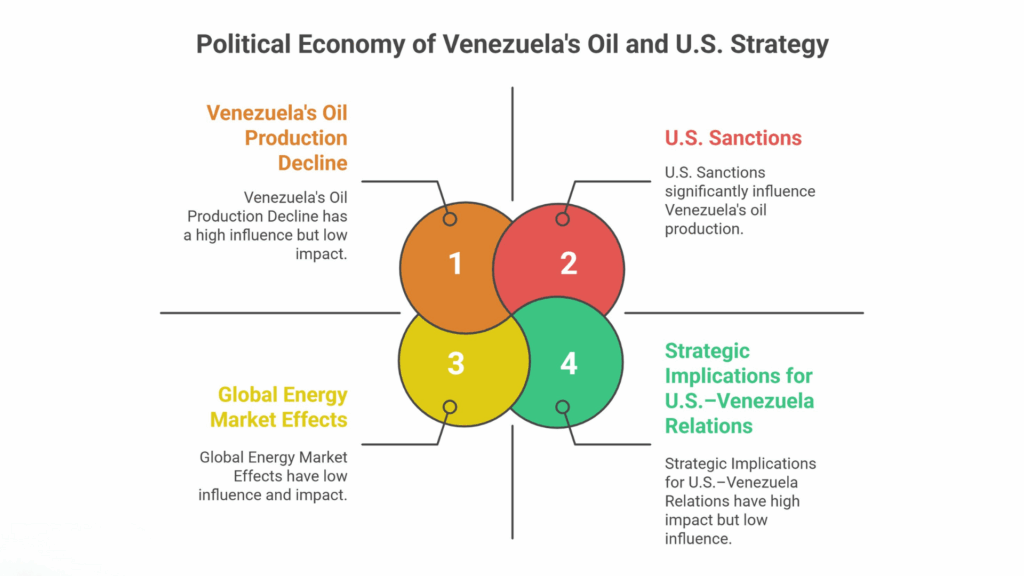
Historically, Venezuela oil transformed the country into one of the world’s most resource-dependent economies. As oil revenues expanded, the state increasingly relied on the Venezuelan oil industry to fund public services and political authority. Consequently, the country’s oil resources production became not just an economic activity but a pillar of governance. However, while Venezuela oil generated wealth, it also discouraged diversification. As a result, the country’s oil resources exports dominated the economy, leaving the country vulnerable to price shocks and political mismanagement. Therefore, the country’s oil resources became both a source of power and long-term fragility.
What Caused the Rise and Collapse of the Venezuelan Oil Industry?
Initially, the Venezuelan oil industry grew rapidly due to foreign investment and strong state control. Nevertheless, over time, political interference weakened institutional capacity. Moreover, mismanagement, corruption, and underinvestment gradually undermined the country’s oil resources production. As U.S. sanctions on Venezuela intensified, access to technology and capital declined further. Consequently, Venezuela oil exports fell sharply, reinforcing economic collapse. Thus, the decline of the Venezuelan oil industry cannot be explained by markets alone; rather, it reflects political decisions embedded in the political economy of the state.
Why Output Has Fallen and Recovery Remains Uncertain
Venezuela oil production has dropped dramatically over the past decade. While infrastructure decay is a key factor, political constraints have played an equally important role. For example, U.S. sanctions on Venezuela limited access to financial markets, while skilled labour left the country. Furthermore, inconsistent policy frameworks discouraged long-term investment. Consequently, Venezuela oil production recovery remains uncertain. Although the country’s oil resources reserves are vast, rebuilding production requires political stability, regulatory reform, and international engagement. Therefore, the country’s oil resources production is ultimately a political challenge, not merely a technical one.
Why Did the U.S. Impose Sanctions on Venezuela?
U.S. sanctions on Venezuela were introduced to pressure political leadership and influence domestic governance. However, sanctions also became a strategic tool affecting the country’s oil resources flows. By restricting oil transactions, U.S. sanctions on Venezuela directly targeted the country’s primary revenue source. Moreover, these measures reshaped US-Venezuela oil relations by limiting formal cooperation. Consequently, Venezuela oil exports declined, while informal and alternative trade routes expanded. Therefore, U.S. sanctions on Venezuela illustrate how economic policy is used to pursue political objectives.
Understanding these dynamics often requires a structured analytical framework. For readers analysing sanctions, state behaviour, and power, Political Studies provides essential tools for explaining how governments design and justify coercive policies within international systems.
How the U.S. Sanctions on Venezuela Affected the Oil Sector?
The impact of U.S. sanctions on Venezuela has been profound. Venezuela oil production slowed as spare parts and financing became scarce. Meanwhile, the country’s oil resources exports shifted toward opaque markets, increasing inefficiency. Additionally, the Venezuelan oil industry struggled to maintain operational standards. As a result, US-Venezuela oil relations became increasingly transactional and conditional. Therefore, U.S. sanctions on Venezuela not only constrained economic activity but also restructured the entire oil sector around survival rather than growth.
Shifting Trade Routes and Global Energy Implications
Despite restrictions, Venezuela oil exports continue to reach global markets. However, export destinations have changed significantly.In recent years, Venezuela oil exports have become increasingly shaped by sanctions, alternative buyers, and geopolitical negotiations. Previously, the country’s oil resources flowed heavily to the United States, strengthening US-the country’s oil resources relations. Today, alternative buyers dominate, altering geopolitical alignments. Moreover, the country’s oil resources exports affect global supply dynamics, particularly during periods of market volatility. Consequently, the country’s oil resources remains strategically relevant, even at reduced production levels. Therefore, the country’s oil resources exports link domestic policy decisions to international energy security.
What Defines US-Venezuela Oil Relations and Strategic Negotiations?
US-Venezuela oil relations have oscillated between cooperation and confrontation. On one hand, the country’s oil resources historically supported U.S. energy security. On the other hand, political disagreements led to U.S. sanctions on Venezuela and diplomatic isolation. Nevertheless, pragmatic considerations occasionally reopen dialogue. Consequently, US-Venezuela oil relations remain fluid, shaped by global energy needs and strategic calculations. Thus, the country’s oil resources continues to function as both leverage and liability in bilateral relations.
To understand this interaction fully, many analysts rely on International Relations and Political Economy, which explains how strategic interests and economic resources intersect in foreign policy decision-making.

Is the U.S. Using Economic Warfare Against Venezuela Beyond Sanctions?
Some observers argue that U.S. sanctions on Venezuela constitute a form of economic warfare. While military force has not been used directly, economic pressure has constrained Venezuela oil production and the country’s oil resources exports. Moreover, financial isolation magnified domestic economic stress. Consequently, debates about economic warfare reflect broader questions about legitimacy and effectiveness. Therefore, the country’s oil resources sits at the centre of a wider discussion on coercive power in international politics.
Does the U.S. Still Pursue Regime Change in Venezuela Through Oil Policy?
Regime change has often been associated with U.S. foreign policy debates. In the Venezuelan case, U.S. sanctions on Venezuela and control over Venezuela oil transactions fuel such perceptions. However, policy objectives have evolved over time. While pressure remains, engagement strategies occasionally emerge. Consequently, Venezuela oil policy reflects both continuity and adaptation in U.S. strategy. Therefore, oil remains a tool through which political outcomes are indirectly pursued.
Has the U.S. Used Military Pressure to Secure Energy Interests in Venezuela?
Although speculation persists, direct military intervention linked to Venezuela oil has not occurred. Nevertheless, security signalling and regional military presence influence perceptions. Moreover, energy security considerations shape strategic planning. Consequently, discussions of military pressure often arise alongside debates on the country’s oil resources production and U.S. sanctions on Venezuela. Therefore, separating economic measures from security narratives remains essential for accurate analysis.
How Venezuela’s Oil Fits into the U.S. Competition with China and Russia
Venezuela oil also intersects with great-power competition. As U.S. sanctions on Venezuela limited engagement, China and Russia expanded involvement in the Venezuelan oil industry. Consequently, the country’s oil resources exports became part of broader geopolitical rivalry. Moreover, US-Venezuela oil relations now exist within a multipolar context. Therefore, the country’s oil resources plays a role in shaping global strategic balances beyond the Western Hemisphere.
This intersection of markets and power is central to International Relations and Political Economy, where oil politics are analysed as instruments of global influence rather than neutral commodities.
How Oil, Power, and State Control Shape Venezuela’s Political Economy
The political economy of Venezuela oil reveals how resource dependence influences governance. Control over Venezuela oil production grants political authority, while revenue volatility undermines stability. Furthermore, U.S. sanctions on Venezuela intensified these structural tensions. Consequently, the Venezuelan oil industry illustrates how economic resources reinforce state power while simultaneously exposing systemic weakness. For students and analysts, such cases are foundational in Political Studies and International Relations and Political Economy, where theory explains real-world outcomes.
What Does the Future Hold for Venezuela’s Oil and U.S. Strategy?
Looking ahead, Venezuela oil will remain central to strategic debates. Although the country’s oil resources production may recover gradually, political uncertainty persists. Moreover, U.S. sanctions on Venezuela continue to shape incentives and constraints. Consequently, US-Venezuela oil relations will likely remain conditional and strategic. Ultimately, the country’s oil resources exports, governance reform, and global energy transitions will determine future trajectories.
Conclusion: From Caracas to Washington
From Caracas to Washington, the country’s oil resources has shaped economic survival, political authority, and global strategy. The interaction between the Venezuelan oil industry, the country’s oil resources production, and U.S. sanctions on Venezuela demonstrates how power operates through markets. Moreover, US-Venezuela oil relations reveal the limits and possibilities of economic statecraft. For readers seeking deeper understanding, structured learning through Political Studies and International Relations and Political Economy provides the analytical tools needed to move beyond headlines and grasp the political economy shaping global affairs.
Frequently Asked Questions
Venezuela’s oil is important to U.S. foreign policy because it affects energy security, regional stability, and geopolitical influence in the Western Hemisphere. As a country with some of the world’s largest oil reserves, Venezuela plays a strategic role in global energy markets and diplomatic negotiations involving United States.
U.S. sanctions have reduced Venezuela’s oil production by limiting access to finance, technology, and international buyers. These restrictions disrupted operations at state-owned oil facilities and forced Venezuela to reroute exports through alternative markets, lowering output and increasing transaction costs across the oil sector.
Yes, Venezuela can still export oil, but under strict conditions. Exports often rely on limited licences, indirect trading routes, or partnerships with non-Western buyers. While sanctions restrict access to major markets, oil shipments continue through alternative channels, usually at discounted prices and with higher logistical and political risks.
China and Russia play key roles by providing investment, financing, and diplomatic backing to Venezuela’s oil sector. Their involvement helps Venezuela maintain exports despite sanctions and reflects broader geopolitical competition, where energy resources are used to expand global influence and strategic partnerships.
U.S.–Venezuela oil relations may change depending on political reforms, sanctions policy, and global energy demand. Temporary easing of restrictions has occurred during periods of market volatility, but long-term change will likely depend on domestic political developments in Venezuela and shifting U.S. strategic priorities.

0 responses on "Venezuela’s Oil, U.S. Sanctions, and Strategy: The Political Economy Linking Caracas to Washington"