





FIFA World Cup History: Winners, Records and Greatest Moments
The FIFA World Cup is more than a football tournament. It is one of the most watched sporting events on the planet, bringing together nations, cultures and generations through a shared passion for the game. Since its debut in 1930, the competition has produced legendary players, unforgettable matches and moments that have shaped football history.
Over the decades, the World Cup has evolved from a small tournament featuring just 13 teams into a global spectacle watched by billions. Moreover, it has provided a stage for icons such as Pelé, Diego Maradona, Zinedine Zidane, Ronaldo and Lionel Messi to leave their mark on the sport. From dramatic upsets and record-breaking performances to controversial decisions and historic victories, every edition has added a new chapter to football’s greatest story.
In this guide, you will discover how the FIFA World Cup began, the most memorable moments in its history, the nations that have dominated the competition, the records that still stand today and how the tournament continues to evolve for future generations.
Table of Contents
What Is the FIFA World Cup?

The FIFA World Cup is an international football tournament contested by men’s national teams. FIFA organises the competition every four years, and the winning team becomes the world champion of football.
Importantly, the World Cup is not just about one final match. It includes years of qualification, regional competition and a final tournament where the best national teams compete for the trophy. As a result, it brings together elite players from different leagues, countries and football cultures.
Unlike club football, the World Cup focuses on national pride. Therefore, each match carries emotional weight for players and supporters. For many fans, it is the highest stage in football because it combines sporting excellence, history and global identity.
Key facts:
- Organiser: FIFA
- First tournament: 1930
- First winner: Uruguay
- Format: Held every four years
- Current champion: Argentina
- Most titles: Brazil, with five World Cup wins
The Origins of the FIFA World Cup

Before the FIFA World Cup existed, international football competitions were limited and lacked a truly global structure. Although football had become increasingly popular during the late nineteenth and early twentieth centuries, there was no dedicated tournament to determine the world’s best national team.
Recognising the growing international appeal of the sport, FIFA decided to create a standalone global championship. Under the leadership of Jules Rimet, FIFA launched the first World Cup in 1930. Uruguay was selected as the host nation because it had recently won Olympic football gold medals and was celebrating the centenary of its independence.
The inaugural tournament was far smaller than today’s competition. Only 13 teams participated, and travel challenges prevented many European nations from attending. Nevertheless, the event marked the beginning of a new era in international football. Uruguay defeated Argentina 4–2 in the final to become the first FIFA World Cup champion.
Several important milestones shaped the tournament’s early years:
- 1930: Uruguay hosted and won the first FIFA World Cup.
- 1934: Italy became the first European nation to win the tournament.
- 1938: Italy successfully defended its title, becoming the first team to win consecutive World Cups.
- 1942 and 1946: The competition was suspended because of World War II.
- 1950: The World Cup returned in Brazil after a 12-year absence.
Although the early tournaments were relatively small, they laid the foundation for what would become the most prestigious football competition in the world. Moreover, the World Cup helped transform football from a regional sport into a truly global phenomenon.
A significant symbol of this growth was the Jules Rimet Trophy, awarded to champions from 1930 to 1970. After Brazil secured its third title in 1970, the trophy was permanently awarded to the nation, and FIFA introduced the modern FIFA World Cup Trophy that remains in use today.
FIFA World Cup Timeline: Major Milestones

Over nearly a century, the FIFA World Cup has evolved from a 13-team competition into the biggest football tournament in the world. While every edition has contributed to its legacy, certain events have fundamentally changed the sport and the tournament itself.
| Year | Milestone | Why It Matters |
|---|---|---|
| 1930 | First FIFA World Cup in Uruguay | Established football’s global championship |
| 1950 | World Cup returns after World War II | Revived international football competition |
| 1958 | Pelé wins his first World Cup | Introduced one of football’s greatest legends |
| 1966 | England wins its only World Cup | Historic triumph on home soil |
| 1970 | Brazil wins third title | Earned permanent possession of the Jules Rimet Trophy |
| 1974 | Modern FIFA World Cup Trophy introduced | Beginning of a new era |
| 1986 | Maradona’s iconic World Cup | Produced some of football’s most famous moments |
| 1998 | Tournament expanded to 32 teams | Increased global representation |
| 2010 | First World Cup in Africa | Historic milestone for the continent |
| 2018 | VAR introduced | Changed officiating and decision-making |
| 2022 | Argentina wins with Lionel Messi | One of the most celebrated World Cup victories |
| 2026 | Expansion to 48 teams | Largest World Cup in history |
The Rise of Global Football
As football spread across continents, the World Cup became increasingly diverse. Initially dominated by European and South American nations, the tournament gradually welcomed stronger competition from Africa, Asia, North America and the Middle East.
Several breakthrough achievements helped shape this evolution:
- 1958: Pelé became the youngest player to score in a World Cup final.
- 1990: Cameroon became the first African nation to reach the quarter-finals.
- 2010: South Africa became the first African country to host the tournament.
- 2022: Morocco became the first African and Arab nation to reach a World Cup semi-final.
Technological Evolution
The World Cup has also embraced technological advancements to improve fairness and accuracy. Consequently, major officiating controversies have led FIFA to introduce new systems.
Notable innovations include:
- Goal-line technology in 2014
- Video Assistant Referee (VAR) in 2018
- Improved player tracking and performance analytics
- Enhanced broadcasting technology for global audiences
Today, the FIFA World Cup attracts billions of viewers and remains one of the most influential sporting events worldwide. Therefore, its history is not only a story of football but also a reflection of how sport can unite people across cultures and generations.
Greatest FIFA World Cup Moments of All Time

The FIFA World Cup is remembered not only for its champions but also for the unforgettable moments that have captured the imagination of football fans around the world. Some moments showcased extraordinary skill, while others delivered shock, controversy or pure sporting drama. Together, they helped shape the tournament’s legendary status.
1. Uruguay Wins the Inaugural FIFA World Cup (1930)
Every great story has a beginning. In 1930, Uruguay hosted the inaugural FIFA World Cup and defeated Argentina 4–2 in the final. This historic victory established the foundation for international football’s most prestigious competition.
2. The Miracle of Bern (1954)
One of the greatest upsets in football history occurred when West Germany defeated heavily favoured Hungary 3–2 in the final. Hungary had been unbeaten for years and entered the match as overwhelming favourites. However, West Germany’s victory became known as the “Miracle of Bern” and remains one of the sport’s most famous surprises.
3. Pelé Announces Himself to the World (1958)
At just 17 years old, Pelé became the youngest player ever to score in a World Cup final. Moreover, Brazil went on to win its first World Cup, beginning one of the most successful eras in football history. Pelé’s performances transformed him into a global sporting icon.
4. England’s Historic Triumph (1966)
England lifted its first and only World Cup on home soil after defeating West Germany 4–2 in the final. The match remains famous for Geoff Hurst’s hat-trick, which is still the only hat-trick ever scored in a men’s World Cup final.
5. Brazil’s Legendary Team of 1970
Many football historians consider Brazil’s 1970 squad to be the greatest national team ever assembled. Led by Pelé, Brazil defeated Italy 4–1 in the final and secured its third World Cup title. As a result, Brazil earned permanent possession of the Jules Rimet Trophy.
6. Maradona’s “Hand of God” and “Goal of the Century” (1986)
Few individual performances have defined a World Cup like Diego Maradona’s display against England in 1986. During the same match, he scored the controversial “Hand of God” goal and the spectacular solo effort later called the “Goal of the Century.” These moments remain among the most discussed incidents in football history.
7. Zidane’s Dramatic Farewell (2006)
The 2006 final delivered one of football’s most unforgettable endings. In his final professional match, Zinedine Zidane was sent off after headbutting Marco Materazzi during extra time. Italy eventually won the World Cup on penalties, while Zidane’s emotional exit became part of tournament folklore.
8. Germany 7–1 Brazil (2014)
Few results have shocked football fans more than Germany’s 7–1 victory over Brazil in the 2014 semi-final. Playing at home and expected to reach the final, Brazil suffered one of the heaviest defeats in World Cup history. Consequently, the match is often cited as the greatest upset of the modern era.
9. Messi Completes Football’s Greatest Career (2022)
After years of near misses, Lionel Messi finally won the FIFA World Cup with Argentina in 2022. The final against France produced one of the greatest matches ever played, ending 3–3 before Argentina triumphed on penalties. Messi’s victory completed an extraordinary career and secured his place among football’s all-time greats.
Why These Moments Matter
These iconic events continue to resonate because they represent more than football results. They tell stories of ambition, resilience, heartbreak and achievement. Moreover, they demonstrate why the FIFA World Cup remains the most emotionally powerful tournament in sport.
Key themes behind the greatest World Cup moments include:
- Historic underdog victories
- Legendary individual performances
- Record-breaking achievements
- Unforgettable goals
- National pride and unity
- Defining moments in football history
As new tournaments unfold, fresh memories will be created. However, these legendary moments remain essential chapters in the story of the FIFA World Cup.
FIFA World Cup Winners Through History

Winning the FIFA World Cup is the highest achievement in international football. Since the tournament began in 1930, only a select group of nations have lifted the trophy. While many countries have produced talented teams, only a few have consistently dominated the global stage.
Brazil remains the most successful nation in World Cup history, having won five titles. Meanwhile, Germany and Italy have each secured four championships, demonstrating remarkable consistency across different generations. Argentina strengthened its legacy by winning its third title in 2022.
🏆 FIFA World Cup Champions Through History
| Country | 🏆 Titles | Winning Years |
|---|---|---|
| 🇧🇷 Brazil | 5 | 1958, 1962, 1970, 1994, 2002 |
| 🇩🇪 Germany | 4 | 1954, 1974, 1990, 2014 |
| 🇮🇹 Italy | 4 | 1934, 1938, 1982, 2006 |
| 🇦🇷 Argentina | 3 | 1978, 1986, 2022 |
| 🇺🇾 Uruguay | 2 | 1930, 1950 |
| 🇫🇷 France | 2 | 1998, 2018 |
| 🏴 England | 1 | 1966 |
| 🇪🇸 Spain | 1 | 2010 |
The Most Successful Nations
Brazil: The Benchmark of Excellence
Brazil’s World Cup success is unmatched. The nation has produced some of football’s greatest players, including Pelé, Ronaldo, Ronaldinho and Neymar. Moreover, Brazil is the only country to have participated in every FIFA World Cup tournament.
Key achievements include:
- Most World Cup titles (5)
- Only nation to appear in every tournament
- Three consecutive triumphs across different eras
- Home to many World Cup legends
Germany: Consistency Across Generations
Germany’s success has been built on organisation, tactical discipline and long-term development. Whether competing as West Germany or a unified nation, Germany has regularly reached the latter stages of the tournament.
Notable strengths:
- Four World Cup titles
- Multiple final appearances
- One of the highest win totals in tournament history
- Strong record across several decades
Argentina: A Legacy of Football Icons
Argentina’s World Cup story is closely linked to two of football’s greatest players: Diego Maradona and Lionel Messi. Both captained their nation to World Cup glory and became symbols of football excellence.
Argentina’s titles came in:
- 1978
- 1986
- 2022
Consequently, Argentina has become one of the most celebrated football nations in the world.
Nations That Changed Football History
Although they have fewer titles, several countries have left a lasting impact on the World Cup:
- Uruguay won the inaugural tournament and shocked Brazil in the famous 1950 final.
- France produced dominant teams in 1998 and 2018.
- England secured its historic victory in 1966.
- Spain showcased one of football’s greatest possession-based systems during its 2010 triumph.
What Winning the World Cup Represents
A World Cup victory is more than a sporting achievement. It often becomes a defining moment in a nation’s history. Furthermore, winning teams inspire future generations, strengthen national pride and create memories that last for decades.
For players, lifting the World Cup trophy is often considered the ultimate accomplishment in football. Therefore, every tournament adds another chapter to the ongoing quest for international glory.
Most Impressive FIFA World Cup Records

Records help define the legacy of the FIFA World Cup. While champions are remembered for lifting the trophy, record holders are remembered for pushing the limits of what is possible in football. Some records have stood for decades, while others continue to inspire new generations of players.
⚽ FIFA World Cup Records That Still Stand
| Record | Holder | Achievement |
|---|---|---|
| 🏆 Most World Cup Titles | Brazil | 5 championships |
| 🎯 Most Goals in a Single Tournament | Just Fontaine (France) | 13 goals in 1958 |
| ⚽ Most World Cup Goals | Miroslav Klose (Germany) | 16 goals |
| 🌟 Youngest World Cup Final Goalscorer | Pelé (Brazil) | 17 years old |
| ⚡ Fastest Goal in World Cup History | Hakan Şükür (Turkey) | 11 seconds (2002) |
| 🔥 Most Goals by a Team in One Tournament | Hungary | 27 goals (1954) |
| 📊 Largest Winning Margin in a Match | Hungary | 10–1 vs El Salvador (1982) |
Brazil’s Five World Cup Triumphs
Brazil remains the benchmark for international success. With five titles, the nation has established a standard that no other country has matched. Furthermore, Brazil’s success spans multiple generations, proving its ability to consistently develop world-class talent.
Key reasons behind Brazil’s dominance include:
- Strong football culture
- Continuous production of elite players
- Success across different tactical eras
- Consistent appearances at major tournaments
Just Fontaine’s Incredible Goal Record
One of the most remarkable records belongs to France’s Just Fontaine. During the 1958 World Cup, he scored 13 goals in just six matches. Remarkably, no player has surpassed that total despite the tournament expanding and modern players playing more matches.
Miroslav Klose: The Ultimate World Cup Goalscorer
Germany’s Miroslav Klose became the highest goalscorer in World Cup history with 16 goals. Unlike many prolific strikers, Klose achieved this record through consistency across multiple tournaments rather than one extraordinary campaign.
His record highlights:
- 16 World Cup goals
- Four World Cup appearances
- World Cup winner in 2014
- One of Germany’s greatest footballers
The Fastest Goal Ever Scored
In the 2002 World Cup, Turkey’s Hakan Şükür scored after just 11 seconds against South Korea. This goal remains the fastest in tournament history and demonstrates how quickly World Cup matches can produce unforgettable moments.
Team Records That Shaped History
The World Cup has also produced remarkable team achievements:
- Hungary scored 27 goals in the 1954 tournament, the highest total by any team in a single World Cup.
- Brazil won five championships, more than any other nation.
- Germany reached multiple finals across different eras, showcasing extraordinary consistency.
- Argentina’s 2022 victory completed Lionel Messi’s historic World Cup journey.
Why World Cup Records Matter
Records do more than measure success. They provide context for comparing generations, teams and players across different periods of football history. Moreover, they help fans appreciate achievements that may never be repeated.
As the tournament expands and evolves, some records may eventually fall. However, many of these milestones remain among the most respected accomplishments in international football and continue to define the rich history of the FIFA World Cup.
How the FIFA World Cup Has Changed Over Time

The FIFA World Cup has undergone significant transformation since its first edition in 1930. What began as a relatively small competition with 13 participating teams has evolved into a global sporting spectacle watched by billions of people worldwide. As football has grown, the tournament has adapted to meet changing expectations, technologies and competitive standards.
Expansion of Participating Teams
One of the most noticeable changes has been the growth in the number of competing nations. Initially, only 13 teams participated in the inaugural tournament. However, as football expanded across continents, FIFA increased the number of places available.
Major expansions include:
- 1930: 13 teams
- 1982: Expanded to 24 teams
- 1998: Expanded to 32 teams
- 2026: Expanded to 48 teams
As a result, more nations now have the opportunity to compete on football’s biggest stage. Furthermore, the expansion helps showcase emerging football nations from Africa, Asia and North America.
Evolution of Tournament Format
The competition format has also changed several times. Early tournaments used simpler structures, while modern editions feature detailed qualification systems and knockout stages.
Today’s format offers:
- Greater competitive balance
- More matches for fans
- Increased global representation
- Higher commercial value
Consequently, the World Cup has become more inclusive while maintaining its competitive intensity.
Advances in Technology
Football has embraced technology to improve fairness and decision-making. Several controversial incidents throughout World Cup history encouraged FIFA to modernise officiating.
Important innovations include:
- Goal-line technology
- Video Assistant Referee (VAR)
- Advanced player tracking systems
- Semi-automated offside technology
- Enhanced match analytics
The introduction of VAR during the 2018 World Cup marked one of the most significant technological changes in the tournament’s history.
Improvements in Broadcasting and Fan Experience
The way fans experience the World Cup has changed dramatically. In the early decades, supporters relied on radio broadcasts and newspaper reports. Today, fans can watch matches live from almost anywhere in the world.
Modern innovations include:
- Ultra-high-definition broadcasts
- Multiple camera angles
- Live statistics
- Interactive digital content
- Real-time social media coverage
Therefore, the World Cup now reaches larger audiences than ever before.
Greater Global Representation
Historically, European and South American teams dominated the tournament. However, football’s development across the globe has increased competition.
Notable milestones include:
- Cameroon reaching the quarter-finals in 1990
- South Africa hosting the tournament in 2010
- Morocco reaching the semi-finals in 2022
These achievements demonstrate how football talent continues to emerge from every region of the world.
A Tournament That Continues to Evolve
Despite its rich traditions, the FIFA World Cup has never remained static. Instead, it has continuously adapted to changes in football, technology and global audiences. Consequently, each generation experiences a tournament that is both rooted in history and shaped by modern innovation.
As the competition moves into a new era with a 48-team format, its ability to evolve will remain one of the key reasons for its enduring popularity.
The Future of the FIFA World Cup
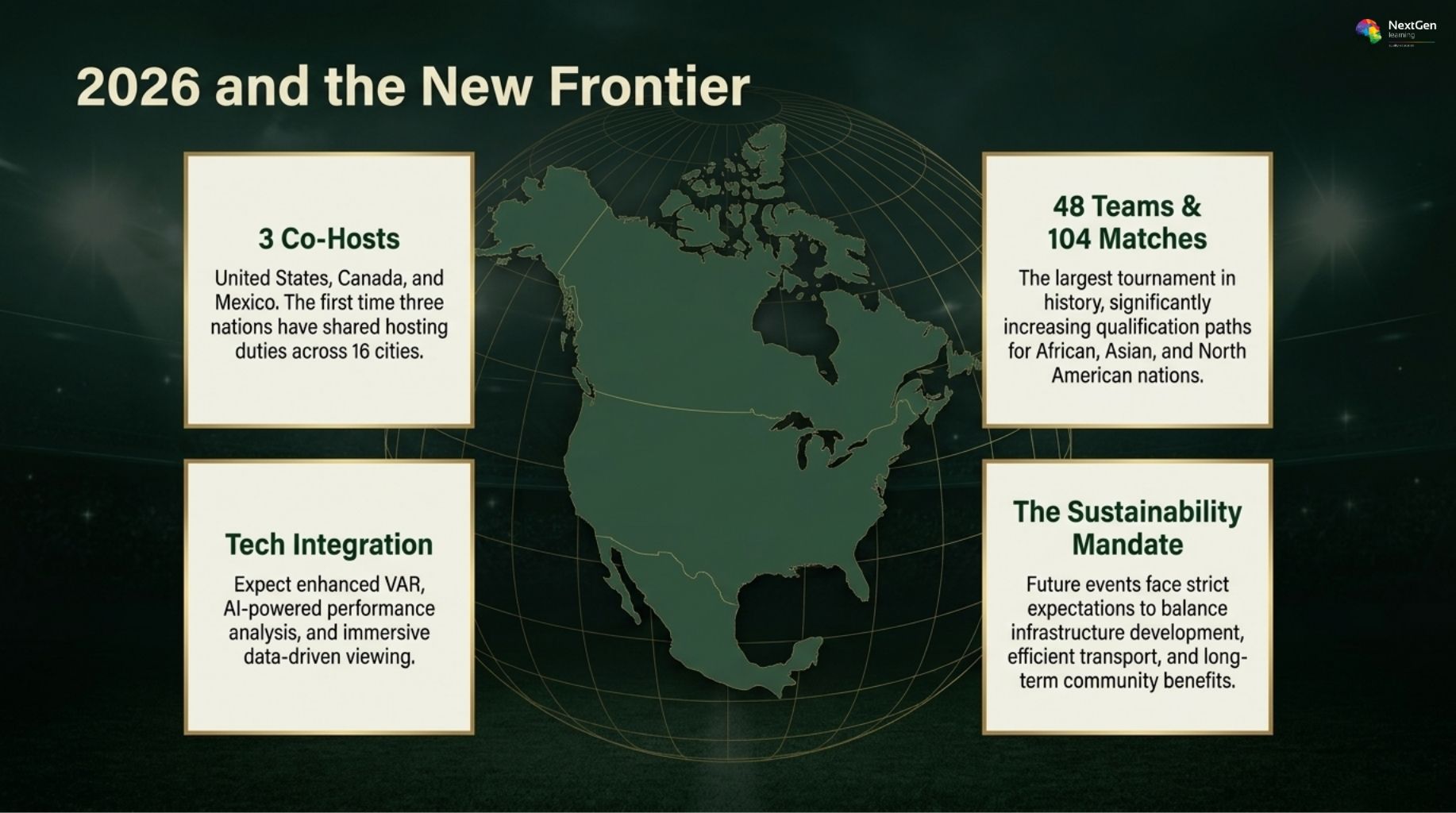
As football continues to grow across the world, the FIFA World Cup is entering a new chapter. While the tournament remains rooted in tradition, FIFA is introducing significant changes designed to increase global participation, improve competitiveness and expand the event’s reach.
The most important development is the expansion of the tournament from 32 teams to 48 teams. The 2026 FIFA World Cup will be the first edition to use this new format, making it the largest World Cup in history. Moreover, it will be jointly hosted by the United States, Canada and Mexico, marking the first time three nations have co-hosted the tournament.
What Will Change in 2026?
The expanded format introduces several important changes:
- 48 participating teams instead of 32
- 104 total matches
- 16 host cities across three countries
- More qualification opportunities for emerging nations
- Longer tournament duration
As a result, more countries will have the opportunity to compete on football’s biggest stage, potentially creating new stories, rivalries and breakthrough performances.
Opportunities for Emerging Football Nations
One of FIFA’s primary goals is to make the World Cup more representative of global football. Consequently, nations that previously struggled to qualify may now have a realistic chance of reaching the finals.
Potential benefits include:
- Greater representation from Africa
- More Asian teams participating
- Increased opportunities for North American nations
- Accelerated football development in emerging markets
Therefore, the World Cup could become even more diverse and competitive in the coming decades.
Technology Will Continue to Shape the Tournament
Technology is expected to play an even bigger role in future tournaments. FIFA has already introduced goal-line technology, VAR and advanced performance tracking systems. Looking ahead, further innovations may improve both officiating accuracy and the fan experience.
Areas likely to evolve include:
- Enhanced VAR systems
- AI-powered performance analysis
- Improved player tracking
- Immersive viewing experiences
- More advanced broadcast technologies
As technology develops, fans can expect a more interactive and data-driven viewing experience.
Sustainability and Global Impact
Future World Cups will also face increasing expectations around sustainability and social responsibility. Host nations will need to balance infrastructure development, environmental considerations and economic benefits.
Key priorities may include:
- Reducing environmental impact
- Sustainable stadium development
- Efficient transportation systems
- Long-term community benefits
- Responsible event management
Consequently, future tournaments will be judged not only by the football on the pitch but also by their wider social and environmental impact.
A Bright Future for Football’s Greatest Tournament
The FIFA World Cup has successfully adapted to nearly a century of change. From a modest 13-team competition in 1930 to a 48-team global event in 2026, its evolution reflects the worldwide growth of football itself.
Although formats, technologies and host nations will continue to change, the essence of the World Cup remains the same: bringing together the world’s best players and teams in pursuit of football’s ultimate prize. For that reason, the tournament is likely to remain one of the most celebrated sporting events on Earth for generations to come.

Why the FIFA World Cup Remains the Biggest Sporting Event on Earth
Few sporting competitions can match the global reach, emotional intensity and cultural significance of the FIFA World Cup. Every four years, billions of people follow the tournament, creating a shared experience that transcends borders, languages and generations.
Unlike club competitions, the World Cup represents national identity. Players compete not for contracts or club rivalries but for their countries. Consequently, victories and defeats often become defining moments in a nation’s sporting history.
Several factors explain the tournament’s enduring popularity:
- Global participation through qualification campaigns
- The world’s best players competing for one trophy
- Historic rivalries and unforgettable matches
- Massive international television audiences
- Strong emotional connection between teams and supporters
- A legacy built over nearly 100 years
Moreover, the World Cup consistently produces stories that inspire people far beyond football. From underdog victories to legendary performances, each tournament adds new memories to the sport’s rich history.
As football continues to grow, the FIFA World Cup remains the ultimate stage where dreams are realised, records are broken and sporting legends are created.
Frequently Asked Questions
The FIFA World Cup is an international football tournament organised by FIFA every four years. National teams from around the world compete to become the world champion.
The first FIFA World Cup took place in 1930 in Uruguay. The host nation won the tournament by defeating Argentina in the final.
Brazil holds the record with five World Cup titles, won in 1958, 1962, 1970, 1994 and 2002.
The four-year cycle gives national teams sufficient time to qualify, prepare and compete while maintaining the tournament’s prestige and global anticipation.
Miroslav Klose of Germany holds the record with 16 World Cup goals across four tournaments.
Opinions vary, but Diego Maradona’s “Hand of God” and “Goal of the Century” against England in 1986 are among the most iconic moments in football history.
The 2026 tournament will feature 48 teams and 104 matches, making it the largest World Cup ever. It will be co-hosted by the United States, Canada and Mexico.
Final Thoughts
The FIFA World Cup has evolved dramatically since Uruguay hosted the first tournament in 1930. Over the decades, it has delivered iconic moments, legendary champions and unforgettable stories that have shaped football history.
From Pelé’s rise to global stardom and Maradona’s brilliance in 1986 to Germany’s historic triumphs and Lionel Messi’s crowning achievement in 2022, the competition has consistently showcased the very best of international football. Furthermore, its expansion to 48 teams in 2026 demonstrates that the tournament continues to evolve while maintaining its core purpose.
Whether you are a lifelong football fan or new to the sport, understanding FIFA World Cup history provides valuable insight into why this tournament remains the most celebrated event in world football. Its legacy is built on passion, excellence and the universal power of sport to unite people across the globe.

0 responses on "FIFA World Cup History: Winners, Records and Greatest Moments"