





Public Inquiry: Holly Wells & Jessica Chapman Case | Soham Murders Explained
The tragic deaths of Holly Wells and Jessica Chapman in 2002 shocked the United Kingdom and exposed serious weaknesses in the country’s safeguarding systems. The case, widely known as the Soham murders, quickly became one of the most significant child protection failures in modern British history. As a result, it forced authorities to examine how someone with a troubling past could gain employment in a school environment.
The disappearance of the two ten-year-old girls from the quiet town of Soham in Cambridgeshire triggered one of the largest police investigations the UK had ever seen. Thousands of officers, volunteers and media organisations joined the search. However, the investigation soon revealed disturbing questions about background checks, police record-keeping and the way different agencies shared information.
Importantly, the case exposed major flaws in safeguarding procedures, recruitment checks and communication between institutions responsible for protecting children. Consequently, public pressure grew for a full investigation into how these failures occurred and how they could be prevented in the future.
To address these concerns, the UK government launched a major public inquiry led by Sir Michael Bichard. The inquiry examined how Ian Huntley, the school caretaker later convicted of the murders, had been able to work in a school despite multiple previous allegations and police interactions.
The inquiry that followed would ultimately transform safeguarding across the United Kingdom. In particular, it led to stronger background checks, improved police information sharing and the development of modern safeguarding frameworks used today.
This article explores:
- What happened in the Holly Wells and Jessica Chapman case
- Why the Bichard Inquiry was launched
- The key failures uncovered by the investigation
- How the Soham case reshaped safeguarding practices in the UK
Understanding the lessons of this case remains critically important. Today, safeguarding policies, recruitment procedures and professional training across schools and child-focused organisations continue to reflect the reforms introduced after the Soham tragedy.
Table of Contents
The Soham Murders: What Happened to Holly Wells and Jessica Chapman?

The Soham murders remain one of the most heartbreaking criminal cases in the United Kingdom. In August 2002, the disappearance of Holly Wells and Jessica Chapman, two ten-year-old school friends, shocked the nation and triggered a massive search operation. Although Soham was a quiet town in Cambridgeshire, the case quickly became a national tragedy that exposed serious safeguarding failures.
Holly and Jessica were close friends who had grown up together in the local community. On the evening of 4 August 2002, they left Holly’s family home to buy sweets from a nearby shop. Importantly, they were wearing matching Manchester United football shirts, which later became one of the most recognisable images associated with the case.
However, the girls never returned home.
Their disappearance prompted an immediate police response. Consequently, one of the largest missing-person investigations in British policing history began. Police forces across the country assisted in the search, while thousands of volunteers joined the effort to find the two girls.
Timeline of the Soham Murders
Understanding the timeline helps explain how the investigation unfolded and why the case quickly attracted national attention.
- 4 August 2002 – Holly Wells and Jessica Chapman disappear after leaving Holly’s home in Soham.
- 5 August 2002 – Police launch a large-scale search operation across Cambridgeshire.
- Following days – National media coverage intensifies and thousands of volunteers assist in search efforts.
- 17 August 2002 – The bodies of the two girls are discovered near Lakenheath, approximately 12 miles from Soham.
- December 2003 – Ian Huntley is convicted of the murders at the Old Bailey.
- 2004 – The Bichard Inquiry begins to investigate safeguarding failures that allowed Huntley to work in a school.
As the investigation progressed, police attention turned toward a man working close to the girls’ school. This individual was Ian Huntley, the caretaker at Soham Village College.
Who Was Ian Huntley?
Ian Huntley was employed as the school caretaker at Soham Village College, the secondary school attended by Holly Wells and Jessica Chapman. During the early stages of the investigation into the girls’ disappearance, he appeared to cooperate with police and even gave interviews to the media.
However, as the investigation progressed, serious concerns began to emerge.
Police later discovered that Huntley had a troubling history involving multiple allegations and police interactions across different regions of the UK. These included accusations of inappropriate relationships with underage girls and other concerning behaviour.
Importantly, much of this information had been recorded by different police forces but was not effectively shared or properly stored within national systems. As a result, when Huntley applied for employment at a school, the full extent of his background did not appear during routine checks.
Several systemic failures contributed to this situation:
- Police intelligence was stored in separate regional databases
- Some allegations had been deleted or poorly recorded
- Searches were not conducted under all known names used by Huntley
- Schools lacked a centralised vetting system for staff
Consequently, Huntley was able to work in a school despite serious safeguarding concerns.
Why Was the Bichard Inquiry Launched?
Following the conviction of Ian Huntley in December 2003, public concern quickly shifted from the crime itself to the systems that had failed to prevent it. Although the murders of Holly Wells and Jessica Chapman shocked the nation, the discovery that Huntley had a history of troubling allegations raised a critical question: how had someone with such a background been able to work in a school?
As these concerns grew, the UK government launched a full public investigation. Consequently, the Bichard Inquiry was established in December 2003 and chaired by Sir Michael Bichard, a senior civil servant with experience in education administration.
The inquiry aimed to examine the systemic failures in safeguarding, recruitment and information sharing that allowed Huntley to secure employment at Soham Village College. Importantly, investigators focused on how different institutions — including police forces, schools and local authorities — managed sensitive information about individuals working with children.
At the time, background checks and intelligence records were handled separately by different organisations. As a result, crucial information about Huntley’s previous police interactions was not properly shared or retained.
The inquiry therefore investigated several key issues, including:
- Failures in police record-keeping systems
- Weak recruitment and vetting procedures in schools
- Poor information sharing between agencies
- Safeguarding responsibilities across institutions
When the Bichard Inquiry Report was published in June 2004, it revealed major weaknesses in safeguarding systems. Consequently, the report recommended reforms that later transformed background checks, recruitment procedures and child protection policies across the UK.
Key Findings of the Bichard Inquiry
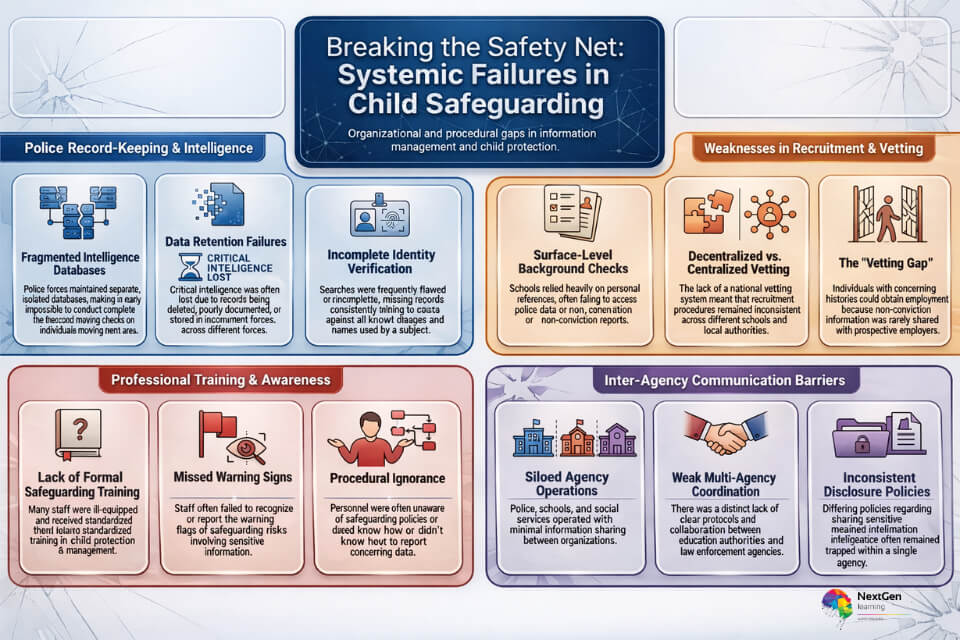
When the Bichard Inquiry Report was published in June 2004, it revealed a series of serious safeguarding failures that had allowed Ian Huntley to gain employment in a school environment. Although many organisations had interacted with Huntley before the Soham murders, weaknesses in record management, communication and recruitment systems meant that warning signs were not properly recognised.
Importantly, the inquiry concluded that the tragedy was not caused by a single mistake. Instead, it resulted from systemic failures across multiple institutions, including police forces, schools and local authorities. As a result, the inquiry identified several critical weaknesses in safeguarding systems across the United Kingdom.
Failure in Police Record-Keeping
One of the most significant findings involved the way police forces recorded and managed intelligence about individuals. At the time, police databases were not fully integrated, which meant information could remain isolated within individual forces.
In Ian Huntley’s case, several police forces had recorded allegations and incidents involving him. However, these records were not consistently stored or shared. Consequently, investigators and employers could not easily identify patterns of concerning behaviour.
The inquiry highlighted several record-keeping failures:
- Police forces maintained separate intelligence databases, making cross-regional checks difficult
- Some records relating to Huntley had been deleted or poorly documented
- Searches were not conducted under all known names used by Huntley
- Important intelligence about previous allegations was not retained in a consistent format
As a result, crucial safeguarding information was effectively lost within fragmented systems.
Weak Recruitment and Vetting Systems
The inquiry also identified major weaknesses in the recruitment processes used by schools and other organisations working with children. At the time, background checks were not as comprehensive or centralised as they are today.
Schools often relied heavily on personal references or limited criminal record checks. However, these checks did not always capture police intelligence or non-conviction information that might indicate safeguarding risks.
Key weaknesses included:
- Lack of a centralised national vetting system for individuals working with children
- Limited ability to access police intelligence beyond criminal convictions
- Over-reliance on references and informal background checks
- Inconsistent recruitment procedures across schools and local authorities
Consequently, individuals with concerning histories could sometimes obtain employment in child-focused environments without full scrutiny.
Lack of Safeguarding Training
Another major issue highlighted by the inquiry was the limited safeguarding awareness among frontline professionals. At the time, many staff working in education, social services and policing had not received consistent training in child protection procedures.
Because of this, professionals sometimes failed to recognise the significance of safeguarding information or did not understand how to manage sensitive records correctly.
The inquiry found that:
- Many professionals lacked formal safeguarding training
- Staff were not always aware of child protection reporting procedures
- Some personnel did not understand how to store or share safeguarding information appropriately
As a result, important warning signs were sometimes overlooked or handled incorrectly.
Poor Communication Between Agencies
Perhaps the most critical failure identified by the inquiry involved the lack of effective communication between different organisations responsible for safeguarding children.
Police forces, schools, social services and other agencies often worked independently, with limited systems for sharing information. Consequently, relevant intelligence about individuals could remain isolated within one organisation and never reach others responsible for child protection.
The inquiry identified several communication problems:
- Limited information sharing between different police forces
- Weak coordination between education authorities and law enforcement
- Lack of clear procedures for multi-agency safeguarding cooperation
- Inconsistent policies regarding the retention and disclosure of intelligence
Because of these failures, the full picture of Huntley’s background was never assembled before he gained employment at Soham Village College.
The Bichard Inquiry ultimately concluded that these systemic failures created a dangerous gap in safeguarding systems. Therefore, the report recommended major reforms aimed at strengthening background checks, improving police record management and ensuring that organisations working with children could share critical information more effectively.
These recommendations would go on to reshape safeguarding practices, recruitment procedures and child protection policies across the United Kingdom.
Major Safeguarding Reforms After the Soham Case
The findings of the Bichard Inquiry triggered one of the most significant transformations in child protection systems in the United Kingdom. Following the failures exposed in the Holly Wells and Jessica Chapman case, the government recognised that safeguarding procedures required major reform. Consequently, new laws, vetting systems and professional safeguarding standards were introduced to prevent similar tragedies in the future.
Moreover, these reforms focused on strengthening background checks, improving information sharing between institutions and ensuring that organisations working with children followed safer recruitment practices.
As a result, several key safeguarding reforms emerged directly from the inquiry.
Importantly, these reforms reshaped how institutions approach safeguarding and child protection across the UK.
Creation of the Vetting and Barring Scheme
One of the most important reforms involved the creation of a national system to prevent unsuitable individuals from working with children or vulnerable adults. Consequently, this led to the introduction of the Vetting and Barring Scheme, which was designed to identify individuals who should be legally barred from certain types of employment.
Importantly, the scheme aimed to strengthen safeguarding by ensuring that employers could identify individuals who posed potential risks. In addition, it helped organisations make safer recruitment decisions.
As a result, institutions working with children gained stronger tools to prevent unsuitable individuals from entering sensitive roles. Therefore, the scheme became a key part of modern safeguarding systems in the UK.
Key objectives of the Vetting and Barring Scheme included:
- Preventing individuals with harmful histories from working with children or vulnerable adults
- Creating a central register of barred individuals
- Strengthening safeguarding checks across education, healthcare and social care sectors
- Supporting employers in making safer recruitment decisions
This reform significantly improved the UK’s ability to monitor individuals who might pose safeguarding risks.
Introduction of DBS Background Checks
Another major reform involved improving the national system used to check an individual’s criminal history before employment in sensitive roles. Previously, the Criminal Records Bureau (CRB) handled background checks. However, reforms introduced a more robust system that later evolved into the Disclosure and Barring Service (DBS).
DBS checks now play a central role in safeguarding across the UK.
These checks allow employers to access important information before hiring individuals who may work with children or vulnerable adults.
DBS background checks provide:
- Access to criminal conviction records
- Disclosure of relevant police intelligence where appropriate
- Identification of individuals on the barred lists for working with children or vulnerable adults
- Stronger protection during recruitment in schools, childcare services and community organisations
As a result, employers now have far greater visibility into an applicant’s background than before the Soham case.
Safer Recruitment in Schools
Following the inquiry, the UK government introduced stricter guidance on recruitment procedures within schools. Education institutions were required to adopt formal safeguarding policies to ensure that individuals working with children were properly vetted.
These policies emphasised the principle of safer recruitment, which focuses on preventing unsuitable individuals from gaining access to children.
Safer recruitment practices now include:
- Mandatory DBS background checks for school staff
- Verification of identity, qualifications and employment history
- Investigation of unexplained employment gaps
- Structured interview processes focused on safeguarding awareness
- Appointment of designated safeguarding leads within schools
These procedures significantly strengthened the screening process for individuals working in education.
Stronger Information Sharing Systems
Another major weakness identified by the inquiry was the lack of effective communication between police forces and safeguarding agencies. Therefore, reforms were introduced to improve how intelligence is recorded, stored and shared across institutions.
Police forces began developing national information systems designed to ensure that important intelligence about individuals could be accessed by relevant authorities.
Improvements included:
- Development of national police databases for intelligence sharing
- Clearer rules for record retention and documentation
- Better coordination between police, schools and safeguarding agencies
- Greater emphasis on multi-agency cooperation in child protection
As a result, safeguarding professionals today are far more capable of identifying potential risks before individuals gain access to children.
How the Soham Case Changed Safeguarding Practices in the UK

The Soham murders did not only lead to new policies and background check systems. More importantly, the case fundamentally changed how safeguarding is understood and implemented across the United Kingdom. Before the tragedy, safeguarding responsibilities were often viewed as the duty of specific organisations or specialists. However, the failures exposed by the Bichard Inquiry demonstrated that protecting children requires coordinated action from multiple professionals and institutions.
As a result, safeguarding is now considered a shared responsibility across education, healthcare, social services and law enforcement. Schools, local authorities, police forces and community organisations must work together to ensure that potential risks are identified and addressed early.
Safeguarding Responsibilities in Schools
Following the inquiry, safeguarding responsibilities within schools became far more structured and clearly defined. Education institutions were required to adopt formal safeguarding policies and ensure that staff understood their roles in protecting children.
Schools must now implement several safeguarding procedures to reduce risk and promote child protection.
These responsibilities include:
- Establishing clear safeguarding and child protection policies
- Ensuring all staff understand reporting procedures for safeguarding concerns
- Conducting background checks and safer recruitment processes
- Maintaining accurate safeguarding records and documentation
- Working closely with local safeguarding partners and external agencies
Because of these responsibilities, safeguarding is now embedded into everyday school operations rather than treated as a separate administrative task.
The Role of Designated Safeguarding Leads (DSL)
One of the most important changes introduced after the Soham case was the requirement for schools to appoint a Designated Safeguarding Lead (DSL). This individual is responsible for overseeing safeguarding policies and responding to child protection concerns.
The DSL plays a central role in ensuring that safeguarding procedures are followed correctly.
Key responsibilities of a Designated Safeguarding Lead include:
- Acting as the main point of contact for safeguarding concerns
- Coordinating communication with local safeguarding authorities
- Supporting staff in identifying signs of abuse or neglect
- Ensuring safeguarding policies are updated and implemented effectively
- Maintaining confidential safeguarding records
By creating a clear safeguarding leadership role, schools can ensure that concerns are managed consistently and appropriately.
Importance of Safeguarding Training
Another major lesson from the Soham case was the need for consistent safeguarding training for professionals working with children. Before the inquiry, many staff members had limited training in recognising safeguarding risks or reporting concerns.
Today, safeguarding training is considered essential for anyone working in education, childcare, healthcare, or social care.
Effective safeguarding training helps professionals:
- Recognise signs of abuse, neglect, or exploitation
- Understand legal safeguarding responsibilities
- Respond appropriately to disclosures from children
- Follow correct reporting and escalation procedures
- Work effectively with multi-agency safeguarding teams
Because safeguarding risks can arise in many different environments, ongoing training ensures that professionals remain aware of their responsibilities and understand how to protect vulnerable individuals.
Lessons for Professionals Working with Children

The tragic deaths of Holly Wells and Jessica Chapman highlighted a painful reality: safeguarding systems can fail when professionals overlook warning signs or when organisations do not communicate effectively. Therefore, the Soham case continues to serve as a powerful lesson for everyone working with children and vulnerable young people.
Importantly, safeguarding today is not limited to police or child protection specialists. Instead, teachers, childcare professionals, healthcare staff, social workers and community organisations all play a role in protecting children. Because of this shared responsibility, professionals must remain alert, informed and proactive when safeguarding concerns arise.
Several key lessons emerged from the inquiry that continue to guide safeguarding practice across the UK.
Safeguarding Requires Vigilance from All Professionals
One of the most important lessons from the Soham case is that safeguarding cannot rely on a single organisation. Instead, effective child protection depends on continuous vigilance from everyone involved in a child’s environment.
Professionals working with children must remain aware of potential risks and take concerns seriously, even when information appears incomplete.
Key safeguarding responsibilities include:
- Recognising warning signs of abuse or neglect in children and young people
- Recording safeguarding concerns accurately and promptly
- Reporting concerns through proper safeguarding channels
- Following organisational safeguarding policies at all times
- Prioritising the safety and wellbeing of the child above all else
When professionals take these responsibilities seriously, early intervention becomes possible and safeguarding risks can be reduced.
Background Checks and Safer Recruitment Are Essential
Another important lesson from the inquiry involves the importance of rigorous recruitment procedures. Before the Soham case, background checks and reference checks were often inconsistent across institutions. As a result, individuals with concerning histories could sometimes gain employment in environments where they had access to children.
Today, safer recruitment processes are designed to identify potential safeguarding risks before employment begins.
Essential recruitment safeguards include:
- Conducting enhanced DBS background checks for relevant roles
- Verifying employment history and professional qualifications
- Investigating unexplained gaps in employment records
- Requesting detailed references from previous employers
- Assessing safeguarding awareness during interviews
By implementing these procedures consistently, organisations can significantly reduce the likelihood of safeguarding failures.
Information Sharing Is Critical for Child Protection
The Bichard Inquiry also demonstrated how dangerous it can be when organisations fail to share important information. In the Soham case, multiple police forces held intelligence about Ian Huntley. However, because these records were not effectively shared, the full picture of risk was never recognised.
Consequently, modern safeguarding systems place far greater emphasis on multi-agency communication and information sharing.
Effective safeguarding communication involves:
- Collaboration between police, schools and social services
- Clear reporting procedures for safeguarding concerns
- Secure sharing of relevant intelligence between agencies
- Timely communication when safeguarding risks emerge
- Coordinated responses from multi-agency safeguarding teams
When organisations share information responsibly, safeguarding professionals can identify risks earlier and take protective action more effectively.
Criticisms of the Bichard Inquiry
Although the Bichard Inquiry was widely praised for exposing safeguarding failures and recommending major reforms, it was not free from criticism. However, while many professionals welcomed the improvements in background checks and safeguarding policies, some experts argued that the reforms also created new challenges for organisations working with children.
Importantly, safeguarding systems must balance child protection, practical implementation and individual rights. Therefore, the inquiry’s recommendations sparked debates about bureaucracy, privacy and the consistency of safeguarding practices across the UK. Moreover, these discussions highlighted the complexity of implementing large-scale safeguarding reforms.
Consequently, several key criticisms emerged in the years following the publication of the report. In addition, some professionals questioned whether the new procedures created excessive administrative burdens. Meanwhile, others raised concerns about privacy and data protection.
Ultimately, these debates reflected the ongoing challenge of strengthening safeguarding systems while maintaining practical and balanced policies.
Increased Bureaucracy and Administrative Burden
One of the most common criticisms was that safeguarding reforms introduced a significant increase in administrative procedures. While stronger checks and documentation were necessary, some professionals felt that the growing amount of paperwork placed additional pressure on teachers, social workers and healthcare staff.
In many organisations, safeguarding responsibilities became more complex due to the expanded requirements for documentation, training and reporting.
Common concerns included:
- Large volumes of safeguarding paperwork and record-keeping
- Additional recruitment checks increasing hiring timelines
- Administrative tasks reducing time available for direct work with children
- Complex safeguarding procedures that required extensive training
However, supporters of the reforms argued that stronger procedures were essential to prevent safeguarding failures and ensure accountability.
Privacy and Data Protection Concerns
Another criticism involved the expansion of background checks and information sharing systems. The introduction of enhanced vetting procedures meant that more personal information about individuals could be stored and accessed by organisations responsible for safeguarding.
While these systems were designed to protect children, some critics raised concerns about potential risks to privacy and civil liberties.
Debates surrounding privacy included:
- Whether individuals could be unfairly restricted from employment
- Concerns about the storage of sensitive personal data
- Potential misuse or misinterpretation of non-conviction information
- Balancing safeguarding responsibilities with individual rights
Because of these concerns, safeguarding systems must carefully manage how personal information is recorded and shared.
Inconsistent Implementation Across Institutions
Another challenge highlighted by critics involved the uneven implementation of safeguarding reforms. Although national policies and guidelines were introduced, different institutions sometimes applied these procedures at varying levels of effectiveness.
Factors influencing this inconsistency included differences in resources, training and organisational culture.
Issues reported by safeguarding professionals included:
- Variation in safeguarding training quality across organisations
- Different levels of awareness among staff members
- Inconsistent application of safer recruitment procedures
- Differences in how safeguarding concerns were recorded or reported
These challenges demonstrated that safeguarding reforms alone cannot guarantee effective protection. Instead, ongoing training, leadership and organisational commitment are required to ensure safeguarding policies are implemented consistently.
Lasting Legacy of the Soham Case
More than two decades after the Soham murders, the tragic deaths of Holly Wells and Jessica Chapman continue to influence safeguarding practices across the United Kingdom. Although the case exposed serious failures in child protection systems, it also became a catalyst for major reform. As a result, many of the safeguarding policies used today were shaped by the lessons learned from this tragedy.
The Bichard Inquiry transformed how organisations approach child protection. Previously, safeguarding responsibilities were often fragmented across different institutions. However, the case demonstrated that effective safeguarding requires stronger recruitment checks, structured procedures and better communication between agencies.
Today, safeguarding is embedded in the daily operations of schools, childcare settings, healthcare services and community organisations. Moreover, modern safeguarding frameworks emphasise prevention, early identification of risks and collaboration between professionals.
Several key changes illustrate the lasting impact of the Soham case:
- Stronger background checks, including enhanced DBS checks for those working with children
- Safer recruitment procedures across schools and youth organisations
- Improved information sharing between police forces and safeguarding agencies
- Mandatory safeguarding training for professionals
- Greater public awareness of child protection responsibilities
Importantly, the case reinforced the principle that safeguarding is everyone’s responsibility. Therefore, teachers, healthcare professionals, social workers and community organisations must remain vigilant in recognising risks and reporting concerns.
Ultimately, although the tragedy remains deeply painful, the reforms that followed significantly strengthened child protection systems across the UK. Consequently, the lessons from the Soham case continue to guide safeguarding practices today.
Frequently Asked Questions (FAQ)
Two 10-year-old girls, Holly Wells and Jessica Chapman, disappeared in Soham in 2002. School caretaker Ian Huntley later murdered them and was convicted in 2003.
The inquiry investigated how Ian Huntley, despite past allegations, was able to work in a school. It examined failures in police records, recruitment checks and safeguarding systems.
The inquiry found major failures in police record-keeping, information sharing, vetting processes and safeguarding training across institutions.
It led to stronger background checks, improved police data sharing, safer recruitment practices and the development of modern safeguarding frameworks.
DBS checks help employers identify criminal records or safeguarding risks before hiring people to work with children or vulnerable adults.
Final Thoughts
The tragic deaths of Holly Wells and Jessica Chapman remain one of the most significant safeguarding failures in modern UK history. However, the tragedy also became a turning point that reshaped how institutions protect children. Consequently, the Bichard Inquiry exposed serious weaknesses in police record-keeping, recruitment procedures and safeguarding awareness across multiple organisations.
As a result, the UK introduced major reforms to strengthen child protection systems. Moreover, these reforms included improved DBS background checks, safer recruitment policies, stronger information sharing between agencies and mandatory safeguarding training for professionals working with children.
Today, the lessons from the Soham case continue to guide safeguarding practices across schools, healthcare services and community organisations. Importantly, the case reinforced a crucial principle: safeguarding is everyone’s responsibility.
Therefore, by maintaining strong safeguarding policies, promoting professional training, and encouraging open communication between agencies, organisations can help ensure that tragedies like the Soham murders never happen again.

Safeguarding Children Level 3

0 responses on "Public Inquiry: Holly Wells & Jessica Chapman Case | Soham Murders Explained"