





35 Amazing World Cup Facts, Records and Trivia Every Football Fan Should Know
The FIFA World Cup is the most watched sporting event on the planet. Every four years, billions of fans follow the tournament as nations compete for football’s biggest prize. However, beyond the famous goals, iconic trophies and legendary players, the World Cup is packed with remarkable stories, surprising records and fascinating moments that many fans have never heard about.
From Brazil’s unmatched success and Lionel Messi’s record-breaking appearances to historic upsets and stadiums that have hosted football history, the tournament has produced countless facts that continue to amaze football supporters around the world. Moreover, each World Cup introduces new milestones, making the competition one of the richest sources of sporting history and trivia.
In this guide, you’ll discover 35 amazing World Cup facts, records and statistics covering players, teams, host nations, stadiums and unforgettable moments. Whether you’re a lifelong football fan or simply looking for interesting FIFA World Cup trivia, these facts will give you a deeper appreciation of the world’s greatest football tournament.
Table of Contents
Quick World Cup Facts at a Glance

Before diving into the detailed facts, here’s a snapshot of some of the most impressive FIFA World Cup records and milestones. These statistics highlight the scale, history and global impact of the tournament.
| World Cup Record | Achievement |
|---|---|
| First FIFA World Cup | Uruguay, 1930 |
| Most World Cup Titles | Brazil (5) |
| Most World Cup Final Appearances | Germany (8) |
| Only Team to Qualify for Every World Cup | Brazil |
| Most World Cup Matches Played | Lionel Messi |
| Most World Cup Goals | Miroslav Klose (16) |
| Youngest World Cup Winner | Pelé (17 years old) |
| Fastest World Cup Goal | Hakan Şükür (11 seconds) |
| Largest World Cup Stadium Record Attendance | Maracanã Stadium, Brazil |
| First Multi-Nation World Cup Hosts | Japan and South Korea (2002) |
| Largest World Cup Tournament | 2026 FIFA World Cup (48 teams) |
Key Highlights
- Brazil remain the most successful nation in World Cup history with five tournament victories.
- Lionel Messi holds the record for most World Cup appearances, further strengthening his place among football’s greatest players.
- Pelé remains one of the tournament’s most remarkable stories, winning his first World Cup as a teenager.
- The 2026 FIFA World Cup will be the largest ever, featuring 48 national teams and matches across three host countries.
- Germany have consistently reached the latter stages of the competition, making more finals than any other European nation.
- World Cup attendance figures regularly reach into the millions, making it one of the biggest sporting spectacles in the world.
These records only scratch the surface. However, they reveal why the FIFA World Cup continues to capture the imagination of football fans across generations.
Fascinating Facts About World Cup History

The FIFA World Cup has evolved from a small international competition into the world’s biggest sporting event. While billions of fans watch every tournament today, the competition’s history contains remarkable stories that shaped modern football.
The First FIFA World Cup Was Held in 1930
The inaugural FIFA World Cup took place in Uruguay in 1930. Only 13 teams participated, compared with the 48 teams scheduled for the 2026 tournament. At the time, international travel was challenging and several European nations travelled by ship to reach South America.
Uruguay hosted the competition and went on to win the first-ever World Cup by defeating Argentina 4–2 in the final. As a result, the tournament established itself as football’s premier international competition.
The World Cup Was Suspended During World War II
Unlike many sporting events that continued in some form, the FIFA World Cup was completely suspended during World War II.
The tournaments scheduled for 1942 and 1946 were cancelled because of the global conflict. Consequently, there was a 12-year gap between the 1938 and 1950 World Cups.
This interruption makes the World Cup one of the few major sporting competitions whose history was significantly affected by world events.
Brazil Is the Only Nation to Play in Every World Cup
Many football powerhouses have failed to qualify for at least one World Cup. However, Brazil stands alone as the only nation to participate in every FIFA World Cup since the competition began in 1930.
This remarkable achievement highlights both Brazil’s consistency and its deep football culture. In addition, Brazil remains the most successful team in tournament history, having won five World Cup titles.
The World Cup Has Grown Dramatically Over Time
The tournament has expanded significantly since its first edition.
Key milestones include:
- 1930: 13 participating teams.
- 1982: Expanded to 24 teams.
- 1998: Expanded to 32 teams.
- 2026: Expanded to 48 teams.
- 2026: First tournament hosted by three nations simultaneously.
Therefore, the modern World Cup provides more matches, more nations and greater global representation than ever before.
The Trophy Has Changed Over the Years
The trophy awarded today is not the same one that football legends lifted decades ago.
The original trophy, known as the Jules Rimet Trophy, was awarded from 1930 until 1970. After Brazil won the competition for a third time in 1970, they permanently received the trophy under FIFA rules.
FIFA then introduced the current World Cup Trophy in 1974. Since then, every World Cup-winning captain has lifted the iconic gold trophy recognised around the world today.
Why World Cup History Still Matters Today
World Cup history provides context for modern achievements. Records set decades ago continue to influence discussions about the greatest players, teams and tournaments of all time. Moreover, understanding the competition’s origins makes modern milestones even more impressive as the tournament continues to evolve and reach new audiences across the globe.
Record-Breaking World Cup Facts
The FIFA World Cup has produced some of the most extraordinary records in sporting history. While new stars emerge every tournament, several achievements have stood the test of time and continue to define football greatness.
Most World Cup Titles Won
Brazil holds the record for the most FIFA World Cup victories.
Their five titles came in:
- 1958
- 1962
- 1970
- 1994
- 2002
As a result, Brazil remains the benchmark for international football success. Their combination of skill, consistency and attacking flair has made them one of the most admired teams in the sport.
Germany Have Reached More Finals Than Any Other European Nation
Germany has appeared in eight World Cup finals, demonstrating remarkable consistency across generations.
Their World Cup triumphs came in:
- 1954
- 1974
- 1990
- 2014
Moreover, Germany’s ability to remain competitive across different football eras has helped establish them as one of the tournament’s most successful nations.
Miroslav Klose Holds the Record for Most World Cup Goals
Scoring at the World Cup is one of football’s greatest achievements. However, no player has scored more goals in the tournament than Germany’s Miroslav Klose.
His record includes:
- 16 World Cup goals
- 24 World Cup appearances
- Participation in four tournaments
Klose surpassed Brazil’s Ronaldo Nazário, whose previous record of 15 goals had stood for several years.
Lionel Messi Holds the Record for Most World Cup Matches Played
Lionel Messi has added numerous World Cup records to his legendary career.
Among his achievements:
- Most World Cup appearances
- Most matches played
- World Cup winner with Argentina
- Multiple World Cup assists and goal contributions
Consequently, many football analysts consider Messi’s World Cup career one of the greatest in tournament history.
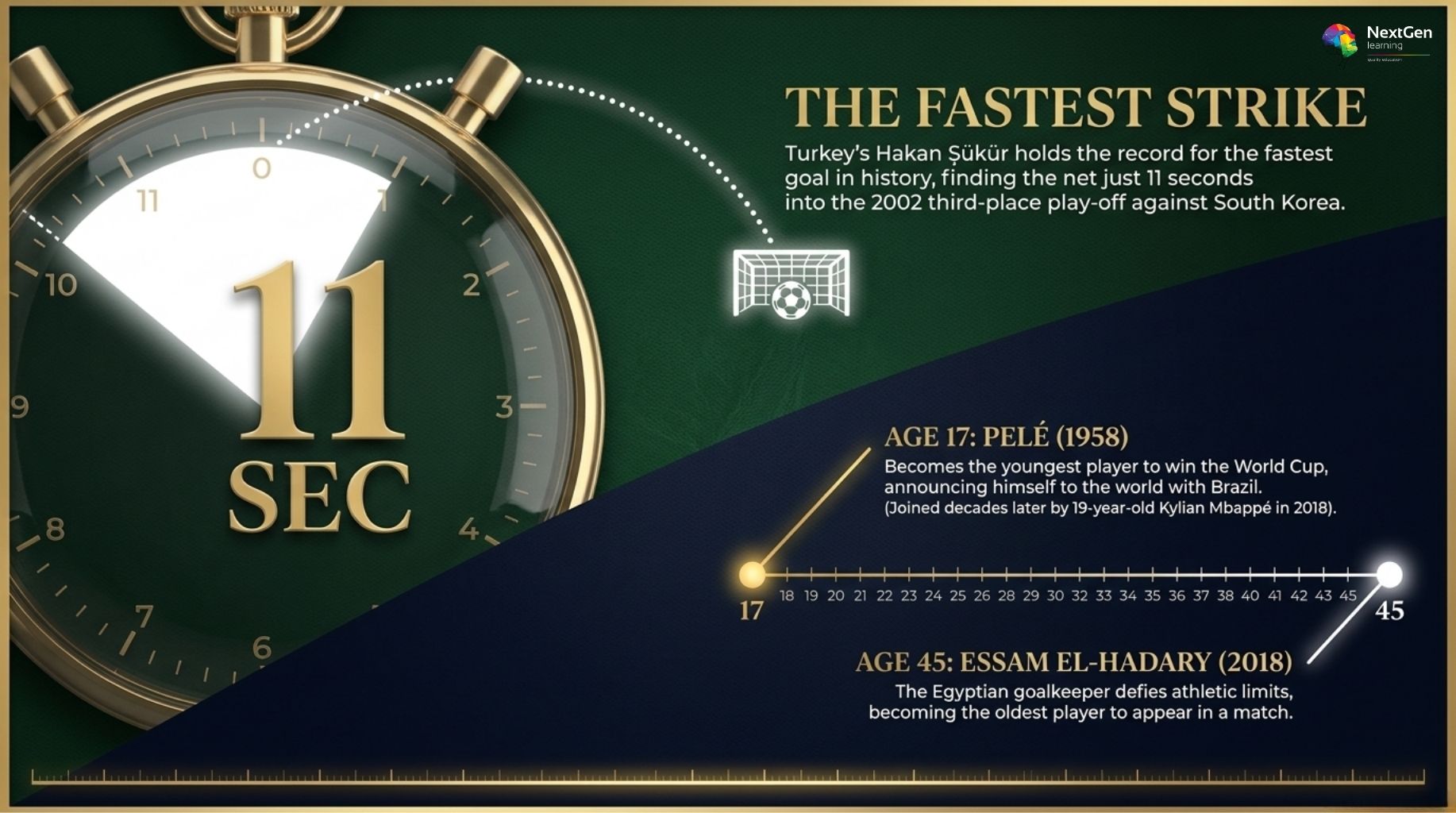
The Fastest Goal in World Cup History Took Just 11 Seconds
Turkey’s Hakan Şükür scored the fastest goal ever recorded at a FIFA World Cup.
During the 2002 third-place play-off against South Korea, he found the net after only 11 seconds.
This record remains unbeaten and highlights how quickly football history can be made.
Pelé Became a World Champion at Just 17
Few records are likely to be broken anytime soon.
Pelé became the youngest player to win a FIFA World Cup when Brazil lifted the trophy in 1958. At only 17 years old, he played a crucial role in Brazil’s success and announced himself to the world as a football superstar.
His achievement remains one of the most remarkable stories in sporting history.
The Oldest World Cup Player Ever
Age is often seen as a limitation in elite football. Nevertheless, some players have competed at the highest level well into their forties.
The oldest player to appear at a FIFA World Cup is Egyptian goalkeeper Essam El-Hadary, who played at the 2018 tournament at the age of 45.
His appearance demonstrated the importance of fitness, experience and determination in professional football.
The Biggest Victory in World Cup History
Several teams have recorded dominant wins, but the largest margin of victory belongs to Hungary.
In the 1982 World Cup, Hungary defeated El Salvador 10–1, setting the record for the biggest win in tournament history.
Notably, this record has survived for decades despite the increasing competitiveness of international football.
Quick Summary of Major World Cup Records
These records showcase the extraordinary achievements that make the FIFA World Cup unique. Furthermore, every tournament creates opportunities for new players and nations to challenge football’s most iconic milestones.
Quick FIFA World Cup Record Holders
Explore the biggest milestones, legendary players and historic achievements from World Cup history.
Incredible Player Facts
The FIFA World Cup has provided the stage for some of football’s greatest players to create unforgettable moments. While many stars have shone at club level, only a select few have left a lasting legacy on the world’s biggest sporting stage.
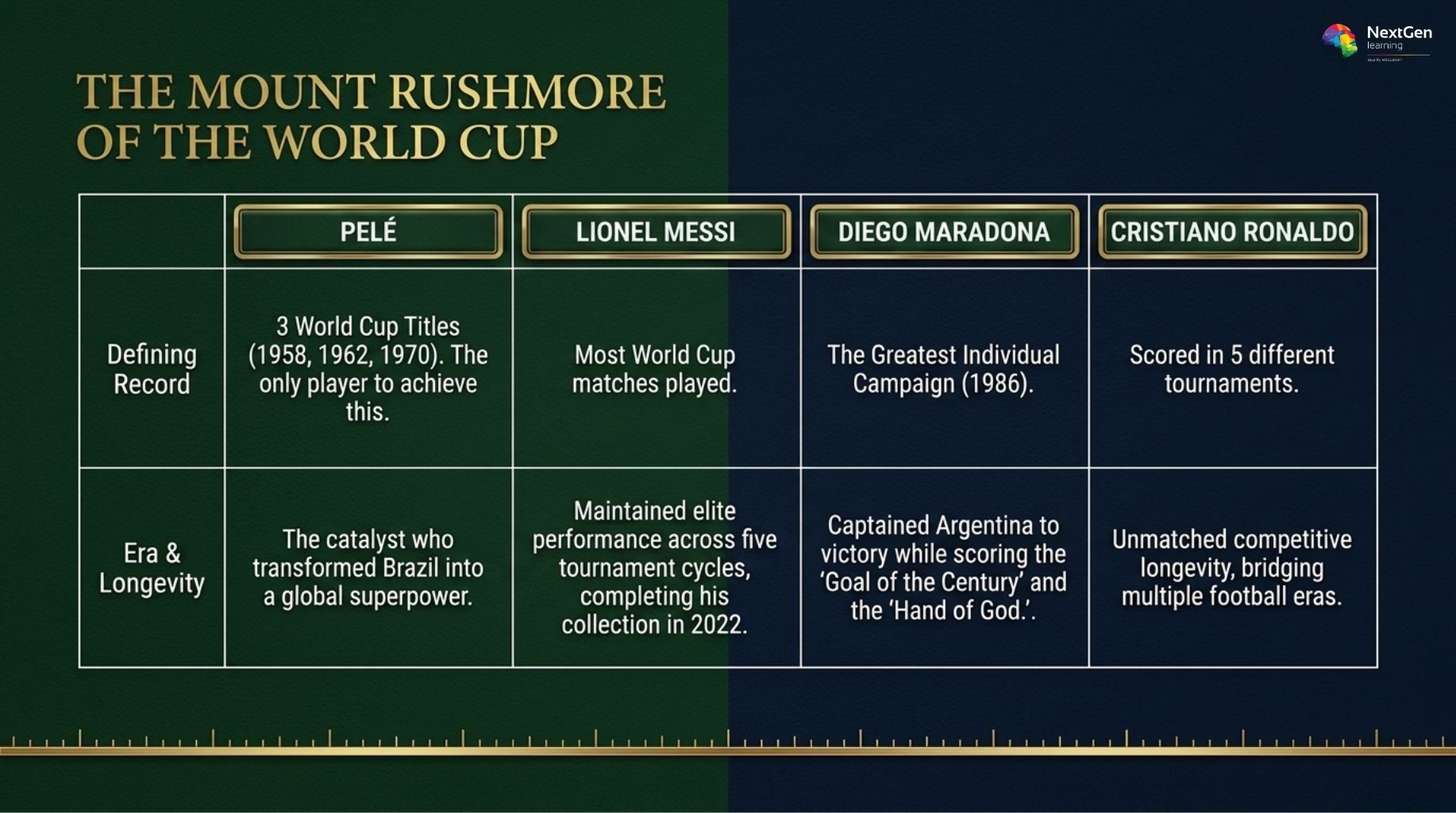
Lionel Messi Finally Completed Football’s Greatest Collection
For years, critics argued that Lionel Messi needed a World Cup trophy to complete his extraordinary career. That debate ended when Argentina won the 2022 FIFA World Cup.
Messi’s World Cup achievements include:
- World Cup winner with Argentina
- Most World Cup matches played
- Goals scored in multiple World Cups
- Appearances across five tournaments
- One of the highest goal contribution totals in tournament history
Moreover, his performances in Qatar strengthened his status as one of football’s greatest players.
Cristiano Ronaldo Made History Across Five World Cups
Cristiano Ronaldo achieved a unique milestone by becoming the first male player to score in five different FIFA World Cup tournaments.
His World Cup journey highlights:
- Exceptional longevity
- Consistent international performance
- Multiple tournament appearances
- Goals across different football eras
Although Ronaldo has not won the World Cup, his individual achievements remain among the most impressive in international football history.
Pelé Won Three World Cups
Many records have fallen over the years. However, Pelé’s achievement remains one of the most iconic.
He won the FIFA World Cup three times:
- 1958
- 1962
- 1970
No other player has matched this record. Furthermore, Pelé transformed the global popularity of football and helped establish Brazil as a football superpower.
Diego Maradona Produced One of the Greatest Individual World Cup Campaigns
The 1986 FIFA World Cup is often remembered for Diego Maradona’s brilliance.
During the tournament, he:
- Captained Argentina to victory
- Scored the famous “Hand of God” goal
- Scored the “Goal of the Century” against England
- Dominated matches through creativity and leadership
As a result, many football historians consider his 1986 campaign one of the finest individual performances ever seen at a World Cup.
Miroslav Klose Became the Tournament’s Greatest Goalscorer
While players such as Pelé, Ronaldo and Messi often dominate headlines, Germany’s Miroslav Klose quietly achieved one of football’s most impressive records.
His success was built on:
- Consistent finishing
- Intelligent movement
- Exceptional positioning
- Performance across four tournaments
Consequently, his record of 16 World Cup goals remains the benchmark for future generations.
Ronaldo Nazário Dominated the Early 2000s
Before Klose broke the record, Brazil’s Ronaldo Nazário held the title of the World Cup’s highest goalscorer.
His World Cup achievements include:
- Two World Cup victories
- 15 tournament goals
- Golden Boot winner
- Star performer in 2002
His comeback from serious injuries to lead Brazil to glory remains one of football’s most inspiring stories.
Young Stars Have Often Changed Football History
Several football legends announced themselves on the World Cup stage at a remarkably young age.
Notable examples include:
- Pelé winning the tournament at 17.
- Kylian Mbappé helping France win the 2018 World Cup at 19.
- Michael Owen becoming a global star after the 1998 tournament.
- Thomas Müller winning the Golden Boot in 2010.
These performances demonstrate how the World Cup can transform talented youngsters into international icons almost overnight.
What Makes World Cup Greatness Different?
Success at club level does not always guarantee success at the World Cup. Players must perform under immense pressure while representing their countries in front of billions of viewers worldwide.
Therefore, World Cup achievements often carry a unique prestige. Winning the tournament or breaking its records can elevate a player’s legacy from excellent to legendary.
Surprising Country Facts
While individual players often dominate headlines, national teams are the foundation of World Cup history. Some countries have built legendary records, while others have produced unforgettable underdog stories that continue to inspire football fans around the world.
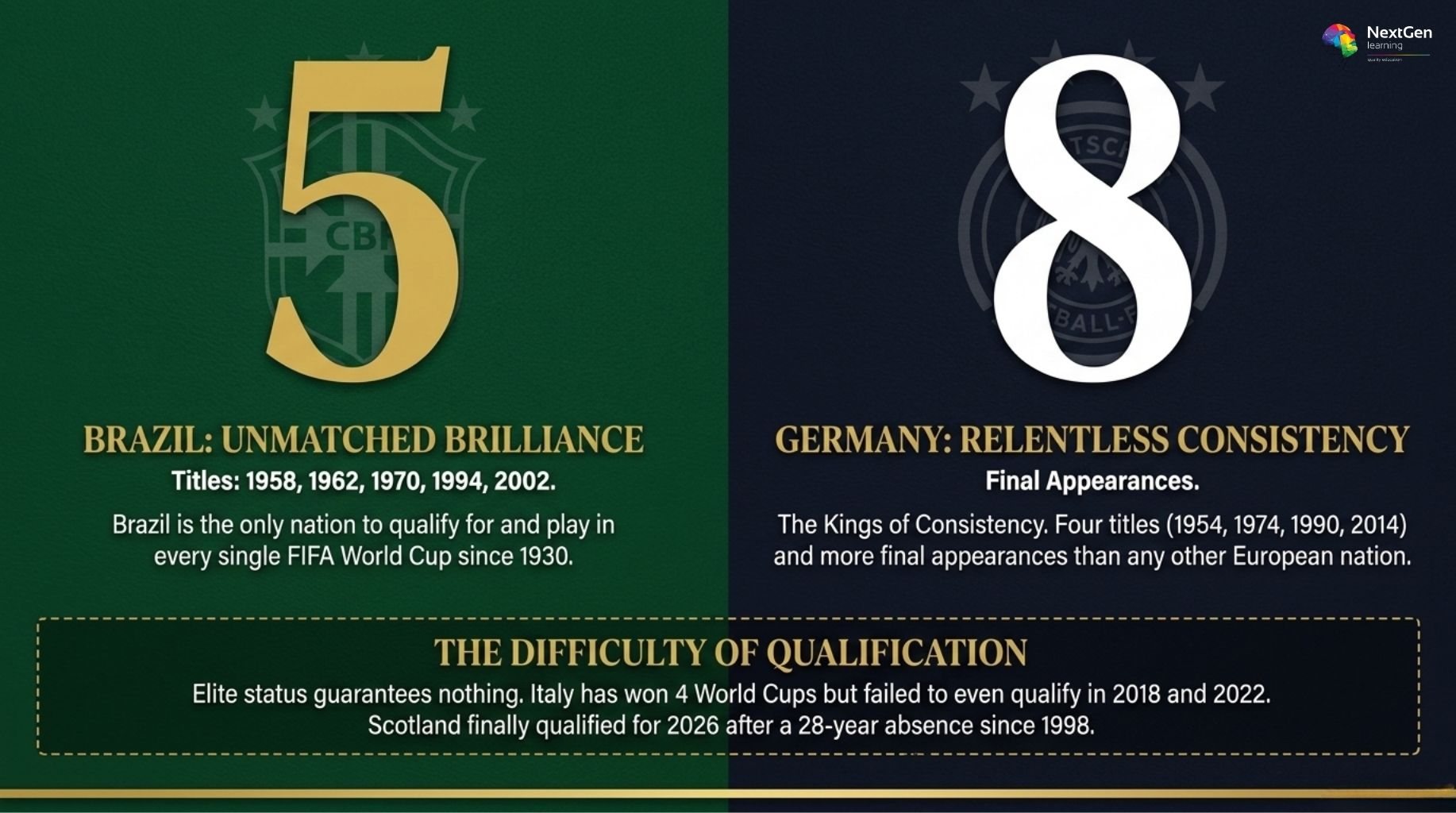
Brazil Is the Most Successful Nation in World Cup History
No country has enjoyed more World Cup success than Brazil.
Their achievements include:
- Five FIFA World Cup titles
- Participation in every World Cup tournament
- Multiple generations of legendary players
- More than six decades of international success
Furthermore, Brazil has produced some of football’s greatest names, including Pelé, Ronaldo, Ronaldinho, Rivaldo and Neymar.
Germany Are the Kings of Consistency
Although Brazil holds the record for most titles, Germany has consistently reached the latter stages of the tournament.
Germany’s impressive achievements include:
- Eight World Cup final appearances
- Four World Cup victories
- Multiple semi-final appearances
- Strong performances across different eras
As a result, Germany has become one of the most reliable teams in World Cup history.
Argentina’s World Cup Legacy Continues to Grow
Argentina has produced some of the tournament’s most memorable moments.
The nation’s World Cup highlights include:
- Multiple World Cup titles
- Legendary players such as Maradona and Messi
- Historic victories in different generations
- Regular appearances in knockout stages
Moreover, Argentina’s 2022 triumph helped connect two football generations by placing Messi alongside Maradona in World Cup history discussions.
Italy Have Won Four Titles Despite Missing Recent Tournaments
Italy remains one of football’s most successful nations.
However, one surprising fact stands out. Despite winning four World Cups, Italy failed to qualify for both the 2018 and 2022 tournaments.
This contrast demonstrates how difficult World Cup qualification can be, even for football’s traditional powerhouses.
Small Nations Have Defied the Odds
Several countries with relatively small populations have achieved remarkable World Cup success.
Notable examples include:
- Iceland, which qualified for the 2018 World Cup.
- Cape Verde, one of the smallest nations ever to qualify.
- Costa Rica, which reached the quarter-finals in 2014.
- Croatia, which reached the 2018 final despite a population of fewer than four million people.
These achievements highlight how organisation, talent development and teamwork can overcome population disadvantages.
The Biggest World Cup Upsets Ever
One reason fans love the World Cup is its unpredictability.
Some of the most famous upsets include:
- USA defeated England in 1950.
- North Korea defeated Italy in 1966.
- Cameroon defeated defending champions Argentina in 1990.
- Saudi Arabia defeating Argentina in 2022.
- South Korea reached the semi-finals in 2002.
Consequently, the World Cup regularly produces moments that few experts predict.
African Nations Continue to Break New Ground
African teams have made significant progress over recent decades.
Important milestones include:
- Cameroon became the first African quarter-finalist in 1990.
- Ghana reached the quarter-finals in 2010.
- Morocco becoming the first African semi-finalist in 2022.
- Growing representation of African nations in expanded tournaments.
Therefore, African football continues to play an increasingly important role on the global stage.
Host Nations Often Exceed Expectations
Playing at home can provide a major advantage.
Several host nations have produced memorable performances, including:
- Uruguay won the inaugural World Cup in 1930.
- England won on home soil in 1966.
- France won as hosts in 1998.
- South Korea reached the semi-finals in 2002.
The support of home fans often creates a unique atmosphere that can influence performances throughout the tournament.
Why National Records Matter
World Cup success is rarely achieved overnight. Instead, it reflects decades of player development, coaching, infrastructure and football culture.
For this reason, national records provide valuable insight into how different countries have shaped the history of the world’s most prestigious football tournament.
Amazing Stadium and Host Nation Facts

The FIFA World Cup is not only defined by players and teams. It is also shaped by iconic stadiums, passionate host nations and unforgettable atmospheres. Over the decades, certain venues and host countries have become permanent parts of football history.
Estadio Azteca Is the Most Historic World Cup Stadium
Few football venues can match the legacy of Mexico City’s Estadio Azteca.
The stadium has hosted some of the sport’s most famous moments, including:
- The 1970 FIFA World Cup Final
- The 1986 FIFA World Cup Final
- Diego Maradona’s “Hand of God” goal
- Maradona’s “Goal of the Century” against England
Moreover, Estadio Azteca is set to become the first stadium to host matches across three separate World Cup tournaments.
Maracanã Hosted One of Football’s Largest Crowds
Brazil’s Maracanã Stadium is one of the most famous football venues ever built.
During the 1950 World Cup final-round match between Brazil and Uruguay, official attendance figures exceeded 170,000 spectators, while some estimates suggest the crowd may have been even larger.
As a result, the Maracanã remains closely associated with one of football’s most historic and emotional matches.
The World Cup Has Been Hosted Across Multiple Continents
Since 1930, the tournament has travelled across the globe.
Host continents include:
- South America
- Europe
- North America
- Asia
- Africa
- The Middle East
This global rotation has helped football expand its popularity while allowing different cultures to showcase their passion for the game.
Joint Hosting Was Once Rare
For many years, FIFA awarded hosting rights to a single nation. However, this approach has gradually changed.
Important examples include:
- 2002: Japan and South Korea became the first co-hosts.
- 2026: USA, Canada and Mexico will jointly host the tournament.
Consequently, modern World Cups can be larger and more geographically diverse than ever before.
The 2026 FIFA World Cup Will Be the Biggest Ever
The 2026 tournament will introduce the largest expansion in World Cup history.
Key changes include:
- 48 participating nations
- More than 100 matches
- Three host countries
- 16 host cities
- Millions of expected visitors
Therefore, the competition will surpass every previous World Cup in terms of scale and global reach.
Some Stadiums Have Hosted Football Legends Across Generations
World Cup venues often become historic landmarks because of the players who perform there.
For example:
- Pelé dazzled fans at iconic World Cup venues.
- Maradona created football history at Estadio Azteca.
- Messi lifted the World Cup trophy in Lusail Stadium.
- Modern stars continue to add new chapters to football history.
As a result, many stadiums become symbols of the tournament itself rather than simply places where matches are played.
Host Nations Often Experience Lasting Benefits
Hosting a FIFA World Cup extends beyond football.
Potential benefits include:
- Tourism growth
- Infrastructure development
- Global media exposure
- Economic opportunities
- Sporting investment
However, the long-term impact often depends on how effectively host nations use these opportunities after the tournament ends.
The World Cup Continues to Evolve
Every generation experiences a different version of the FIFA World Cup. New host nations, larger tournaments and modern stadiums continue to reshape the competition.
Nevertheless, iconic venues such as Estadio Azteca and Maracanã remain powerful reminders of the moments that helped transform the World Cup into the world’s most celebrated football event.
Fun World Cup Trivia Most Fans Don't Know

The FIFA World Cup has produced thousands of memorable moments since 1930. While many fans know the champions and star players, some of the tournament’s most fascinating stories remain surprisingly unknown.
1. The First FIFA World Cup Had Only 13 Teams
Today, qualifying for the FIFA World Cup is one of football’s toughest challenges. However, the first tournament in 1930 featured just 13 teams, with many European nations choosing not to participate because of the long journey to Uruguay.
2. Brazil Is the Only Nation to Play in Every World Cup
While football giants such as Germany, Italy and Argentina have occasionally missed tournaments, Brazil remains the only country to qualify for every FIFA World Cup.
3. The Original World Cup Trophy Was Different
The famous gold trophy seen today was introduced in 1974. Before that, winners received the Jules Rimet Trophy, which was permanently awarded to Brazil after their third title in 1970.
4. A Goal Was Once Scored After Just 11 Seconds
Turkey’s Hakan Şükür scored the fastest goal in World Cup history against South Korea in 2002. Remarkably, only 11 seconds had passed before the ball hit the net.
5. Pelé Won the World Cup as a Teenager
At just 17 years old, Pelé helped Brazil win the 1958 FIFA World Cup. Consequently, he became the youngest World Cup winner in football history.
6. The Tournament Was Cancelled Twice
The FIFA World Cup was not held in:
- 1942
- 1946
Both tournaments were cancelled because of World War II, creating a 12-year gap between World Cups.
7. One Stadium Has Hosted Three World Cups
Mexico City’s Estadio Azteca will become the first stadium to host matches in three separate FIFA World Cup tournaments.
8. England Once Lost to a Team of Part-Time Players
One of football’s biggest shocks occurred in 1950 when the United States defeated England 1–0. Many American players were not full-time professionals at the time.
9. The Largest World Cup Win Was 10–1
Hungary’s victory over El Salvador in 1982 remains the biggest winning margin in World Cup history.
10. A Goalkeeper Holds One of the Oldest Records
Egypt’s Essam El-Hadary became the oldest player ever to appear in a World Cup match at the age of 45.
11. The World Cup Trophy Is Surprisingly Small
Although it represents football’s greatest prize, the FIFA World Cup Trophy stands at just over 36 centimetres tall and weighs approximately 6.1 kilograms.
12. The Tournament Is Watched by Billions
The FIFA World Cup attracts one of the largest global audiences of any sporting event. Finals regularly draw hundreds of millions of viewers worldwide.
13. Some Nations Wait Decades Between Appearances
Several countries have experienced long gaps between World Cup qualifications. For example, Scotland qualified for the 2026 tournament after last appearing at the World Cup in 1998.
14. Messi and Ronaldo Have Redefined Longevity
Few players maintain elite international careers for decades. Nevertheless, Lionel Messi and Cristiano Ronaldo have remained competitive across multiple World Cup cycles, setting records for appearances and longevity.
15. Every World Cup Creates New History
No matter how many records exist, each tournament introduces new surprises. New nations qualify, new stars emerge and long-standing records are challenged. Therefore, the FIFA World Cup continues to captivate football fans generation after generation.
Quick Trivia Summary
- Brazil are the only nation to play in every World Cup.
- Pelé became a world champion at 17.
- Hakan Şükür scored the fastest World Cup goal.
- Estadio Azteca will host matches at three World Cups.
- Hungary recorded the biggest World Cup victory.
- Messi holds major appearance records.
- Germany has reached more finals than any other European nation.
These trivia facts reveal why the FIFA World Cup is much more than a football tournament. It is a collection of stories, records and moments that continue to shape sporting history.
Frequently Asked Questions About the World Cup
The FIFA World Cup is an international football tournament organised by FIFA. It brings together the world’s top national teams every four years to compete for the most prestigious trophy in football. Since its launch in 1930, it has become the most watched sporting event globally.
Brazil holds the record for the most FIFA World Cup titles, with five championships. Their victories came in 1958, 1962, 1970, 1994 and 2002. Moreover, Brazil is the only nation to have qualified for every World Cup tournament.
Germany’s Miroslav Klose holds the record for the most FIFA World Cup goals. He scored 16 goals across four tournaments, surpassing Brazil’s Ronaldo Nazário, who finished with 15 goals.
Lionel Messi holds the record for the most World Cup matches played. His appearances across multiple tournaments helped Argentina win the 2022 FIFA World Cup and cemented his place among football’s greatest players.
Germany has appeared in eight FIFA World Cup finals, more than any other European nation. Their consistency over several decades has made them one of the most successful teams in international football history.
The fastest goal in FIFA World Cup history was scored by Turkey’s Hakan Şükür in 2002. He found the net just 11 seconds after kick-off against South Korea in the third-place play-off match.
The 2026 FIFA World Cup will feature 48 teams, making it the largest tournament in the competition’s history. Additionally, it will be jointly hosted by the United States, Canada and Mexico.
Mexico City’s Estadio Azteca is widely regarded as one of the most iconic World Cup stadiums. It hosted two World Cup finals and witnessed Diego Maradona’s famous “Hand of God” goal. Furthermore, it is set to become the first stadium to host matches across three different World Cup tournaments.
Final Thoughts
The FIFA World Cup is far more than a football tournament. It is a global event that brings together nations, creates sporting legends and produces moments that are remembered for generations. From Brazil’s record-breaking success and Pelé’s historic achievements to Lionel Messi’s modern milestones and the unforgettable atmosphere of iconic stadiums, the World Cup continues to shape football history.
Throughout this guide, we’ve explored some of the most fascinating World Cup facts, records and trivia. Moreover, these stories demonstrate why the tournament remains one of the most anticipated sporting events in the world. Every edition introduces new records, surprising upsets and future legends, ensuring that the competition never loses its appeal.
Key Takeaways
- Brazil is the most successful World Cup nation with five titles.
- Lionel Messi holds major appearance records in the tournament.
- Miroslav Klose remains the all-time top World Cup goalscorer.
- Pelé is the youngest World Cup winner in history.
- Estadio Azteca is one of the most iconic World Cup stadiums ever built.
- The 2026 FIFA World Cup will be the largest tournament in history, featuring 48 teams across three host nations.
- The World Cup continues to evolve, while preserving the traditions and stories that make it unique.
Whether you’re preparing for the next tournament, testing your football knowledge or simply exploring the history of the beautiful game, these World Cup facts reveal the remarkable journey behind football’s biggest stage. As new tournaments unfold, fresh records will be set, new heroes will emerge and the story of the FIFA World Cup will continue to grow.
Enrol In Our Free Courses for Career Development



0 responses on "35 Amazing World Cup Facts, Records and Trivia Every Football Fan Should Know"