



What Is Safeguarding? A Simple Guide for Beginners
What is safeguarding? In simple words, safeguarding means keeping people safe from harm, abuse and neglect, and helping them live healthy, happy lives. In the UK, it mainly covers children and adults who may struggle to protect themselves.
If you’ve just started a job in a school, nursery or care setting, or signed up to help at a youth club, you’ll hear the word “safeguarding” everywhere. It comes up in interviews, at induction and on posters in the staffroom. It can sound big and serious. The idea behind it, though, is simple.
This guide explains what safeguarding means, who it protects, who is responsible for it and what to do if you’re ever worried about a child. It focuses on England, with notes on Scotland, Wales and Northern Ireland where the rules differ.
If a child is in immediate danger, call 999.
Want a Clear Starting Point for Safeguarding Children?
This CPD-accredited online course covers safeguarding laws, types of abuse, responding to disclosures and record keeping in eight short, self-paced modules.
Start the Safeguarding Children course →
Table of Contents
What Is Safeguarding? The Meaning in Simple Words
Safeguarding is everything we do to stop children and adults at risk from coming to harm and to act quickly when something goes wrong. It’s about prevention as much as protection.
Picture a swimming pool. The fence and the locked gate help prevent accidents before they happen. The lifeguard watches closely and jumps in if someone gets into trouble. Safeguarding works in the same way: it covers both the safety measures and the response.
In everyday terms, safeguarding includes:
- checking that adults who work with children are safe to do so;
- having clear rules, such as how staff use mobile phones around children;
- noticing when a child seems hurt, frightened or not cared for properly;
- passing worries on to the right person quickly.
What Is Safeguarding According to UK Guidance?
In England, the official definition comes from Working Together to Safeguard Children 2023, the government’s statutory guidance for everyone who works with children. Its definition of safeguarding children includes:
- protecting children from maltreatment, whether inside or outside the home, including online;
- preventing harm to children’s mental and physical health or development;
- making sure children grow up with safe and effective care;
- taking action so that all children have the best outcomes.
The 2023 update placed explicit emphasis on extra-familial harm such as peer-on-peer abuse, criminal exploitation, and online risks reinforcing that safeguarding duties extend beyond safety within the home environment.
If someone asks you “What is safeguarding?” at work, a short answer is: protecting children from harm and helping them thrive.
You’ll also hear the term “child protection”. Safeguarding is the wide umbrella. Child protection sits underneath it and focuses on children who are suffering, or likely to suffer, significant harm.
Still unsure where safeguarding ends and child protection begins? Safeguarding vs Child Protection: What’s the Difference? explains exactly where one stops and the other starts.
Who Does Safeguarding Protect?
Safeguarding protects two main groups.
Children. In UK safeguarding law and guidance, a child is anyone under 18. That includes teenagers who seem very grown-up and young people living away from home.
Adults at risk. In England, section 42 of the Care Act 2014 covers adults who have care and support needs, are experiencing or at risk of abuse or neglect, and can’t protect themselves because of those needs. An older person living with dementia or an adult with a learning disability are two examples.
So, what is safeguarding for adults? It follows the same idea, with one big difference: adults usually have the right to make their own choices, even ones other people disagree with. Adult safeguarding is guided by six principles, set out in the care and support statutory guidance.
Some children may face a higher risk of harm. These include disabled children, children in care, young carers and children with special educational needs. This isn’t because of who they are. It’s because they may find it harder to speak up or to be heard when they do.
Does safeguarding apply to everyone? The protections focus on children and adults at risk, but the responsibility belongs to all of us. From here on, this guide focuses on children.
Why Is Safeguarding Important?
Children can’t always keep themselves safe, and they don’t always have the words to explain what’s happening. Here are five reasons safeguarding matters:
- 1. It stops harm before it starts. Safe recruitment, clear rules and good supervision prevent many problems.
- 2. It means children have someone to turn to. Children are more likely to speak up when the adults around them are approachable and trained.
- 3. It turns small worries into early help. Spotting a problem early means a family can get support before things get worse.
- 4. It meets legal duties. Many organisations that work with children must have safeguarding arrangements in place.
- 5. It earns trust. Parents, carers and inspectors need confidence that children are safe in your care.
What Does Safeguarding Protect Children From?
Safeguarding covers a wide range of harm. The four main categories of child abuse used in UK guidance are physical abuse, emotional abuse, sexual abuse and neglect.
It also covers:
- exploitation, such as “county lines”, where gangs use children to move drugs, and child sexual exploitation;
- bullying, including cyberbullying;
- domestic abuse, which harms children who live with it, even if they aren’t hurt themselves;
- radicalisation, where a young person is drawn towards extremist views;
- harm outside the home, from peers, adults in the local area or people they meet online.
The online world is now part of everyday safeguarding. Many risks, from harmful content to strangers making contact, start on a phone, tablet or games console.
Wondering what each type of abuse looks like in real life? The 4 Categories of Child Abuse Explained covers all four, one by one.
Safeguarding is Everyone’s Responsibility
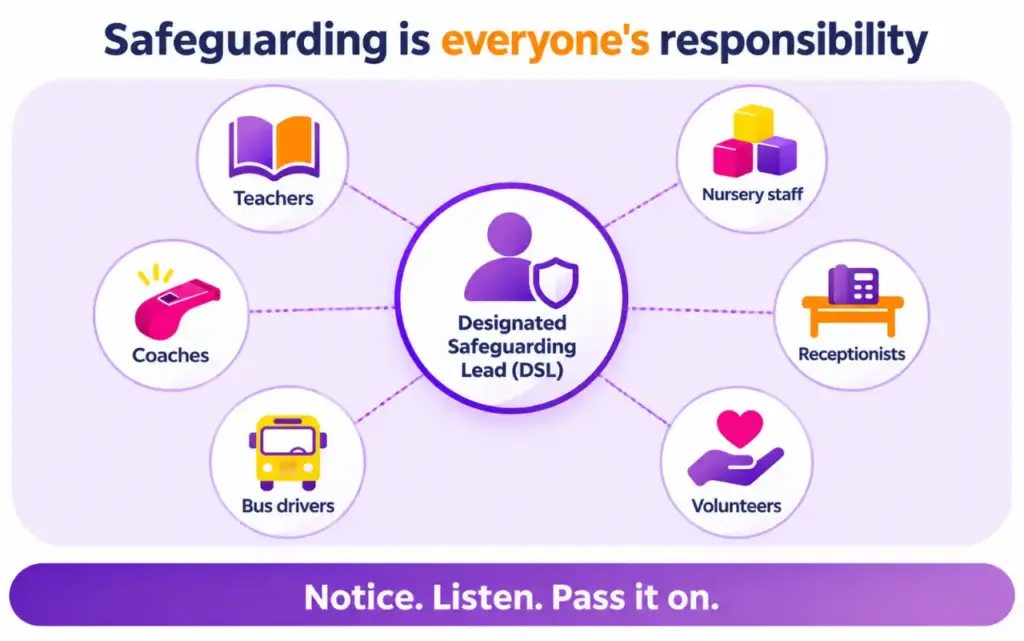
Anyone who comes into contact with children has a part to play. That means teachers and nursery staff, but also receptionists, cleaners, coaches, bus drivers and volunteers. You don’t need to be an expert. Your job is to notice, listen and pass concerns on. You are not expected to investigate.
Who Has Legal Safeguarding Duties?
In England, specific legal duties sit with organisations rather than individuals:
- Safeguarding partners. The local council, the integrated care board (the local NHS) and the police work together to plan safeguarding in each area.
- Public bodies. Section 11 of the Children Act 2004 requires bodies such as councils, NHS organisations and the police to make sure their work safeguards and promotes children’s welfare.
- Schools and colleges must follow Keeping Children Safe in Education, the Department for Education’s statutory guidance.
- Early years settings and childminders must meet the safeguarding and welfare requirements in the EYFS statutory framework.
Scotland, Wales and Northern Ireland have their own arrangements, covered further down.
What Does A Designated Safeguarding Lead Do?
Most schools, nurseries and organisations working with children have a named safeguarding lead, often called the Designated Safeguarding Lead (DSL). This person takes the lead on safeguarding, supports staff who have worries and decides when to refer a concern to children’s social care or the police. If you’re new to a setting, find out who your DSL is on your first day.
Running a home-based childcare setting? Safeguarding Training for Childminders: What Ofsted Expects sets out the training and records inspectors will look for.
Feel Ready for the Moment a Child Speaks Up
Just over two hours of online modules on handling disclosures, assessing risk, referrals and keeping accurate records, studied at your own pace.
View the Safeguarding Children course modules →
What Is Safeguarding in Practice? Everyday Examples
Safeguarding isn’t only about dramatic moments. Most of it happens quietly, every day. Here’s what it can look like in different UK settings:
| Setting | Safeguarding in Action |
|---|---|
| Primary school | A teaching assistant notices that a pupil often arrives hungry and has stopped joining in at playtime. She records her observations factually and reports them to the Designated Safeguarding Lead (DSL) the same day. |
| Nursery | Staff follow the nursery’s mobile phone and photography policy, ensuring children’s images are not taken using unauthorised personal devices. |
| Childminder | A childminder records an unexplained bruise, notes the parent’s explanation and dates the entry. Any safeguarding concern is assessed and escalated according to the setting’s procedures. |
| Football club | The club appoints a welfare officer, maintains a code of conduct and follows safeguarding procedures to prevent inappropriate one-to-one situations in changing rooms. |
| Online | A secondary school teaches pupils how to block and report harmful accounts, recognise online risks and use appropriate website filtering and safety settings. |
| At home or nearby | A neighbour concerned that a child is regularly left alone for long periods contacts the NSPCC helpline for safeguarding advice. |
None of these steps is complicated. Together, they make it much harder for harm to go unnoticed.
Phones, games and group chats bring new risks home. Online Safety for Children: A Practical Guide for Parents and Staff shares simple steps that help.
What to Do If You're Worried About a Child: The 5 Rs
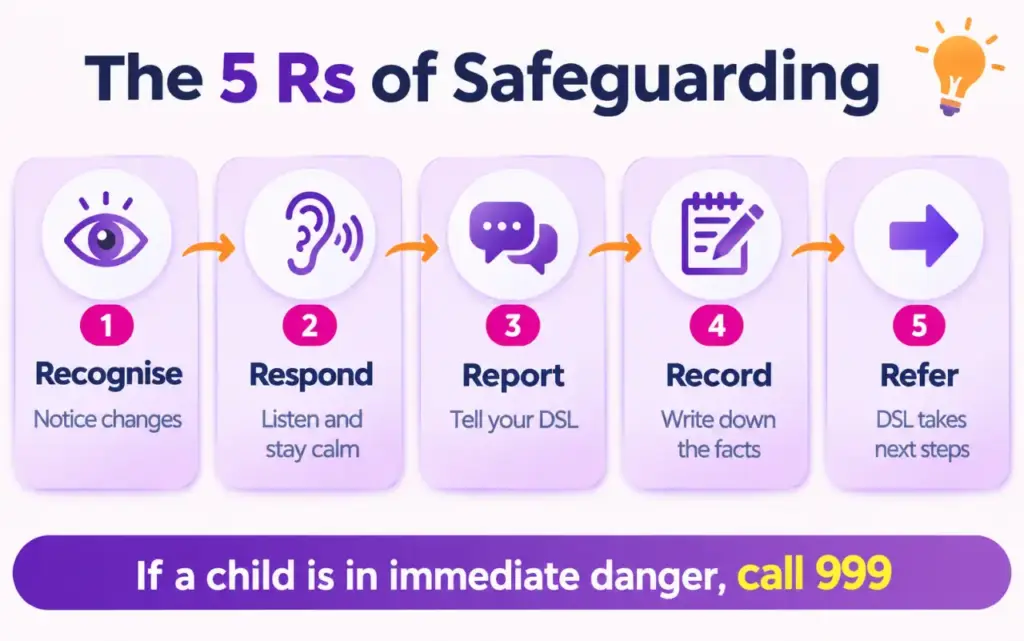
If something doesn’t feel right, the 5 Rs offer a simple order to follow. Some organisations word them slightly differently, so always follow your own setting’s policy.
- 1. Recognise. Notice changes in a child’s behaviour, mood, appearance or what they say. You don’t need proof. A worry is enough.
- 2. Respond. If a child tells you something, stay calm and listen. Let them talk in their own words and avoid leading questions such as “Did your dad do this?”. Tell them they’ve done the right thing by speaking up. Never promise to keep it a secret.
- 3. Report. Tell your DSL or safeguarding lead as soon as possible, ideally the same day. If a child is in immediate danger, call 999.
- 4. Record. Write down what you noticed or what the child said, using their exact words. Add the date, the time and your name. Stick to facts, not opinions.
- 5. Refer. Your DSL decides on the next steps, which may include a referral to children’s social care or the police.
What Happens After You Report A Concern?
Once you’ve passed on your concern, the DSL looks at it alongside any other information the setting holds. If they believe a child may need help or protection, they contact the local council’s children’s social care team. In many areas, referrals go through a multi-agency safeguarding hub (MASH), where council, police and health staff share information.
If the concern is about a member of staff or a volunteer, it goes to the local authority designated officer (LADO), who oversees how allegations against adults working with children are handled.
You may not hear the outcome. That’s normal, because information is only shared with people who need it.
If You’re Worried But Don’t Work with Children
Parents, relatives and neighbours can report child abuse to the local council directly. You can also contact the NSPCC helpline for advice on 0808 800 5000. Children and young people can call Childline for free on 0800 1111.
Common Safeguarding Frameworks and Acronyms Explained
Safeguarding training often uses short memory aids. They’re handy, but they aren’t legal tests, and trainers use them in slightly different ways.
| Term | What It Stands For | Where It Comes From | Mainly Applies To |
|---|---|---|---|
| 5 Rs | Recognise, Respond, Report, Record and Refer. | A commonly used safeguarding training framework. The wording and order can vary between organisations. | Children and adults at risk. |
| 6 principles | Empowerment, Prevention, Proportionality, Protection, Partnership and Accountability. | The statutory guidance accompanying the Care Act 2014 in England. | Adult safeguarding. |
| 4 Cs (formerly 3 Cs) | Content, Contact, Conduct and Commerce. | Online safety risk categories reflected in Keeping Children Safe in Education guidance. | Children’s online safety. |
A common mix-up is to treat the six principles as rules for safeguarding children. They come from adult safeguarding guidance, although the ideas behind them are useful everywhere.
You may also come across the “4 Ps” or “PENS”. There’s no single official meaning for either, and different training providers use them in different ways, so follow the version your organisation uses.
How Often Should Safeguarding Training Be Refreshed?
The heart of safeguarding is the same across the UK, but each nation has its own laws, guidance and terms. Always follow the guidance for the nation you work in.
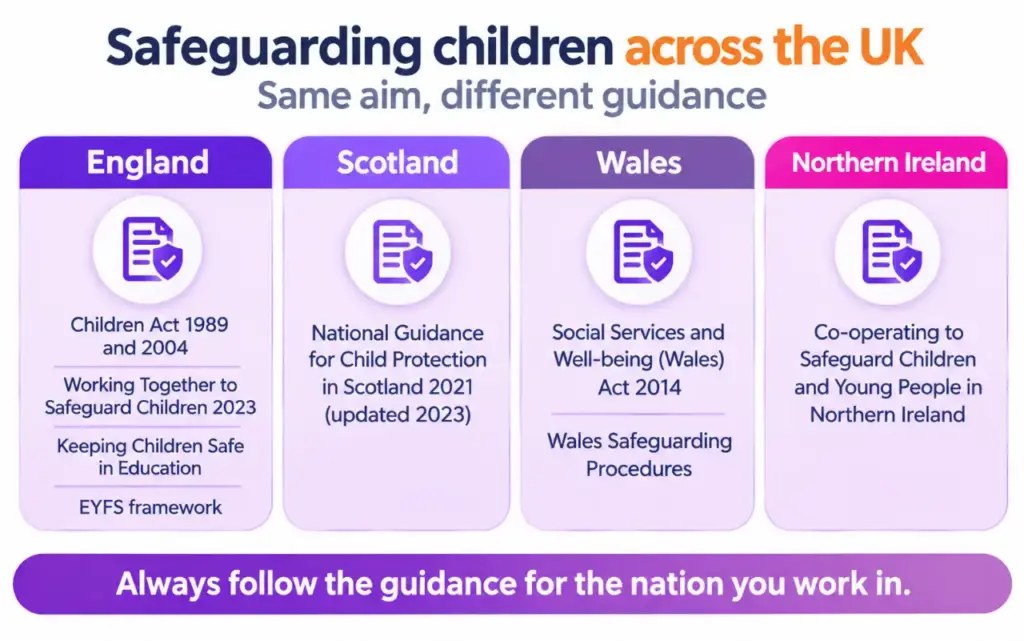
| Nation | Key laws and guidance for safeguarding children |
|---|---|
| England | Children Act 1989 and Children Act 2004; Working Together to Safeguard Children 2023; Keeping Children Safe in Education (schools); EYFS framework (early years) |
| Scotland | National Guidance for Child Protection in Scotland 2021 (updated 2023) |
| Wales | Social Services and Well-being (Wales) Act 2014; Wales Safeguarding Procedures |
| Northern Ireland | Children (Northern Ireland) Order 1995; Co-operating to Safeguard Children and Young People in Northern Ireland (Department of Health statutory guidance) |
Inspection bodies differ too. Ofsted inspects schools and childcare in England, while Scotland, Wales and Northern Ireland each have their own inspectorates.
Do You Need Safeguarding Training?
If you work or volunteer with children, the answer is almost always yes. Schools, nurseries, childminders, clubs and charities usually expect staff and volunteers to complete safeguarding training, and many are required to provide it.
There isn’t one national “levels” system for safeguarding training that covers every sector. The training you need depends on your role and where you work, so check with your employer or the organisation you volunteer with.
An online course can be a helpful foundation alongside your setting’s own induction. Our Safeguarding Children course is CPD-accredited and covers laws and guidance, child abuse, child sexual exploitation, responding to disclosures, risk assessment and record keeping. It doesn’t replace the safeguarding training your employer provides, but it can help you feel more prepared before you start.
Key Takeaways
- What is safeguarding? Keeping children and adults at risk safe from harm and helping them thrive.
- It’s everyone’s responsibility, but specific legal duties sit with organisations.
- If you’re worried, follow the 5 Rs and tell your DSL straight away. In an emergency, call 999.
- Rules vary across the UK, so follow the guidance for your nation and setting.
Ready to feel more confident in your role? Take a closer look at the Safeguarding Children course and study at your own pace.
Frequently Asked Questions About Safeguarding
Yes, for many organisations. Laws and statutory guidance place safeguarding duties on councils, schools, early years settings and other bodies working with children.
No. You must never promise secrecy. Reassure the child, then share what they said only with your safeguarding lead or people who need it.
Answer “what is safeguarding?” in one line: protecting children from harm. Then add that it’s everyone’s responsibility and outline the 5 Rs.
Answer “what is safeguarding?” in one line: protecting children from harm. Then add that it’s everyone’s responsibility and outline the 5 Rs.
It usually means training for staff in regular contact with children. Meanings vary between providers and sectors, so check what your employer expects.
Yes. The NSPCC helpline accepts anonymous reports, though sharing your details can help professionals follow up if they need more information.