




Clinical Coding Audit: 9 Mistakes That Can Affect NHS Data Accuracy
A clinical coding audit examines whether diagnoses and procedures have been recorded using the correct codes and whether those codes follow the relevant NHS standards.
Even a small mistake can affect the accuracy of healthcare information. For clinical coders, understanding how errors happen is essential for producing reliable records and supporting better data quality.
An audit may uncover incorrect diagnosis selection, missing codes, poor sequencing, unsupported code assignments or problems with clinical documentation. This guide explains nine errors that auditors may identify, why they happen and what can help prevent them.
Table of Contents
What Is a Clinical Coding Audit?
A clinical coding audit is a review of coded healthcare records to assess whether the assigned codes accurately represent the information in patient documentation and follow applicable coding standards.
In NHS England, approved clinical coding auditors examine coded inpatient and day-case records using the relevant audit methodology. They assess diagnosis codes, procedure codes, sequencing and whether the coded information is supported by the available documentation.
Two main classification systems are used:
- ICD-10: Classifies diseases, diagnoses and other health conditions.
- OPCS-4: Classifies surgical procedures and other healthcare interventions.
SNOMED CT is different. It provides structured clinical terminology used to record and share clinical information; it is not interchangeable with ICD-10 or OPCS-4.
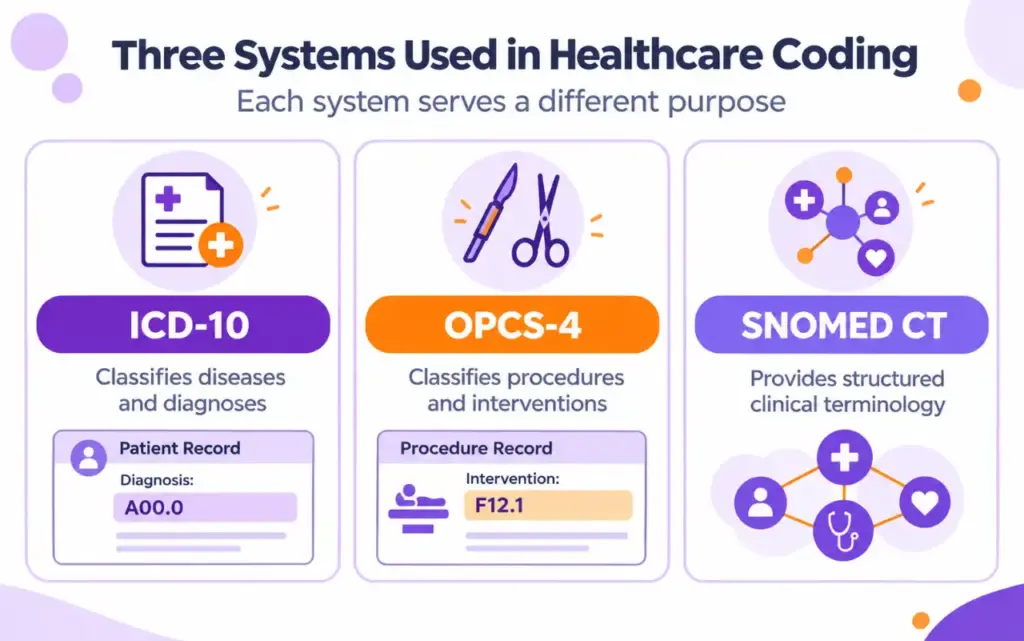
The audit also examines how coding was carried out. This helps organisations identify whether an error came from an individual coding decision or an external problem, such as unclear documentation or an unsuitable local process.
Different conditions require specific ICD-10 codes, making accurate selection essential.
Why Does Clinical Coding Accuracy Matter?
Accurate coding helps NHS organisations maintain reliable information about patient conditions, treatments and hospital activity. This information supports healthcare reporting, service planning, research, clinical governance and financial planning.
When codes are incorrect or incomplete, the recorded information may not reflect the care provided. This can affect reports and make it harder for organisations to assess their activity accurately.
Accurate hospital coding is essential not only for reporting but also for reimbursement, as understanding how HRG codes influence NHS payments helps explain how clinical activity translates into funding.
Clinical coding accuracy also depends on more than the coder’s knowledge. Clear clinical records, suitable coding policies, current classification references and effective review processes all contribute to reliable results.
For example, a procedure may be recorded correctly in an operating note but assigned an unsuitable OPCS-4 code. An audit can identify the difference between the documented procedure and the coded record.
9 Common Clinical Coding Errors Auditors May Identify
A clinical coding audit can uncover several types of inaccuracies. The following nine examples cover diagnosis selection, code assignment, sequencing, procedure coding and documentation-related problems.
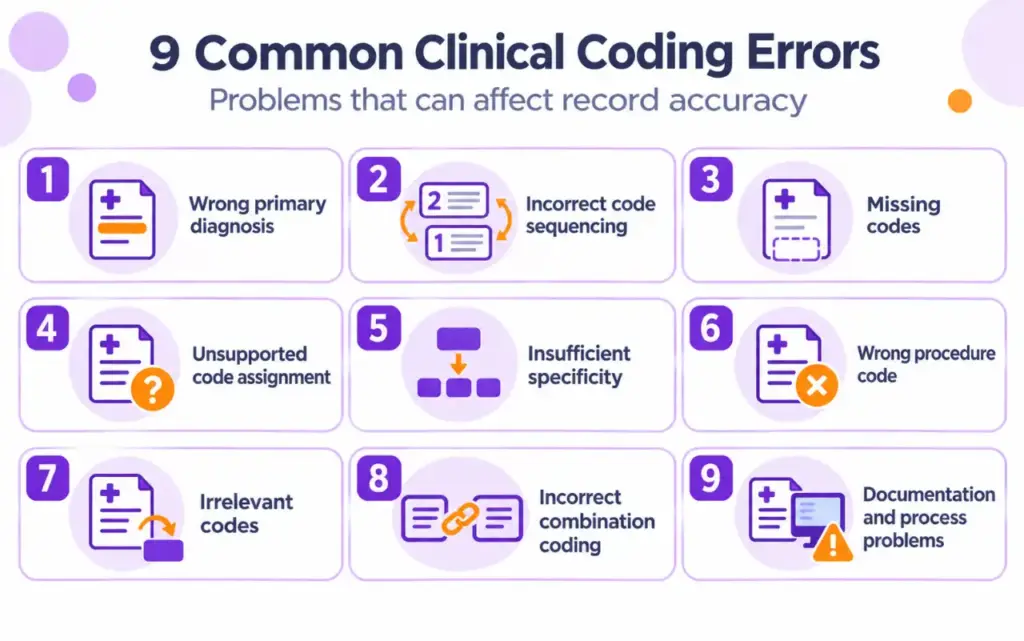
1. Selecting the wrong primary diagnosis
The primary diagnosis is the main condition treated or investigated during the relevant healthcare episode, according to the applicable ICD-10 coding standard.
An error occurs when the coded record identifies a different condition as the primary diagnosis without sufficient support from the clinical information.
Example: A patient is admitted for treatment of cellulitis, but another recorded condition is selected as the primary diagnosis even though the coding rules and clinical record support cellulitis as the main condition.
NHS England’s 2026 ICD-10 National Clinical Coding Standards explain the primary diagnosis definition and how it should be applied.
Coders must review the relevant documentation and follow the classification instructions rather than selecting a diagnosis simply because it appears first in a medical note.
2. Incorrect sequencing of diagnosis or procedure codes
Sequencing means arranging assigned codes in the correct order according to the relevant classification rules. An audit may identify a problem when the right codes are present but their order does not follow the required instructions.
Example: A procedure record contains the necessary procedure and additional site codes, but they are arranged incorrectly.
This is important because code order can affect how healthcare activity is interpreted and reported. The correct sequence depends on the applicable ICD-10 or OPCS-4 instructions. Coders should therefore consult the relevant national standards rather than rely on memory alone.
3. Omitting relevant diagnosis or procedure codes
An omitted code means relevant information from the clinical record has not been represented in the coded record when the applicable rules require it.
Example: A patient undergoes a documented procedure, but the corresponding procedure code is missing from the completed record.
Missing information can make the coded record incomplete and affect the accuracy of healthcare reporting. Auditors review the documentation against the assigned codes to identify relevant information that has been left out.
However, not every condition mentioned in a medical record automatically requires a separate code. The relevant classification rules and episode details determine what should be included.
4. Assigning codes without supporting clinical documentation
Every assigned code should be supported by the information available in the relevant clinical record. An unsupported code may appear when a coder makes an assumption or selects a diagnosis that the documentation does not justify.
Example: A diagnosis appears in the coded record, but the available notes do not contain sufficient information to support that assignment.
This type of finding requires careful investigation. The issue may involve the coding decision, unclear clinical wording or missing information from the original record. Coders should not invent clinical details to complete a record. Where clarification is needed, they must follow the organisation’s approved procedures.
5. Using codes that lack the required specificity
A code may be too general when the clinical documentation contains more precise information that should be reflected in the final code.
Example: The record identifies a more specific location or type of condition, but the coded entry uses an unspecified category without a valid reason.
This can reduce the usefulness of healthcare information and affect the accuracy of reporting. However, coders must not add details that are absent from the clinical record. The correct level of specificity depends on what has been documented and what the classification permits. The applicable ICD-10 coding instructions should guide the final decision.
6. Selecting the wrong OPCS-4 procedure code
OPCS-4 coding errors occur when the selected procedure code does not accurately represent the intervention documented in the clinical record. The procedure’s purpose, method, anatomical site and other recorded details may affect code selection.
Example: An operating note records a particular intervention, but the assigned OPCS-4 code describes a different procedure.
This may happen when a coder relies on a broad procedure description without reviewing the full documentation and relevant classification instructions.
The NHS Classifications Browser provides access to the current classifications and national coding standards. For England, the 2026 OPCS-4.11 classification and relevant standards should be used for coding covered by that version.
The selected procedure code must accurately represent the documented intervention, with OPCS-4 codes for medical procedures helping distinguish between treatments, operations and other clinical interventions for reliable reporting.
Interested in practical procedure coding exercises?
The Clinical Coding: PCS 3M Workshop covers practical procedure-coding scenarios, including a range of surgical and clinical interventions.
Want to prepare for a career in clinical coding?
Study clinical terminology, coding classifications, documentation and confidentiality through flexible online training covering the foundations of clinical coding.
- Clinical terminology
- Coding classifications
- Documentation
- Confidentiality
7. Assigning irrelevant or unnecessary codes
An irrelevant code is one that does not appropriately represent the clinical information or the episode being coded.
Example: A code is included in a patient’s record even though the available documentation does not establish its relevance to that episode.
This is different from omitting a code. An omission involves leaving out relevant information, while an irrelevant assignment involves including information that should not be coded for the episode.
Auditors may report these findings and provide examples for training and improvement. Their treatment in accuracy calculations depends on the applicable audit methodology. Coders should follow the classification rules and avoid adding codes simply to make a record appear more detailed.
8. Incorrect use of combination codes or multiple coding instructions
Some ICD-10 entries represent more than one related aspect of a condition. These are known as combination codes.
Other situations require additional codes because the classification contains specific instructions. An error may occur when a coder selects an unsuitable combination code or fails to follow an instruction requiring another code.
Example: A record describes related conditions, but the assigned codes do not follow the applicable combination-coding instructions.
This can lead to incomplete or inaccurate diagnostic information. The correct approach is to review the relevant index, tabular instructions and national coding standards before confirming the assignment. The clinical record must support the final decision.
Consistent coding depends on applying established guidelines to every record, and the standards used in clinical coding help maintain accuracy, consistency and compliance across healthcare settings.
9. Documentation and process-related coding problems
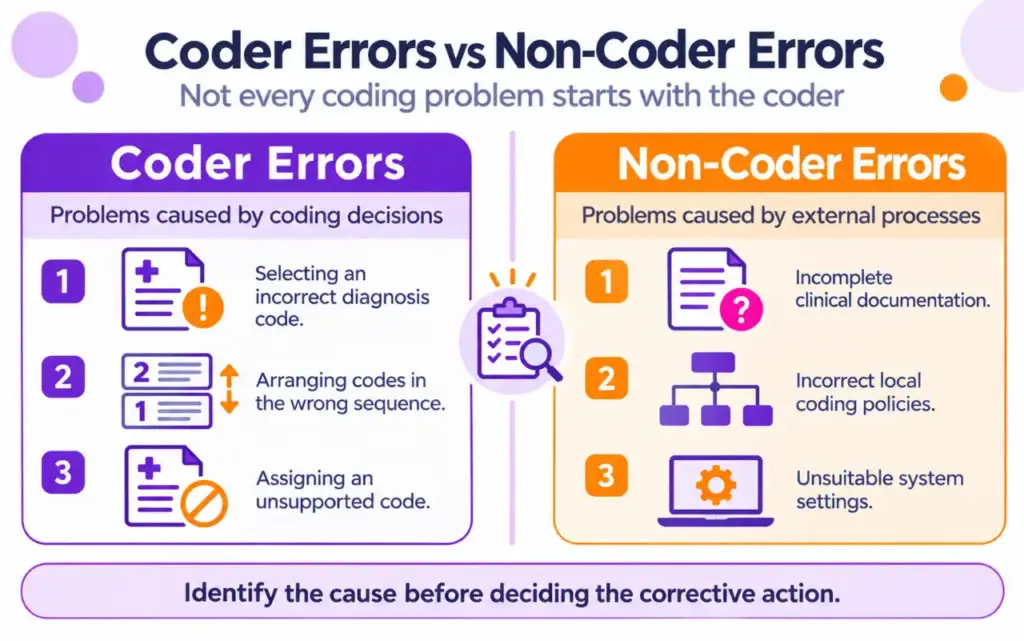
Not every audit finding originates from the individual coder. Some problems arise from incomplete records, unclear clinical wording, unsuitable local policies or system settings.
Example: An encoder system automatically changes the sequence of codes after the coder has assigned them, producing an incorrect final order.
Digital Health and Care Wales distinguishes coder errors from non-coder errors in its clinical coding audit methodology.
This distinction matters because the solution depends on the cause. A coder may need further training, while an organisation may need to improve its documentation procedures, software settings or local coding policy.
How Can Clinical Coding Errors Be Reduced?
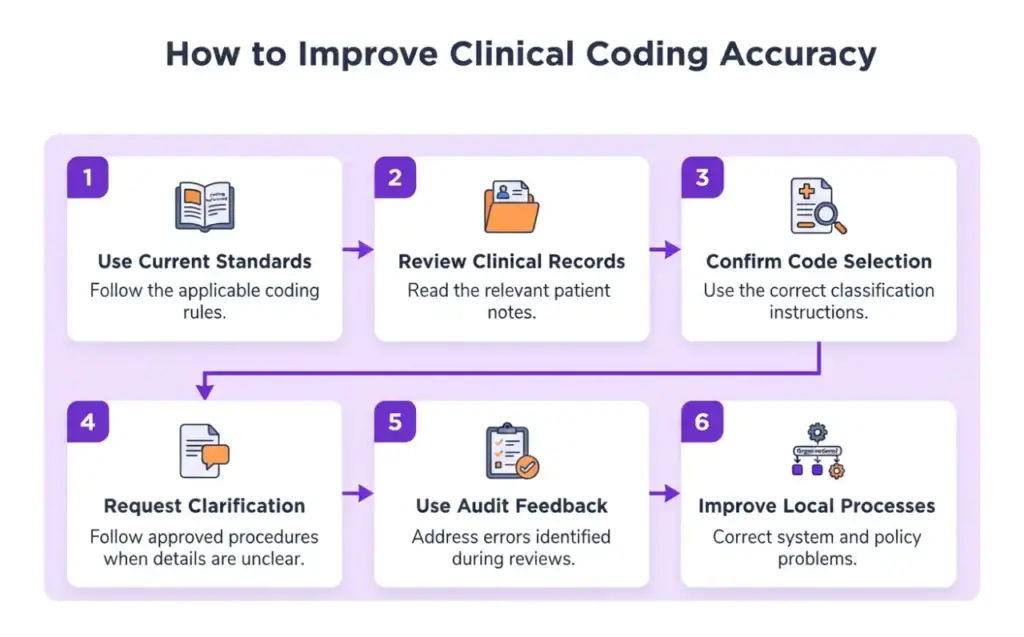
Reducing coding errors requires accurate documentation, consistent procedures and regular quality reviews. The following practices can help:
↪ Use current coding standards: Follow the classification version and instructions applicable to the coding period.
↪ Review the full clinical record: Read relevant notes before assigning diagnosis or procedure codes.
↪ Confirm code selection: Check the classification index, tabular instructions and supporting documentation.
↪ Request clarification appropriately: Follow local procedures when clinical information is unclear or incomplete.
↪ Review audit feedback: Use identified errors to address recurring problems.
↪ Improve local processes: Correct system or policy issues that contribute to inaccurate coding.
Training can also support consistent coding practice. However, introductory online training does not replace the formal employer-led development and approval arrangements required for specialist NHS coding and audit responsibilities.
Conclusion
Accurate coding depends on correct code selection, complete documentation, proper sequencing and consistent use of national standards. A clinical coding audit helps identify where these processes need attention.
The nine examples show why coding accuracy involves both individual decisions and organisational systems. Regular reviews, suitable training and corrective action can all contribute to more reliable healthcare information.
Frequently Asked Questions About Clinical Coding Audits
A clinical coding audit assesses whether coded healthcare information follows applicable standards and identifies inaccuracies, documentation problems and opportunities to improve data quality.
In England, formal audits under the NHS England framework are conducted by NHS England-approved clinical coding auditors who meet the programme requirements.
NHS England guidance provides for regular audit through a continuous programme or a single audit every 12 months, subject to applicable requirements.
A clinical coding audit examines coded healthcare information. A clinical audit assesses healthcare practice against agreed standards to identify improvements.
Findings are recorded, causes are investigated and recommendations are followed through. Organisations should retain evidence showing how previous audit recommendations were addressed.
Yes. Missing or unclear clinical information can prevent accurate code assignment and may require clarification through the organisation’s approved procedures.
Coder errors arise from coding decisions. Non-coder errors result from external factors, such as unsuitable software settings, local policies or documentation problems.
Audit accuracy is assessed across relevant diagnosis and procedure categories using the applicable methodology, classification standards and prescribed accuracy thresholds.
ICD-10 classifies diagnoses, OPCS-4 classifies procedures, and SNOMED CT provides structured clinical terminology. They serve different but related purposes.