




ICD-10 Codes Explained: A Simple UK Guide with Examples
Ever looked at a medical code such as J06.9 and wondered what it means? These combinations of letters and numbers help healthcare organisations classify medical conditions consistently. If you’re new to healthcare administration or clinical coding, understanding ICD-10 codes is a useful starting point.
ICD-10 codes are standardised codes used to classify diseases, injuries and other health conditions. In the UK, they help clinical coders record diagnoses consistently for healthcare statistics, reporting and service planning. Each code represents a specific classification category, making medical information easier to organise and analyse.
This guide explains how ICD-10 works, how to read the codes and where to find reliable UK examples.
Table of Contents
What Are ICD-10 Codes?
ICD-10 stands for the International Statistical Classification of Diseases and Related Health Problems, Tenth Revision. It is part of a classification system developed by the World Health Organization (WHO).
The World Health Organization’s ICD classification provides a standard way to organise information about diseases, injuries and causes of death.
Instead of relying on different descriptions for the same condition, healthcare organisations can use recognised classification categories.
For example, a doctor might document that someone has asthma. ICD-10 provides codes that distinguish between different classifications of asthma, depending on the available clinical information.
However, a code does not diagnose a patient. Diagnosis is a clinical responsibility, while coding involves classifying information already documented in healthcare records.
The system follows a structured hierarchy. Broad categories group related conditions, while more detailed codes identify particular classifications.
For anyone researching ICD-10 codes in the UK, this distinction matters: accurate code assignment depends on clinical documentation and professional coding standards.
What Are ICD-10 Codes Used for in the NHS?
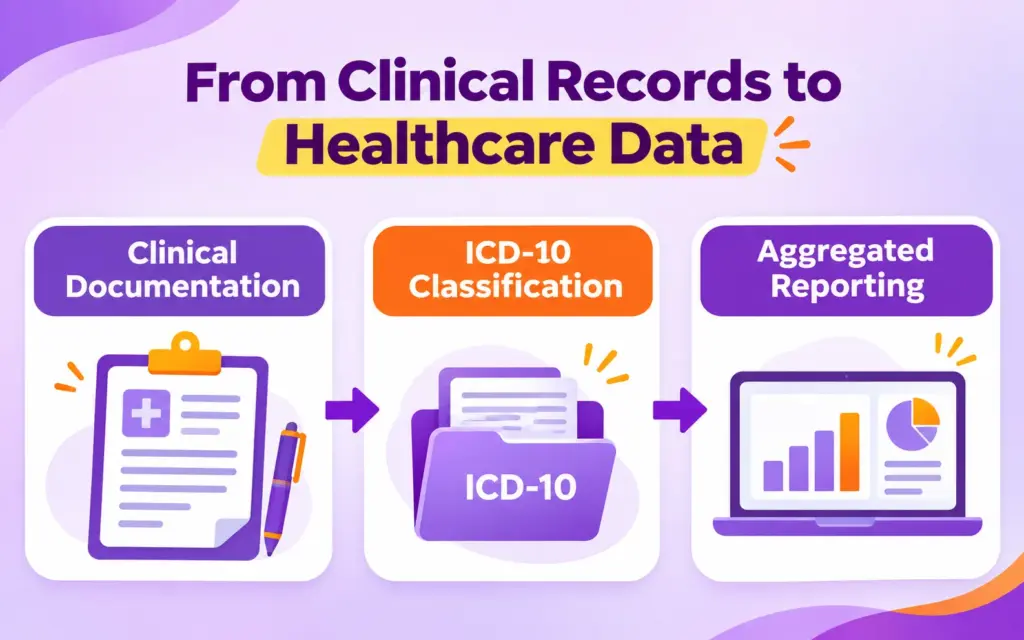
Within the NHS, ICD-10 helps turn clinical documentation into consistent classification data. That information supports reporting, research and healthcare planning.
Recording and Classifying Diagnoses
Clinical coders review relevant medical records and assign codes that represent documented diagnoses according to applicable standards.
For example, a hospital record may contain details about a patient’s main condition alongside other conditions that affected their care.
Coding provides a structured way to classify these diagnoses. It does not replace the original clinical notes, which remain essential for understanding the patient’s care.
The NHS clinical classifications guidance explains how ICD-10 supports standardised healthcare information.
Healthcare Statistics, Reporting and Planning
ICD-10 diagnosis codes help organisations analyse patterns of illness and understand healthcare activity.
They contribute to:
- Healthcare statistics: Comparing information about diseases and health conditions.
- Hospital reporting: Organising diagnosis information across care episodes.
- Service planning: Supporting decisions informed by healthcare activity data.
- Research: Helping analysts study patterns in classified health information.
Diagnosis codes can also contribute to Healthcare Resource Group (HRG) calculations, which are relevant to hospital activity and payment arrangements.
HRG grouping is a separate process that uses clinical coding information alongside other data.
How to Read ICD-10 Codes
Understanding ICD-10 code structure becomes easier when you break a code into its individual parts.
Beginners can start by recognising the chapter, three-character category and any additional characters that provide further detail.
Understanding the Letters and Numbers
Consider this example:
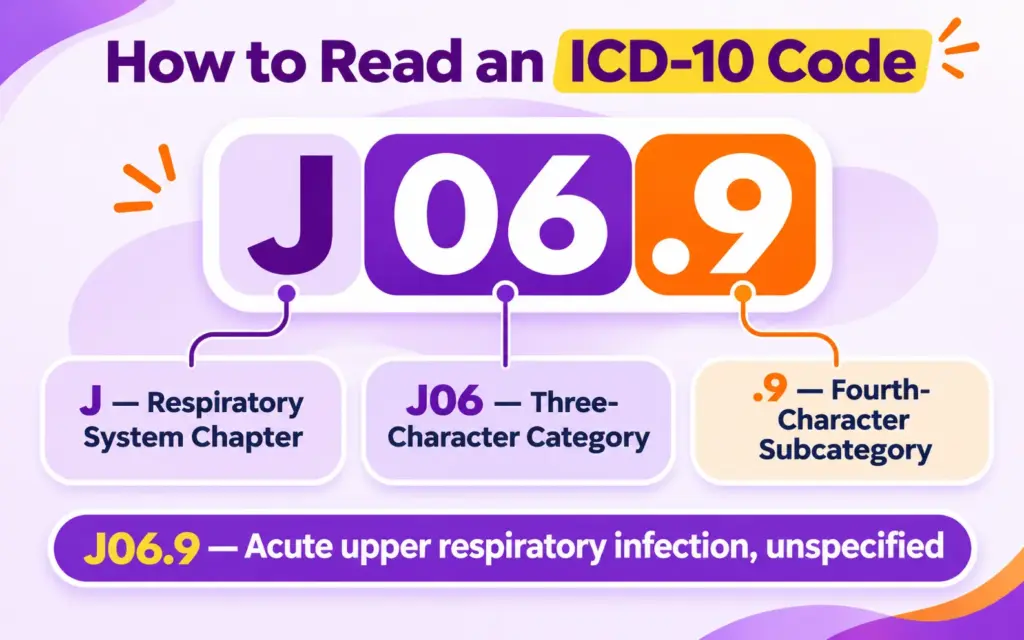
J06.9 — Acute upper respiratory infection, unspecified
The code contains three important elements:
- J: Identifies the chapter covering diseases of the respiratory system.
- 06: Combines with the letter to form category J06, covering acute upper respiratory infections of multiple and unspecified sites.
- .9: Identifies a more specific classification within that category.
The first three characters establish the category. Additional characters help identify the relevant subcategory.
For instance, J06.0 refers to acute laryngopharyngitis, while J06.9 refers to an unspecified acute upper respiratory infection.
These examples appear in the NHS ICD-10 respiratory classification.
Not every ICD-10 code has the same length. Some categories stand alone, while others require additional characters.
What Does an Unspecified Code Mean?
An unspecified ICD-10 code indicates that the classification does not identify a more particular type or detail of the condition.
That does not automatically mean the coding is incorrect. Sometimes, the clinical documentation lacks the information needed to select a more specific classification.
A trained coder must assess the documented diagnosis, relevant classification notes and applicable standards before deciding which code is appropriate.
The important principle is accuracy, not simply choosing the longest or most detailed-looking code.
ICD-10 Code Examples in UK Healthcare
Looking at real ICD-10 code examples can make the classification easier to understand.
The following examples are drawn from NHS ICD-10 classification entries.
| ICD-10 Code | Diagnosis Classification |
|---|---|
| J06.9 | Acute upper respiratory infection, unspecified |
| I10 | Essential (primary) hypertension |
| J45.9 | Asthma, unspecified |
| M54.5 | Low back pain |
| J01.0 | Acute maxillary sinusitis |
These examples show how different medical conditions are represented within the classification.
They are provided for education, not as instructions for selecting codes for individual patients. The correct classification depends on clinical documentation and applicable coding rules.
A Simple Example of How Diagnosis Coding Works
Imagine a hospital record documenting acute maxillary sinusitis.
A clinical coder would review the relevant documentation and search the official classification for the condition.
The classification includes J01.0 for acute maxillary sinusitis. However, the coder would still need to review relevant notes and standards before assigning the code.
This illustrates an important distinction: knowing what a code means is different from deciding whether it belongs in a particular patient’s record.

Where Can You Find ICD-10 Codes in the UK?
The most reliable starting point for UK diagnosis-code lookup is the official NHS classification resource.
Using the NHS Classifications Browser
The official NHS Classifications Browser provides access to ICD-10 classification entries and related coding resources.
To search for a code:
- Open the browser. Visit the official NHS Classifications Browser website.
- Choose the appropriate edition. Select the ICD-10 release relevant to your work.
- Search or browse. Enter a condition or navigate through the classification chapters.
- Review the complete entry. Check the code description, category and any inclusion or exclusion notes.
- Check the coding standards. For professional use, confirm the relevant instructions before assigning a code.
For beginners, browsing categories is helpful because it shows how different conditions fit within the wider classification.
Remember that finding a code online does not establish that it is appropriate for a particular clinical record.
Why the Correct Edition and Standards Matter
Classification releases and coding guidance can change, so using the appropriate edition is essential.
There are also differences across the UK. NHS England’s National Clinical Coding Standards apply in England and are used with some local variation in Wales and Northern Ireland.
Scotland maintains its own clinical coding standards.
Professional coders must therefore follow the guidance applicable to their healthcare system rather than assuming every UK organisation uses identical instructions.
Common ICD-10 Coding Mistakes to Avoid
Even when someone understands the code format, assigning diagnosis codes requires careful attention to detail.
Common mistakes include:
- Using an incorrect category: Choosing a related condition rather than the documented diagnosis.
- Ignoring classification notes: Missing instructions that affect code selection.
- Using an unsuitable edition: Relying on outdated or inapplicable reference material.
- Assuming unspecified means incorrect: Choosing unnecessary specificity without sufficient documentation.
- Mixing UK and US systems: Applying ICD-10-CM conventions directly to NHS ICD-10 coding.
Accurate coding also depends on understanding clinical terminology and the information recorded by healthcare professionals.
The National Clinical Coding Standards for ICD-10 provide official instructions for morbidity coding in NHS England.
These professional standards go beyond basic code recognition and are important for maintaining consistent classification practices.
ICD-10 vs OPCS-4, SNOMED CT and ICD-10-CM
Several healthcare coding and terminology systems appear similar, but they serve different purposes.
ICD-10 classifies diseases, injuries and other health conditions.
OPCS-4 classifies healthcare interventions and procedures. For example, ICD-10 may represent a diagnosed condition, while OPCS-4 can classify a procedure performed during care.
Understanding OPCS-4 helps learners distinguish diagnosis coding from procedure coding, particularly within NHS hospital records.
SNOMED CT is a detailed clinical terminology system used to represent clinical information. It serves a different purpose from ICD-10’s statistical classification and is particularly relevant to structured electronic health records.
ICD-10-CM is a US clinical modification of ICD-10. Its conventions and codes should not automatically be applied to UK clinical coding.
These distinctions help beginners avoid confusing diagnosis classification with procedure coding or detailed clinical terminology.
Is ICD-10 Still Used in the UK?
Yes. ICD-10 remains an established classification used in NHS healthcare reporting and clinical coding.
You may also encounter ICD-11, the newer international revision developed by WHO.
According to the WHO guidance on ICD-11 implementation, ICD-11 came into effect internationally on 1 January 2022. However, this does not mean every country immediately replaced ICD-10.
Healthcare systems manage implementation through their own national processes.
For UK clinical coding, always check the classification edition and national standards currently applicable to the organisation concerned.
Take the Next Step with Clinical Coding
Knowing how to read ICD-10 codes is a useful starting point, but clinical coding involves much more than identifying letters and numbers. It also requires an understanding of medical terminology, clinical documentation, coding standards and how different classification systems work together.
If you want to develop these skills further, Nextgen Learning’s Clinical Coding course offers structured learning covering ICD-10, OPCS-4, SNOMED CT and essential coding principles.
This course supports professional development but does not, by itself, provide a regulated NHS clinical coding qualification or guarantee employment.
Whether you’re exploring a career in healthcare administration or looking to strengthen your existing knowledge, the course can help you develop a clearer understanding of clinical coding practices.
Ready to take your ICD-10 knowledge further? Explore Nextgen Learning’s Clinical Coding course and find out what you’ll study.
Frequently Asked Questions About ICD-10 Codes
ICD-10 provides an international classification framework, but countries may use different modifications and coding standards. The UK uses its applicable ICD-10 classification and national guidance, while the United States uses ICD-10-CM for diagnosis coding.
An unspecified code identifies a condition without a particular level of detail. It may be appropriate when the documentation does not support a more specific classification.
Anyone can study publicly available ICD-10 codes for educational purposes. However, assigning codes within professional healthcare records requires appropriate knowledge, access, responsibility and adherence to the relevant coding standards.
Yes. Classification releases and accompanying guidance can be revised. Professional coders should check the edition relevant to their work and consult current national standards rather than relying on old code lists.