




OPCS Codes: Meaning, Structure and Clinical Examples
When a patient undergoes surgery or another medical procedure, hospitals need a consistent way to record what happened. A written description provides essential clinical information, while standardised codes help organise, analyse and report that information.
This is where OPCS codes come in. They allow clinical coders to classify documented procedures using a recognised UK healthcare system.
For anyone new to clinical coding, this guide explains what OPCS codes mean, how they’re structured, and how to interpret practical examples using current NHS guidance.
Quick Answer: OPCS codes classify surgical procedures and healthcare interventions using standardised alphanumeric codes. The OPCS-4 system is used in UK healthcare to support consistent clinical reporting, hospital activity analysis and NHS resource planning. Procedure codes can also contribute to healthcare resource grouping, which informs NHS payment and resource allocation processes.
Table of Contents
What Are OPCS Codes?
OPCS codes are standardised alphanumeric codes used to classify surgical procedures and healthcare interventions in the UK. They belong to OPCS-4, formally known as the OPCS Classification of Interventions and Procedures.
The classification provides a consistent way to represent information about procedures performed during patient care.
For example, a clinician might document that a patient underwent a colonoscopy. A clinical coder reviews the documentation and uses the classification and applicable rules to identify the appropriate code.
This allows similar procedures to be recorded consistently across healthcare organisations.
OPCS-4 refers to the classification system, while OPCS-4.11 identifies the version introduced on 1 April 2026.
These codes are more than abbreviations for medical procedures. Each code belongs to a structured classification, and its correct use depends on the procedure details and relevant coding instructions.
What Are OPCS Codes Used for in the NHS?
OPCS procedure codes help NHS organisations turn detailed clinical information into consistent healthcare data.
Their main uses include:
- Recording procedures: Classifying surgical operations, diagnostic examinations and other interventions.
- Healthcare reporting: Supporting consistent information about hospital activity.
- Service planning: Helping organisations understand which procedures are being performed.
- Data analysis: Supporting comparisons of healthcare activity across services and reporting periods.
- Resource management: Contributing to information used for healthcare resource grouping and payment processes.
For example, hospitals can analyse coded procedure information to understand patterns in surgical activity and support decisions about service capacity.
OPCS codes also contribute to Healthcare Resource Group (HRG) calculations. HRGs bring together information about healthcare activity and resource use, helping support aspects of NHS payment and planning.
However, an OPCS code does not independently determine the payment for a patient’s treatment. Other information and grouping rules also contribute.
The relationship between procedure coding and NHS payments is covered in the related article HRG Codes Explained: How Coding Decides NHS Payments.
How Are OPCS-4 Codes Structured?
OPCS-4 codes follow a structured format that helps identify and organise different healthcare procedures.
Understanding the Letters and Numbers
A typical OPCS-4 code contains four alphanumeric characters, displayed with a decimal point before the final character.
Consider this example:
H22.9 — Unspecified
In the official OPCS-4.11 Tabular List, H22.9 has the standalone title “Unspecified” within its parent category, H22 — Diagnostic endoscopic examination of colon during colonoscopy.
An explanatory description of H22.9 is therefore unspecified diagnostic endoscopic examination of the colon during colonoscopy. This combines the parent category’s meaning with the four-character code title; it is not the verbatim standalone title.
The code structure works as follows:
- H: Identifies Chapter H, covering the lower digestive tract.
- H22: Identifies the category for diagnostic endoscopic examination of the colon during colonoscopy.
- .9: Identifies the unspecified subdivision within that category.
The complete code, H22.9, represents a particular classification entry.
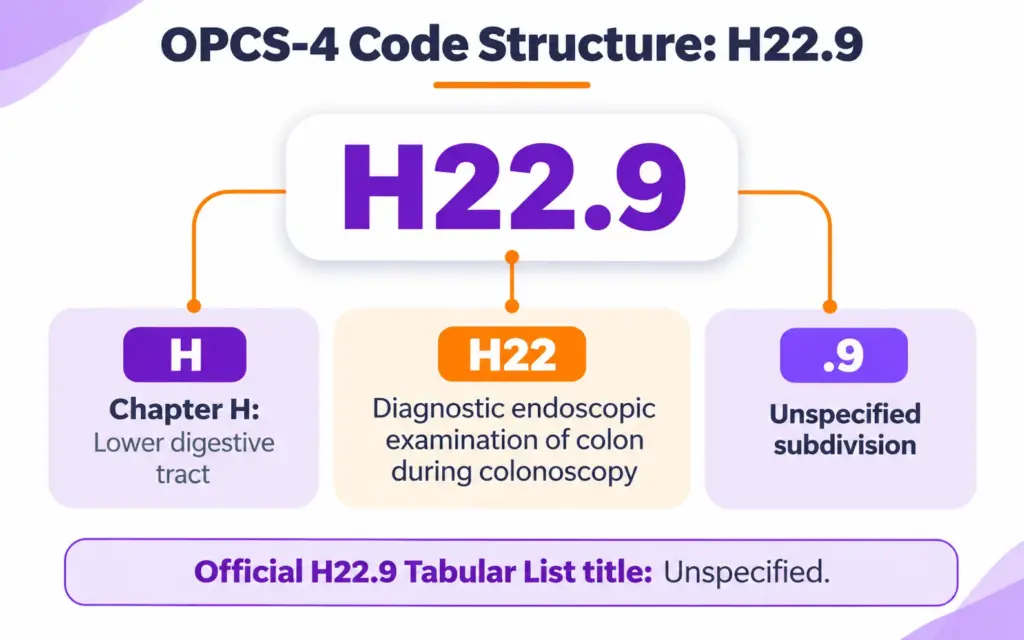
The decimal point is used to display the code clearly. It is not counted as one of the four alphanumeric characters.
Understanding this structure helps readers navigate the classification, but code selection must always follow the relevant instructions.
The official OPCS-4.11 classification requirements provide further technical information.
OPCS-4 Chapters and Subsidiary Codes
OPCS-4 organises procedures into chapters covering anatomical systems and different types of intervention.
For example, Chapter H covers the lower digestive tract, Chapter K covers the heart, and Chapter M covers the urinary system.
Two additional chapters provide important supporting information:
- Chapter Y: Subsidiary classification of methods of operation.
- Chapter Z: Subsidiary classification of sites of operation.
These codes can describe additional procedural details when required by the classification.
However, a procedure’s anatomical location alone does not always identify the correct code. Its purpose, technique and documented details also matter.
OPCS Coding Examples: How Procedure Codes Work
Practical OPCS coding examples show how the classification works in a clinical setting.
The following examples use codes found in OPCS-4.11 and the 2026 National Clinical Coding Standards.
Example 1: A Diagnostic Colonoscopy
Suppose a patient undergoes a colonoscopy without a separately documented biopsy or therapeutic intervention.
Depending on the clinical record and applicable coding instructions, the relevant classification entry may be:
H22.9 — Unspecified
This belongs to category H22, which covers diagnostic endoscopic examination of the colon during colonoscopy.
The Tabular List also includes Colonoscopy NEC under H22.9. Here, NEC means not elsewhere classified.
The code therefore needs to be understood in the context of its parent category rather than interpreted from the word “Unspecified” alone.
Importantly, this does not mean a coder should automatically choose H22.9 whenever a record mentions a colonoscopy. The documented procedure and applicable coding instructions must support the selection.
If a biopsy or another intervention is performed, different codes or additional instructions may apply.
Example 2: When Additional Procedural Information Is Needed
Consider a colonoscopy involving intubation of the terminal ileum and a biopsy of that area.
The 2026 NHS National Clinical Coding Standards provide a specific example under PCSH2: Colonoscopy with ileal intubation (H22.1).
The required codes are:
- H22.1: Diagnostic fibreoptic endoscopic examination of colon and biopsy of lesion of colon during colonoscopy.
- Z27.6: Ileum.
H22.1 identifies the classified procedure, while Z27.6 provides the additional anatomical site information.
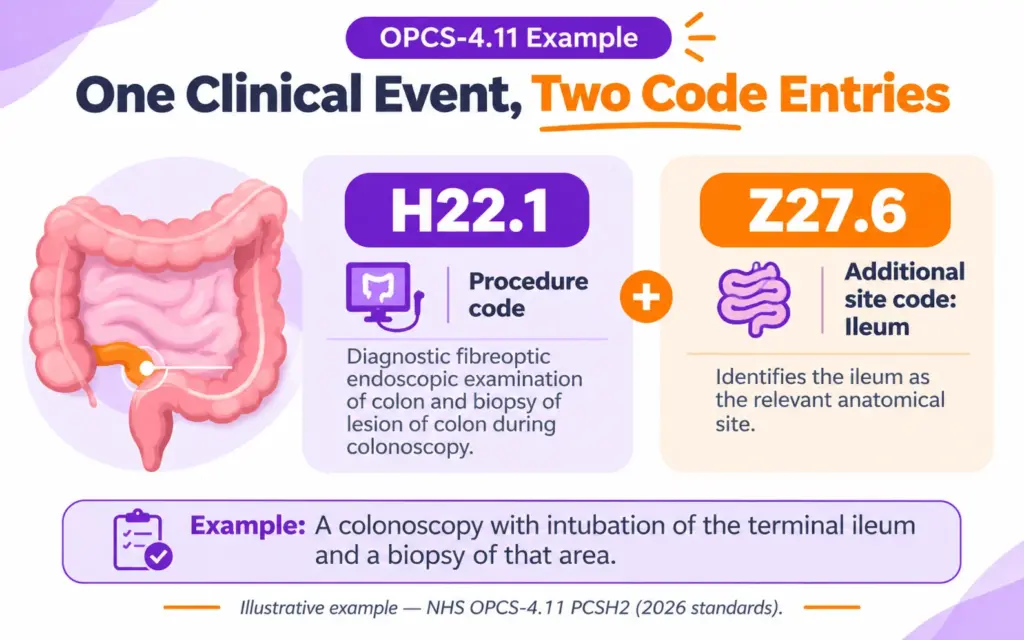
The coding standard also states that a separate code from category G80 for diagnostic examination of the ileum should only be assigned when diagnostic ileoscopy or diagnostic endoscopic examination of the ileum is specifically documented.
This example demonstrates why multiple OPCS codes may be necessary to describe one clinical event correctly.
What These Examples Do Not Tell You
Actual clinical records may contain further information affecting code selection, including the procedure’s purpose, method, site and outcome.
These examples illustrate classification principles rather than replace professional coding instructions.
Readers can check current code entries using the official NHS Classifications Browser.
How to Find an OPCS Code: A Beginner's Process
Finding an appropriate OPCS code involves more than searching for a medical procedure by name.
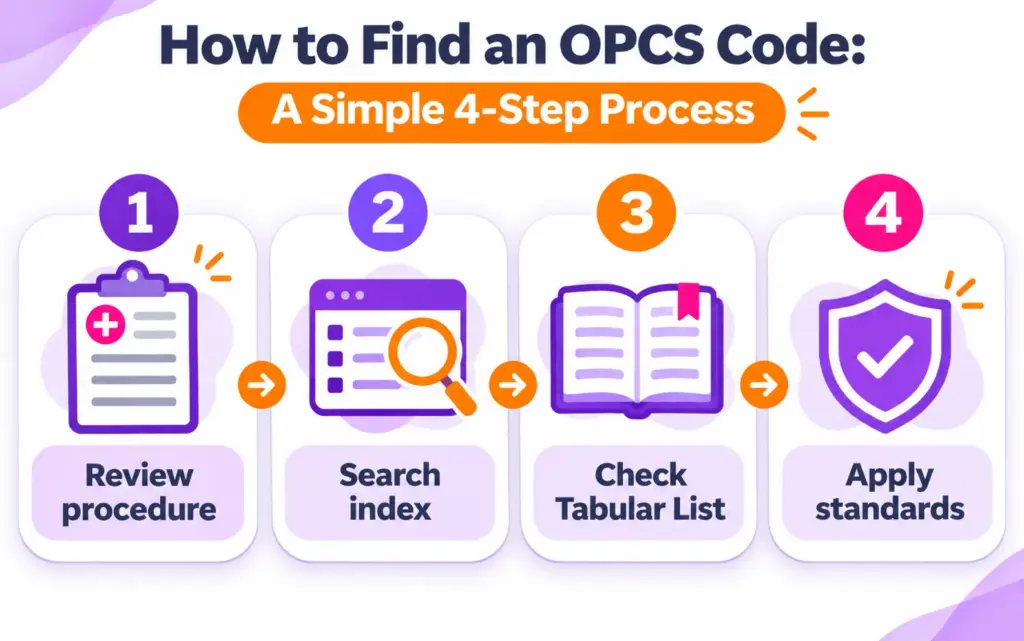
A careful approach includes four stages.
Step 1: Identify the Documented Procedure
Begin by reviewing the clinical record.
Identify the procedure performed, the anatomical site, the method used and any additional interventions.
For instance, the term endoscopy may not provide enough information to identify the correct classification entry.
Coders should work from the documented details rather than making assumptions.
Step 2: Search the Official Classification
OPCS-4 includes an Alphabetical Index to help locate procedures and potential codes.
Search using the appropriate clinical terminology and review any relevant cross-references.
The index helps identify a possible classification entry, but finding a code there does not complete the coding process.
Step 3: Check the Tabular List
After identifying a potential code, confirm it in the Tabular List.
Check:
- The full code and its official description.
- Relevant inclusion and exclusion notes.
- Whether subsidiary or additional codes are required.
- Instructions affecting the procedure or anatomical site.
Two procedures with similar everyday descriptions may have different coding requirements.
Step 4: Apply the Relevant Coding Standards
Confirm the correct classification version and follow the applicable national coding instructions.
NHS England’s National Clinical Coding Standards for OPCS-4 explain the conventions and requirements for procedure coding in England.
Professional code assignment requires appropriate training, careful documentation review and the application of relevant coding standards.
For beginners, understanding this process provides a foundation for studying clinical coding in greater detail.
OPCS Coding Guidelines: Common Mistakes to Avoid
Even familiar procedures can involve coding details that are easy to overlook.
Do Not Select Codes From Descriptions Alone
A code title may appear suitable without satisfying every classification instruction.
Always check the relevant category, inclusion notes, exclusions and coding standards before confirming a code.
Do Not Assume Every Procedure Needs Only One Code
Some interventions require additional codes describing the method, site or other details.
The colonoscopy example involving H22.1 and Z27.6 demonstrates this principle.
However, additional codes should not be assigned simply to provide more information. Their use must follow the applicable coding rules.
Do Not Use Outdated Classifications
OPCS-4 is updated periodically. New versions may introduce, amend or retire classification entries.
Using an outdated code list without checking the version applicable to the reporting period can lead to inaccurate coding.
Do Not Guess When Documentation Is Unclear
Clinical coders should use the available medical record and follow appropriate clarification procedures when required.
Accurate coding depends on reliable documentation and consistent professional practice.
These principles are explored more broadly in Clinical Coding Standards Course: What Really Happens, which addresses professional coding rules and training.
OPCS-4 vs ICD-10: What Is the Difference?
OPCS-4 and ICD-10 are both used in UK clinical coding, but they classify different information.
| Classification | What It Records |
|---|---|
| OPCS-4 | Surgical procedures and healthcare interventions. |
| ICD-10 | Diagnoses, diseases and other health conditions. |
For example, a patient might be admitted with a digestive condition and undergo surgery.
ICD-10 helps classify the diagnosis, while OPCS-4 identifies the procedure performed.
Both systems may contribute to the coded record for the same hospital episode, but neither replaces the other.
The distinction is explored further in the related pillar article ICD-10 Codes Explained: A Simple UK Guide with Examples.
What Is the Current OPCS-4 Version in the UK?
As of November 2026, OPCS-4.11 is the current version, introduced on 1 April 2026.
Classification updates reflect developments in clinical practice and may introduce, amend or retire codes.
NHS England publishes the national clinical coding standards used in England. These are also used in Wales and Northern Ireland, subject to applicable local variations.
Scotland publishes its own clinical coding guidance. Public Health Scotland’s Scottish Clinical Coding Standards 2026 apply to relevant discharges from 1 April 2026.
The applicable classification version and national guidance must therefore be checked when assigning codes.
Developing Your Understanding of Clinical Coding
OPCS-4 is one part of clinical coding. Coders also need knowledge of medical terminology, clinical documentation, diagnosis classification and relevant professional standards.

For beginners interested in these subjects, Nextgen Learning’s Clinical Coding course includes an introduction to OPCS-4 alongside ICD-10 and SNOMED CT.
The course supports introductory learning but should not be confused with a regulated professional qualification, NHS accreditation or a guaranteed route into employment.
Conclusion
OPCS codes help NHS organisations classify healthcare procedures consistently. Understanding their structure, practical examples and coding guidelines provides a useful foundation for studying clinical coding.
For accurate code selection, always consult the current classification, clinical documentation and relevant national standards.
Frequently Asked Questions About OPCS Codes
OPCS-4 refers to the fourth revision of the OPCS Classification of Interventions and Procedures. It is used to classify surgical procedures and healthcare interventions in the UK.
OPCS-4 classifies procedures for healthcare reporting and analysis. SNOMED CT provides detailed clinical terminology used to record and exchange healthcare information.
The differences are discussed in What Is SNOMED CT? A Plain-English Guide for Beginners.
Yes. Some procedures require additional codes to identify the anatomical site, method or other details. The classification and applicable national coding standards determine when multiple codes are necessary.