





Teaching Assistant Salary UK: Hourly Rates, Pay Scale & Earnings
Teaching assistant salary in the UK varies more than most people expect. Pay depends on your level, experience, location, contract type, and whether you work term-time or full-time. Many roles are advertised with hourly rates, while annual salaries are shown as pro-rata figures, which can cause confusion for new and aspiring teaching assistants.
This guide explains exactly how much teaching assistants earn in the UK in 2025. It covers hourly pay, annual salaries, NJC pay scales, Level 1–3 and HLTA rates, London weighting, SEN roles, and how term-time contracts affect take-home pay. You’ll also learn what to expect if you have no experience, how salaries increase over time, and whether teaching assistant pay is above the National Living Wage.
Whether you’re considering becoming a teaching assistant, comparing job offers, or planning your next step in education, this guide gives you clear, up-to-date salary information so you can make informed decisions.
Table of Contents
Teaching Assistant Salary in the UK (2026 Overview)

Teaching assistant salary in the UK in 2026 typically falls between £12.50 and £16.50 per hour, depending on role level, experience, location, and employer. When converted to full-time equivalent (FTE), this equates to roughly £23,000 to £29,000 per year, before adjustments for term-time working.
Most teaching assistants are paid under the National Joint Council (NJC) pay scale, which applies to local authority schools and many academies. Although pay rates increased in recent years, actual take-home pay is often lower than expected because most TAs work term-time only, usually around 38–39 weeks per year.
What is the average teaching assistant salary in 2026?
In practical terms, the average teaching assistant in the UK earns:
- Hourly rate: £13–£15 (outside London)
- Annual FTE salary: £24,000–£27,500
- Typical take-home (term-time): £17,000–£21,000
Higher Level Teaching Assistants (HLTAs) and SEN specialists often earn more, particularly in London and high-cost areas.
Why teaching assistant pay varies across the UK
Teaching assistant pay is not a single national figure. It varies because of:
- Pay band and level (Level 1, 2, 3, HLTA)
- Location, especially London weighting
- Type of school (local authority, academy, independent)
- Contract type (full-time, part-time, term-time)
- Additional responsibilities such as SEN support or class cover
As a result, two teaching assistants doing similar roles in different areas can earn noticeably different salaries.
Key takeaway
- Teaching assistant salary in 2026 is stable, structured, and predictable, but take-home pay depends heavily on contract type and location, not just the headline figure.
Teaching Assistant Hourly Pay vs Annual Salary
Teaching assistant pay in the UK is usually advertised as an hourly rate, but many contracts also show an annual salary. Understanding the difference between the two is essential, as this is where most confusion arises—especially for new or first-time teaching assistants.
Teaching assistant hourly rate explained
In 2026, most teaching assistants earn between £12.50 and £16.50 per hour, depending on their pay band and location. Hourly pay is calculated using the NJC formula, which is based on:
- The full-time equivalent (FTE) salary
- A standard 37-hour working week
- A 52.143-week working year
This hourly rate does not change if you work term-time only or part-time. Two TAs on the same grade will earn the same hourly rate, even if one works fewer weeks or hours.
Full-time equivalent (FTE) salary vs take-home pay
FTE salary represents what you would earn if you worked all year round. However, most teaching assistants work only during school terms. As a result:
- You are paid for fewer weeks per year
- Your salary is pro-rated
- Payments are spread evenly over 12 months
For example:
- An FTE salary of £25,500 may result in a take-home pay of £18,500–£20,000 for a term-time contract.
Why annual salaries look lower than expected
Annual figures often appear low because they reflect actual paid weeks, not the full-year equivalent. This does not mean the hourly rate is reduced—only the number of paid weeks.
Key takeaway
- Hourly pay stays the same
- Annual pay depends on weeks and hours worked
- Term-time contracts reduce yearly income but provide long school holidays
Teaching Assistant Pay Scale Explained (Level 1–3 & HLTA)

Teaching assistant pay in the UK follows a graded structure, with salary increasing as responsibilities, experience, and qualifications grow. Most schools use the NJC (National Joint Council) pay scale, which assigns pay based on spinal column points (SCPs). In 2026, this structure remains the most common across local authority schools and many academies.
Level 1 teaching assistant salary
Level 1 roles are entry-level positions, often suitable for those with no prior school experience. Responsibilities usually include classroom support, preparation tasks, and assisting pupils under supervision.
- Typical hourly rate: £12.50–£13.50
- FTE salary: £23,000–£24,500
- Term-time take-home: £17,000–£18,500
These roles focus on learning the classroom environment rather than leading activities.
Level 2 teaching assistant salary
Level 2 teaching assistants take on more responsibility, such as supporting small groups or working more independently with pupils.
- Typical hourly rate: £13.50–£14.75
- FTE salary: £24,500–£26,000
- Term-time take-home: £18,500–£20,000
Many Level 2 TAs hold a recognised supporting teaching and learning qualification.
Level 3 teaching assistant salary
Level 3 teaching assistants are experienced classroom professionals. They may assist with lesson delivery, track pupil progress, or manage learning activities.
- Typical hourly rate: £14.75–£16.00
- FTE salary: £26,000–£28,500
- Term-time take-home: £19,500–£22,000
This level often leads to specialist or leadership pathways.
A full breakdown of duties and expectations is covered in our article on Level 3 teaching assistant salary and responsibilities.
Higher Level Teaching Assistant (HLTA) salary
HLTAs perform advanced duties, including covering classes, delivering planned lessons, and supporting curriculum areas.
- Typical hourly rate: £16.00–£18.00
- FTE salary: £28,000–£32,000
- Term-time take-home: £21,000–£24,000
SEN teaching assistant salary differences
Teaching assistants working with special educational needs (SEN) pupils may receive higher pay or additional allowances due to increased responsibility and specialist skills.
Key takeaway
- Pay rises steadily from Level 1 to HLTA
- SEN and leadership responsibilities increase earning potential
- Progression is structured and predictable under NJC scales
Those interested in higher-paying SEN roles can explore the pathway in our guide on how to become a SEN teaching assistant.
Teaching Assistant Salary by Location
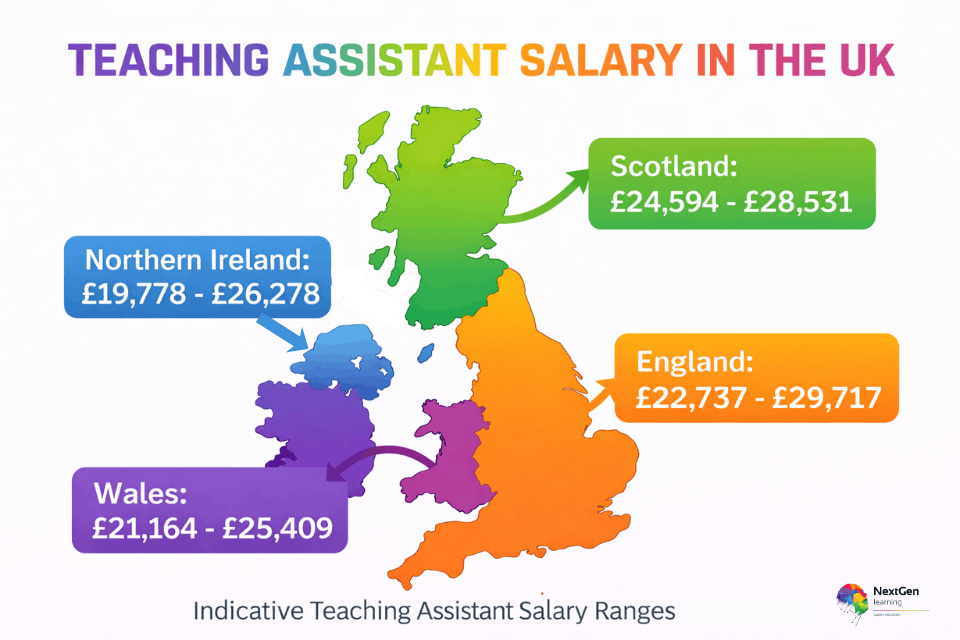
Location has a significant impact on teaching assistant salary in the UK. While the NJC pay scale provides a national framework, actual earnings vary depending on local authority rates, London weighting, and regional cost-of-living adjustments.
Teaching assistant salary in London
Teaching assistants working in London earn more due to London weighting allowances, which are designed to offset higher living costs. In 2026, these allowances remain a key salary differentiator.
- Inner London:
- Hourly rate: £15.50–£18.50
- FTE salary: £28,000–£32,500
- Hourly rate: £15.50–£18.50
- Outer London:
- Hourly rate: £14.50–£17.00
- FTE salary: £26,500–£30,000
- Hourly rate: £14.50–£17.00
Even on term-time contracts, London-based teaching assistants typically earn several thousand pounds more per year than their counterparts elsewhere in the UK.
Teaching assistant salary outside London
Outside London, salaries are lower but more consistent across regions. Most teaching assistants earn within standard NJC bands without additional weighting.
- Typical hourly rate: £12.50–£15.50
- FTE salary: £23,000–£27,500
Pay can still vary by county or city, particularly where local councils set slightly higher starting points to attract staff.
England vs Scotland vs Wales pay differences
Pay structures differ slightly across the UK:
- England & Wales:
- NJC pay scale widely used
- London weighting applies in Greater London
- NJC pay scale widely used
- Scotland:
- Separate local government agreements
- Generally higher starting salaries but fewer term-time-only roles
- Separate local government agreements
- Wales:
- Similar to England but with regional variations
- Similar to England but with regional variations
Key takeaway
- London roles pay more due to weighting allowances
- Regional differences can equal £3,000–£6,000 annually
- Always check local authority pay tables for exact figures
Teaching Assistant Salary With No Experience
Many people considering this role want to know whether they can earn a reasonable income without prior experience. In 2026, it is entirely possible to start as a teaching assistant with no formal school background, and salaries are clearly defined from day one.
Starting salary for teaching assistants
Entry-level teaching assistants usually begin on Level 1 pay bands. These roles focus on classroom support rather than independent teaching duties.
- Typical hourly rate: £12.50–£13.50
- Full-time equivalent (FTE): £23,000–£24,500
- Term-time take-home pay: £17,000–£18,500
Schools do not reduce pay because you are new. Once appointed, you are paid at the rate linked to the role—not your personal background.
What schools look for instead of experience
For entry-level roles, schools often prioritise:
- GCSE-level English and maths (or equivalent)
- Confidence working with children
- Reliability and safeguarding awareness
- Willingness to learn on the job
If you are starting from scratch, our beginner’s guide on how to become a teaching assistant explains the full pathway from entry to employment.
Many teaching assistants gain experience through volunteering, childcare work, or parenting, which schools recognise as transferable skills.
How fast salary increases in the first few years
Salary progression for teaching assistants is typically steady:
- Movement to a higher pay point may happen annually
- Progression to Level 2 or 3 roles can occur within 1–3 years
- Additional duties (SEN support, group work) often increase pay sooner
Key takeaway
- You can start as a teaching assistant with no experience
- Entry-level pay is above minimum wage in most areas
- Salary growth depends more on responsibility than time served
Term-Time, Part-Time & Pro Rata Teaching Assistant Pay

Teaching assistant pay often causes confusion because most roles are not full-year contracts. In 2026, the majority of teaching assistants work term-time only, meaning pay is calculated differently from standard year-round jobs.
What term-time only pay really means
Term-time contracts usually cover 38–39 weeks per year, aligned with the school calendar. You are paid only for the weeks you work, but your salary is spread evenly across 12 months, so you still receive monthly pay during school holidays.
Important points to understand:
- Your hourly rate does not change
- You are paid for fewer total hours per year
- The annual salary shown is pro-rated, not reduced unfairly
For example, an FTE salary of £26,000 may result in a take-home salary of £19,000–£21,000 on a term-time contract.
Do teaching assistants get paid in the holidays?
In most cases, no additional pay is earned during school holidays, but pay is smoothed across the year. This means:
- You are not working during holidays
- You still receive a monthly salary
- The total annual pay remains the same
Some full-year or permanent contracts do include paid holiday leave, but these roles are less common.
Part-time teaching assistant salary explained
Part-time teaching assistants earn the same hourly rate as full-time staff. The only difference is the number of hours worked each week.
- A TA working 20 hours per week earns roughly half the annual salary of a 37-hour role
- Hourly pay remains consistent across grades
Part-time roles are common and often preferred for flexibility.
How pro rata teaching assistant salary is calculated
Pro-rata pay is calculated using:
- Full-time salary
- Hours worked per week
- Number of working weeks per year
Schools and councils apply a standard NJC formula to ensure pay remains fair and consistent.
Key takeaway
- Teaching assistants are not underpaid per hour
- Annual pay reflects hours and weeks worked
Term-time contracts trade income for flexibility and school holidays
Teaching Assistant Salary Progression & Career Growth

Teaching assistant salary progression in the UK is structured rather than performance-based. In 2026, most pay increases follow defined NJC pay points, with additional growth linked to responsibility, qualifications, and role level rather than negotiation.
How teaching assistant pay increases over time
Most teaching assistants progress in one of two ways:
- Annual incremental increases within the same pay band
- Role-based progression to a higher level (Level 2, Level 3, HLTA)
A typical progression timeline looks like this:
- Year 1–2: Level 1 entry role
- Year 2–4: Level 2 or early Level 3 role
- Year 4+: Level 3, SEN specialist, or HLTA
Each step increases hourly and annual pay, provided responsibilities also increase.
Moving from teaching assistant to HLTA
Becoming a Higher Level Teaching Assistant (HLTA) is the most direct way to significantly increase earnings without training as a teacher.
HLTAs:
- Deliver pre-planned lessons
- Cover classes short-term
- Support curriculum areas
This progression can increase annual FTE salary by £3,000–£5,000 compared to Level 3 roles.
Teaching assistant vs teacher salary comparison
Teaching assistants earn less than qualified teachers, but the roles are not directly comparable.
- Teaching assistant (2026 FTE): £23,000–£32,000
- Qualified teacher starting salary: £30,000+
Teachers have longer training routes and higher responsibility, while teaching assistants benefit from:
- Shorter entry pathway
- Term-time working
- Lower workload outside school hours
Key takeaway
- Salary growth depends on responsibility, not time alone
- HLTA roles offer the strongest pay increase
- Teaching assistant roles prioritise stability and flexibility
Skills, Qualifications & Their Impact on Salary
Teaching assistant salary in the UK is closely linked to role level and responsibility, but skills and qualifications strongly influence how quickly you progress and how much you can earn in 2026. While qualifications are not always mandatory to start, they play a key role in pay growth.
Schools increasingly link higher pay and progression to specific classroom competencies, which are outlined in our guide on top skills schools are looking for in teaching assistants in 2026
Minimum qualifications needed to start
Many entry-level teaching assistant roles do not require formal qualifications beyond:
- GCSEs (or equivalents) in English and maths
- Safeguarding awareness
- A DBS check
Schools often value transferable experience, such as childcare, youth work, or parenting, especially for Level 1 roles. Pay is tied to the role itself, not whether you hold a certificate.
A detailed breakdown of required and optional qualifications is explained in our guide on teaching assistant qualifications and entry requirements.
Qualifications that increase teaching assistant pay
Holding recognised qualifications makes it easier to progress to higher-paying roles:
- Level 2 Supporting Teaching and Learning
- Common requirement for Level 2 roles
- Helps secure higher starting pay
- Common requirement for Level 2 roles
- Level 3 Supporting Teaching and Learning
- Often required for Level 3 and HLTA pathways
- Associated with higher hourly rates
- Often required for Level 3 and HLTA pathways
- HLTA status
- Enables class cover and lesson delivery
- Significantly increases earning potential
- Enables class cover and lesson delivery
These qualifications do not automatically raise pay but unlock access to higher-paid positions.
SEN, safeguarding and specialist pay boosts
Specialist skills can lead to additional pay or faster progression, including:
- SEN support experience
- Behaviour management training
- First aid certification
- Speech, language, or autism support skills
Some schools offer SEN allowances or higher pay bands for roles involving complex needs.
Key takeaway
- Qualifications speed up progression rather than guarantee pay rises
- Specialist skills improve access to higher-paid roles
- SEN and HLTA pathways offer the strongest salary growth
Is Being a Teaching Assistant Worth It Financially?
Whether a teaching assistant role is financially worthwhile depends on your expectations, lifestyle needs, and long-term plans. In 2026, teaching assistant pay is stable and predictable, but it is not designed to compete with graduate-level professional salaries.
Teaching assistant salary vs minimum wage
In 2026, the UK National Living Wage sits close to £12 per hour. Most teaching assistant roles pay at or above this level, particularly outside entry-level posts.
- Entry-level TAs usually earn slightly above minimum wage
- Experienced Level 3 and HLTA roles earn well above minimum wage
- London-based roles benefit further from weighting allowances
This places teaching assistant pay in line with many public-sector support roles.
In the UK, minimum and living wage rates are set nationally by the government and reviewed annually, as outlined in the UK government’s National Living Wage guidance.
Benefits beyond salary
Financial value is not limited to take-home pay. Teaching assistant roles often include:
- Term-time working with long school holidays
- Predictable daytime hours
- Local Government Pension Scheme (LGPS)
- Job stability in a high-demand sector
For many people, these benefits offset lower headline salaries compared to private-sector roles.
Who the role is best suited for
Teaching assistant roles are often a good financial fit for:
- Parents balancing work and family life
- Career changers seeking stability
- Those entering education without lengthy training
- People prioritising work–life balance over maximum earnings
Key takeaway
- Teaching assistant pay is modest but reliable
- Financial value improves with progression and location
- The role suits those prioritising stability and flexibility
Teaching Assistant Jobs, Demand & Outlook in the UK
Demand for teaching assistants in the UK remains strong and stable in 2026, driven by ongoing staffing pressures in schools, increased SEN provision, and a continued focus on classroom support roles.
Teaching assistants are a recognised part of the UK education workforce, with role guidance and employment information provided in the UK government’s working in schools guidance.
Demand for teaching assistants in 2026
Schools across England, Wales, and Scotland continue to rely heavily on teaching assistants to:
- Support inclusive education
- Reduce teacher workload
- Provide targeted one-to-one and small-group support
SEN teaching assistants are particularly in demand, with many schools actively recruiting for these roles year-round.
Job security and long-term prospects
Teaching assistant roles are generally considered secure, especially in state-funded schools. While contracts are often term-time only, many posts are:
- Permanent rather than fixed-term
- Renewed year after year
- Protected by local authority employment frameworks
This makes teaching assistant work more stable than many entry-level private-sector roles.
Regional hiring trends
Hiring levels vary slightly by location:
- London and the South East: High demand but higher competition
- Midlands and North of England: Consistent demand with fewer applicants
- Rural areas: Ongoing recruitment challenges, sometimes offering higher starting points
Key takeaway
- Teaching assistant roles remain in steady demand
- SEN experience improves employability
- Job security is strong within the state education system

References
- 1.UK Government – National Minimum & Living Wage Rates
- 2.Local Government Association (LGA) – National Joint Council (NJC) Pay Framework
- 3.UK Government – Working in Schools (Education Employment Guidance)
- 4.Office for National Statistics (ONS) – Earnings and Labour Market Data
- 5.Local Authority Education Pay Scales (Published Council Frameworks)
Frequently Asked Questions
In 2026, the average teaching assistant salary in the UK is around £23,000–£27,500 (FTE). Most teaching assistants work term-time only, so typical take-home pay is £17,000–£21,000 per year, depending on hours, location, and role level.
Teaching assistants in the UK earn £12.50–£16.50 per hour in 2026. Entry-level roles sit at the lower end, while Level 3, SEN, and HLTA roles earn higher hourly rates, especially in London.
Most teaching assistants are on term-time-only contracts. They are not paid extra during school holidays, but their salary is spread evenly across 12 months, so they still receive monthly pay.
Check the hourly rate and applicable age or apprenticeship category. From 1 April 2026, the National Living Wage for workers aged 21 and over is £12.71 an hour. Different rates apply to younger workers and eligible apprentices. See the current government minimum-wage rates.
Hourly rates range from £12.50 to £16.50, depending on grade, location, and responsibilities. London roles typically pay more due to weighting allowances.
Most teaching assistants are paid for 38–39 weeks per year, aligned with school terms. Pay is then averaged across 12 monthly payments.
Level 3 teaching assistants earn £1,500–£3,000 more per year (FTE) than Level 2 roles due to higher responsibility and qualifications.
You usually need GCSE-level English and maths. Formal TA qualifications are not always required to start but help with progression and higher pay.
Level 2 or Level 3 TA qualifications typically take 6–12 months, depending on study method and pace.
Some schools accept equivalent qualifications or relevant experience, but GCSE English and maths are commonly required, especially for progression.
Teaching assistant courses typically cost £300–£800 for Level 2 or 3 qualifications, depending on provider and accreditation.
Pay rises depend on national NJC agreements and local authority decisions. Any increases are usually applied annually and reflected in updated pay scales.
Teaching assistant pay scales are based on NJC spinal column points, which define hourly and annual pay by role level and experience.
Some schools reduce TA numbers due to budget pressures, not reduced demand. SEN and specialist TA roles remain in high demand.
Experience is helpful but not essential. Schools value transferable skills such as childcare, volunteering, and safeguarding awareness.
Yes. Many entry-level teaching assistant roles do not require formal qualifications, though training improves progression and pay.
You can apply directly for Level 1 roles, volunteer in schools, or gain childcare experience. Once hired, pay is the same as other entry-level TAs.
Anyone with the right safeguarding clearance, basic education, and suitability to work with children can apply for teaching assistant roles.
SEN teaching assistants often earn £1–£3 more per hour or receive additional allowances due to specialist responsibilities.


0 responses on "Teaching Assistant Salary UK: Hourly Rates, Pay Scale & Earnings"