





What Is Safeguarding? A Clear Guide for Care, Schools & Health
Safeguarding is the process of protecting people from harm, abuse, neglect, and exploitation. In the UK, safeguarding applies across care, education, health, and social care settings and is a legal and professional responsibility, not a choice.
This guide explains what safeguarding is, who it protects, and how it works in real settings, including care homes, schools, and health and social care services. It also covers key concepts such as safeguarding policies, safeguarding adults and children, contextual safeguarding, and early help.
Whether you work with children, support adults, manage staff, volunteer, or simply want a clear understanding of safeguarding, this page provides a structured, UK-focused explanation. By the end, you will understand why safeguarding matters, what the law requires, and how safeguarding protects people’s safety, rights, and wellbeing.
Table of Contents
What Is Safeguarding? (Definition and Meaning)
Safeguarding definition explained simply
Safeguarding means protecting people from harm, including abuse, neglect, exploitation, and preventable risks. It applies in settings where individuals may be vulnerable, such as education, care, healthcare, social services, community organisations, and online environments.
Safeguarding is not limited to reacting after harm occurs. It focuses on prevention, early identification of risk, and appropriate action to protect people’s safety, rights, and well-being.
Globally, safeguarding is recognised as a core responsibility wherever there is a duty of care. While terminology and legal frameworks differ between countries, the underlying principle is the same: people should be able to live free from harm and abuse.
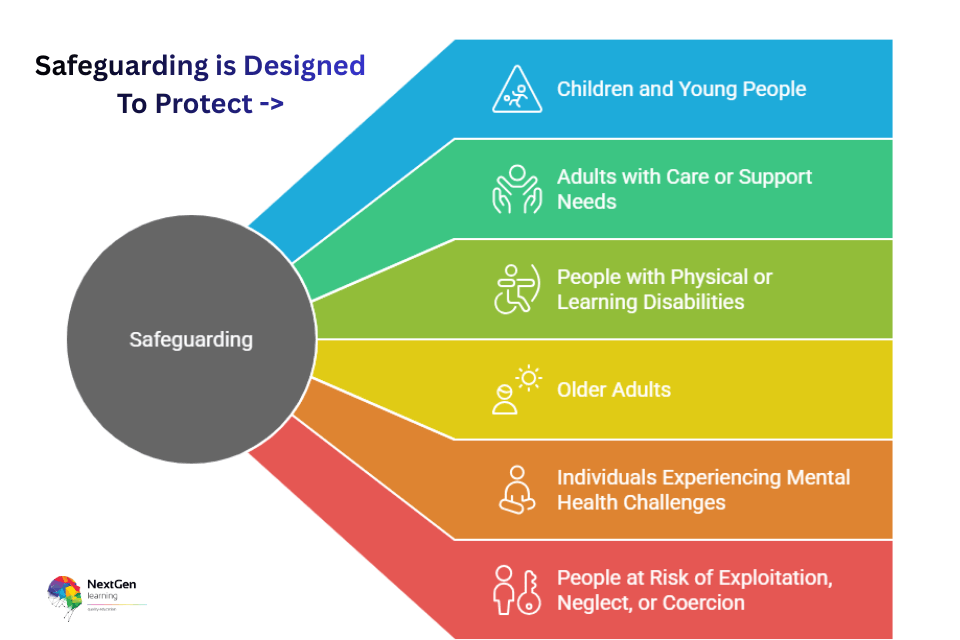
Description
This visual explains who safeguarding is designed to protect, including children and young people, adults with care or support needs, people with physical or learning disabilities, older adults, individuals experiencing mental health challenges, and those at risk of exploitation, neglect, or coercion.
Safeguarding applies to people of all ages and backgrounds. It is particularly focused on individuals who may face higher levels of risk due to personal, social, or environmental factors, including:
- Children and young people
- Adults with care or support needs
- People with physical or learning disabilities
- Older adults
- Individuals experiencing mental health challenges
- People at risk of exploitation, neglect, or coercion
Safeguarding is person-centred, meaning protective actions should respect individual rights, choices, and dignity wherever possible.
How safeguarding works in the UK (legal context)
In the UK, safeguarding has a formal legal and regulatory meaning. It is embedded across care, education, health, and social services through legislation and statutory guidance. UK safeguarding frameworks place a clear duty on organisations and professionals to:
- Prevent harm before it occurs
- Identify concerns early
- Respond proportionately and appropriately.
- Work with other agencies when risks are identified.
UK safeguarding law is often referenced internationally as a structured model, but the core safeguarding principles apply globally across different legal systems and sectors.
Section summary
- Safeguarding means protecting people from harm, abuse, and exploitation
- It is recognised globally wherever there is a duty of care.e
- The UK applies safeguarding through clear legal and professional frameworks.
Why Safeguarding Is Important
Safeguarding is essential because it protects people from harm and helps create environments where individuals are safe, respected, and supported. Without effective safeguarding, abuse and neglect can go unnoticed, allowing harm to continue or escalate.
Preventing abuse, neglect, and exploitation
One of the primary purposes of safeguarding is prevention. Safeguarding measures aim to identify risks early and reduce the likelihood of harm occurring. This includes recognising warning signs, setting clear standards of behaviour, and creating systems that discourage abuse and exploitation.
Safeguarding covers many forms of harm, including:
- Physical abuse
- Emotional or psychological abuse
- Sexual abuse and exploitation
- Neglect
- Financial or economic abuse
- Online and digital harm
By addressing risk factors early, safeguarding helps prevent serious and long-lasting harm.
Protecting rights, dignity, and well-being
Safeguarding is not only about safety; it is also about human rights and dignity. Effective safeguarding ensures that people are:
- Treated with respect
- Listened to and taken seriously
- Supported to make informed choices
- Protected without unnecessary restriction
A safeguarding approach that respects autonomy and proportionality helps individuals maintain control over their lives while still receiving protection when needed.
What happens when safeguarding fails
When safeguarding systems fail, the consequences can be severe. Harm may go unreported, individuals may feel unsafe or unsupported, and trust in organisations can break down. In serious cases, safeguarding failures have led to:
- Long-term physical or emotional trauma
- Repeated abuse or neglect
- Legal action and regulatory intervention
- Loss of public confidence in services
These outcomes highlight why safeguarding is a shared responsibility across organisations, professionals, and communities.
Section summary
- Safeguarding prevents abuse, neglect, and exploitation.
- It protects dignity, rights, and well-being.
- Safeguarding failures can cause serious and lasting harm.
Who Is Safeguarding For?

Safeguarding applies to everyone, but it places particular focus on people who may be more vulnerable to harm due to their age, health, circumstances, or environment. It recognises that vulnerability is not fixed and can change over time.
Safeguarding children
Children and young people are a central focus of safeguarding because they may lack the ability or power to protect themselves. Safeguarding children involves creating safe environments, recognising risks early, and ensuring that concerns are acted on quickly and appropriately.
Safeguarding for children addresses risks such as abuse, neglect, exploitation, bullying, and online harm. It also supports children’s emotional well-being, development, and right to be heard.
Safeguarding adults
Safeguarding adults focuses on protecting individuals who may be at risk due to care or support needs, disability, age, mental health challenges, or social circumstances. Adult safeguarding aims to prevent abuse while respecting independence and personal choice.
Safeguarding adults balances protection with empowerment, ensuring that individuals are supported without being unnecessarily restricted.
Safeguarding vulnerable groups
Safeguarding also applies to people who may be vulnerable due to situational or contextual factors, including:
- Social isolation
- Poverty or homelessness
- Dependency on others
- Exposure to exploitation or coercion
- Unsafe environments, both offline and online
Safeguarding recognises that vulnerability can be temporary and that support should adapt as circumstances change.
Section summary
- Safeguarding applies to children, adults, and wider vulnerable groups.
- Vulnerability can be permanent or temporary.
- Safeguarding supports protection while respecting individual rights
What Is Safeguarding in Care?

Safeguarding in care refers to the measures and practices used to protect people who receive care or support from harm, abuse, neglect, or exploitation. It applies across a wide range of care environments, including residential care homes, domiciliary care, supported living arrangements, and community-based care services.
People receiving care may rely on others for personal, medical, or emotional support, which can increase vulnerability if appropriate safeguards are not in place. Safeguarding in care ensures that individuals are treated with dignity, respect, and fairness, and that their safety and well-being remain central to all care decisions.
Care settings often involve close personal contact, assistance with daily activities, and access to private spaces or personal information. For this reason, clear safeguarding procedures are essential to prevent abuse, reduce risk, and ensure concerns are identified and addressed promptly. Safeguarding in care is not only about responding to incidents but also about creating environments where harm is less likely to occur.
Effective safeguarding in care requires staff and organisations to remain alert to warning signs, follow clear reporting processes, and work collaboratively with other services when concerns arise. It also supports a culture where people receiving care feel safe to speak up, are listened to, and know their concerns will be taken seriously.
Safeguarding responsibilities in care settings
In care environments, safeguarding is a shared responsibility. Organisations and individuals are expected to:
- Create safe care environments
- Follow safeguarding policies and procedures.
- Recognise signs of abuse or neglect.
- Report concerns through the correct channels.
- Act in a timely and proportionate way
Safeguarding responsibilities apply to managers, care workers, support staff, volunteers, and anyone involved in delivering or overseeing care.
Common safeguarding risks in care environments
People receiving care may face increased risk due to dependency on others or reduced ability to speak up. Common safeguarding concerns in care settings include:
- Physical or emotional abuse
- Neglect or poor standards of care
- Financial exploitation
- Medication misuse
- Discrimination or loss of dignity
- Unsafe or unsuitable living conditions
Safeguarding aims to reduce these risks by promoting accountability, oversight, and person-centred care.
How safeguarding protects adults receiving care
Effective safeguarding in care focuses on prevention, early action, and support. This includes:
- Risk assessments tailored to individual needs
- Clear reporting and response procedures
- Involving individuals in decisions about their care
- Working with families, advocates, and external agencies when needed
Safeguarding helps ensure that care supports wellbeing, independence, and safety, rather than increasing vulnerability.
Section summary
- Safeguarding in care protects people receiving support from harm.
- It applies across residential, home, and community care settings.
- Prevention, accountability, and person-centred practice are central.
What Is Safeguarding in Schools?

Safeguarding in schools refers to the actions taken to protect children and young people from harm, while also promoting their welfare, well-being, and development within educational environments. It applies across early years settings, schools, colleges, and other learning institutions, both in physical settings and online learning spaces.
Schools play a critical role in safeguarding because they have regular, sustained contact with children. This places education staff in a strong position to notice early signs of concern, changes in behaviour, or indicators that a child may be at risk. Safeguarding in schools is therefore not limited to responding to serious incidents but also includes prevention, early identification, and timely support.
Safeguarding responsibilities in education extend beyond the classroom. They include creating safe learning environments, maintaining appropriate professional boundaries, supporting emotional well-being, and ensuring that children feel able to speak openly if something is wrong. Effective safeguarding in schools helps reduce barriers to learning and supports positive outcomes for children.
Modern safeguarding in schools also recognises that risks may arise outside the school setting, including online spaces, peer relationships, and community environments. As a result, safeguarding practice in education increasingly focuses on online safety, peer-on-peer abuse, mental health, and wider contextual risks that can affect pupils’ safety and wellbeing.
Safeguarding duties in education
Schools and education providers are responsible for creating environments where children feel safe, supported, and able to learn. Safeguarding duties in education typically include:
- Having clear safeguarding policies and procedures
- Training staff to recognise and respond to concerns
- Maintaining safe recruitment and vetting practices
- Promoting safe behaviour, including online safety
- Responding promptly to safeguarding concerns
Safeguarding in schools is not limited to serious incidents. It also includes early support to address emerging risks.
The role of the Designated Safeguarding Lead (DSL)
Most education settings appoint a Designated Safeguarding Lead (DSL). This person is responsible for overseeing safeguarding practice within the organisation. Their role commonly includes:
- Managing safeguarding concerns and referrals
- Supporting staff with safeguarding decisions
- Liaising with external agencies when required
- Ensuring safeguarding records are accurate and secure.
- Promoting a safeguarding culture across the school
While the DSL leads safeguarding, all staff share responsibility for protecting pupils.
Safeguarding concerns commonly seen in schools
Safeguarding issues identified in schools may include:
- Physical, emotional, or sexual abuse
- Neglect or unmet basic needs
- Bullying or peer-on-peer abuse
- Online harm, including grooming or exploitation
- Mental health concerns
- Attendance or behaviour patterns indicating risk
Safeguarding in schools focuses on acting early, listening to children, and ensuring appropriate support is in place.
Section summary
- Safeguarding in schools protects children’s safety and well-being
- Educational staff play a key role in early identification.
- Safeguarding is a shared responsibility led by designated roles
What Is Safeguarding in Health and Social Care?

Safeguarding in health and social care refers to the systems and actions used to protect individuals from harm, abuse, neglect, or exploitation while receiving medical treatment, care, or support services. It applies across hospitals, clinics, care homes, community health services, social care organisations, and voluntary or third-sector providers.
People using health and social care services may be vulnerable due to illness, disability, age, mental health challenges, or reliance on others for support. Safeguarding in these settings ensures that care is delivered in a way that prioritises safety, dignity, and respect, while also recognising individuals’ rights and choices.
Health and social care professionals are often among the first to identify safeguarding concerns because of their close contact with individuals and families. Effective safeguarding practice requires staff to remain alert to signs of abuse or neglect, follow clear reporting procedures, and share information appropriately when safety concerns arise. Safeguarding in health and social care is not limited to protecting service users; it also helps maintain safe working environments and professional standards.
Safeguarding within these services often involves multi-agency collaboration, ensuring that concerns are addressed holistically and that individuals receive coordinated support across health, social care, and community services.
Safeguarding responsibilities for healthcare professionals
Healthcare and social care workers have a duty to:
- Recognise signs of abuse, neglect, or exploitation
- Respond appropriately to safeguarding concerns.
- Follow safeguarding policies and reporting procedure.s
- Respect confidentiality while prioritising safety
- Act in the best interests of the individual
Safeguarding responsibilities apply to all roles, including doctors, nurses, care workers, social workers, therapists, and support staff.
Safeguarding across health and social care services
Safeguarding in health and social care covers a wide range of risks, including:
- Physical or emotional abuse
- Neglect or inadequate care
- Financial exploitation
- Domestic abuse
- Self-neglect
- Risks linked to mental health or substance misuse
Safeguarding systems aim to ensure that people receive care in environments that are safe, respectful, and responsive to their needs.
Multi-agency safeguarding working
Safeguarding in health and social care often involves multi-agency collaboration. This means different services working together to protect individuals, such as:
- Healthcare providers
- Social services
- Education services
- Law enforcement
- Community and voluntary organisations
Working together helps ensure concerns are shared appropriately and that individuals receive coordinated support.
Section summary
- Safeguarding is a core responsibility in health and social care.
- Professionals must recognise, report, and respond to concerns.
- Multi-agency working strengthens safeguarding outcomes.
What Is Safeguarding Adults?

Safeguarding adults refers to protecting adults who may be at risk of harm due to care or support needs, disability, age, mental health challenges, or personal circumstances. The aim is to prevent abuse and neglect while supporting individuals to live as independently and safely as possible.
Adult safeguarding recognises that vulnerability is not fixed and can change over time. An adult may be at risk temporarily due to illness, bereavement, financial pressure, or social isolation. Safeguarding adults therefore focuses on person-centred approaches that respect choice, autonomy, and dignity while addressing risk appropriately.
Safeguarding adults requires professionals and organisations to balance protection with empowerment. This means involving individuals in decisions that affect them, providing clear information, and ensuring safeguarding actions are proportionate to the level of risk. Effective adult safeguarding also relies on partnership working between health services, social care providers, community organisations, and authorities.
While legal frameworks vary by country, the principles underlying adult safeguarding are internationally recognised and focus on wellbeing, prevention, and accountability.
Adult safeguarding explained
Adult safeguarding focuses on situations where an adult:
- Has care or support needs, and
- Is experiencing, or is at risk of, abuse or neglect, and
- May be unable to protect themselves from harm
Safeguarding adults is person-centred. This means actions should involve the individual wherever possible, respect their wishes, and balance protection with autonomy.
The Care Act 2014 and adult safeguarding (UK context)
In the UK, adult safeguarding is set out in the Care Act 2014, which places a legal duty on local authorities and partner organisations to prevent abuse and neglect. The Act emphasises:
- Early intervention
- Proportionate responses to risk
- Multi-agency cooperation
- Accountability through safeguarding adults boards
While the Care Act is UK-specific, similar adult protection frameworks exist in many countries under health, social care, or human rights legislation.
Examples of adult safeguarding concerns
Adult safeguarding concerns can include:
- Physical, emotional, or sexual abuse
- Financial exploitation or fraud
- Neglect or poor care
- Domestic abuse
- Discrimination or loss of dignity
- Self-neglect
Safeguarding aims to identify these concerns early and ensure appropriate support and protection are put in place.
Section summary
- Safeguarding adults protects those at risk due to care or support needs
- It balances protection with empowerment and choice
- Legal frameworks guide adult safeguarding, with global principles and UK-specific duties
What Is Safeguarding Children?

Safeguarding children means protecting children and young people from harm, while also promoting their welfare, safety, and healthy physical, emotional, and social development. It applies wherever children live, learn, or receive support, including homes, schools, healthcare settings, community services, and online environments.
Children may be more vulnerable to harm because they depend on adults for care, guidance, and protection. Safeguarding children therefore focuses not only on preventing abuse and neglect, but also on creating safe, supportive environments where children can grow, learn, and thrive.
Child safeguarding is recognised globally as a fundamental responsibility shared by parents, carers, professionals, and organisations, supported in the UK by statutory safeguarding children guidance that emphasises early intervention and multi-agency working. Although safeguarding laws and procedures vary by country, they are built around the same core aim: ensuring that children grow up safe, supported, and able to reach their full potential.
Modern safeguarding also recognises that risks to children may arise beyond the home, including within peer relationships, community settings, and digital spaces. Effective safeguarding requires early identification of concerns, listening to children’s voices, and taking appropriate action to reduce risk and provide support.
Child safeguarding explained
Safeguarding children involves:
- Preventing harm before it occurs
- Identifying concerns at an early stage
- Taking action to protect children when risks are identified
- Supporting children’s physical, emotional, and social wellbeing
It recognises that children may not always be able to recognise abuse or speak up, which places a responsibility on adults and organisations to act in their best interests.
Child protection vs safeguarding
Although closely linked, child protection and safeguarding are not the same.
- Safeguarding is the broader concept. It includes prevention, early help, and creating safe environments.
- Child protection refers specifically to actions taken when a child is at risk of significant harm.
Safeguarding aims to reduce the need for child protection by addressing risks early and providing appropriate support.
Key risks to children and young people
Safeguarding children addresses a wide range of risks, including:
- Physical, emotional, or sexual abuse
- Neglect
- Exploitation, including online exploitation
- Bullying and peer-on-peer abuse
- Exposure to domestic abuse
- Mental health concerns
Effective safeguarding ensures concerns are taken seriously and responded to in a way that prioritises the child’s safety and wellbeing.
Section summary
- Safeguarding children protects safety, welfare, and development
- Safeguarding is broader than child protection
- Early action is key to reducing harm
What Is a Safeguarding Policy?
A safeguarding policy is a formal document that sets out how an organisation prevents, identifies, and responds to safeguarding concerns. It explains the standards, responsibilities, and procedures in place to protect children, adults, and other vulnerable individuals from harm.
Safeguarding policies are used across education, care, healthcare, charities, community organisations, and workplaces worldwide.
What a safeguarding policy includes
While the exact content may vary by country or sector, an effective safeguarding policy usually includes:
- A clear definition of safeguarding and its purpose
- The organisation’s commitment to protecting people from harm
- Roles and responsibilities for staff, volunteers, and leaders
- Procedures for recognising and reporting safeguarding concerns
- Guidance on responding to disclosures
- Information on confidentiality and information sharing
- Training and review requirements
A well-written safeguarding policy ensures everyone understands what to do, who to contact, and how concerns are handled.
Why safeguarding policies are required
Safeguarding policies help organisations:
- Meet legal and regulatory requirements
- Create consistent safeguarding practices
- Reduce risk and prevent harm
- Protect individuals, staff, and the organisation itself
- Demonstrate accountability and transparency
In many countries, including the UK, safeguarding policies are a statutory or regulatory requirement for organisations working with children or vulnerable adults.
Who must follow safeguarding policies
Safeguarding policies apply to:
- Employees
- Volunteers
- Contractors
- Trustees or governors
- Anyone working on behalf of the organisation
Following safeguarding policy is a shared responsibility and is essential for maintaining safe and trusted environments.
Section summary
- A safeguarding policy explains how an organisation protects people from harm
- It sets clear procedures, roles, and responsibilities
- Safeguarding policies support consistency, compliance, and safety
What Are the Key Principles of Safeguarding?
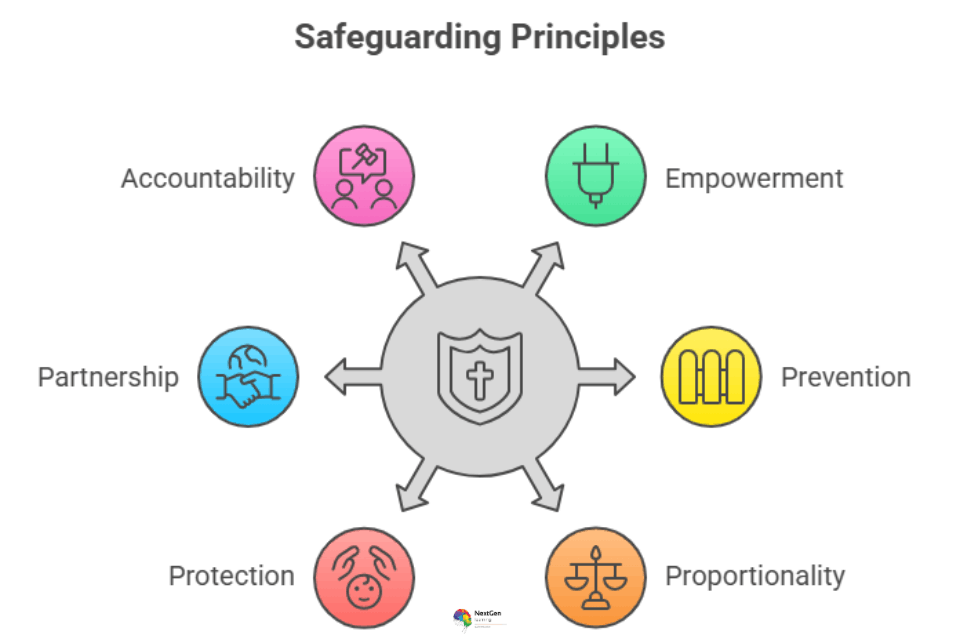
Safeguarding is guided by a set of core principles that help organisations and individuals respond to concerns in a consistent, ethical, and proportionate way. While the wording may vary internationally, these principles are widely recognised and used across care, education, health, and social services.
Empowerment
Empowerment means supporting people to make their own decisions and have control over their lives wherever possible. Safeguarding should involve individuals in decisions that affect them, respect their views, and provide information in a way they can understand.
Prevention
Prevention focuses on acting early to reduce the risk of harm. This includes raising awareness, identifying warning signs, providing early support, and creating safe environments before serious concerns develop.
Proportionality
Proportionality means responding to safeguarding concerns in a way that is appropriate to the level of risk. Actions taken should be the least restrictive necessary to protect the person while respecting their rights and independence.
Protection
Protection involves taking action to support and safeguard people who are at greatest risk. This includes intervening when harm is occurring or likely to occur and ensuring appropriate support and safeguards are in place.
Partnership
Safeguarding is most effective when organisations and professionals work together. Partnership involves sharing information appropriately, collaborating across services, and involving families, carers, and communities where suitable.
Accountability
Accountability ensures that safeguarding responsibilities are clear and that organisations and individuals are held responsible for their actions. This includes having clear reporting structures, governance arrangements, and review processes.
Section summary
- Safeguarding principles guide ethical and effective decision-making
- They balance protection with rights and autonomy
- Consistent application improves safeguarding outcomes
What Is Contextual Safeguarding?
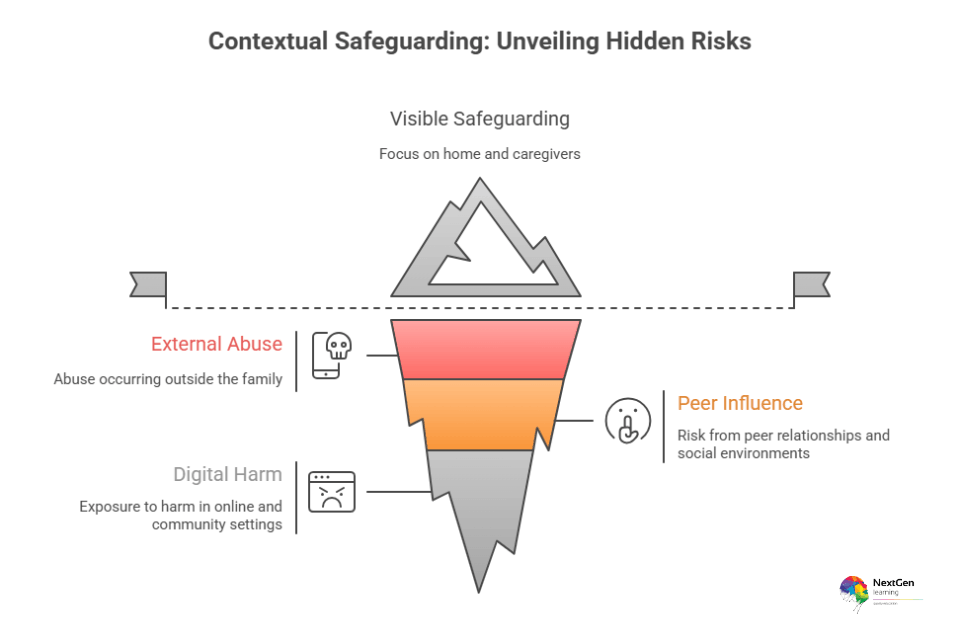
Contextual safeguarding is an approach that recognises that harm does not only happen within families or homes. It focuses on the wider environments in which people—especially children and young people—spend their time, such as schools, neighbourhoods, peer groups, online spaces, and public places.
This approach is increasingly used internationally to address risks that traditional safeguarding models may overlook.
Contextual safeguarding explained
Traditional safeguarding often focuses on risks within the home or from primary caregivers. Contextual safeguarding expands this view by recognising that:
- Abuse and exploitation can occur outside the family
- Peer relationships and social environments can create risk
- Online and community settings can expose individuals to harm
Contextual safeguarding looks at patterns of risk, not just individual incidents, and considers how environments can be made safer.
How contextual safeguarding differs from traditional models
Contextual safeguarding differs from traditional safeguarding approaches in several ways:
- It addresses extra-familial harm, such as peer abuse or exploitation
- It focuses on locations and contexts, not just individuals
- It involves working with schools, communities, and local services
- It aims to reduce risk by changing unsafe environments
Rather than asking only “Who is harming this person?”, contextual safeguarding also asks “Where and how is harm happening?”
Real-world examples of contextual safeguarding
Examples of contextual safeguarding include:
- Addressing peer-on-peer abuse within schools
- Reducing exploitation risks in public spaces or transport hubs
- Tackling online grooming through digital safety measures
- Working with communities to reduce local safeguarding risks
By targeting environments as well as individuals, contextual safeguarding supports more effective and sustainable protection.
What Is Early Help in Safeguarding?

Early help in safeguarding refers to support provided as soon as concerns emerge, before problems escalate into serious harm or statutory intervention. It focuses on identifying risks early and offering timely, proportionate support to individuals or families who may be experiencing difficulties.
Early help recognises that safeguarding concerns often develop gradually. Factors such as family stress, mental health challenges, social isolation, or unmet needs can increase risk over time if not addressed. By intervening early, safeguarding systems aim to reduce long-term harm and improve outcomes.
Safeguarding through early help is preventative rather than reactive. It involves working collaboratively with individuals, families, and services to strengthen resilience, address underlying issues, and provide practical or emotional support. Early help can reduce the need for crisis intervention and helps people remain safe within their own communities wherever possible.
This approach is widely used across education, health, and social care settings and forms a key part of modern safeguarding frameworks worldwide.
Early help safeguarding explained
Early help involves:
- Identifying emerging concerns or unmet needs
- Offering support before abuse or neglect occurs
- Working collaboratively with individuals, families, and services
- Reducing the need for crisis intervention or statutory action
Rather than waiting for significant harm, early help aims to reduce risk through prevention and support.
Why early intervention matters
Early intervention:
- Improves outcomes for children and adults
- Reduces long-term harm and trauma
- Supports wellbeing and stability
- Helps individuals remain independent and safe
- Reduces pressure on specialist safeguarding services
By addressing issues early, safeguarding systems become more effective and less reactive.
Early help examples in practice
Early help may include:
- Additional support for families experiencing stress or hardship
- Mental health or wellbeing support
- Educational or behavioural interventions
- Community-based services and advice
- Coordinated support from multiple agencies
These measures help prevent concerns from escalating into serious safeguarding incidents.
Section summary
- Early help focuses on prevention and early support
- It reduces risk before harm occurs
- Early intervention strengthens safeguarding outcomes
Key Safeguarding Legislation and Frameworks
Safeguarding is supported by legal frameworks and professional guidance that set out responsibilities, standards, and expectations. While laws differ between countries, many safeguarding systems share common principles around prevention, protection, and accountability.
Below is an overview of key safeguarding frameworks, with the UK used as a clear reference model that is often cited internationally.
International safeguarding frameworks (global context)
Globally, safeguarding is informed by international agreements and standards, including:
- Human rights conventions protecting children and vulnerable adults
- International child protection frameworks
- Duty of care obligations across education, health, and social services
- Safeguarding standards used by charities, NGOs, and humanitarian organisations
These frameworks emphasise protection from abuse, exploitation, and neglect, regardless of nationality or setting.
The Children Act 1989 and 2004 (UK example)
The Children Act forms the foundation of child safeguarding in the UK. It establishes that:
- The welfare of the child is the primary concern
- Organisations must work together to protect children
- Early intervention and coordinated support are essential
These principles are mirrored in child safeguarding systems across many countries.
The Care Act 2014 (UK example)
The Care Act sets out the legal framework for safeguarding adults in England. It focuses on:
- Preventing abuse and neglect
- Promoting wellbeing and independence
- Person-centred safeguarding
- Multi-agency cooperation
Although UK-specific, similar adult safeguarding laws exist internationally under health, social care, or disability legislation.
Other key safeguarding guidance (UK reference)
Additional UK safeguarding frameworks include:
- Working Together to Safeguard Children
- Keeping Children Safe in Education
- Safeguarding Vulnerable Groups legislation and background checking systems
These provide structured models that many organisations worldwide adapt for their own safeguarding policies.
Section summary
- Safeguarding is supported by legal and professional frameworks worldwide
- The UK provides a structured example often used as a reference
- Laws and guidance reinforce prevention, protection, and accountability
Roles and Responsibilities in Safeguarding

Safeguarding is a shared responsibility. While specific roles may vary by country or organisation, effective safeguarding depends on clear accountability and cooperation between individuals, organisations, and authorities.
Employers and organisations
Organisations that work with children or adults have a responsibility to:
- Create safe environments
- Develop and maintain safeguarding policies
- Provide appropriate training
- Ensure safe recruitment and vetting
- Respond to concerns promptly and appropriately
Organisations are responsible for embedding safeguarding into everyday practice, not treating it as a one-time requirement.
Staff, volunteers, and professionals
Anyone working or volunteering with people has a duty to:
- Understand safeguarding policies and procedures
- Recognise signs of abuse or neglect
- Report concerns through the correct channels
- Act in a timely and proportionate manner
- Maintain professional boundaries
Safeguarding is not limited to senior roles. Everyone has a part to play in protecting people from harm.
Local authorities and safeguarding bodies
In many countries, safeguarding is coordinated by public authorities or designated safeguarding bodies. Their responsibilities often include:
- Investigating safeguarding concerns
- Coordinating multi-agency responses
- Setting local safeguarding standards
- Monitoring and reviewing safeguarding practice
These bodies help ensure consistency, oversight, and accountability across services.
Section summary
- Safeguarding is a shared responsibility
- Organisations, staff, and authorities all have roles to play
- Clear accountability strengthens safeguarding outcomes
Examples of Safeguarding in Practice
Safeguarding is most effective when it is applied consistently in everyday situations, not only when serious incidents occur. The examples below show how safeguarding works in practice across different settings, using scenarios that are recognised internationally.
Safeguarding examples in care
In care settings, safeguarding may include:
- A care worker reporting unexplained injuries or changes in behaviour
- Identifying signs of neglect, such as poor hygiene or missed medication
- Protecting an individual from financial exploitation by limiting unauthorised access to money
- Addressing unsafe living conditions that increase risk
These actions help ensure care supports safety, dignity, and wellbeing.
Safeguarding examples in schools
In education, safeguarding in practice may involve:
- A teacher reporting concerns about a child’s sudden withdrawal or distress
- Addressing bullying or peer-on-peer abuse early
- Responding to online safety concerns, such as grooming or inappropriate contact
- Providing early support for mental health or wellbeing concerns
Schools play a key role in identifying concerns early due to their regular contact with children.
Safeguarding examples in health and social care
In health and social care settings, safeguarding actions may include:
- A healthcare professional identifying signs of domestic abuse
- Recognising self-neglect or unmet care needs
- Sharing information with relevant agencies to protect an individual
- Ensuring consent and capacity are properly considered in care decisions
Safeguarding in these settings often relies on professional judgement and multi-agency cooperation.
Section summary
- Safeguarding applies in everyday situations across settings
- Early recognition and action reduce risk
- Practical safeguarding protects people’s safety and rights
Frequently Asked Questions about What is Safeguarding

Safeguarding is the process of protecting people from harm, abuse, neglect, and exploitation. It is important because it helps prevent serious harm, protects rights and dignity, and ensures people—especially children and vulnerable adults—can live safely and with support.
Safeguarding means keeping people safe from harm. It involves noticing risks, listening to concerns, and taking action to protect someone if they are unsafe, at risk, or being treated badly.
Safeguarding is everyone’s responsibility. While organisations and designated safeguarding leads have specific duties, all staff, volunteers, carers, and community members are expected to recognise concerns and report them appropriately.
The key safeguarding principles are empowerment, prevention, proportionality, protection, partnership, and accountability. Together, they ensure safeguarding actions protect people while respecting rights, choice, and dignity.
A good example of safeguarding is a teacher reporting concerns about a child’s sudden withdrawal and unexplained injuries, leading to early support and protection before serious harm occurs.
Safeguarding is the process of protecting individuals from abuse, neglect, exploitation, and harm by identifying risks early, taking preventive action, and responding appropriately when concerns arise.
Safeguarding means noticing when someone may be unsafe and doing the right thing to protect them, whether that involves offering support, reporting concerns, or working with others to reduce risk.
The six principles are empowerment, prevention, proportionality, protection, partnership, and accountability. These guide ethical decision-making and ensure safeguarding responses are effective and person-centred.
The 4 P’s of safeguarding are prevention, protection, partnership, and proportionality. They focus on stopping harm early, protecting those at risk, working together, and responding appropriately to concerns.
The main safeguarding issues include physical abuse, emotional abuse, sexual abuse, neglect, and financial exploitation. Online harm and exploitation are also increasingly recognised as key safeguarding risks.
Safeguarding in care involves protecting people receiving support from abuse, neglect, or exploitation. It includes safe care practices, reporting concerns, respecting dignity, and ensuring care environments reduce risk.
Safeguarding in schools means protecting children’s safety, wellbeing, and development. It includes safe recruitment, staff training, reporting concerns, online safety, and early support for pupils at risk.
Safeguarding adults focuses on protecting adults who may be at risk due to care or support needs, disability, age, or circumstances, while supporting independence, choice, and control wherever possible.
Safeguarding children involves protecting young people from harm while promoting their welfare, development, and safety across home, school, healthcare, and online environments.
A safeguarding policy is a formal document that explains how an organisation prevents, identifies, and responds to safeguarding concerns. It sets out responsibilities, procedures, and reporting processes to protect people from harm.
Contextual safeguarding is an approach that recognises harm can happen outside the home, such as in schools, peer groups, communities, or online, and focuses on making those environments safer.
Early help in safeguarding means providing support as soon as concerns arise, before serious harm occurs. It focuses on prevention, early intervention, and coordinated support to reduce long-term risk.
A strong answer explains safeguarding as protecting people from harm, recognising risks early, following procedures, and acting responsibly. Interviewers look for awareness, accountability, and understanding of duty of care.
Safeguarding interviews often ask about recognising abuse, reporting concerns, confidentiality, professional boundaries, and how you would respond if someone disclosed harm or appeared at risk.
Ofsted defines safeguarding as protecting children from maltreatment, preventing impairment of health or development, ensuring safe care, and taking action so children grow up in safe environments.

0 responses on "What Is Safeguarding? A Clear Guide for Care, Schools & Health"