




What Is SNOMED CT? Meaning, Uses and Examples
Healthcare professionals record enormous amounts of clinical information, from symptoms and diagnoses to treatments and medical histories. But how can different healthcare systems recognise the same medical condition when people describe it differently?
That is where SNOMED CT comes in. It provides a consistent way to represent clinical information, making patient records easier for healthcare systems to interpret and share.
If you have come across SNOMED CT while studying clinical coding, medical terminology or NHS administration, this guide explains its meaning, how it works and where it is used, with practical examples.
SNOMED CT stands for Systematized Nomenclature of Medicine – Clinical Terms. It is a standardised clinical terminology used to record health information in electronic patient records. Each clinical concept has a unique identifier, helping healthcare systems represent and exchange information consistently. In the NHS, it supports structured clinical documentation.
Table of Contents
How Does SNOMED CT Work?
SNOMED CT is more than a collection of medical terms. It is an organised terminology system that links clinical meanings to readable descriptions and defined relationships.
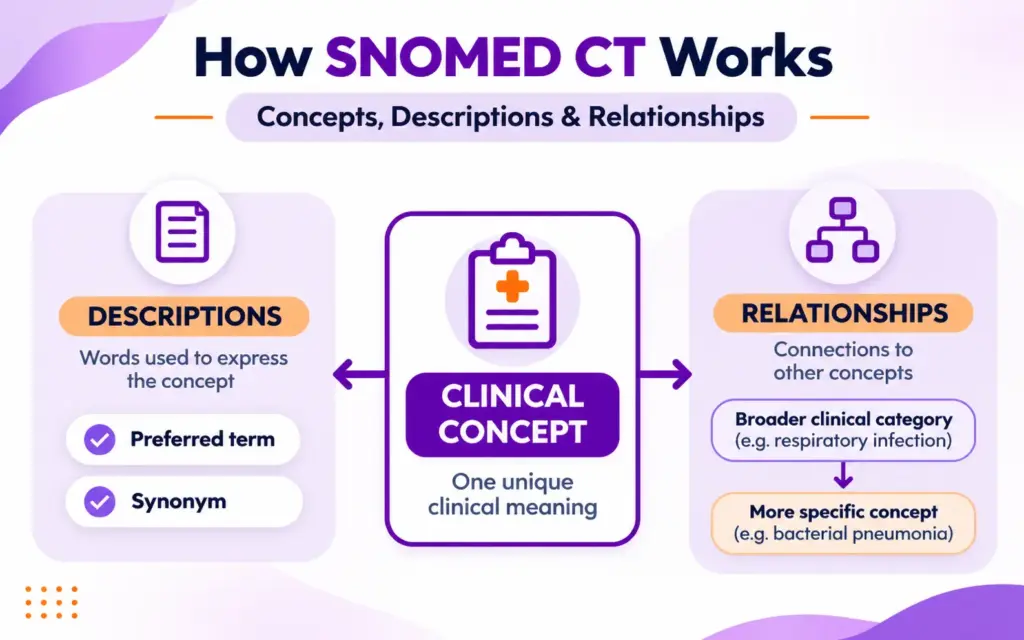
To understand how SNOMED CT works, you need to know three components: concepts, descriptions and relationships.
Clinical Concepts and Their Identifiers
A clinical concept represents a particular medical meaning. It might describe a disease, symptom, procedure, clinical finding or another aspect of healthcare.
Each concept receives a unique numerical identifier, known as a SNOMED CT concept identifier.
For example, a heart attack is represented by a particular clinical concept, regardless of whether a healthcare professional uses the expression “heart attack” or “myocardial infarction”.
The identifier gives computer systems a consistent reference to that concept. It does not change simply because someone uses different wording.
These identifiers are not abbreviations, and their digits do not explain the medical condition.
Descriptions and Synonyms
Healthcare professionals do not always use identical language.
One clinician might write “myocardial infarction”, while another uses “heart attack”. SNOMED CT can associate different descriptions with the same clinical concept.
Its descriptions include:
- Fully specified name (FSN): A description that identifies a concept’s meaning unambiguously, including its category.
- Preferred term: A description designated as preferred within a particular language or terminology setting.
- Synonyms: Alternative descriptions that refer to the same clinical concept.
This structure allows clinical information to retain a consistent meaning even when the words displayed to users differ.
Relationships and Hierarchies
SNOMED CT also defines how clinical concepts relate to one another.
For example, bacterial pneumonia belongs within broader categories of respiratory infection. These connections allow systems to recognise relationships between specific and general clinical concepts.
This organisation is called a hierarchy.
Unlike an ordinary alphabetical list of medical terms, SNOMED CT can represent relationships that computers can interpret.
The official explanation of SNOMED CT concepts, descriptions and relationships provides further technical detail.
For beginners, the central idea is simple: concepts identify clinical meanings, descriptions express those meanings in words, and relationships connect them.
SNOMED CT Codes: A Simple Clinical Example
A practical example makes SNOMED CT codes easier to understand.
What Does a SNOMED CT Code Look Like?
Consider the medical condition commonly called a heart attack.
SNOMED CT represents this condition using a specific concept identifier.
| Element | Example |
|---|---|
| Clinical Concept | Myocardial infarction |
| Concept Identifier | 22298006 |
| Fully Specified Name | Myocardial infarction (disorder) |
| Everyday Description | Heart attack |
This example comes from NHS England’s clinical coding guidance.
The number 22298006 identifies the clinical concept rather than spelling out the condition. The fully specified name makes its meaning clear, while the everyday description provides an alternative way to express it.
This distinction matters because different terms can refer to the same clinical meaning without needing separate identifiers for each expression.
How the Concept Appears in a Clinical Record
Imagine a clinician documenting a patient who has experienced a heart attack.
Depending on the electronic patient-record system, the clinician may search for a suitable clinical term and select the appropriate concept.
The system can associate the readable description with its underlying SNOMED CT identifier.
Someone reviewing the record may see a familiar clinical description rather than the numerical identifier.
Meanwhile, compatible software can use the structured information for appropriate recording, searching or information exchange.
The exact interface varies between healthcare systems, and selecting a code does not replace professional judgement or adequate clinical notes.
Understanding these distinctions is relevant to anyone studying patient documentation. Nextgen Learning’s Clinical Records and Coding course includes clinical terminology, records and an introduction to SNOMED CT.
How Is SNOMED CT Used in the NHS?
SNOMED CT plays an important role in the way clinical information is recorded within NHS electronic systems.
Its purpose is not to replace healthcare professionals’ language, but to give clinical information a consistent, computer-readable meaning.
Recording Clinical Information in Patient Records
In NHS GP practices in England, SNOMED CT is used to capture clinical terms in electronic patient records.
These can include information about:
- Diagnoses and medical conditions.
- Symptoms and clinical findings.
- Procedures and treatments.
- Measurements and other relevant clinical observations.
For example, when a GP records a diagnosis, structured terminology can help distinguish that condition from similar medical concepts.
This matters because clinical records must serve different purposes. They help healthcare professionals understand a patient’s history and allow authorised systems to retrieve relevant information.
SNOMED CT provides terminology for these records; it is not itself a patient-record application.
Healthcare administration learners may also encounter related subjects such as records management, medical terminology and confidentiality. These areas are covered in Nextgen Learning’s Medical & Clinical Administration Diploma.
Sharing Information Between Healthcare Services
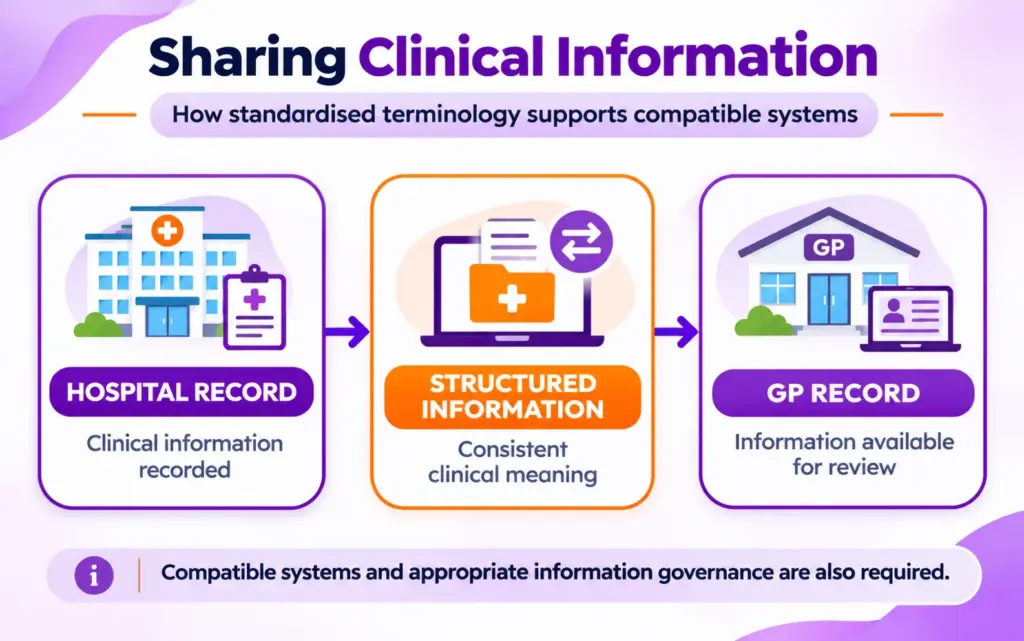
Patients may receive care from GP practices, hospitals and specialist services.
For continuity of care, relevant information sometimes needs to move between their electronic systems.
SNOMED CT helps by providing a consistent terminology for representing clinical meaning.
Consider a hospital discharge summary containing coded clinical information. A compatible GP system may be able to incorporate that information without requiring every detail to be entered manually.
This supports healthcare interoperability: the ability of systems to exchange information and interpret it meaningfully.
However, SNOMED CT alone does not guarantee successful information sharing. Compatible systems, appropriate data structures, information governance and accurate documentation remain necessary.

SNOMED CT UK Edition and National Requirements
The SNOMED CT UK Edition includes UK-specific terminology, such as certain screening procedures, assessment scales and British English expressions.
According to NHS England’s SNOMED CT guidance, NHS healthcare providers in England must use SNOMED CT when capturing clinical terms in electronic patient-record systems.
This is a national information standard and associated contractual requirement for NHS providers in England, not a personal certification requirement for every employee.
SNOMED CT implementation differs across the UK’s devolved nations. NHS England advises checking the relevant national health authority for details.
Why Is SNOMED CT Important in Healthcare?
The main benefit of SNOMED CT is consistency. It helps healthcare systems record and interpret clinical information using recognised meanings rather than relying solely on individual wording.
This can support healthcare in several ways.
More consistent patient records: When different descriptions point to the same clinical concept, it becomes easier for compatible systems to recognise the intended meaning.
Better information exchange: Structured terminology supports meaningful communication between healthcare systems, particularly when information must be retrieved or transferred.
More useful clinical data: Healthcare organisations can use appropriately recorded information for activities such as identifying patient groups, analysing patterns and supporting approved clinical processes.
Structured terminology can also support clinical decision-support software, although such systems require suitable implementation and reliable data.
These benefits depend on correct documentation. Choosing an inappropriate concept can still misrepresent a patient’s condition, even when the terminology system itself is standardised.
SNOMED CT therefore supports accurate record-keeping, but it does not remove the need for trained professionals, appropriate checks and clinical judgement.
SNOMED CT vs ICD-10: What's the Difference?
SNOMED CT and ICD-10 are both associated with clinical coding, but they serve different purposes.
Clinical Terminology vs Disease Classification
SNOMED CT is a clinical terminology designed to represent detailed healthcare information.
ICD-10, the International Classification of Diseases, Tenth Revision, groups diseases and related health conditions into classification categories.
Their main differences are:
| Feature | SNOMED CT | ICD-10 |
|---|---|---|
| Main Purpose | Represent clinical meaning | Classify diseases and health conditions |
| Main Emphasis | Detailed clinical concepts | Standardised classification categories |
| Common Use | Structured clinical documentation | Clinical classification and reporting |
For example, SNOMED CT can represent detailed information recorded during care, while ICD-10 may be used to classify a diagnosis for reporting purposes.
The systems can complement one another. SNOMED CT has not simply replaced ICD-10.
UK healthcare also uses OPCS-4 to classify procedures and interventions. This serves a different purpose from recording detailed clinical concepts.
Why Healthcare Learners Should Know Both
Understanding these distinctions can help learners recognise why different healthcare coding systems exist.
Recognising the difference between clinical terminology, diagnosis classification and procedure classification provides a useful foundation for further study.
Learners interested in these classification systems can explore the Clinical Coding Course (UK): NHS ICD-10 & OPCS-4, which introduces UK clinical classification work alongside foundational SNOMED CT awareness.
Common Misunderstandings About SNOMED CT
SNOMED CT can seem complicated when clinical terminology, coding and classification are discussed together. Three misunderstandings are particularly worth clearing up.
- SNOMED CT is simply a list of medical abbreviations.
It is a structured clinical terminology, not an abbreviation dictionary. Its concepts, descriptions and relationships allow information to be represented in a way that software can interpret.
- Every SNOMED CT code represents a disease.
SNOMED CT includes much more than diseases. Concepts can represent symptoms, procedures, findings, body structures and other healthcare information.
- Using SNOMED CT automatically makes patient records accurate.
A structured code does not guarantee that the correct concept has been selected. Healthcare professionals still need to document clinical information appropriately and include additional context where necessary.
The distinction is important: SNOMED CT provides a consistent terminology, while the quality of the record depends on how that terminology is used.
How Can Beginners Learn More About Clinical Coding?
Understanding SNOMED CT is a useful starting point for anyone interested in healthcare terminology, clinical records or clinical coding.
A sensible learning progression is to become familiar with medical terminology before exploring how information is documented and classified.
Beginners can focus on:
- Common clinical terms and their meanings.
- How electronic patient records are organised.
- The difference between SNOMED CT, ICD-10 and OPCS-4.
- Patient confidentiality and responsible information handling.
- The importance of accurate clinical documentation.
For structured introductory study, Nextgen Learning’s Clinical Coding Course Online includes a dedicated introduction to SNOMED CT, alongside modules covering clinical records, ICD-10, OPCS-4 and other clinical coding topics.
Learners who want to build on this knowledge can explore how clinical coding standards support consistent classification, documentation and data quality within healthcare settings.
An introductory course can build subject knowledge, but professional responsibilities and qualification requirements depend on the particular healthcare role and employer.
Frequently Asked Questions About SNOMED CT
SNOMED CT stands for Systematized Nomenclature of Medicine – Clinical Terms. It is an internationally recognised clinical terminology used to represent medical information consistently. Each clinical concept has a unique numerical identifier, allowing healthcare systems to recognise the same medical meaning even when different terms are used. This helps support accurate clinical documentation and information sharing.
Yes. SNOMED CT is used in GP practices across England to record clinical information in electronic patient records. GPs and other authorised healthcare professionals can use it to document diagnoses, symptoms, clinical findings and procedures. Its structured terminology helps maintain consistent records and supports the exchange of relevant patient information between compatible healthcare systems.
No. Although both are used in healthcare information management, they serve different purposes. SNOMED CT records detailed clinical meanings, including conditions, symptoms and findings, while ICD-10 classifies diseases and related health conditions into standardised categories. Healthcare organisations may use both systems because clinical documentation and classification for reporting require different levels of detail.
Yes. SNOMED CT replaced Read codes as the standard terminology for recording clinical information in GP systems in England. It provides a broader, more structured way to represent clinical concepts and their relationships. However, historical patient records may still contain Read codes, so healthcare systems sometimes need to interpret or map older terminology when working with existing information.
No, there is no universal requirement to hold a specific SNOMED CT qualification to work in healthcare. Training expectations depend on the role, employer and responsibilities involved. Healthcare administrators may only need a basic understanding of clinical terminology, while clinical coding or health informatics professionals may require more specialised training. Learning SNOMED CT can strengthen relevant knowledge, but completing a course does not automatically qualify someone for a particular NHS position.