





CAVA Qualification Explained: What the Level 3 Certificate in Assessing Vocational Achievement Actually Involves
The CAVA qualification, formally called the Level 3 Certificate in Assessing Vocational Achievement, is one of the broadest recognised routes for people who want to assess learners in vocational education and workplace settings. It covers both practical competence and vocational knowledge, so it suits assessors who work across more than one learning environment.
However, CAVA involves more than completing online lessons or written assignments. Learners usually need relevant occupational competence, access to suitable candidates and opportunities to carry out real assessments. Moreover, they must gather evidence through observations, questioning, portfolio reviews and professional discussions.
Therefore, understanding the qualification structure before enrolling is essential. This guide explains the units, practical requirements, assessment methods, online study options and career opportunities involved in completing CAVA.
Table of Contents
What Does CAVA Stand For?
CAVA stands for Certificate in Assessing Vocational Achievement. Its full title is the Level 3 Certificate in Assessing Vocational Achievement.
The qualification prepares learners to assess occupational competence in the workplace and vocational knowledge in learning environments. Therefore, it offers broader coverage than assessor awards designed for only one assessment setting.
Importantly, CAVA develops assessment competence rather than subject expertise. You still need suitable occupational knowledge and experience in the sector you plan to assess.
What Is the CAVA Qualification?
The Level 3 Certificate in Assessing Vocational Achievement is a competence-based assessor qualification. The City & Guilds Assessment and Quality Assurance qualifications guidance explains that CAVA suits practitioners who use workplace and vocationally related assessment methods based on sound assessment principles. It prepares you to assess learners in both workplace and vocational learning environments. Therefore, it suits trainers and assessors who use several assessment methods across different settings.
The qualification can support assessment within areas such as apprenticeships, NVQs, diplomas and other work-based programmes. However, CAVA confirms your ability to assess. It does not automatically prove that you have the subject expertise required for every industry.
In practice, you still need relevant occupational competence in the field you plan to assess. Moreover, employers and awarding organisations may check your qualifications, work history and current sector knowledge before allowing you to assess learners independently.
What Are the Three CAVA Units?

The City & Guilds CAVA qualification overview confirms that its Level 3 Certificate contains three compulsory units covering assessment principles, occupational competence and vocational skills, knowledge and understanding. Together, they cover assessment theory, workplace competence and vocational knowledge. Therefore, learners must understand assessment principles and apply them in real or suitable vocational settings.
Understanding the Principles and Practices of Assessment
This unit covers the foundation of good assessment. You learn how to plan assessments, choose suitable methods, give feedback and keep accurate records. Moreover, you explore fairness, validity, reliability, confidentiality and professional responsibility.
Assessing Occupational Competence in the Work Environment
This practical unit focuses on assessing learners while they complete genuine workplace tasks. For example, you may use direct observation, questioning, work products and witness testimony to confirm competence.
Assessing Vocational Skills, Knowledge and Understanding
This unit covers assessment in learning or training environments. You may review assignments, projects, portfolios, tests or professional discussions. As a result, you learn how to judge both practical skills and underpinning knowledge.
Together, these units make CAVA broader than assessor Awards that cover only one assessment context.
CAVA vs Other Level 3 Assessor Qualifications
CAVA is not the only Level 3 assessor route. However, it offers the broadest practical coverage because it combines assessment theory with competence across workplace and learning environments.
| Qualification | Best Suited To | Assessment Context |
|---|---|---|
| Level 3 Award in Understanding the Principles and Practices of Assessment | Learners who need assessment theory before taking practical responsibility | No practical assessment required |
| Level 3 Award in Assessing Competence in the Work Environment | Assessors judging occupational performance on the job | Real workplace settings |
| Level 3 Award in Assessing Vocationally Related Achievement | Trainers assessing knowledge, projects or simulated activity | Classrooms and training environments |
| Level 3 Certificate in Assessing Vocational Achievement | Assessors working across both practical and vocational settings | Workplace and learning environments |
Therefore, CAVA is often the stronger choice when your role requires several assessment methods. In contrast, a smaller Award may be more efficient when you assess in only one setting.
Importantly, training providers sometimes use TAQA as an umbrella term for these qualifications. However, TAQA is not usually one standalone qualification. Consequently, you should always check the exact title, units and assessment scope before enrolling.
What Practical Evidence Does CAVA Require?
CAVA is a competence-based qualification. Therefore, learners must show that they can plan, carry out and review real assessments rather than only explain assessment theory.
Common evidence methods include:
| Evidence Method | What It Demonstrates |
|---|---|
| Direct observation | Confirms how a learner performs a practical workplace task |
| Portfolio review | Shows collected work, records and evidence of achievement |
| Questioning | Checks knowledge, understanding and decision-making |
| Witness testimony | Confirms performance observed by another suitable professional |
| Professional discussion | Explores reasoning, judgement and reflective practice |
| Work products | Provides authentic evidence created during vocational activity |
In addition, learners may need assessment plans, feedback records, reflective accounts and copies of completed documentation. However, providers must protect learner confidentiality. Therefore, names and sensitive workplace details may need to be removed or anonymised.
The assessor will also check whether the evidence is valid, authentic, current, sufficient and reliable. As a result, strong portfolios show not only what happened, but also why the chosen assessment method was appropriate.
Do You Need Learners and Workplace Access?
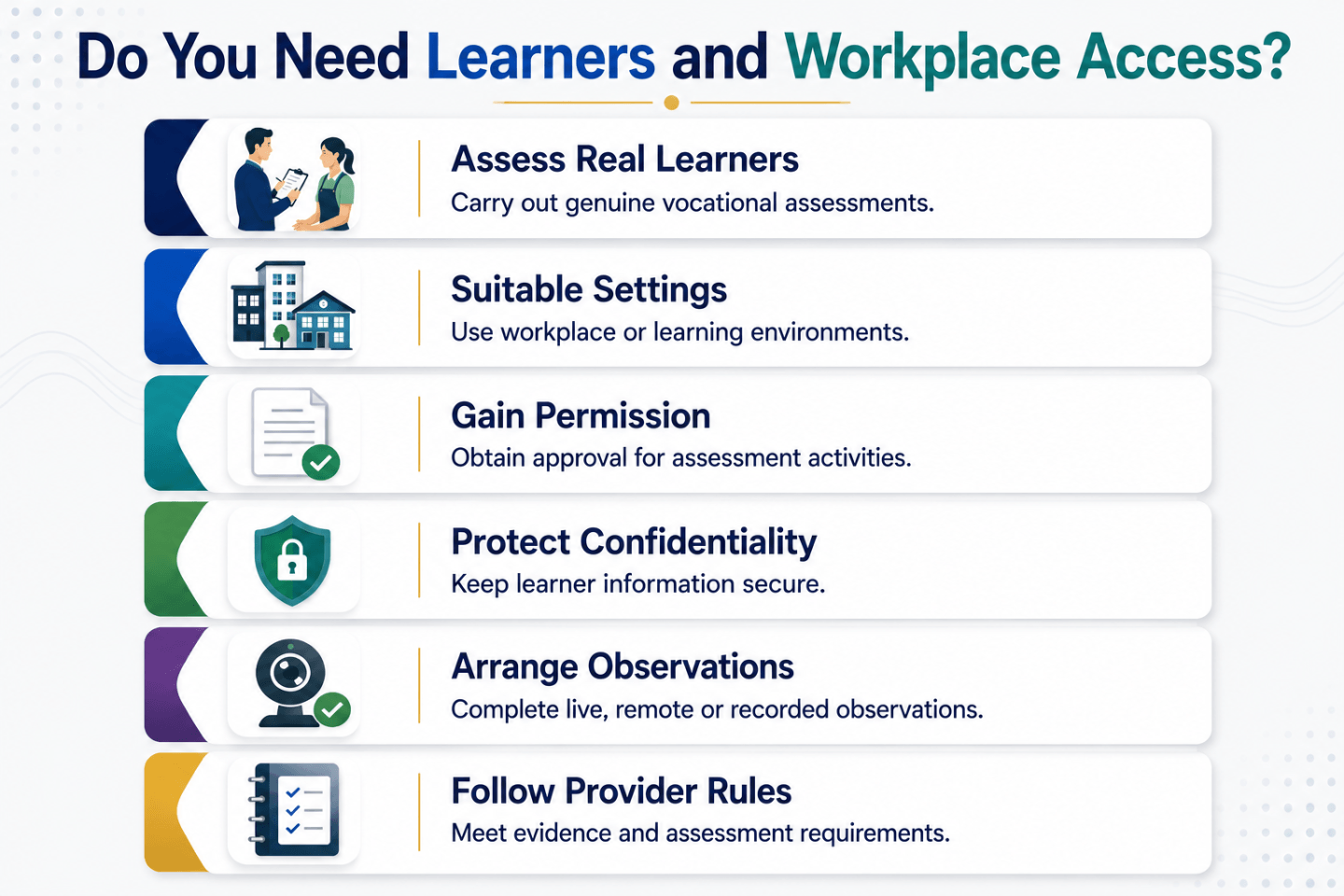
In most cases, you need access to suitable learners because CAVA requires practical assessment evidence. Therefore, written assignments alone may not be enough to complete the qualification.
You may need to:
- Assess real learners: Plan and carry out assessments with candidates working towards a vocational outcome.
- Access appropriate settings: Use workplace and learning environments that match the units being assessed.
- Gain permission: Confirm that the employer or training provider allows observations and evidence collection.
- Protect confidentiality: Remove names and sensitive details from portfolio documents where necessary.
- Arrange observations: Allow your assessor to review your assessment practice live, remotely or through approved recordings.
- Follow provider rules: Meet specific requirements for learner numbers, evidence types and assessment contexts.
However, requirements can vary between awarding organisations and providers. Consequently, you should ask how many learners you need, which settings count and whether simulated evidence is allowed before enrolling.
What Does Occupational Competence Mean?
Occupational competence means having the knowledge, skills and recent experience needed to understand the job role you assess. Therefore, CAVA does not allow you to assess every subject or industry automatically.
For example, someone assessing health and social care learners may need relevant care experience and sector knowledge. Similarly, a construction assessor may need suitable trade qualifications, practical experience and awareness of current industry standards.
Employers and awarding organisations may check:
- Relevant qualifications: Show that you understand the occupational area.
- Work experience: Prove that you have performed or supervised the role.
- Current knowledge: Keep up with legislation, technology and professional practice.
- Sector requirements: Meet any licence, registration or awarding-body conditions.
- Continuing development: Maintain competence through training and workplace activity.
Importantly, CAVA confirms your ability to assess learners fairly and consistently. However, it does not replace the occupational expertise required in the sector. Consequently, you should confirm both assessor and industry requirements before applying for a role.
Can You Complete CAVA Fully Online?
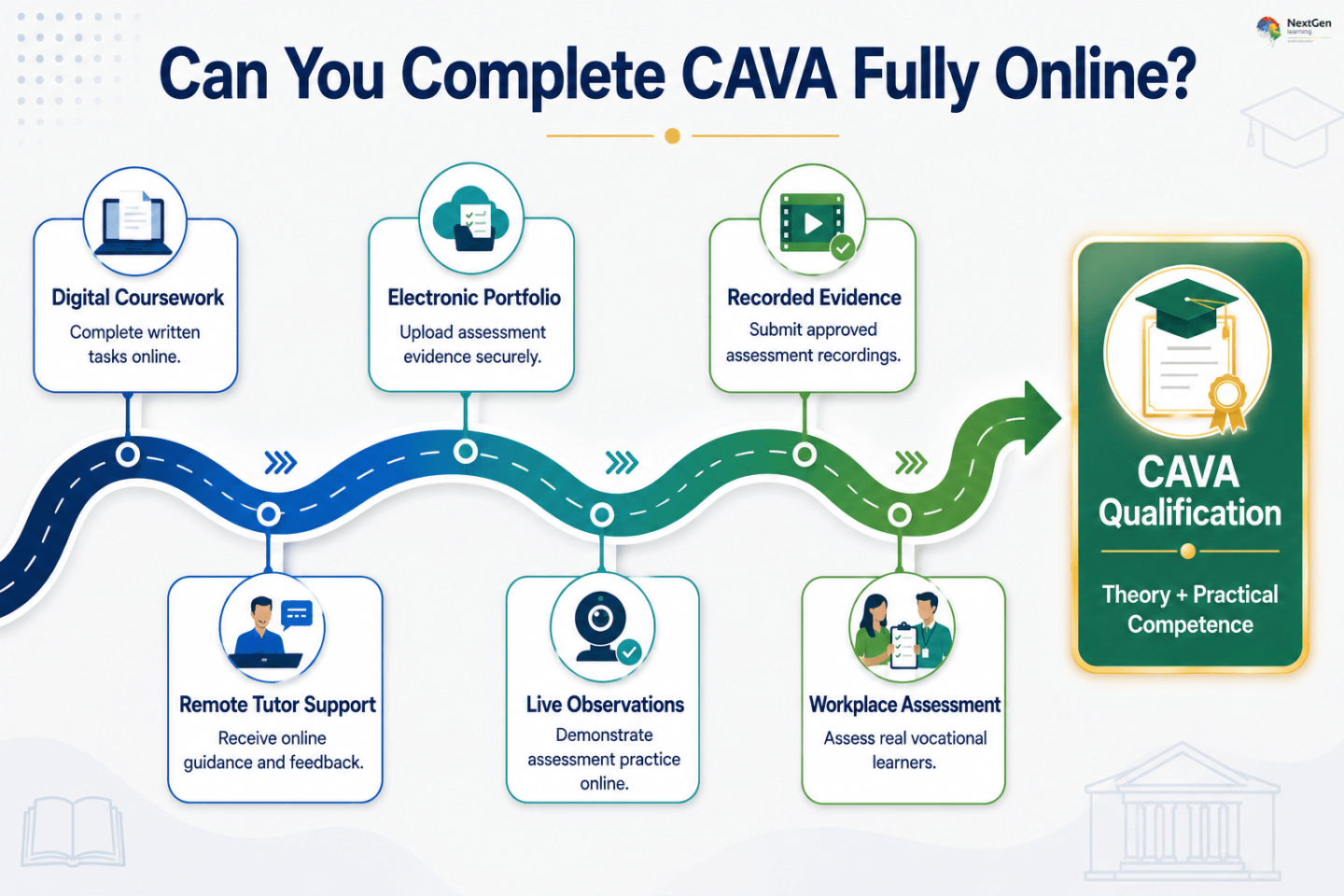
You can usually complete the theory, tutor communication and portfolio submission online. Therefore, online CAVA courses can suit professionals who need flexible study around work and family commitments.
However, CAVA is not simply a theory course. You still need to demonstrate practical assessment competence. Depending on the provider, this may involve:
- Digital coursework: Complete written tasks through an online learning platform.
- Remote tutor support: Discuss assessment decisions and portfolio progress with your assessor.
- Electronic portfolios: Upload plans, feedback records, witness statements and supporting evidence.
- Live observations: Allow an assessor to watch your practice through video conferencing.
- Recorded evidence: Submit approved recordings of assessment activity where permitted.
- Workplace assessment: Carry out genuine assessments with suitable vocational learners.
Consequently, “fully online” usually describes course delivery rather than the absence of practical work. Before enrolling, confirm how observations take place, whether recordings are accepted and what learner access you need.
How Long Does the CAVA Qualification Take?
The time needed to complete CAVA varies because the qualification depends on practical evidence, not only study hours. Therefore, two learners may finish at very different speeds.
Completion time usually depends on:
- Previous experience: Experienced trainers may understand assessment principles more quickly.
- Learner access: Regular access to suitable candidates can speed up practical evidence collection.
- Assessment opportunities: Frequent workplace activity makes it easier to complete observations and records.
- Portfolio quality: Clear, complete evidence reduces delays and repeated submissions.
- Tutor feedback: Prompt responses help learners correct gaps and move forward.
- Provider deadlines: Some centres allow several months, while others set shorter completion windows.
Some providers advertise an estimated number of study hours. However, this should not be treated as a universal completion time. In practice, the biggest factor is often how quickly you can gather valid workplace evidence and complete assessor observations.
What Can You Do with a CAVA Qualification?
The CAVA qualification can support work in vocational education, apprenticeships, workplace training and professional development. The National Careers Service RQF assessor profile identifies NVQ assessor and training assessor as related job titles and explains that assessors observe trainees, review portfolios, provide feedback and keep progress records. However, employers will also expect relevant occupational competence in the subject you assess.
Possible roles include:
- Vocational Assessor: Judge learner competence against qualification standards.
- NVQ Assessor: Assess practical skills and knowledge within work-based programmes.
- Apprenticeship Assessor: Review evidence, track progress and support apprentices.
- Workplace Trainer-Assessor: Combine training delivery with assessment duties.
- Learning and Development Assessor: Evaluate staff performance and development.
- Training Coordinator: Organise assessment activity, records and learner support.
Moreover, CAVA can support progression into Internal Quality Assurance, Lead Assessor or Training Manager roles. Some assessors also move into teaching, curriculum support or External Quality Assurance after gaining further qualifications.
Therefore, CAVA can widen your career options. Nevertheless, it does not guarantee employment by itself. Your sector experience, current competence and ability to manage learners will still influence job opportunities.
Who Should Take the CAVA Qualification?

CAVA is most suitable for people who already have strong occupational competence and need to assess learners across both workplace and learning environments. Therefore, it often suits experienced professionals moving into vocational assessment or combining assessment with training duties.
The qualification may suit:
- Industry professionals: Use existing sector expertise to assess vocational learners.
- Workplace trainers: Add formal assessment responsibilities to training duties.
- Apprenticeship staff: Assess practical competence, knowledge and portfolio evidence.
- College or training staff: Work across classroom and workplace assessment settings.
- Existing assessors: Broaden assessment scope beyond one environment.
- Future IQAs: Build a foundation for Internal Quality Assurance progression.
However, CAVA may not be the best route for everyone. For example, learners without access to suitable candidates may struggle to complete the practical units. In addition, someone who only needs assessment theory may find the theory-only Award more appropriate.
Consequently, you should confirm your occupational competence, learner access and intended assessment setting before enrolling.
Frequently Asked Questions
No. TAQA is a broad term for Training, Assessment and Quality Assurance qualifications. In contrast, CAVA is one specific Level 3 Certificate within the assessor qualification suite. Therefore, always check the exact qualification title before enrolling.
CAVA is widely viewed as the modern successor to the older A1 assessor route. However, the qualifications are not identical. CAVA reflects newer assessment standards and covers both workplace competence and vocational knowledge.
A regulated CAVA qualification is recognised across the UK when an approved awarding organisation issues it. Nevertheless, employers may also check your occupational competence, recent industry experience and sector-specific requirements.
You may not need a formal assessor job title. However, you usually need access to suitable learners and genuine assessment opportunities. Therefore, confirm practical placement and observation requirements before enrolling.
The required number can vary between awarding organisations and training providers. Some centres may require assessment activity with more than one learner. Consequently, ask the provider for its exact evidence and observation rules.
Yes. CAVA can provide a strong foundation for progression into Internal Quality Assurance. However, IQA roles usually require separate Level 4 training and experience of monitoring assessment quality.


0 responses on "CAVA Qualification Explained: What the Level 3 Certificate in Assessing Vocational Achievement Actually Involves"