




15 Clinical Coder Interview Questions (With Answers)
Starting a career in healthcare information or applying for an NHS coding position?
Preparing for clinical coder interview questions can help you explain your knowledge, demonstrate attention to detail and respond confidently to practical situations. Interviewers may ask about coding classifications, medical terminology, patient confidentiality and how you handle unclear clinical records.
Some questions test technical knowledge, while others assess communication, accuracy and professional judgement. The following 15 questions and example answers cover both areas, including guidance for applicants who have not worked as clinical coders before.
Want to prepare for a career in clinical coding?
Study clinical terminology, coding classifications, documentation and confidentiality through flexible online training covering the foundations of clinical coding.
- Clinical terminology
- Coding classifications
- Documentation
- Confidentiality
Table of Contents
What to expect in a clinical coder interview
A clinical coder interview usually assesses your understanding of clinical documentation, coding systems, accuracy and healthcare information management. The questions will depend on whether you are applying for a trainee, qualified or more senior position.
You may face general questions about your background, technical questions about ICD-10 and OPCS-4, or practical scenarios involving incomplete patient records.
Some employers may also include a coding exercise or assessment, although this is not compulsory for every vacancy.
15 common clinical coder interview questions and answers
1. Tell me about yourself and why you want to become a clinical coder.
Example answer:
“I am interested in healthcare information and the importance of keeping accurate patient records. I have good attention to detail and enjoy working with information that requires careful review. Clinical coding appeals to me because it combines medical terminology, organisation and accuracy. I would like to contribute to reliable healthcare records while continuing to develop my knowledge of clinical coding.”
What the interviewer wants: A clear introduction that connects your interests, relevant skills and reasons for applying. If you are new to the profession, discuss transferable skills rather than claiming experience you do not have.
2. What does a clinical coder do in an NHS setting?
Example answer:
“A clinical coder reviews patient records and translates documented diagnoses and procedures into standardised codes. These codes help hospitals record patient activity accurately and support reporting, healthcare planning, audit and other NHS information requirements. The role also involves identifying missing information and following the relevant coding standards.”
What the interviewer wants: Evidence that you understand the responsibilities of the position, rather than believing clinical coding simply involves entering numbers into a computer.
3. What is the difference between ICD-10 and OPCS-4?
Example answer:
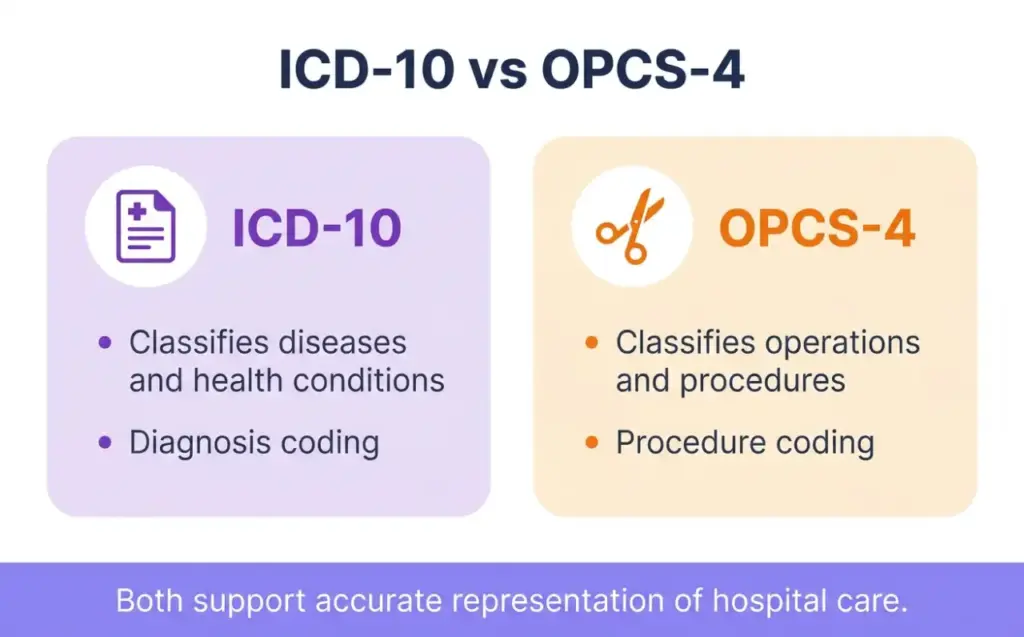
“ICD-10 is used to classify diseases and other health conditions, whereas OPCS-4 classifies operations and procedures. They serve different purposes but work together to represent important information about a patient’s hospital care. I would use the relevant classification rules and documentation when assigning codes.”
What the interviewer wants: A clear distinction between diagnosis coding and procedure coding. You should also recognise that SNOMED CT is a separate clinical terminology system, not another name for ICD-10 or OPCS-4.
4. What are the fundamental principles of accurate clinical coding?
Example answer:
“The main principle is to assign codes that accurately reflect the information documented in the patient’s clinical record. I would follow the relevant classification rules, conventions and national standards rather than making assumptions. If important information were missing or unclear, I would follow the correct procedure to request clarification.”
What the interviewer wants: An understanding that clinical coding must be evidence-based and consistent. Accuracy is not simply about selecting a code that appears suitable; it also involves following the applicable coding instructions.
5. What are some common clinical coding errors, and how would you prevent them?
Example answer:
“Common problems include assigning an incorrect code, overlooking relevant documentation, misunderstanding medical terminology and failing to follow coding conventions. I would reduce these risks by reviewing the complete available record, consulting approved coding references and checking my decisions before finalising them. I would also take feedback from audits seriously.”
What the interviewer wants: An understanding of why coding errors happen and how careful working practices can prevent them. You should demonstrate responsibility rather than suggesting that mistakes are always someone else’s fault.
6. What would you do if clinical documentation was unclear or incomplete?
Example answer:
“I would review the available records to identify exactly what information was unclear. I would then follow the organisation’s procedures for obtaining clarification from the appropriate clinical professional. I would never guess a diagnosis or assign a code based on information that the documentation does not support.”
What the interviewer wants: Good judgement, professional communication and an understanding of the limits of your role. Clinical coders interpret documented clinical information; they should not independently diagnose patients.
7. How would you maintain accuracy when handling a large volume of clinical records?
Example answer:
“I would follow a consistent process for reviewing and coding each record. I would organise my workload according to departmental priorities, use the appropriate coding references and check important details before completing each record. If workload pressures started affecting accuracy, I would raise the issue with my supervisor.”
What the interviewer wants: Evidence that you can manage competing tasks without sacrificing coding quality. Accuracy should remain central even when deadlines are important.

8. How would you maintain patient confidentiality when working with clinical records?
Example answer:
“I would only access patient information when authorised and necessary for my work. I would follow the organisation’s information governance policies, protect login details and avoid discussing identifiable patient information in inappropriate settings. If I noticed a possible data breach, I would report it through the correct procedure.”
What the interviewer wants: Awareness of confidentiality, responsible information handling and the additional protection given to health information under UK GDPR. Health information is classified as special category personal data.
9. How would you respond if a clinical coding audit identified an error in your work?
Example answer:
“I would review the audit feedback carefully and understand why the original coding decision was incorrect. I would follow the required correction process, ask for guidance if necessary and apply the feedback to similar cases in the future. I would treat the audit as an opportunity to improve the quality of my work.”
What the interviewer wants: Accountability and a constructive attitude towards quality assurance. Avoid becoming defensive or dismissing feedback without examining the evidence.
10. How would you communicate with a clinician to clarify clinical documentation?
Example answer:
“I would identify the exact information that needs clarification and explain the issue politely and clearly. I would ask an appropriate, neutral question without suggesting a diagnosis or influencing the clinician’s response. I would then follow the department’s procedure for recording and using the clarification.”
What the interviewer wants: Professional communication, respect for clinical responsibilities and the ability to work with different healthcare teams.
11. How do you prioritise your workload and meet coding deadlines?
Example answer:
“I would organise my tasks according to departmental priorities, deadlines and the importance of each record. I would keep track of outstanding work, maintain a consistent coding process and communicate early if I anticipated a delay. I would not rush through records in a way that could affect accuracy.”
What the interviewer wants: Good organisation, time management and an understanding of how to balance productivity with accurate coding.
12. What would you consider your greatest professional weakness?
Example answer:
“Sometimes I spend longer reviewing detailed information because I want to make sure everything is correct. I am working on balancing careful checking with efficient time management by following a structured process and recognising which details require further attention.”
What the interviewer wants: An honest answer that shows self-awareness and a practical effort to improve. Choose a genuine development area rather than giving a rehearsed answer that sounds unrealistic.
13. Why should we hire you as a clinical coder?
Example answer:
“I would bring a careful and responsible approach to handling clinical information. I understand the importance of accurate records, confidentiality and following established coding standards. I am also willing to accept feedback, undertake the required training and work with colleagues to maintain good data quality.”
What the interviewer wants: A connection between your abilities and the employer’s requirements. If you have relevant experience, include a genuine example that demonstrates your suitability.
14. How would you approach a challenging clinical coding scenario?
Example answer:
“I would start by reading the available clinical documentation carefully and identifying the relevant diagnoses and procedures. I would consult the appropriate classification and coding guidance, then identify whether any information needs clarification. I would only finalise the coding decision when it was supported by the documentation and relevant rules.”
What the interviewer wants: A logical approach to problem-solving rather than an immediate answer based on guesswork.
For example, if an operation note and discharge summary appear to contain conflicting information, explain how you would review the records and follow the appropriate clarification procedure before assigning the relevant codes.
15. How would you keep your clinical coding knowledge up to date?
Example answer:
“I would refer to current clinical coding standards, follow relevant NHS guidance and take part in the training provided by my employer. I would also review audit feedback and take responsibility for addressing gaps in my knowledge. As my experience grows, I would consider relevant professional development and qualification opportunities.”
What the interviewer wants: An understanding that clinical coding requires continued professional development, not just knowledge gained when starting the role.
How to prepare for a clinical coder interview
Good clinical coding interview preparation involves more than memorising definitions. You should be able to explain how you would apply your knowledge when reviewing real patient records.
Use these steps before attending your interview:
↪ Review coding classifications: Refresh your knowledge of ICD-10, OPCS-4 and the different purposes of clinical terminology systems.
↪ Revise medical terminology: Familiarise yourself with common medical terms, diagnoses, procedures and basic anatomy.
↪ Read the job description: Identify the skills, responsibilities and experience the employer expects.
↪ Practise scenario questions: Prepare responses about unclear documentation, coding errors and patient confidentiality.
↪ Prepare genuine examples: Use examples from previous employment, education or relevant training to demonstrate accuracy, organisation and communication.
↪ Research the employer: Understand the healthcare organisation and the type of clinical coding work involved.
↪ Prepare questions: Ask about training arrangements, supervision, coding software and opportunities for professional development.
The NHS clinical coding occupational standard also identifies medical terminology, accurate information extraction, coding rules and communication with colleagues as important occupational competencies.
If you need to revise diagnosis classifications before an interview, ICD-10 codes are explained. Similarly, candidates who expect questions about surgical procedures can refer to OPCS-4 procedure coding.
Want to improve your clinical coding knowledge before applying?
The Clinical Coding Course at Nextgen Learning provides structured online training covering clinical terminology, ICD-10, OPCS-4, SNOMED CT, clinical documentation and confidentiality.
The course is CPD-accredited, and successful learners can order a QLS-endorsed Certificate in Clinical Coding at QLS Level 3. It provides foundational knowledge but does not independently qualify learners for regulated NHS clinical coding roles or award NCCQ or ACC status.
Want to prepare for a career in clinical coding?
Study clinical terminology, coding classifications, documentation and confidentiality through flexible online training covering the foundations of clinical coding.
- Clinical terminology
- Coding classifications
- Documentation
- Confidentiality
Prepare for your clinical coder interview with confidence
A successful interview is not about memorising every clinical code. It is about demonstrating that you can interpret medical information carefully, follow coding standards, protect patient confidentiality and communicate professionally.
Review the questions, practise your answers and use examples that genuinely reflect your skills and experience. Most importantly, be honest about what you know and show that you are willing to improve.
If you are applying for a trainee position, focus on your transferable skills, attention to detail and willingness to undertake further training. Experienced candidates should prepare examples that demonstrate coding accuracy, problem-solving and how they respond to audit feedback.
A clear understanding of ICD-10, OPCS-4, clinical documentation and coding conventions can also help you approach technical questions with greater confidence. Use the interview as an opportunity to demonstrate not only what you know, but how you would apply that knowledge responsibly in an NHS working environment.
Frequently asked questions about clinical coder interviews
Clinical coding requires accuracy, medical terminology and knowledge of coding standards. Appropriate training and supervised workplace experience can help beginners develop these skills.
Yes, some trainee and entry-level positions accept applicants without previous coding experience, depending on employer requirements and willingness to undertake training.
Some employers may include coding exercises or technical assessments, but interview formats vary according to the vacancy and experience level.
Requirements vary between employers. Trainee positions may provide structured training, while qualified positions may require relevant clinical coding experience and accreditation.
The NCCQ is the nationally recognised UK qualification for clinical coders. Successful candidates can use the Accredited Clinical Coder (ACC) designation.
ACC means Accredited Clinical Coder. It is the professional designation available to candidates who successfully achieve the National Clinical Coding Qualification.
Interpreting complex medical documentation, applying coding conventions correctly and maintaining accuracy when records contain incomplete or conflicting information can be challenging.
Attention to detail, analytical thinking, medical terminology, confidentiality, communication and accurate interpretation of clinical documentation are important skills for clinical coders.
An online course can provide foundational knowledge, but it does not replace employer requirements, formal NHS training or relevant professional accreditation.