




El Niño Explained: Global Weather, UK and US Impacts, Heatwaves and Climate Change
El Niño is one of the world’s most influential climate patterns. It begins in the tropical Pacific Ocean, yet its effects can reach far beyond the sea. As a result, it can shift rainfall, raise global temperatures, influence storm tracks, affect food production and increase heat-related health risks in some regions.
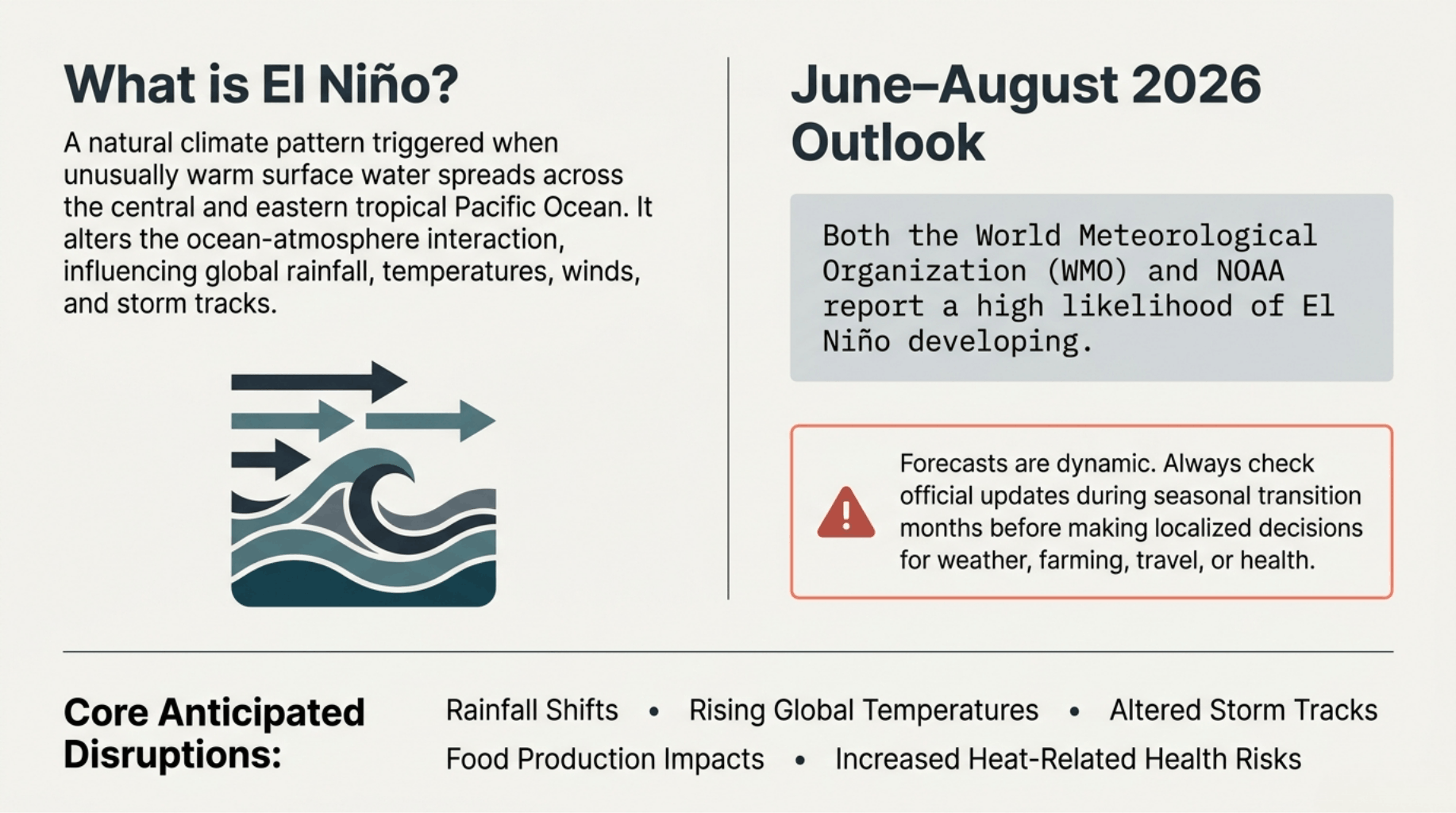
In simple terms, El Niño happens when surface waters in the central and eastern equatorial Pacific become warmer than usual. However, it is not just an ocean event. It also changes the way the ocean and atmosphere interact. Therefore, it can alter winds, rainfall and pressure patterns across large parts of the world.
Importantly, El Niño does not affect every country in the same way. Some regions may face drought, heat and wildfire risk. In contrast, others may see heavier rainfall, flooding or milder winter conditions. The UK often feels El Niño indirectly, while parts of the USA, South America, Africa, Asia and the Pacific can see stronger seasonal impacts.
Table of Contents
Current Context: Why El Niño Matters Now
As of June 2026, official climate agencies are again watching the Pacific closely. The World Meteorological Organisation has reported a high likelihood of El Niño developing during June-August 2026, while NOAA has also placed the outlook firmly towards El Niño conditions.
However, forecasts can change as ocean and wind patterns develop. Therefore, readers should treat this article as an educational guide and check official updates before making weather, travel, farming, workplace or health decisions, especially during seasonal transition months when forecasts are refined for local conditions.
Quick Answer: What Is El Niño?
El Niño is a natural climate pattern that develops when unusually warm surface water spreads across the central and eastern tropical Pacific Ocean. As a result, it changes how heat moves between the ocean and the atmosphere. This can then influence rainfall, temperature, winds and storms in many parts of the world.
El Niño forms as part of a larger climate cycle called the El Niño-Southern Oscillation, often shortened to ENSO. During neutral conditions, trade winds usually push warm surface water westward across the Pacific. However, during El Niño, those winds weaken. Consequently, warmer water shifts eastward, and this changes atmospheric circulation above the tropics.
- El Niño can raise global average temperatures for a period.
- It can increase drought risk in some tropical and subtropical regions.
- It can bring heavier rainfall to selected areas.
- It can influence storm tracks and hurricane activity.
- It can increase heat-related health and safety concerns in vulnerable communities.
However, El Niño is a broad climate signal, not a local forecast. Timing, strength, season and local conditions shape each impact.
How El Niño Forms in the Pacific Ocean
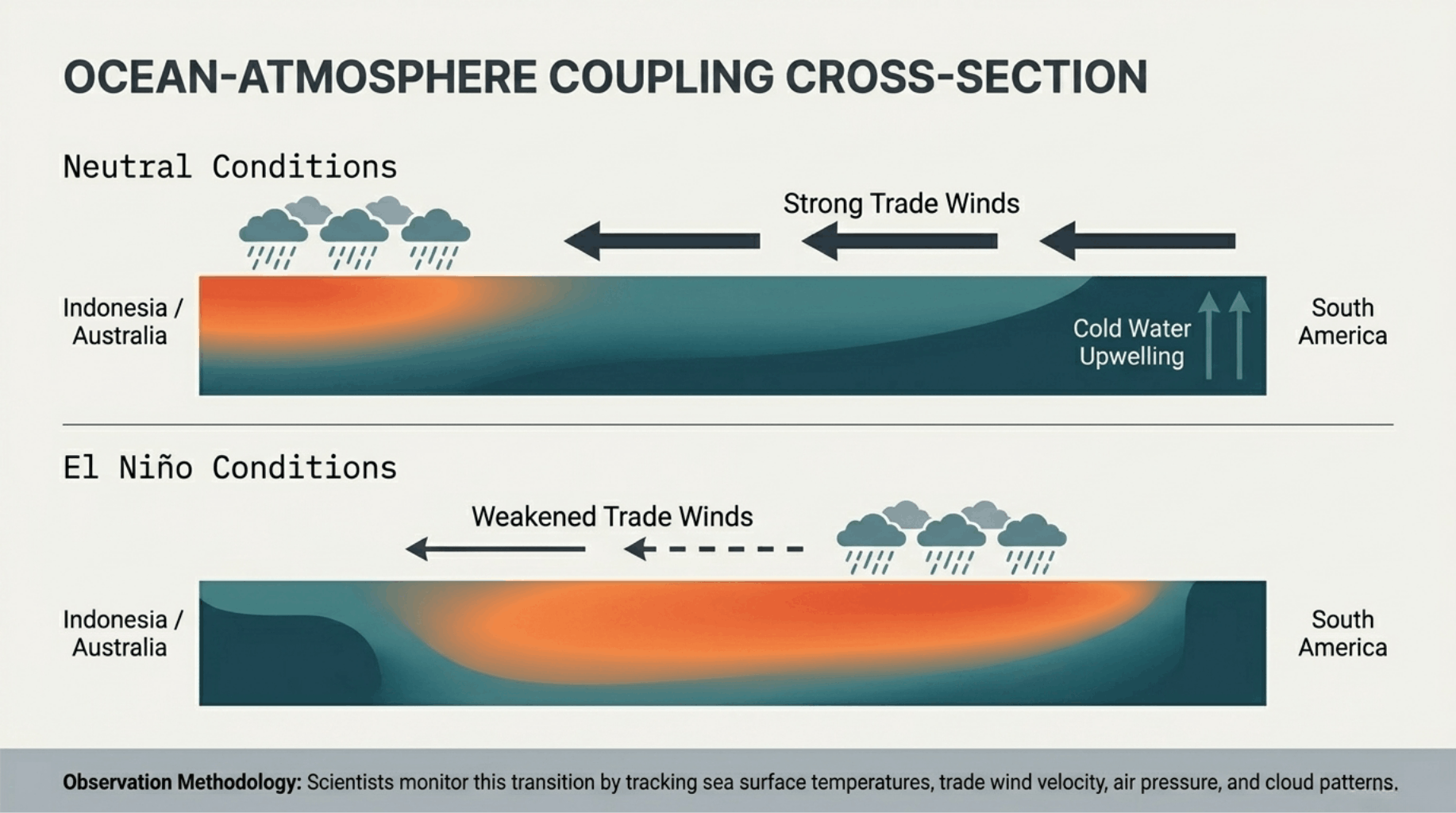
In neutral conditions, strong trade winds blow from east to west across the tropical Pacific. These winds push warm surface water towards Indonesia and Australia. Meanwhile, colder deep water rises near the west coast of South America, which helps keep the eastern Pacific cooler.
During El Niño, those trade winds weaken. As a result, the warm water that usually piles up in the western Pacific moves back towards the central and eastern Pacific. This weakens normal upwelling near South America and allows sea surface temperatures to rise above average.
Scientists monitor El Niño through sea surface temperature changes, trade winds, air pressure and cloud patterns. Therefore, it is best understood as an ocean-atmosphere event.
El Niño, La Niña and ENSO: What Is the Difference?
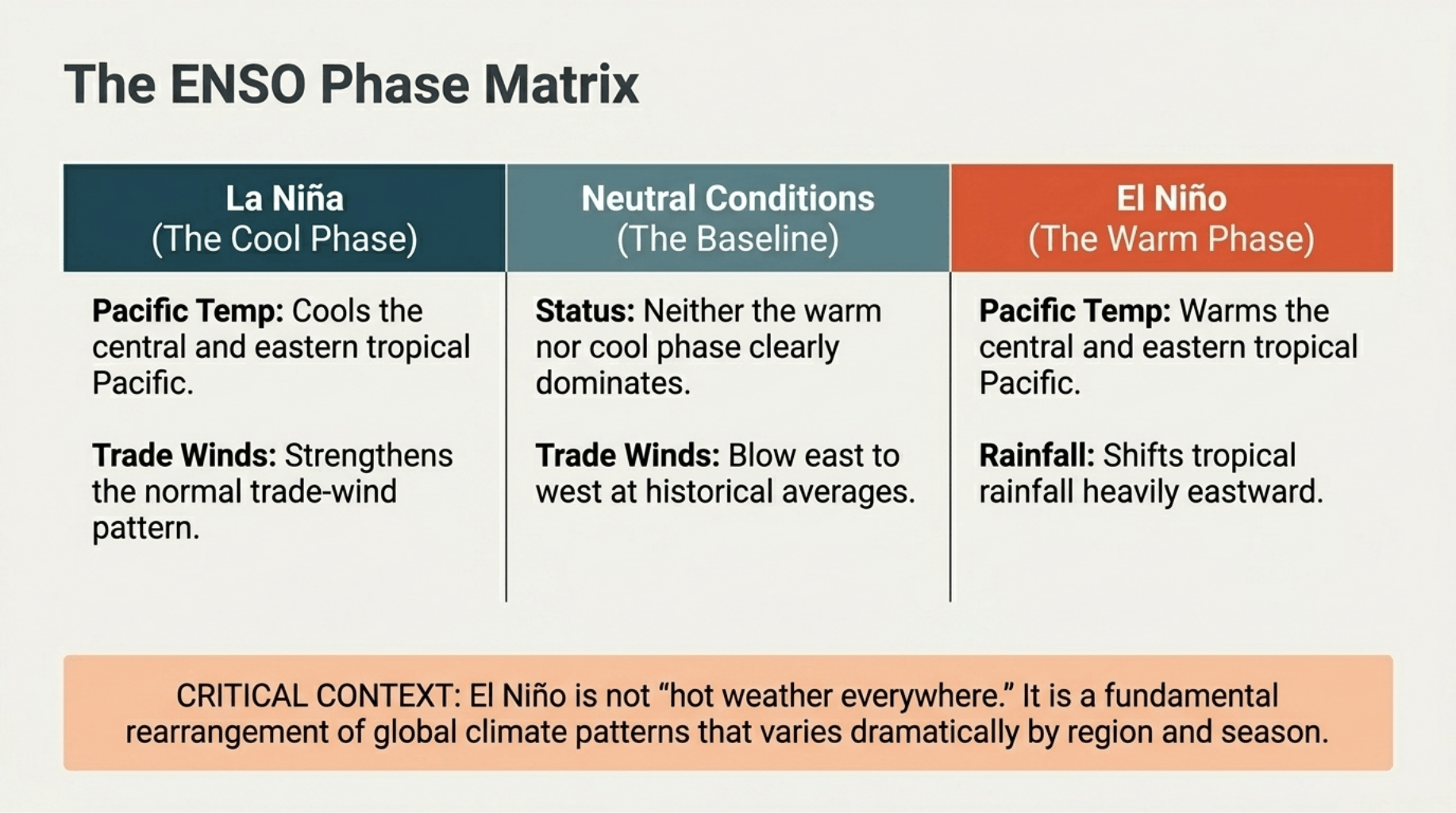
ENSO is the wider climate cycle. El Niño is the warm phase, La Niña is the cool phase, and neutral conditions sit between them. Therefore, El Niño and La Niña are not separate systems. They are different phases of the same ocean-atmosphere pattern.
- El Niño warms the central and eastern tropical Pacific and often shifts rainfall eastward.
- La Niña cools the same region and often strengthens the normal trade-wind pattern.
- Neutral conditions mean neither warm nor cool phase clearly dominates.
This distinction matters because El Niño does not mean “hot weather everywhere”. Instead, it rearranges climate patterns in ways that vary by region and season.
Why El Niño Changes Weather Around the World
El Niño changes global weather because the tropical Pacific covers a huge area and stores a large amount of heat. When that heat shifts eastward, rising air, cloud formation and rainfall also shift. Consequently, the atmosphere adjusts across long distances.
These changes can influence jet streams, storm tracks and monsoon patterns. For example, some places may receive less seasonal rain, while others may face heavier downpours.
Importantly, strength matters. A weak event may have limited effects, while a moderate or strong event can increase the chance of wider disruption.
Global Effects of El Niño by Region

El Niño effects vary widely, so a regional view is more useful than one global statement. Actual outcomes can still differ between events.
Common El Niño-Related Weather Patterns by Region
El Niño affects regions differently. Some areas may face heavier rainfall, while others may experience drought, heat stress and supply chain disruption.
| Region | Common El Niño-Related Pattern |
|---|---|
| 🇬🇧 UK | Indirect effects; possible influence on winter patterns, storm tracks and supply chains. |
| 🇺🇸 USA | Wetter conditions often affect parts of the southern states, while northern areas may see milder winter conditions. |
| 🌎 South America | Peru and nearby coastal areas may face heavier rainfall, flooding and fishery disruption. |
| 🌏 South and Southeast Asia | Some monsoon regions may face drier conditions and heat stress. |
| 🔥 Australia and Indonesia | Drier and hotter conditions can increase drought, wildfire and water-stress risks. |
| 🌧️ East Africa | Some events can increase rainfall and flood risk. |
Drought, Flooding and Food Supply
One of the clearest El Niño risks is rainfall disruption. In some countries, reduced rainfall can damage crops, lower river levels and increase pressure on water supplies. As a result, food prices may rise, especially where farming depends on predictable seasonal rain.
Tropical Storms and Hurricane Patterns
El Niño can also influence tropical storms. In many El Niño years, stronger upper-level winds over the Atlantic can make it harder for hurricanes to organise. However, the eastern and central Pacific may become more favourable for tropical cyclone activity.

What El Niño Could Mean for the UK
The UK sits far from the tropical Pacific, so El Niño does not control UK weather directly. However, it can influence broad winter patterns, storm tracks and supply-chain risks.
The UK signal is often less clear than it is in tropical or Pacific-facing regions. Therefore, UK readers should treat El Niño as one risk factor, not a direct forecast.
- Follow Met Office forecasts for local weather changes.
- Plan for hotter summers as climate change increases baseline heat risk.
- Check flood, storm and heat-health alerts during high-risk periods.
· Review travel and supply-chain risks if your work depends on imported goods.

What El Niño Could Mean for the USA
The USA often sees clearer El Niño patterns than the UK, especially during winter. Parts of the southern United States may become wetter, while some northern areas may be milder.
For the Atlantic hurricane season, El Niño can sometimes reduce activity by increasing wind shear. In contrast, the eastern Pacific may become more favourable for tropical storms.
- Southern states should monitor flood and storm forecasts.
- Western communities should watch drought, wildfire and water-supply updates.
- Coastal areas should follow hurricane guidance from official agencies.
· Outdoor workers should plan for heat, hydration and rest breaks during hot periods.
El Niño, Heatwaves and Health Risks
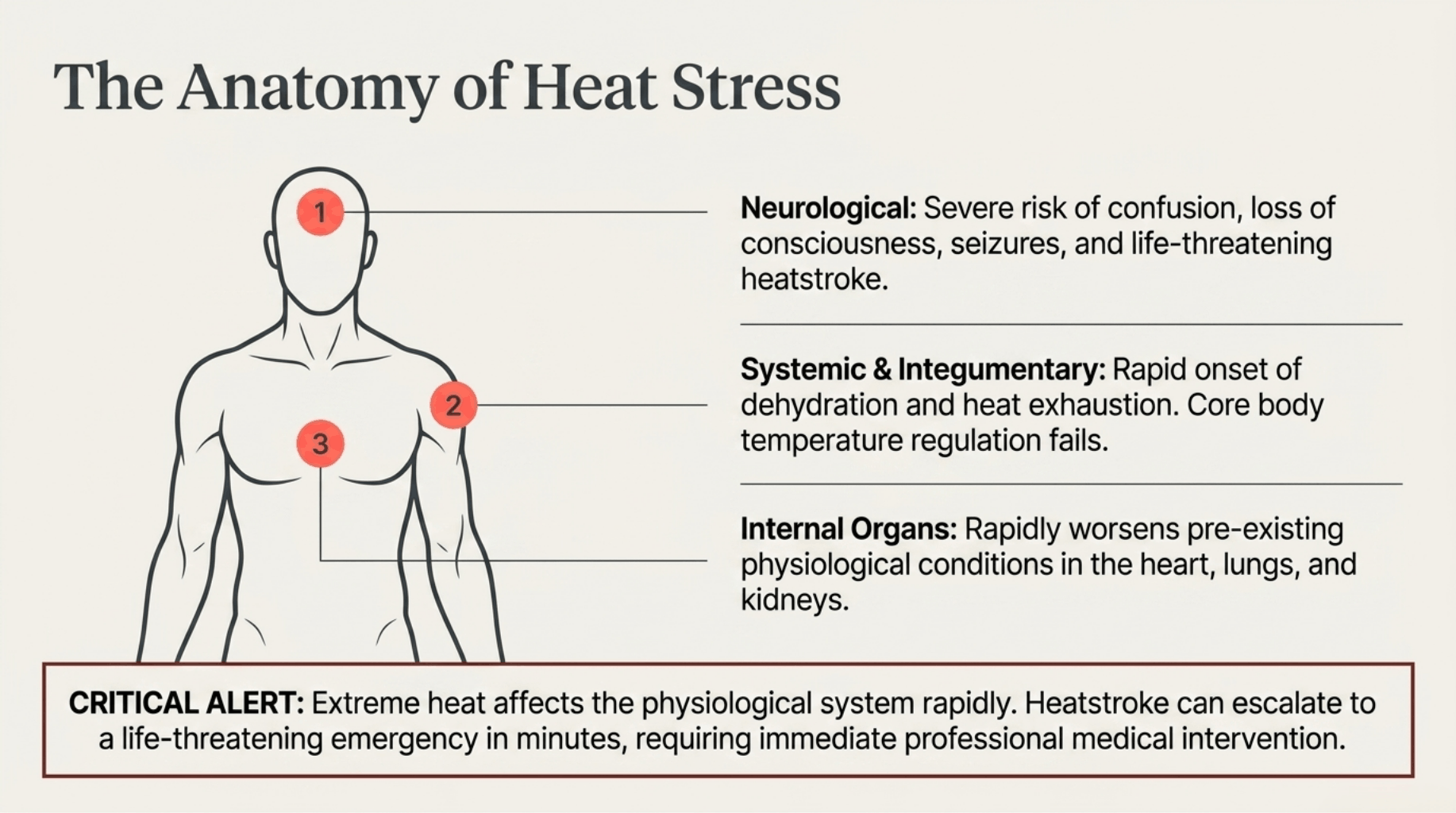
El Niño can raise global average temperatures for a time, especially when it occurs against a warmer climate background. Consequently, it can increase concern about extreme heat, even though local heatwaves still depend on regional weather systems.
Extreme heat affects the body quickly. It can cause dehydration, heat exhaustion and heatstroke. Moreover, it can worsen heart, lung and kidney conditions.
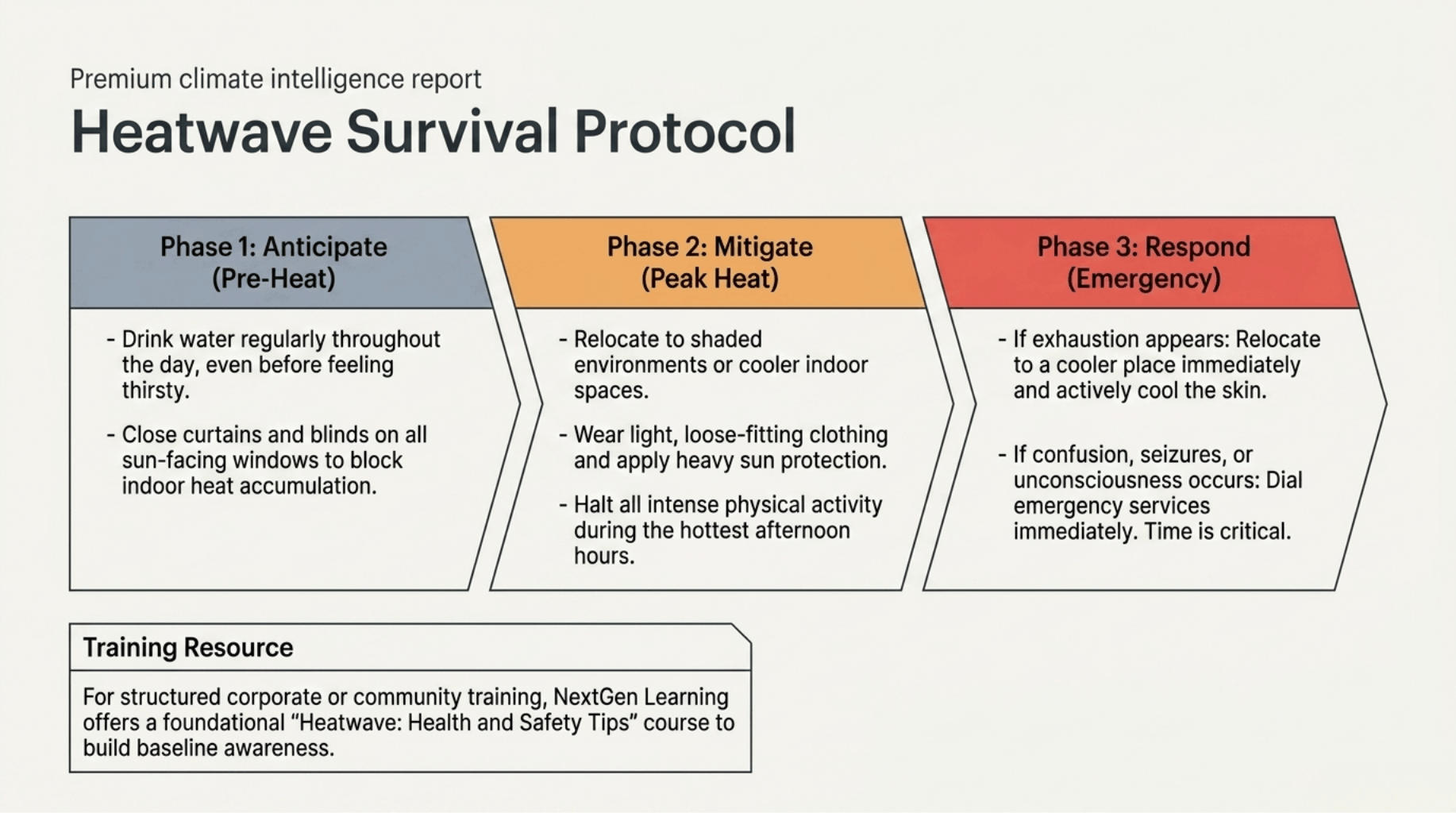
For readers who want a structured way to build heat awareness, NextGen Learning offers a relevant course on Heatwave: Health and Safety Tips. The course link is included here as a helpful learning resource, not as a replacement for local weather warnings or medical advice.
Who Faces Higher Risk During Extreme Heat?
Anyone can become unwell in hot weather. However, some people face higher risk because their bodies, homes or workplaces increase exposure.
- Check on older adults, babies and young children during hot weather.
- Support people with long-term health conditions or limited mobility.
- Help outdoor workers, delivery staff and construction workers reduce heat exposure.
- Protect people who live alone, in high-rise homes or in poorly ventilated housing.
- Never leave children, older people or pets in parked vehicles.
Simple Heatwave Safety Steps
Heatwave safety works best when people act early. Therefore, households and workplaces should prepare before the hottest part of the day.
- Drink water regularly, even before you feel thirsty.
- Stay in shade or cooler indoor spaces during peak heat.
- Close curtains on sun-facing windows to reduce indoor heat.
- Wear light, loose clothing and use sun protection outdoors.
- Avoid intense activity during the hottest hours where possible.
- Move to a cooler place and cool the skin if heat exhaustion signs appear.
If someone becomes confused, loses consciousness, has a seizure or remains very hot after cooling efforts, seek emergency medical help. Heatstroke can become life-threatening, so fast action matters.

El Niño and Climate Change: What Scientists Know
El Niño is natural and has occurred for centuries. However, today’s events happen in a warmer world, so heat-related impacts can feel stronger.
Climate change does not mean every El Niño will become stronger. However, human-driven warming raises the background temperature on which El Niño operates.
This distinction is important. El Niño can help push a year towards record warmth, but long-term warming mainly comes from greenhouse gas emissions.
Are There Any Benefits of El Niño?
El Niño is usually discussed because of its hazards. However, some regions can see short-term benefits, such as useful rainfall or milder winter conditions.
Even so, benefits are uneven and often come with trade-offs. Therefore, it is better to describe El Niño as a pattern of shifting risks.
- Some dry regions may receive useful rainfall.
- Some areas may experience milder winter conditions.
- Atlantic hurricane activity may reduce in some El Niño years.
- Fishing patterns may change, although impacts can harm some coastal economies.

FAQs About El Niño
El Niño usually develops irregularly every two to seven years. However, timing varies, and not every event has the same strength or global impact.
Many events last around nine to twelve months, although some last longer. Typically, El Niño peaks around the Northern Hemisphere winter.
El Niño can raise global temperature averages, but it does not directly cause every heatwave. Instead, it can increase background risk in some periods and regions.
It may influence UK weather indirectly, especially during winter. However, local outcomes depend on the jet stream, pressure systems and nearby ocean temperatures.
No. El Niño is natural, while modern climate change is mainly driven by human-caused greenhouse gas emissions. However, the two can combine to raise heat risk.
Conclusion: What to Remember About El Niño
El Niño starts in the tropical Pacific, but its effects can spread across the world. It can influence rain, heat, storms, food production, water supply and health risks.
For UK, US and worldwide readers, the best approach is to combine climate awareness with local preparation. Follow official forecasts, heat alerts and storm guidance.
References
World Meteorological Organization – Prepare for El Niño: https://wmo.int/news/media-centre/wmo-prepare-el-nino
WMO El Niño/La Niña Update, May 2026: https://wmo.int/resources/publication-series/el-ninola-nina-updates/el-ninola-nina-update-may-2026
NOAA Ocean Service – What are El Niño and La Niña?: https://oceanservice.noaa.gov/facts/ninonina.html
NOAA Climate.gov – El Niño-Southern Oscillation: https://www.climate.gov/enso
NASA – El Niño: https://science.nasa.gov/earth/explore/el-nino/
Met Office – Pacific Ocean warming signals the possible return of a strong El Niño: https://www.metoffice.gov.uk/blog/2026/met-office-what-is-el-nino-and-will-we-see-one-this-year
NHS – Heatwave: how to cope in hot weather: https://www.nhs.uk/live-well/seasonal-health/heatwave-how-to-cope-in-hot-weather/
CDC – About Heat and Your Health: https://www.cdc.gov/heat-health/about/index.html
UK Government/UKHSA – Beat the heat: staying safe in hot weather: https://www.gov.uk/government/publications/beat-the-heat-hot-weather-advice/beat-the-heat-staying-safe-in-hot-weather
WHO – Heat and health: https://www.who.int/news-room/fact-sheets/detail/climate-change-heat-and-health
NOAA Climate Prediction Center: https://www.cpc.ncep.noaa.gov/products/analysis_monitoring/enso_advisory/ensodisc.shtml


0 responses on "El Niño Explained: Global Weather, UK and US Impacts, Heatwaves and Climate Change"