




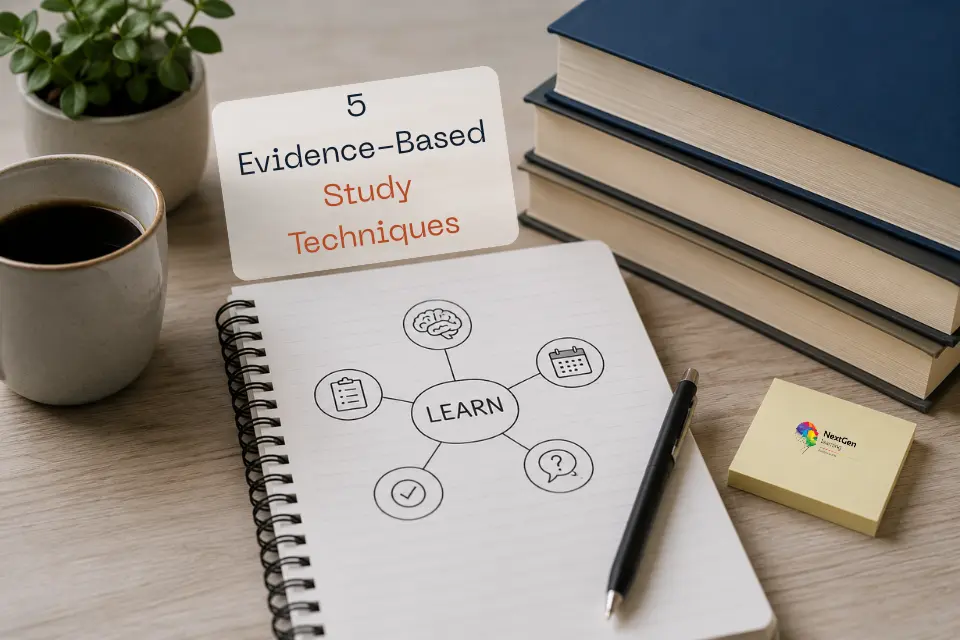
Five Evidence-Based Study Techniques Every Learner Can Use (and Why the Popular Ones Do Not Work)
Most people never get taught how to study. They get taught what to study, then are left to work out the method themselves, usually by copying whatever their classmates did. The result is that the most popular study techniques in the world are also among the least effective, and millions of capable adults conclude they are “bad at studying” when what they actually have is a bad method.
That matters more for adult learners than for anyone else. If you are working through a professional qualification alongside a job, your study time is not elastic. You have an hour on a Tuesday evening and a slow Sunday morning, and that is the whole budget. Using a technique that is half as effective does not mean you work a bit harder to compensate. It means half your available time produces nothing.
The good news is that this is one of the best-settled questions in learning research, and the techniques that win are all free.
Table of Contents
The problem with highlighting and re-reading
In 2013 a team of cognitive psychologists led by John Dunlosky published a review in *Psychological Science in the Public Interest* that graded ten common study techniques by how well the evidence actually supported them. Two of the most popular, highlighting and re-reading, came out with a rating of low utility, and summarising landed in the same band. You can read the full review here.
The reason is something researchers call the illusion of fluency. When you re-read a chapter, it gets easier each time. That growing ease feels exactly like learning. It is not. It is recognition, and recognition is a much weaker thing than recall.
The test in your exam room, or the moment in your job when a patient asks you a question, does not put the page in front of you. It asks you to produce the information from nothing. If every hour of your revision trained recognition, you have practised the wrong skill.
So the honest summary is uncomfortable but useful:
- Re-reading feels productive and mostly is not.
- Highlighting feels active and is close to passive.
- Neat, colour-coded notes are often procrastination wearing a lanyard.
- Difficulty during study is usually a sign it is working, not a sign it is going badly.
That last point is the key that unlocks the rest. The five techniques below all share one property: they feel harder than re-reading, and that is precisely why they work.
1. Practice testing (the single highest-return habit)
If you adopt only one thing from this article, adopt this one. Practice testing came out of the Dunlosky review as one of only two techniques rated high utility.
The classic demonstration comes from Henry Roediger and Jeffrey Karpicke, who compared learners who repeatedly restudied material against learners who studied once and then repeatedly tested themselves. On a test given straight away, the restudy group looked slightly better. A week later, the self-testing group substantially outperformed them. The effort of retrieving something is what strengthens the memory of it, and restudying skips that effort entirely.
In practice, for an adult learner:
- Close the book and write down everything you can remember about the topic, then open it and mark your own gaps.
- Turn every heading in your course notes into a question, and answer it from memory before reading on.
- Use the end-of-chapter questions before you read the chapter, not after. You will get most of them wrong, and you will read far more attentively as a result.
The gaps you find are the point. A revision session that makes you feel competent has told you nothing. A revision session that exposes three things you could not recall has just handed you your next three study targets.
2. Distributed practice (spread the same hours further)
The other high utility technique in the review is spacing. Take the total hours you were going to spend and split them across more days, and long-term retention improves markedly, with no extra time spent.
This is unusually good news for people studying around work, because it means the constraint you already have is close to optimal. Four separate forty-minute sessions across a fortnight will beat one long Sunday session, and they are easier to actually schedule.
The mechanism is counter-intuitive. The partial forgetting that happens between sessions is not a problem to be minimised. It is the thing that makes the next retrieval effortful, and effortful retrieval is what builds durable memory. Studying something you have half-forgotten is more valuable than studying something still fresh.
A workable pattern for a professional qualification:
- Same evening: five minutes recalling the main points of what you covered.
- Two or three days later: ten minutes testing yourself on it.
- A fortnight later: another ten minutes, mixed with other topics.
- Then leave it alone until you revisit it in a mixed practice set.
3. Interleaving (stop studying in tidy blocks)
Course materials are organised by topic, one unit at a time, and most people revise the same way. Real assessments do not work like that, and neither does real work. Questions arrive in an unpredictable order and much of the difficulty is simply recognising what kind of problem you are looking at.
Interleaving means mixing topics within a session rather than blocking them. Instead of an evening on medication calculations followed by an evening on safeguarding, do a set that jumps between them.
Be warned that it feels worse. Your accuracy during practice drops, and the session feels choppy and unsatisfying compared to the smooth rhythm of a single-topic block. Research on this is consistent: blocked practice produces better practice-day performance and worse test-day performance. Interleaving does the opposite.
Blocked practice makes you feel ready. Interleaved practice makes you ready.
4. Self-explanation (say why, not just what)
Self-explanation means asking yourself, out loud or on paper, *why* something is true and how it connects to what you already know, rather than simply restating it.
For adult learners this is often the fastest route to real understanding, because you already have a large stock of professional experience to connect new material to. When you meet a new framework or piece of legislation, the useful question is not “what does it say” but “why is it written this way, and where have I seen the problem it is solving?”
Concretely:
- After reading a section, explain it aloud as if briefing a new colleague who knows nothing.
- Where your explanation goes vague or you find yourself saying “you just do it,” you have located a genuine gap rather than a remembered phrase.
- Tie each new concept to one specific situation from your own work.
The moment you stumble is the finding. Fluent recitation of a definition you cannot explain is one of the easiest ways to walk into an exam overconfident.
5. Take your errors seriously
When you get a practice question wrong, the weak response is to read the correct answer, feel a flicker of recognition, and move on. The strong response is to work out why you chose what you chose.
Almost every wrong answer comes from a specific, identifiable misunderstanding, and that same misunderstanding will produce wrong answers on every future question that touches it. Fixing the reasoning fixes a whole class of errors. Reading the right answer fixes exactly one.
Keep a short running list of the errors you make and what caused each one. Reviewing that list for five minutes is often the highest-value five minutes in a whole week of study, because it is the only part of your revision aimed precisely at your actual weak points.
Fitting this around a job
None of this requires more hours. It requires reordering the hours you already have. A realistic week for someone studying alongside full-time work might be:
- Three short sessions rather than one long one.
- Each session starts with five minutes of recall from last time, before anything new is opened.
- Practice questions mixed across topics rather than grouped.
- One new concept explained out loud, in your own words, per session.
- A five-minute review of your error list on the weekend.
If that still feels like a lot, start with one change: before you re-read anything, close it and ask yourself what you remember. It costs nothing, it takes no extra time, and it converts your least effective habit into your most effective one. Everything else on this list builds from there.
For a readable, free summary of the underlying evidence, The Learning Scientists is written by cognitive psychologists specifically to make this research usable by learners and teachers.
About the author
Louis Vanhove is a working tutor and the founder of iTutorOnline, a European online tutoring platform where every tutor is manually verified. He studies computer science at the VUB in Brussels and writes about the study methods that hold up in practice across the hundreds of tutors and learners he works with.

0 responses on "Five Evidence-Based Study Techniques Every Learner Can Use (and Why the Popular Ones Do Not Work)"