





How to Become a Professional Photographer and Build a Successful Career
Photography is more than simply taking pictures. It is a creative and professional skill that combines technical knowledge, visual storytelling, communication, and business strategy. Today, photography continues to grow as a career path because businesses, brands, influencers, media companies, and individuals constantly need high-quality visual content.
However, becoming a professional photographer requires more than owning an expensive camera. Successful photographers must develop technical photography skills, build a strong portfolio, understand client expectations, and market themselves effectively in a competitive industry.
Whether you want to specialise in wedding photography, fashion photography, portrait photography, commercial photography, wildlife photography, or freelance content creation, building a successful photography career takes consistency, creativity, and continuous learning.
Professional photographers often develop skills in several key areas, including:
- Camera handling and exposure settings to capture high-quality images professionally.
- Photo editing and retouching using industry-standard software and tools.
- Portfolio development and branding to attract clients and showcase unique style.
- Communication and networking to build strong professional relationships.
- Marketing and business management to grow a sustainable photography career.
In today’s digital world, photographers also need to understand social media marketing, personal branding, online portfolios, and client engagement strategies. Consequently, modern photography careers combine both artistic creativity and business development skills.
This guide explains everything you need to know about becoming a professional photographer, including the essential skills you need, photography career pathways, equipment advice, portfolio-building strategies, freelance business tips, and practical steps to help you build a successful long-term career in photography.
Table of Contents
What Does a Professional Photographer Do?

A professional photographer creates high-quality images for commercial, creative, editorial, or personal purposes. However, photography involves far more than simply taking photographs. In professional environments, photographers must combine technical expertise, creativity, communication skills, and business knowledge to deliver professional results consistently.
Modern photographers work across many industries, including fashion, advertising, events, weddings, media, marketing, eCommerce, journalism, travel, real estate, and social media content creation. Therefore, the role can vary significantly depending on the photography niche and client requirements.
Professional photographers are typically responsible for planning shoots, selecting equipment, managing lighting, editing images, communicating with clients, and delivering finished work within deadlines. Many photographers also work independently, which means they must handle marketing, pricing, networking, contracts, and client management alongside their creative work.
Main Responsibilities of a Professional Photographer
| Responsibility | Purpose |
|---|---|
| Planning and preparing shoots | Organise locations, concepts, lighting, and equipment |
| Capturing professional images | Produce high-quality photographs for clients or projects |
| Editing and retouching photos | Improve image quality using editing software |
| Managing client communication | Understand client expectations and project requirements |
| Building a professional portfolio | Showcase photography style and expertise |
| Marketing photography services | Attract new clients and grow business opportunities |
Popular Photography Career Paths
Professional photographers often choose to specialise in specific photography niches based on their interests, creativity, and career goals.
Common Photography Specialisations Include:
- Wedding Photography — Capture weddings, engagements, and special events professionally.
- Portrait Photography — Create professional portraits for individuals, families, models, or businesses.
- Fashion Photography — Work with clothing brands, magazines, designers, and influencers.
- Commercial Photography — Produce images for advertising, products, and business marketing campaigns.
- Wildlife and Nature Photography — Capture landscapes, animals, and outdoor environments.
- Sports and Event Photography — Photograph live events, concerts, sports, and entertainment activities.
Some photographers work full-time for companies or media organisations, while others build freelance photography businesses and work independently with multiple clients.
Importantly, successful photographers continuously improve their technical skills, creative style, and industry knowledge to remain competitive in a fast-changing digital industry.
Skills You Need to Become a Professional Photographer

Becoming a professional photographer requires more than creativity alone. Successful photographers combine technical photography knowledge with communication, business awareness, editing skills, and creative vision. Therefore, developing a balanced skill set is essential if you want to build a long-term and successful photography career.
In today’s competitive photography industry, clients expect photographers to deliver high-quality images consistently while also maintaining professionalism, reliability, and strong communication throughout projects.
Essential Skills Professional Photographers Need
| Skill | Why It Matters |
|---|---|
| Technical Photography Skills | Helps capture well-exposed, high-quality images professionally |
| Creativity and Visual Storytelling | Allows photographers to create unique and engaging photographs |
| Photo Editing Skills | Improves image quality and professional presentation |
| Communication Skills | Helps manage clients, models, and project expectations |
| Business and Marketing Knowledge | Supports client growth and career development |
| Time Management | Ensures projects are completed efficiently and professionally |
Technical Photography Skills
Understanding camera settings and photography fundamentals is one of the most important parts of becoming a professional photographer. Strong technical knowledge helps photographers work confidently in different environments, lighting conditions, and shooting situations.
Professional photographers should understand:
- Exposure settings including aperture, shutter speed, and ISO.
- Lighting techniques for both indoor and outdoor photography.
- Composition and framing to create visually balanced images.
- Camera equipment and lenses for different photography styles and subjects.
Technical confidence allows photographers to adapt quickly during professional shoots and consistently produce high-quality results.
Creativity and Visual Storytelling
Creativity plays a major role in professional photography because clients often look for photographers who can create unique and visually engaging images. Strong visual storytelling helps photographers communicate emotions, ideas, and brand messages effectively through photography.
Developing a personal photography style can also help photographers stand out in a highly competitive market. Consequently, many successful photographers build their careers around a recognisable creative approach.
Photo Editing and Retouching Skills
Modern photography involves significant post-production work. Therefore, professional photographers must understand how to edit and retouch images professionally using editing software such as Adobe Lightroom and Photoshop.
Editing skills help photographers improve image quality, adjust colours and lighting, remove distractions, and create a polished final product suitable for clients, websites, social media, or commercial campaigns.
Communication and Client Management
Professional photographers regularly work with clients, models, businesses, event organisers, and creative teams. As a result, strong communication skills are essential for understanding project requirements, managing expectations, and building long-term professional relationships.
Photographers who communicate professionally often gain more referrals, repeat clients, and stronger business opportunities over time.
Business and Marketing Skills
Many professional photographers work independently or run freelance photography businesses. Therefore, understanding marketing, branding, pricing, networking, and social media promotion is extremely important for long-term success.
Successful photographers often invest time in:
- Building a professional portfolio website
- Promoting services through social media platforms
- Networking with clients and creative professionals
- Developing personal branding and online visibility
Photography is both a creative profession and a business. Consequently, photographers who combine artistic skills with strong business knowledge are often more successful in building sustainable careers.
Best Photography Niches to Choose
Choosing the right photography niche is one of the most important steps in building a successful photography career. A niche helps photographers develop specialised skills, build a targeted portfolio, attract the right clients, and stand out in a competitive industry.
Although some photographers work across multiple styles, many professionals eventually specialise in a specific photography area based on their interests, creativity, and career goals. Therefore, identifying a niche that matches both your passion and market demand can significantly improve long-term career opportunities.
Popular Photography Niches and Career Opportunities
| Photography Niche | Main Focus | Career Opportunities |
|---|---|---|
| Wedding Photography | Weddings and events | Freelance weddings, event agencies |
| Portrait Photography | Individual and family portraits | Studios, personal branding, social media |
| Fashion Photography | Clothing, models, brands | Magazines, designers, advertising |
| Commercial Photography | Products and business marketing | eCommerce, advertising, corporate brands |
| Wildlife Photography | Nature and animals | Publications, travel brands, conservation |
| Sports Photography | Live sports and action events | Media agencies, sports organisations |
| Real Estate Photography | Property and interior photography | Estate agencies, property marketing |
| Travel Photography | Destinations and cultures | Tourism brands, magazines, content creation |
Wedding Photography
Wedding photography remains one of the most popular and profitable photography careers. Wedding photographers capture ceremonies, receptions, portraits, and emotional moments while working in fast-paced environments.
This niche requires strong communication skills, creativity, time management, and the ability to work under pressure. Additionally, photographers often build long-term client referrals through weddings and family events.
Portrait Photography
Portrait photography focuses on capturing individuals, families, professionals, and personal branding images. This niche is highly popular because businesses, influencers, and professionals increasingly require high-quality portraits for websites, LinkedIn profiles, and social media platforms.
Successful portrait photographers usually develop strong lighting techniques, posing skills, and communication abilities to help clients feel comfortable during shoots.
Fashion Photography
Fashion photography combines creativity, styling, branding, and commercial photography techniques. Fashion photographers often work with designers, clothing brands, magazines, influencers, and marketing agencies.
This niche is highly competitive; however, it can offer exciting opportunities for photographers with strong creative direction and editing skills.
Commercial and Product Photography
Commercial photography focuses on products, advertising campaigns, branding, and business marketing. As online shopping and digital marketing continue to grow, businesses increasingly need professional product images for websites, social media, and advertising campaigns.
Commercial photographers often work with companies, eCommerce brands, restaurants, and corporate clients to create professional marketing visuals.
Commercial Photography Often Includes:
- Product photography for eCommerce stores
- Corporate branding photography
- Food and restaurant photography
- Social media and advertising content
Wildlife and Travel Photography
Wildlife and travel photography are ideal for photographers who enjoy outdoor environments, nature, and exploration. These niches often involve photographing landscapes, wildlife, cultures, tourism destinations, and environmental subjects.
Although highly competitive, photographers can build careers through magazines, travel companies, stock photography, tourism campaigns, and social media content creation.
How to Choose the Right Photography Niche
Choosing the right photography niche depends on your interests, strengths, creative style, and long-term career goals. Importantly, you do not need to decide immediately. Many photographers experiment with multiple styles before specialising professionally.
When selecting a niche, consider:
- Your personal interests and creativity
- Market demand and career opportunities
- Your preferred working environment
- The type of clients you want to work with
- Long-term income and business potential
Developing expertise in a specific photography niche can help you build a stronger portfolio, improve professional credibility, and attract higher-quality clients over time.
10 Practical Steps to Become a Professional Photographer
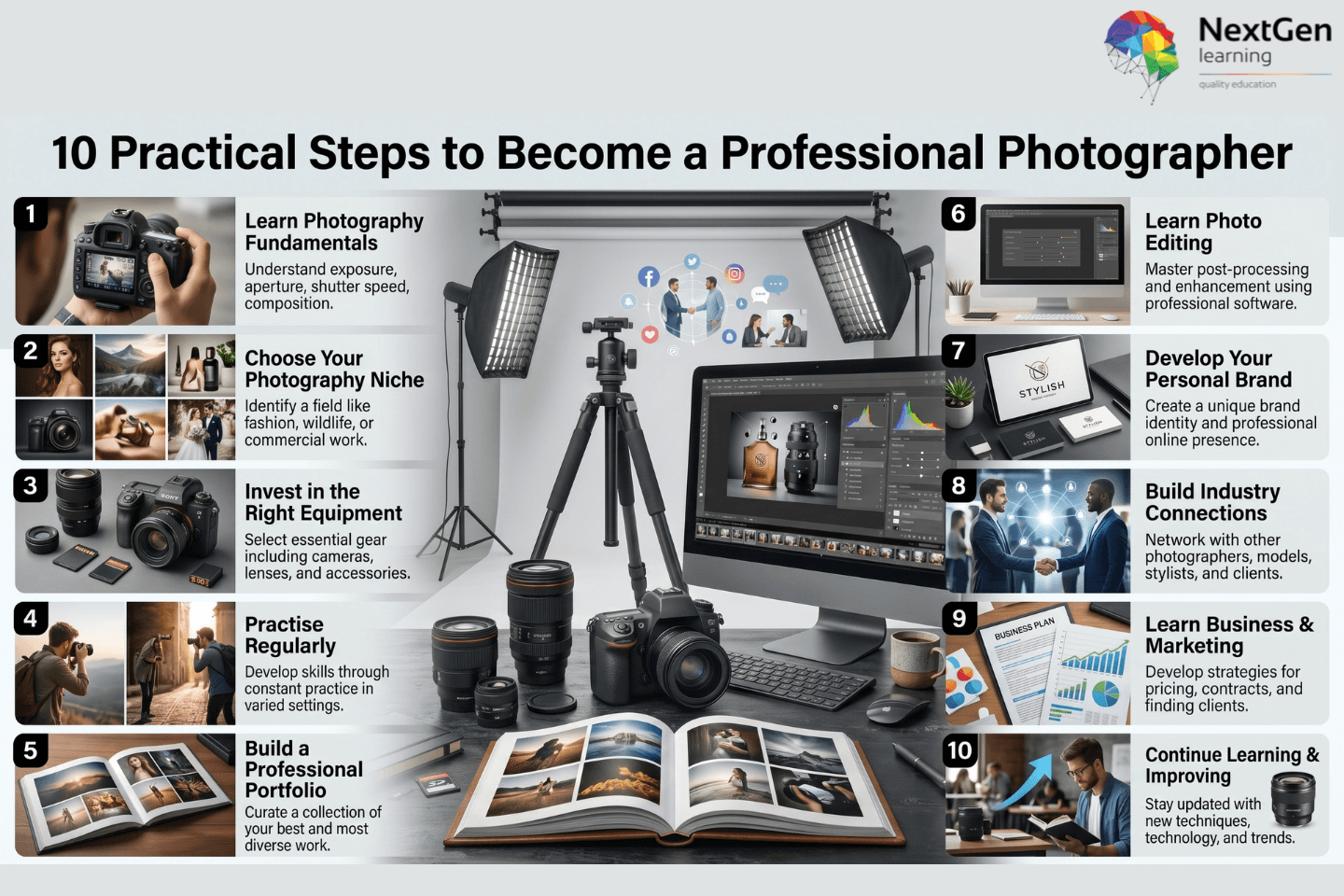
Building a successful photography career requires patience, consistency, technical improvement, and professional development. Although photography can be highly competitive, individuals who continuously improve their skills and build strong industry knowledge can create long-term career opportunities in both freelance and commercial photography.
The following practical steps can help aspiring photographers build confidence, improve professional skills, and develop a successful photography career.
1. Learn the Fundamentals of Photography
Before working professionally, photographers must understand the technical foundations of photography. Strong knowledge of exposure settings, lighting, composition, camera functions, and image quality is essential for producing professional results consistently.
Professional photographers should become confident using:
- Aperture, shutter speed, and ISO settings
- Manual camera controls and focusing techniques
- Natural and studio lighting setups
- Composition and framing techniques
Developing strong technical knowledge creates a solid foundation for long-term growth in photography.
2. Choose Your Photography Niche
Choosing a photography niche helps photographers develop specialised skills and attract the right clients. Some photographers specialise in weddings, while others focus on fashion, portraits, wildlife, sports, commercial work, or product photography.
Specialisation also helps photographers create a more focused portfolio and stronger personal brand within their chosen industry.
3. Invest in the Right Photography Equipment
Professional photography equipment can improve image quality and shooting flexibility. However, beginners do not need the most expensive cameras immediately. Instead, photographers should focus on learning how to use their equipment effectively before upgrading.
Essential Beginner Photography Equipment
| Equipment | Purpose |
|---|---|
| DSLR or Mirrorless Camera | Capture high-quality professional images |
| Prime or Zoom Lens | Improve image sharpness and creative flexibility |
| Tripod | Stabilise shots and improve image consistency |
| Lighting Equipment | Improve indoor and studio photography |
| Editing Software | Enhance and professionally retouch photographs |
As photographers gain experience, they can gradually upgrade their equipment based on their photography niche and professional needs.
4. Practise Regularly and Build Experience
Photography skills improve through regular practice and real-world experience. Therefore, photographers should consistently experiment with different lighting conditions, subjects, locations, and techniques to strengthen their abilities.
Many successful photographers improve their skills by:
- Taking photos regularly in different environments
- Assisting experienced photographers during shoots
- Practising editing and retouching techniques
- Participating in photography projects and challenges
Continuous practice helps photographers improve creativity, technical confidence, and shooting consistency over time.
5. Build a Professional Photography Portfolio
A strong portfolio is one of the most important tools for attracting photography clients and showcasing professional ability. Your portfolio should demonstrate technical quality, creativity, consistency, and your preferred photography style.
Professional photographers often create online portfolio websites, social media galleries, or digital presentations to display their best work professionally.
Importantly, quality matters more than quantity. A smaller portfolio with strong images is usually more effective than a large portfolio with inconsistent work.
6. Learn Photo Editing and Retouching
Modern photography involves significant post-production work. Therefore, learning professional editing software such as Adobe Lightroom and Photoshop is essential for improving image quality and delivering polished results.
Editing skills help photographers adjust colours, improve lighting, remove distractions, and maintain a consistent professional style across projects.
7. Develop Your Personal Brand
Building a personal photography brand helps photographers stand out in a crowded industry. A strong brand includes your photography style, online presence, communication style, and overall professional identity.
Professional photographers often strengthen their branding by:
- Creating a professional website and portfolio
- Using social media consistently
- Sharing photography projects and behind-the-scenes content
- Developing a recognisable editing or visual style
Strong branding can improve visibility, trust, and client engagement significantly.
8. Start Networking and Building Connections
Networking is extremely important in the photography industry. Building professional relationships can lead to referrals, collaborations, partnerships, and long-term client opportunities.
Photographers can expand their network by attending photography events, joining online communities, collaborating with creative professionals, and connecting with businesses or brands in their niche.
9. Learn Basic Business and Marketing Skills
Many photographers work as freelancers or run their own businesses. Therefore, understanding pricing, contracts, invoicing, client communication, and marketing strategies is essential for long-term success.
Successful photographers often invest time in learning:
- Social media marketing
- Client communication and customer service
- Photography pricing strategies
- Business management and invoicing systems
Photography careers grow much faster when creative skills are supported by strong business knowledge.
10. Continue Learning and Improving
Photography trends, technology, editing styles, and client expectations continue to evolve. Consequently, successful photographers constantly improve their skills, explore new creative techniques, and adapt to industry changes.
Continuous learning may involve:
- attending photography courses
- studying professional photographers
- practising advanced editing
- experimenting with new styles
- learning marketing and branding strategies
Professional growth in photography is a long-term journey that combines creativity, technical development, consistency, and business improvement.
Photography Equipment Beginners Need

Starting a professional photography career does not mean you need the most expensive camera equipment immediately. Instead, beginners should focus on learning photography fundamentals and investing in reliable equipment that supports their photography style and career goals.
The right photography equipment can improve image quality, shooting flexibility, and overall workflow efficiency. However, understanding how to use your equipment properly is far more important than simply owning high-end gear.
Essential Photography Equipment for Beginners
| Equipment | Why It’s Important |
|---|---|
| DSLR or Mirrorless Camera | Captures high-quality professional images |
| Standard Lens | Suitable for portraits, travel, and general photography |
| Prime Lens | Produces sharper images and better low-light performance |
| Tripod | Helps stabilise images and improve consistency |
| Memory Cards & Storage | Protects and stores photography work safely |
| Editing Software | Enhances image quality and professional presentation |
Choosing the Right Camera
One of the first decisions beginners face is choosing between a DSLR camera and a mirrorless camera. Both options can produce professional-quality photographs; therefore, the best choice often depends on budget, photography style, and personal preference.
Beginners should prioritise cameras that offer:
- Manual exposure controls for learning photography fundamentals properly.
- Interchangeable lenses to improve shooting flexibility.
- Good low-light performance for different photography environments.
- Comfortable handling and usability during long shoots.
Importantly, many professional photographers start with entry-level or second-hand equipment before upgrading later in their careers.
Understanding Photography Lenses
Lenses have a major impact on image quality, depth, sharpness, and creative style. Different photography niches often require different types of lenses depending on the subject and shooting environment.
Common Lens Types for Beginners
| Lens Type | Best For |
|---|---|
| 50mm Prime Lens | Portraits and low-light photography |
| 24–70mm Zoom Lens | Everyday and event photography |
| Wide-Angle Lens | Landscapes and architecture |
| Telephoto Lens | Wildlife and sports photography |
Learning how different lenses affect composition and depth of field is an important step in becoming a professional photographer.
Lighting Equipment and Accessories
Lighting plays a critical role in photography because it directly affects image quality, mood, and overall professionalism. Although natural light is valuable, many photographers eventually invest in lighting equipment for better creative control.
Useful beginner accessories may include:
- External flash or speedlight for indoor photography.
- Reflectors and diffusers to control lighting conditions.
- Tripods and stabilisers for sharper and more stable images.
- Camera bags and protective gear for safe equipment transport.
These accessories help photographers work more efficiently in different shooting situations.
Editing Software for Professional Photography
Modern photography involves significant editing and post-production work. Therefore, learning professional editing software is essential for improving image quality and developing a consistent photography style.
Popular photography editing software includes:
- Adobe Lightroom for colour correction and workflow management.
- Adobe Photoshop for advanced retouching and image manipulation.
- Capture One for professional studio and commercial editing.
Editing skills help photographers enhance lighting, improve colours, remove distractions, and deliver polished professional results.
Focus on Skills Before Expensive Equipment
Many beginners believe expensive equipment automatically creates better photography. However, professional-quality images depend far more on creativity, technical knowledge, lighting, composition, and experience.
Successful photographers often focus first on:
- understanding camera settings
- practising composition
- improving lighting techniques
- developing editing skills
- gaining real-world experience
As photography skills improve, equipment upgrades become more valuable and strategic for long-term professional growth.
How to Start a Freelance Photography Business
Many professional photographers choose to work independently and build freelance photography businesses. Freelancing offers flexibility, creative freedom, and the opportunity to work with different clients, industries, and photography styles. However, building a successful freelance photography career requires more than strong photography skills alone.
Freelance photographers must also understand marketing, branding, pricing, networking, customer service, and business management to grow sustainably in a competitive industry.
Build a Strong Personal Brand
Personal branding is extremely important for freelance photographers because clients often choose photographers based on style, professionalism, and online presence. Therefore, creating a clear and recognisable brand can help photographers stand out from competitors.
A strong photography brand usually includes:
- A professional photography portfolio website
- Consistent editing and visual style
- Professional social media presence
- Clear communication and client experience
Strong branding helps photographers build trust, improve visibility, and attract higher-quality clients over time.
Set Up Your Photography Portfolio and Online Presence
In today’s digital industry, most clients search for photographers online before making contact. Consequently, freelance photographers should create professional online platforms to showcase their work and services.
Important Online Platforms for Photographers
| Platform | Purpose |
|---|---|
| Professional Website | Showcase portfolio and photography services |
| Build audience and share visual content | |
| Connect with professional clients and businesses | |
| Increase visibility and drive portfolio traffic | |
| Behance | Display creative and commercial photography projects |
Maintaining a strong online presence can significantly improve client enquiries and networking opportunities.
Learn Photography Pricing and Business Management
One of the biggest challenges for beginner photographers is pricing services correctly. Charging too little can reduce profitability, while unrealistic pricing can discourage potential clients.
Freelance photographers should consider:
- equipment costs
- editing time
- travel expenses
- software subscriptions
- marketing costs
- project complexity
Understanding contracts, invoices, deposits, and licensing agreements is also important for protecting both photographers and clients professionally.
Use Social Media and Marketing Strategically
Marketing plays a major role in freelance photography success. Even highly skilled photographers may struggle to gain clients if they do not promote their services effectively.
Successful photographers often grow their businesses through:
- social media marketing
- networking events
- collaborations
- referrals
- content creation
- SEO-focused portfolio websites
Sharing behind-the-scenes content, photography projects, client work, and educational posts can also help photographers build trust and improve audience engagement online.
Build Professional Relationships and Network
Networking is one of the most effective ways to grow a freelance photography business. Building strong relationships with clients, businesses, agencies, models, designers, and other photographers can lead to referrals and long-term opportunities.
Professional photographers who maintain positive client experiences often benefit from repeat bookings, recommendations, and stronger industry credibility.
Deliver Excellent Customer Service
Customer service is a major factor in long-term photography success. Clients value photographers who communicate clearly, meet deadlines, behave professionally, and deliver consistent quality.
Strong Customer Service Includes:
- Responding to enquiries professionally and quickly
- Communicating project expectations clearly
- Delivering photographs within agreed timelines
- Handling feedback and revisions professionally
Good customer experiences often lead to referrals, repeat business, and stronger professional reputation.
Continue Improving Your Business Skills
Freelance photography combines creativity with entrepreneurship. Therefore, photographers who continue improving both artistic and business skills are usually more successful long term.
Many successful photographers regularly invest time in:
- photography education
- marketing skills
- branding strategies
- social media growth
- networking opportunities
- client relationship management
Building a freelance photography business takes patience, consistency, professionalism, and continuous development. However, photographers who combine creative talent with strong business knowledge can build highly rewarding and sustainable careers.
How Much Do Professional Photographers Earn in the UK?
Photography income in the UK can vary significantly depending on experience, photography niche, location, client base, and whether a photographer works freelance or full-time for a company. While some photographers work part-time or freelance initially, many professionals eventually build highly profitable careers through specialisation, branding, and strong client relationships.
In general, photographers with stronger portfolios, professional networks, and business skills often earn higher incomes over time.
Average Photographer Salaries in the UK
| Photography Role | Estimated UK Salary |
|---|---|
| Beginner Photographer | £18,000 – £25,000 per year |
| Portrait Photographer | £25,000 – £40,000 per year |
| Wedding Photographer | £30,000 – £60,000+ per year |
| Commercial Photographer | £35,000 – £70,000+ per year |
| Fashion Photographer | £30,000 – £65,000+ per year |
| Freelance Photographer | Income varies based on projects and clients |
These salary estimates can increase significantly for photographers who work with premium brands, large commercial campaigns, luxury events, or high-profile clients.
Factors That Affect Photography Income
Photography earnings depend on several professional and business-related factors. Consequently, photographers who continuously improve their technical, creative, and marketing skills often increase their income potential more quickly.
Key Factors That Influence Earnings
- Photography niche and specialisation
- Portfolio quality and professional reputation
- Client demand and networking opportunities
- Marketing and personal branding skills
- Experience level and technical expertise
- Location and target market
For example, photographers working in London or major cities may charge higher rates because of increased commercial demand and larger client markets.
Freelance Photography Income Potential
Freelance photography income can vary greatly because photographers often charge per project, hourly rate, event package, or licensing agreement. Some freelancers work part-time alongside other jobs, while others operate full-time photography businesses.
Successful freelance photographers usually increase their income by:
- specialising in profitable niches
- improving client retention
- building strong personal brands
- expanding professional networks
- offering premium photography packages
Additionally, many photographers create multiple income streams through photo licensing, content creation, social media partnerships, print sales, workshops, and online photography education.
Highest-Paying Photography Niches
Certain photography specialisations generally offer higher earning potential because of commercial demand, technical difficulty, or premium client markets.
Higher-Paying Photography Niches Include:
| Photography Niche | Why It Pays Well |
|---|---|
| Commercial Photography | Businesses invest heavily in branding and advertising |
| Fashion Photography | Works with brands, magazines, and campaigns |
| Wedding Photography | High client demand and premium event pricing |
| Product Photography | eCommerce and online marketing demand |
| Real Estate Photography | Growing property marketing industry |
However, profitability often depends on portfolio quality, client relationships, marketing strategy, and business management rather than niche alone.
Can Photography Become a Full-Time Career?
Yes. Many photographers successfully build full-time careers through freelance work, studio photography, commercial projects, social media content creation, and long-term client relationships. However, photography careers usually require patience, consistency, and continuous improvement before becoming financially stable.
Successful photographers often focus on:
- improving technical skills
- strengthening portfolios
- building client relationships
- learning business and marketing strategies
- developing strong personal branding
With dedication and professional development, photography can become both a creatively fulfilling and financially rewarding long-term career.
Common Mistakes New Photographers Make

Starting a photography career can be exciting; however, many beginners make mistakes that slow their professional growth and affect the quality of their work. In most cases, these mistakes happen because new photographers focus too heavily on equipment while overlooking important areas such as technical knowledge, portfolio development, client communication, and business strategy.
Understanding these common mistakes can help aspiring photographers improve faster, build stronger portfolios, and avoid unnecessary setbacks during their professional journey.
Focusing Too Much on Expensive Equipment
One of the most common beginner mistakes is believing that expensive cameras automatically produce professional-quality photography. While good equipment can improve flexibility and image quality, photography success depends far more on creativity, lighting, composition, technical understanding, and experience.
Many successful photographers begin with entry-level or second-hand equipment and gradually upgrade as their skills and business grow.
Instead of immediately purchasing expensive gear, beginners should focus on:
- mastering camera settings
- understanding lighting
- improving composition
- practising regularly
- developing editing skills
Ignoring Photography Fundamentals
Some beginners rely heavily on automatic camera settings without fully understanding exposure, lighting, or composition. Consequently, they struggle to adapt in professional shooting environments.
Strong photography fundamentals remain essential regardless of photography niche or equipment quality.
Important Photography Fundamentals Include:
- Aperture, shutter speed, and ISO settings
- Lighting and exposure control
- Composition and framing techniques
- Focus and depth of field management
Photographers who build strong technical foundations usually improve faster and produce more consistent professional results.
Building a Weak or Inconsistent Portfolio
A portfolio is often the first thing potential clients review before hiring a photographer. However, many beginners upload too many average-quality images instead of focusing on strong and consistent work.
Professional portfolios should highlight:
- best-quality images
- consistent editing style
- niche specialisation
- creativity and technical ability
A smaller portfolio with polished work is usually more effective than a large collection of inconsistent photographs.
Neglecting Editing and Post-Production Skills
Modern photography involves significant editing and retouching work. Beginners who ignore post-production skills often struggle to achieve polished professional results.
Learning editing software such as Adobe Lightroom and Photoshop helps photographers:
- improve image quality
- maintain visual consistency
- correct lighting and colour issues
- create professional presentation standards
Editing is now an essential part of professional photography workflow.
Poor Client Communication and Professionalism
Many talented photographers lose opportunities because of poor communication, delayed responses, or unprofessional behaviour. In photography, technical skills alone are not enough. Clients also value reliability, professionalism, and strong customer experience.
Professional Photography Habits Include:
- Responding to enquiries quickly and professionally
- Communicating expectations clearly with clients
- Delivering projects within agreed deadlines
- Handling feedback professionally and respectfully
Strong communication often leads to repeat clients, referrals, and better long-term business growth.
Not Marketing Their Photography Work
Some beginner photographers wait for clients to discover them naturally. However, photography is highly competitive, and strong marketing plays a major role in career growth.
Successful photographers usually invest time in:
- social media marketing
- SEO portfolio websites
- networking
- collaborations
- content creation
- personal branding
Building visibility online can significantly increase photography opportunities and client enquiries.
Giving Up Too Early
Photography careers take time to develop. Many beginners become discouraged when they do not achieve immediate success or consistent income quickly. However, professional growth in photography usually happens gradually through continuous learning, practice, networking, and experience.
Successful photographers remain consistent, improve their skills regularly, and continue building their portfolio and professional reputation over time.
Professional Photography Course
Build practical photography skills with our CPD-accredited Professional Photography Course. This online course helps learners improve camera handling, lighting, composition, photo editing, and portfolio development through structured and beginner-friendly training.
You will learn essential photography techniques, professional editing skills, and creative approaches that can support freelance opportunities, content creation, and long-term photography career growth.
Course Benefits
- Learn professional photography techniques and camera settings
- Improve editing, lighting, and composition skills
- Build a professional photography portfolio confidently
- Study online flexibly at your own pace
- Receive a CPD-accredited digital certificate for your CV
Whether you want to become a freelance photographer, improve creative skills, or start a photography career, this course provides practical training suitable for beginners and aspiring professionals.
FAQs About Becoming a Professional Photographer
No. A university degree is not essential to become a professional photographer. Many successful photographers build strong careers through practical experience, portfolio development, professional training, and continuous skill improvement. However, photography courses and certifications can help strengthen technical knowledge, creative confidence, and industry understanding.
The time required varies depending on experience, practice, learning consistency, and career goals. Some individuals begin working professionally within a year, while others spend several years refining technical skills, building a portfolio, and developing a client base. Consistent practice and professional development are key to long-term success in photography.
Beginners should choose a camera that offers manual controls, interchangeable lenses, and reliable image quality. Entry-level DSLR and mirrorless cameras are both excellent options for learning professional photography fundamentals. Importantly, understanding lighting, composition, and camera settings is far more valuable than purchasing expensive equipment at the beginning.
Portrait photography, event photography, lifestyle photography, and product photography are often ideal starting points because they provide practical shooting experience and strong portfolio opportunities. However, the right photography niche ultimately depends on personal interests, creativity, career goals, and preferred working style.
Yes. Many photographers build successful full-time careers through freelance work, commercial photography, weddings, branding projects, social media content creation, and long-term client relationships. However, building a sustainable photography career requires strong technical skills, consistent networking, effective marketing, and professional business management.
Yes. Photo editing and retouching are essential parts of modern photography workflows. Professional photographers regularly use software such as Adobe Lightroom and Photoshop to improve image quality, enhance colours and lighting, maintain consistency, and deliver polished professional results to clients.
Professional photographers typically attract clients through portfolio websites, social media marketing, networking, referrals, collaborations, SEO, and personal branding. Building a strong online presence and maintaining professional communication often play a major role in long-term client growth and business success.
Successful photographers require a combination of technical photography knowledge, creativity, communication skills, editing ability, and business understanding. Additionally, adaptability, time management, client communication, and marketing skills are highly important for building a successful long-term photography career in today’s competitive industry.



0 responses on "How to Become a Professional Photographer and Build a Successful Career"