




How Watching Netflix Can Help Students Learn a Language Faster?
By Ange

Most people who study a language spend years working through grammar exercises and vocabulary lists, then feel completely lost the first time they hear a native speaker talk at normal speed. The distance between the language of the classroom and the language of real life is one of the main reasons learners lose motivation and give up. Watching films and series in the language you are studying is one of the most effective ways to close that gap, and it fits into daily life far more easily than another hour of drills.
This article looks at why watching works so well, what the research actually shows, and how students and teachers can turn ordinary screen time into steady progress. None of it requires special talent or extra hours in the day. It only asks for a small change in how you watch.
Language sticks when you understand, not when you memorise
The linguist Stephen Krashen is best known for a simple but powerful idea: we acquire a language mainly when we understand messages that are a little beyond our current level. He called this comprehensible input. Studying grammar helps you notice how a language is built, but the deeper ability to understand and produce it comes from meeting the language in situations where the meaning is clear.
Films and series are an unusually rich source of this kind of input. Meaning is not carried by the words alone. It is carried by the situation, the expressions on the actors’ faces, the tone of their voices, and the action on screen. That context is exactly what lets your brain guess a word and then confirm it, without stopping to translate every line. When a character slams a door and says a short phrase in anger, the scene already tells you roughly what was said. The next time you hear that phrase, you have a memory to attach it to, which is far stronger than a definition copied from a list.
Why subtitles help you remember more
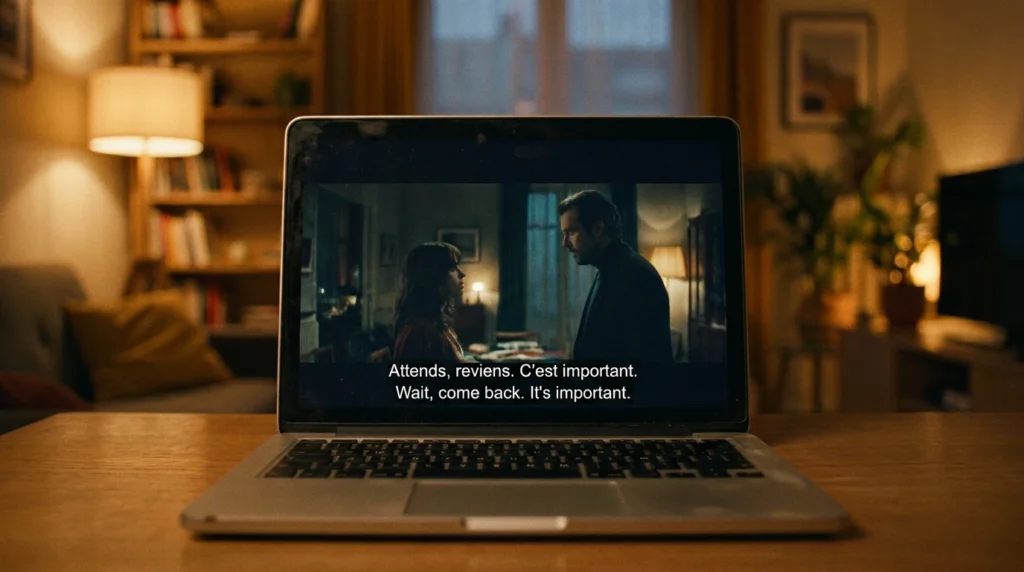
There is a well established idea in psychology called dual coding, developed by the researcher Allan Paivio. It says that information which arrives through more than one channel at the same time is easier to store and to recall later. Watching with subtitles is a natural example. You hear a line, you see it written, and a scene gives it meaning, all at once. Sound, text, and image reinforce each other instead of competing.
Research on captioned video supports this. A 2013 meta-analysis published in the journal System, which combined the results of many separate studies, found that captions had a positive overall effect on both vocabulary learning and listening comprehension for language learners. Robert Vanderplank, who has studied subtitles for decades, reaches a similar conclusion in his work: used with a little intention, on screen text turns passive viewing into a genuine learning activity.
It helps to know that not all subtitles do the same job:
- Subtitles in the language you are learning, matched to audio in the same language, build a strong link between how words sound and how they are written.
- Dual subtitles, which show the target language together with your own language, help beginners grasp meaning quickly without losing the connection to the original.
- Subtitles in your own language only are the most comfortable, but they carry a risk. It is easy to read the translation and ignore the foreign audio completely.
Passive watching is not enough
Here is the honest part that many guides skip. Watching a whole season with your own language subtitles, while half asleep on the sofa, does very little for your language. You follow the story in your native language and the foreign audio becomes background noise. The benefit comes from attention, not from screen time on its own.
The good news is that you do not need to turn every episode into a lesson. That would drain the fun and you would stop. A better approach is to mix enjoyment with short bursts of focus. Watch mostly for the story, and give a few minutes of real attention to the language. A small amount of active watching, done regularly, beats an occasional marathon study session that leaves you exhausted.
Simple ways students can turn screen time into practice
These habits take almost no extra time and make a clear difference over a few weeks:
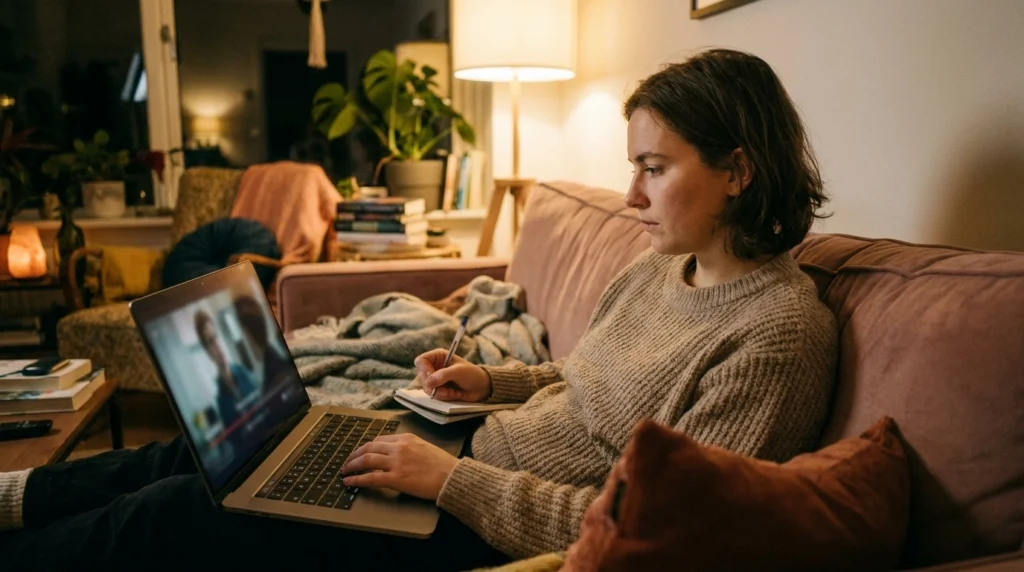
- Watch a short scene twice. The first time, use dual subtitles to understand it. The second time, switch to subtitles in the target language only, so you connect the sound with the spelling.
- Choose only one or two useful phrases per episode, not twenty. Write each one down together with the moment it appeared, so the memory has a hook.
- Pause and repeat a line out loud. Copying the rhythm and the intonation trains your mouth, not just your ears, which is what makes speaking feel natural later.
- Rewatch shows you already know well. Because you remember the plot, your attention is free to notice the language.
- Keep a light review habit. Put your new phrases into a flashcard app and spend a few minutes a day going through them.
Choosing the right show for your level
The single most common mistake is picking content that is far too hard. A fantasy epic full of invented names and old fashioned speech will discourage almost any learner. Match the show to your level instead:
- Beginners do best with clear, everyday dialogue and simple plots. Children’s series, sitcoms, and reality shows tend to use common words and short sentences.
- Intermediate learners can move to dramas and comedies set in ordinary life, where the language is realistic but still followable.
- Advanced learners can watch anything they enjoy, including fast dialogue, slang, and regional accents, which are exactly the things most textbooks leave out.
A quick test helps you judge difficulty. If you understand almost nothing, the show is too hard for now. If you understand everything with no effort, it is too easy to teach you much. Aim for content you can follow with a little work. That mild challenge is where learning happens.
How teachers can use this inside and outside the classroom
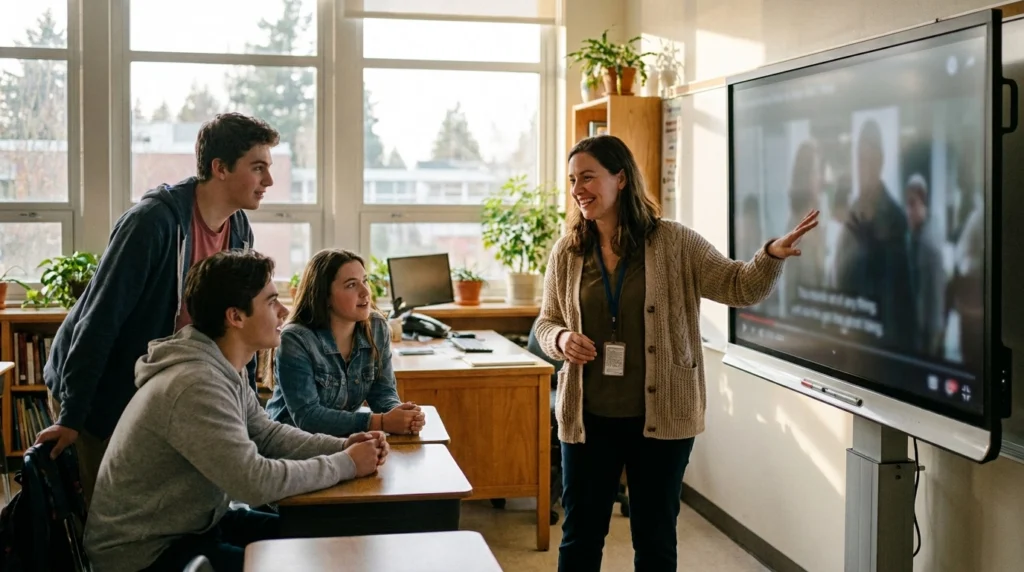
Students already watch this content in their free time. Guiding that habit turns hours they spend anyway into practice, and it tends to raise engagement because the material feels real rather than assigned. A few practical ideas:
- Build a short lesson around a single clip of three to five minutes. Ask students to predict what will happen, watch, then discuss the language that came up.
- Use scenes to teach function, not only vocabulary. One short argument can show how people interrupt, disagree, and apologise in natural speech, which textbooks rarely capture.
- Ask each student to bring one phrase they liked from something they watched at home. It turns their entertainment into shared classroom material and tells you what genuinely interests them.
- Alternate listening with and without captions, so learners practise both supported reading and pure listening.
A simple weekly routine that actually works
Consistency matters more than intensity. A realistic plan looks like this:
- Three or four short sessions a week, of twenty to thirty minutes each, are more effective than one long weekend session.
- Spend most of that time enjoying the story, and only a few minutes noticing and saving new language.
- On the days you do not watch, spend a short moment reviewing the phrases you saved.
Across a single term, this quietly adds up to many hours of contact with real spoken language, spread out in the way memory prefers. Very few learners manage that many hours through drills, because drills are tiring. A story you want to finish pulls you back on its own.
Where a tool can make this easier
Doing all of this by hand can be slow. Switching subtitle tracks, pausing to look up a word, and writing phrases down breaks the flow of the story. Browser tools built for learning through video remove most of that friction. Streal.app, for example, adds dual subtitles to Netflix and lets you see translations and save words in their original context, so the watching stays enjoyable while the study happens in the background. The specific tool matters less than the principle behind it: understandable input, a little active attention, and steady review.
The takeaway
Films and series are not a replacement for study, and no one becomes fluent by watching alone. What they offer is the thing textbooks cannot: real speech, in real context, at natural speed, delivered by a story you actually care about. For students, that means progress that feels less like homework and more like a habit worth keeping. For teachers, it means a nearly endless supply of authentic material that learners are already motivated to engage with. Start with a show you enjoy, watch with a little intention, and let consistency do the rest.
Sources and further reading
- Krashen, S. (1982). Principles and Practice in Second Language Acquisition. Available free at sdkrashen.com.
- Paivio, A. (1986). Mental Representations: A Dual Coding Approach. Oxford University Press.
- Montero Perez, M., Van Den Noortgate, W., and Desmet, P. (2013). Captioned video for L2 listening and vocabulary learning: A meta-analysis. System, 41(3).
- Vanderplank, R. (2016). Captioned Media in Foreign Language Learning and Teaching. Palgrave Macmillan.

0 responses on "How Watching Netflix Can Help Students Learn a Language Faster?"