



Learning Support Assistant vs Teaching Assistant
Thinking about working in a school but unsure whether to apply for a Learning Support Assistant or Teaching Assistant position? The job titles can be confusing, especially when vacancies describe similar responsibilities.
The main difference between a Learning Support Assistant (LSA) and a Teaching Assistant (TA) is often the emphasis of the job, rather than a completely different profession. Both support pupils and teachers. Some schools use LSA for positions involving more targeted learning support, while TA may describe broader classroom duties.
However, these differences are not universal. The actual responsibilities depend on the school, pupils’ needs and job description.
This guide compares both roles in UK schools, including daily duties, qualifications, salaries and working conditions, so you can decide which opportunities suit you.
Not sure which role fits you? Take our 2-minute quiz to find out.
Table of Contents
Are a Learning Support Assistant and a Teaching Assistant the Same?
Yes, Learning Support Assistants and Teaching Assistants often perform the same type of work, although individual employers may assign different responsibilities.
The National Careers Service lists Learning Support Assistant and Classroom Assistant as alternative titles for Teaching Assistant.
Both roles involve helping pupils access education, supporting classroom activities and working alongside teachers. A school might advertise an LSA vacancy focused on individual learning needs, while another might employ TAs to carry out almost identical duties.
Neither title automatically indicates a higher qualification, salary or level of responsibility.
The important distinction is what the employer expects you to do. When comparing vacancies, examine the responsibilities, pupils supported, required experience and working arrangements rather than relying on the job title.
Learning Support Assistant vs Teaching Assistant: Key Differences
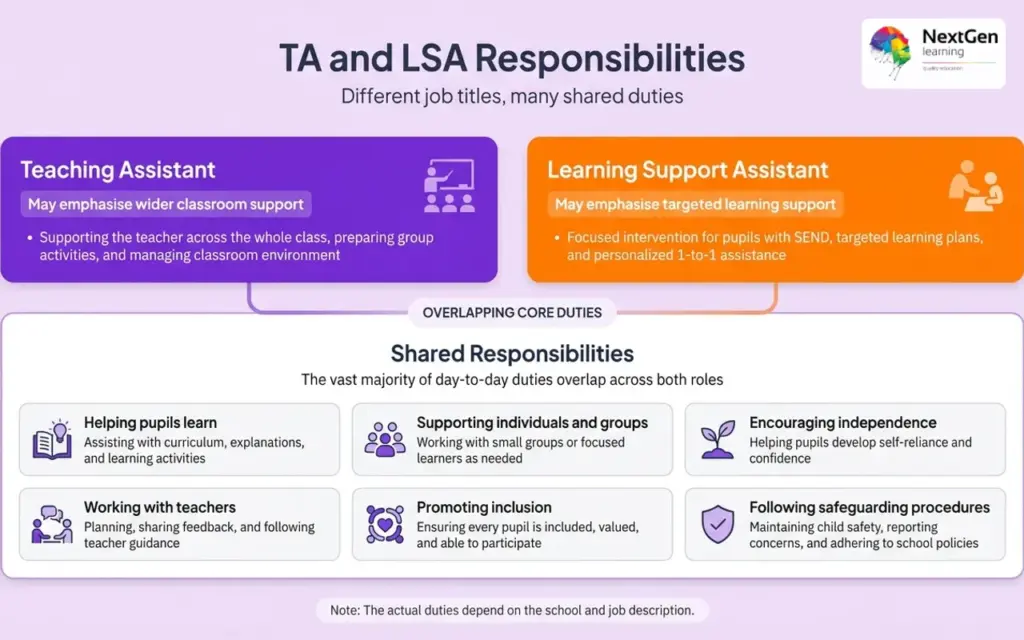
Although the roles overlap, some schools use the titles to describe different areas of classroom support.
| Comparison | Teaching Assistant (TA) | Learning Support Assistant (LSA) |
|---|---|---|
| Main focus | Often broader classroom support | Sometimes more targeted learning support |
| Pupils supported | Whole classes, groups or individuals | Individuals, groups or whole classes |
| Typical duties | Classroom activities, learning resources and pupil support | Learning interventions, participation and individual support |
| SEND involvement | Common in many positions | Often emphasised in some vacancies |
| Qualifications | Depend on employer requirements | Depend on employer requirements |
| Salary | Depends on grade, duties and contract | Depends on grade, duties and contract |
| Workplace | Mainstream or specialist schools | Mainstream or specialist schools |
These are common patterns, not fixed national definitions. Both roles can involve the responsibilities listed in either column.
What Does a Teaching Assistant Do?
Teaching Assistants help teachers create a productive learning environment and support pupils during lessons.
Their responsibilities may include:
- Helping pupils with reading, writing and numeracy.
- Preparing classroom resources and learning materials.
- Supporting individual pupils and small groups.
- Encouraging positive behaviour and participation.
- Helping teachers monitor learning progress.
- Supporting children with special educational needs and disabilities (SEND).
A TA may move between different pupils during a lesson or spend considerable time helping one child.
Some positions focus specifically on supporting pupils on a one-to-one basis, particularly where additional learning support is required.
For those starting to explore classroom responsibilities, Nextgen Learning’s Level 2 Teaching Assistant Course introduces school routines, child development, behaviour and classroom communication.
What Does a Learning Support Assistant Do?
Learning Support Assistants help pupils participate in learning activities and develop greater confidence and independence.
Depending on the school, responsibilities may include:
- Helping pupils understand classroom instructions.
- Supporting activities adapted to individual learning needs.
- Assisting with reading, communication or numeracy.
- Encouraging pupils to complete tasks independently.
- Supporting learning interventions planned by teachers.
- Sharing relevant observations with teaching staff.
Some LSA positions focus on pupils with SEND, including those who need additional communication, emotional or learning support.
However, not every LSA works exclusively with SEND pupils. Equally, Teaching Assistants frequently undertake specialist support work.
If you are particularly interested in targeted learning support, Nextgen Learning’s Learning Support Assistant (LSA) Course covers relevant responsibilities, mentoring and SEN awareness.
What Skills Do Both Roles Require?
Strong communication, patience and adaptability matter in both positions.
You should be comfortable following teachers’ instructions, building professional relationships and adjusting your approach to different pupils.
Safeguarding awareness, confidentiality and teamwork are equally important.
Neither role is simply about completing tasks for children. Effective support means helping pupils develop their own knowledge, confidence and independence.
Interested in Targeted Learning Support?
Learn how to help pupils with additional needs and work closely with teachers through flexible online Learning Support Assistant training.
- Flexible online learning
- Support pupils with additional needs
- Work confidently alongside teachers
What Do the Two Jobs Look Like in Practice?
Consider two ordinary school situations.
Example 1: General classroom support
A Year 3 teacher is delivering a literacy lesson. A Teaching Assistant helps prepare resources, checks that pupils understand the task and supports a small group with reading.
Later, the TA helps a pupil who needs additional time to complete their writing.
Example 2: Targeted learning support
A Learning Support Assistant works with a pupil who finds written instructions difficult. Following the teacher’s plan, the LSA breaks the activity into manageable steps, checks the pupil’s understanding and encourages independent work.

Both examples involve supporting learning under a teacher’s direction. Either position could carry the TA or LSA title.
An LSA or TA should not automatically be confused with a Cover Supervisor. While TAs and LSAs support pupils’ learning, cover supervisor responsibilities generally involve supervising classes during a teacher’s absence, following work already set.
Learning Support Assistant vs Teaching Assistant Salary in 2026
Neither job title automatically earns more than the other. Pay depends on the employer, salary grade, responsibilities, working hours and contract.
According to the National Careers Service, Teaching Assistants typically earn between £19,000 and £26,000 a year, depending on experience. For specialist SEN Teaching Assistants, the indicative salary range is £19,000 to £27,000.
Learning Support Assistants do not have a separate national pay scale. Actual earnings depend on the employer, responsibilities, salary grade and contracted working hours. Part-time and term-time-only positions may pay less than the advertised full-time equivalent (FTE) salary.
Why Advertised Salaries Can Be Misleading
School vacancies may advertise a full-time equivalent (FTE) salary even when the position is part-time or term-time only.
For example, a position advertised at £26,000 FTE does not necessarily pay £26,000 annually if the employee works fewer hours or weeks than the full-time reference contract.
The actual salary may be lower after the appropriate pro-rata calculation.
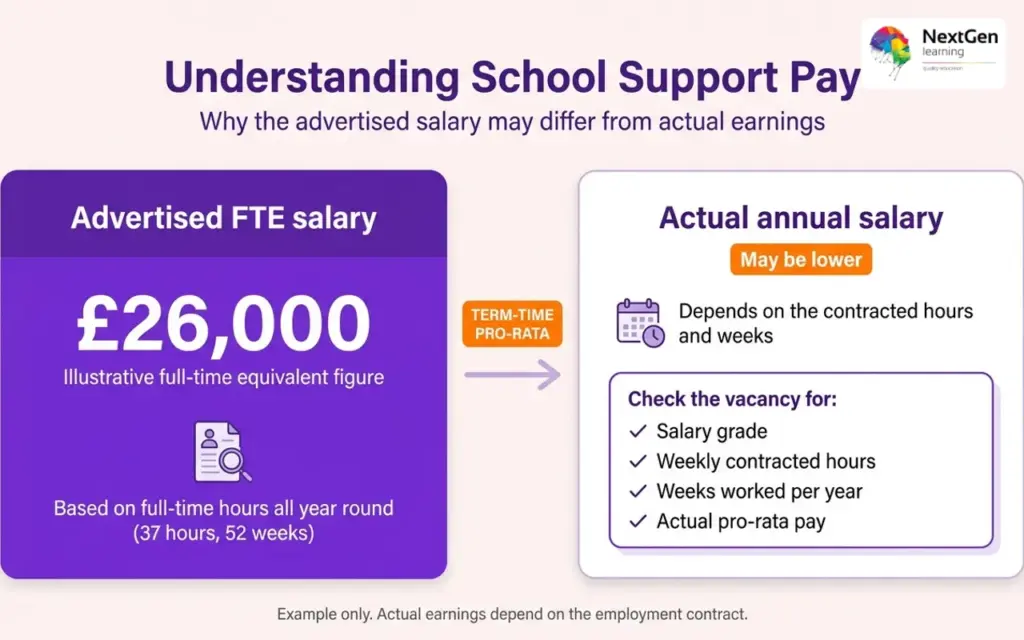
When comparing LSA and TA jobs, check:
- The advertised salary grade.
- Whether the figure is FTE or actual annual pay.
- Weekly contracted hours.
- Weeks worked each year.
- Additional responsibilities attached to the position.
You can also examine school support vacancies published through the Department for Education to compare real job descriptions and salary arrangements in England.
Do Learning Support Assistants and Teaching Assistants Need Different Qualifications?
There is no single qualification requirement that applies to every LSA or TA vacancy across the UK.
Some schools recruit applicants with relevant experience and suitable English and maths skills. Others request specific Supporting Teaching and Learning qualifications or previous classroom experience.
Requirements may be more specialised when pupils need additional communication, behavioural or learning support.
Entry Routes and Training Options
People enter school support work through several routes, including relevant college qualifications, volunteering, direct applications and apprenticeships.
If you are new to education, gaining experience with children can help you assess whether classroom support work suits you.
Some applicants prefer training through a teaching assistant apprenticeship, which combines employment and structured learning.
Relevant Training for Both Roles
If you want to develop foundational school support knowledge, Nextgen Learning offers the Focus Awards Level 3 Award in Supporting Teaching and Learning in Schools.
This is an Ofqual-regulated RQF Level 3 Award, awarded by Focus Awards. The qualification covers communication, school organisation, child development and safeguarding.
It is knowledge-based, carries 12 credits and does not require learners to be employed in a school before starting.
The official qualification specification confirms its structure and requirements.
For people interested in more targeted support, Nextgen Learning also offers an SEN Teaching Assistant Course, covering special educational needs and inclusive classroom approaches.
These courses serve different learning purposes. A CPD course is not automatically equivalent to an Ofqual-regulated qualification, and completing either type of training does not guarantee employment.
Want a Recognised Level 3 School Support Qualification?
Build the knowledge schools look for in classroom support roles with the Focus Awards Level 3 Award in Supporting Teaching and Learning in Schools.
- Regulated Level 3 Award
- Classroom support and safeguarding
- Prepare for TA and LSA roles
Working Hours, School Holidays and Employment Conditions
Learning Support Assistants and Teaching Assistants may work part-time, full-time or term-time-only contracts.
Before accepting a position, it is worth checking typical teaching assistant working hours and how term-time contracts affect annual earnings. The working pattern may matter more than whether the vacancy uses the TA or LSA title.
The National Careers Service lists typical Teaching Assistant working hours of approximately 16–37 hours per week during term time, although individual contracts vary.
Do LSAs and TAs Get Paid During School Holidays?
Some school support employees receive their annualised salary in equal monthly payments throughout the year.
This does not necessarily mean they earn additional wages during school holidays. Their pay may reflect contracted term-time hours, annual leave and the employer’s payment arrangements.
Check your employment contract for the exact calculation.
Temporary positions and agency assignments can operate differently. If you prefer more flexibility, working as a supply teaching assistant may be worth considering, although pay arrangements and the availability of assignments can differ from permanent school employment.
Do Learning Support Assistant and Teaching Assistant Roles Differ Across the UK?
Job titles and professional requirements can vary across England, Wales, Scotland and Northern Ireland.
In England, TA and LSA are widely used, although schools may apply them differently.
In Wales, relevant school learning support workers must register with the Education Workforce Council. Anyone considering a school support position in Wales should check the registration requirements for teaching assistants, as eligibility and registration obligations depend on the work undertaken rather than the job title alone.
In Scotland, similar positions may be advertised as Pupil Support Assistant, Classroom Assistant or Additional Support Needs Assistant.
If you are looking for school support work in Scotland, researching pupil support assistant roles can help you identify relevant vacancies, understand employer expectations and prepare for applications.
Wherever you apply, check local employer requirements and any relevant professional registration rules.
Learning Support Assistant or Teaching Assistant: Which Role Is Right for You?

LSA or TA: Which Role Suits You?
Answer 8 quick questions about how you like to work.
For guidance only. Schools use these job titles differently, so always check the job description.
The best choice depends less on the title and more on the daily work you want to do.
You might prefer a vacancy focused on wider classroom activities if you enjoy moving between groups, helping prepare lessons and supporting several pupils.
Alternatively, you may be interested in a position involving more targeted interventions, additional learning needs or sustained individual support.
But remember: either job title can include both types of work.
Before applying, ask yourself:
- What pupils and age groups would I support?
- Would I work with individuals, small groups or whole classes?
- What qualifications and experience does the school expect?
- What are the actual salary and contracted hours?
- What training and supervision will the employer provide?
Your previous experience may also be relevant. Childcare, volunteering, youth activities and customer-facing roles can help demonstrate communication, patience and organisation.
When preparing applications, focus on presenting your classroom support experience on a CV rather than simply listing qualifications.
If your interests lie specifically in inclusive primary education, the Supporting Children with Special Educational Needs in Primary Schools course offers additional introductory knowledge about supporting pupils with different learning needs.
Conclusion
Learning Support Assistants and Teaching Assistants share many responsibilities, and their job titles often overlap. The most useful differences are found in the actual duties, pupils supported, qualifications and employment conditions.
Choose the vacancy that matches your interests and experience, rather than relying on its title alone.
Frequently Asked Questions
Yes, the titles often refer to overlapping school support roles. Some employers use them interchangeably, while others assign different duties. Always check the vacancy description.
No. Some Learning Support Assistants work mainly with pupils who have SEND, but others provide broader classroom support. Teaching Assistants can also work extensively with SEND pupils.
Some schools recruit applicants without previous school employment. Relevant transferable skills, volunteering and training can strengthen an application, although individual employers set their requirements.
Not necessarily. Pay depends on responsibilities, employer, salary grade and contract. Neither title automatically indicates a higher salary.
Some receive annualised salaries spread across 12 months. However, their contractual earnings and holiday entitlement depend on the employment arrangement.
Yes. A relevant Level 3 qualification can develop knowledge applicable to both positions. However, schools determine their recruitment requirements, and some specialist roles may require additional experience.