




Mainstream vs Special Schools: Careers for SEN Teaching Assistants Compared
Choosing where to begin your career as a SEN Teaching Assistant is one of the most important decisions you’ll make. While both mainstream and special schools offer rewarding opportunities, they provide very different working environments, responsibilities, and experiences. Therefore, understanding these differences can help you choose the setting that best matches your skills, interests, and long-term career goals.
Mainstream schools educate pupils with a wide range of abilities, including those with Special Educational Needs (SEN). In these classrooms, SEN Teaching Assistants work alongside teachers to help pupils access the curriculum, adapt learning activities, and encourage inclusion. In contrast, special schools are specifically designed for children and young people with additional learning needs, disabilities, or complex educational requirements. As a result, Teaching Assistants often provide more personalised support and work closely with multidisciplinary teams to meet each pupil’s individual needs.
Neither career path is better than the other. Instead, each offers unique challenges, valuable experiences, and opportunities for professional growth. Some Teaching Assistants enjoy the fast-paced, diverse environment of mainstream schools, while others prefer the specialised support and smaller class sizes found in special schools. Consequently, choosing the right setting depends on your personality, strengths, and the type of impact you want to make in pupils’ lives.
In this guide, we’ll compare mainstream and special schools from the perspective of SEN Teaching Assistants. You’ll discover the key differences in daily responsibilities, classroom environments, required skills, career progression, and the rewards and challenges of each setting. By the end, you’ll have a clearer understanding of which career path is the best fit for your aspirations and how you can build a successful future supporting pupils with Special Educational Needs.
Table of Contents
What Is the Difference Between Mainstream and Special Schools?
Although both mainstream and special schools aim to provide pupils with a high-quality education, they differ significantly in how learning is delivered and the level of support pupils receive. For SEN Teaching Assistants, understanding these differences is essential because your daily responsibilities, teaching approaches, and working environment will vary depending on the setting you choose.
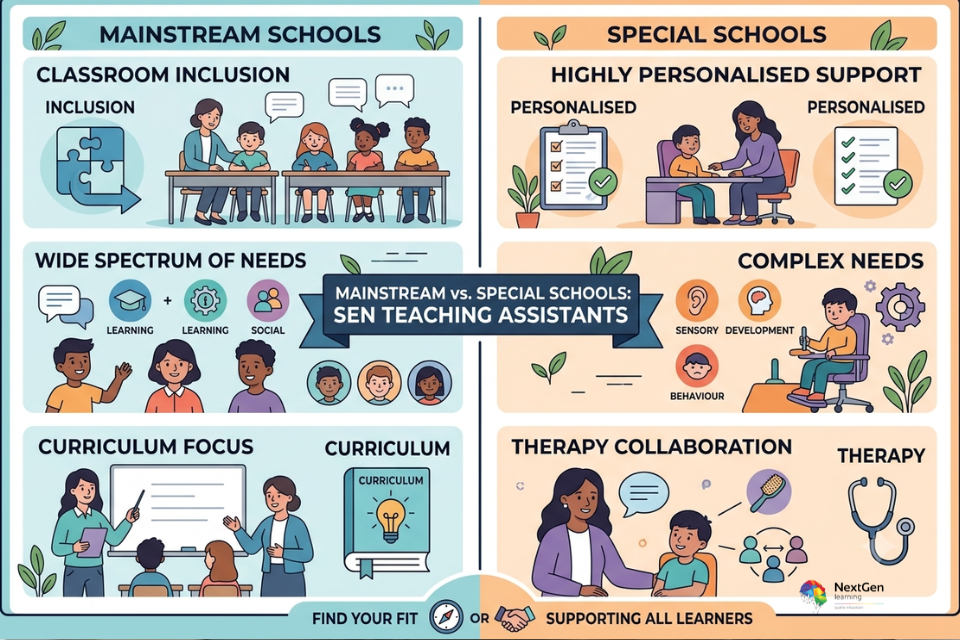
Mainstream schools educate pupils of all abilities, including those with Special Educational Needs (SEN). Here, Teaching Assistants help pupils access the national curriculum while encouraging inclusion within a larger classroom environment. They work closely with teachers to adapt activities, provide targeted support, and ensure that pupils with additional needs can participate alongside their peers.
In contrast, special schools are designed specifically for pupils with more complex educational needs, including autism, severe learning difficulties, physical disabilities, sensory impairments, and communication challenges. Consequently, Teaching Assistants play a more specialised role, delivering personalised support tailored to each pupil’s Education, Health and Care Plan (EHCP) and individual learning goals.
While both settings require patience, empathy, and excellent communication skills, the pace and focus of the work can be very different.
Mainstream Schools
Teaching Assistants in mainstream schools typically:
- Support pupils with SEN within larger classes.
- Help adapt classroom activities to suit different learning needs.
- Encourage inclusion during lessons and school activities.
- Assist teachers with behaviour management and classroom organisation.
- Promote independence while supporting access to the national curriculum.
- Work with a diverse range of pupils throughout the school day.
Special Schools
Teaching Assistants in special schools are more likely to:
- Support pupils with complex or multiple additional needs.
- Work in smaller classes or provide one-to-one support.
- Adapt learning using specialist teaching approaches and resources.
- Assist with communication, sensory regulation, and personal care where required.
- Collaborate closely with teachers, therapists, SENCOs, and families.
- Focus on individual learning outcomes rather than age-related curriculum expectations.
Ultimately, neither setting is better than the other. Instead, each offers unique opportunities to make a meaningful difference in pupils’ lives. Understanding these differences will help you choose a career path that aligns with your strengths, interests, and long-term professional goals.
Mainstream vs Special Schools: A Comparison for SEN Teaching Assistants
Choosing between a mainstream school and a special school can feel challenging, especially if you’re starting your career as a SEN Teaching Assistant. Both settings offer the opportunity to support pupils with Special Educational Needs, but the nature of the role differs in several important ways. Therefore, understanding these differences can help you decide which environment best matches your skills, interests, and career aspirations.
In mainstream schools, Teaching Assistants often support pupils with SEN alongside their classmates. The focus is on helping learners access the national curriculum while encouraging inclusion and participation in everyday classroom activities. As a result, no two days are the same, and you’ll work with a wide range of pupils, learning styles, and educational needs.
Special schools, however, provide education specifically for pupils with more complex or severe learning needs. Teaching Assistants typically work with smaller groups or on a one-to-one basis, allowing them to deliver highly personalised support. Moreover, they often collaborate with teachers, therapists, SENCOs, and healthcare professionals to help pupils achieve individual learning and development goals.
The following comparison highlights the key differences between the two career paths.
Mainstream Schools vs Special Schools for SEN Teaching Assistants
| Area | Mainstream Schools | Special Schools |
|---|---|---|
| Class Size | Usually larger classes with pupils of mixed abilities. | Smaller classes with higher staff-to-pupil ratios. |
| Learning Focus | Supports access to the national curriculum. | Focuses on personalised learning and EHCP outcomes. |
| Support Provided | Targeted classroom support and inclusion. | Intensive one-to-one or small-group support. |
| Daily Responsibilities | Assist lessons, adapt activities, and encourage participation. | Support communication, independence, life skills, and personalised learning. |
| Collaboration | Work mainly with class teachers and SENCOs. | Work closely with therapists, SENCOs, teachers, and families. |
Skills and Qualities You Need to Succeed in Both Settings

Whether you choose to work in a mainstream school or a special school, becoming an effective SEN Teaching Assistant requires much more than subject knowledge. The role demands patience, adaptability, strong communication, and a genuine commitment to helping every pupil reach their potential. Although the day-to-day responsibilities may differ, the core skills needed to support children with Special Educational Needs remain largely the same.
Teaching Assistants often work with pupils who learn in different ways, communicate differently, or require additional emotional and behavioural support. Therefore, being flexible and responsive is essential. You must be able to adapt your approach, recognise when a pupil needs extra guidance, and encourage independence without completing tasks for them.
Strong teamwork is equally important. In both mainstream and special schools, Teaching Assistants regularly collaborate with class teachers, SENCOs, therapists, and parents to provide consistent support. Consequently, effective communication and a willingness to learn from others help create the best possible outcomes for pupils.
Essential skills every SEN Teaching Assistant should develop include:
- Excellent communication and active listening skills.
- Patience when supporting pupils with different learning needs.
- Empathy and understanding towards individual challenges.
- Adaptability when changing teaching strategies.
- Positive behaviour management techniques.
- Organisation and effective time management.
- Observation skills to monitor pupil progress.
- Confidence in supporting inclusive learning.
- Problem-solving and critical thinking.
- A commitment to continuous professional development (CPD).
Additional skills that are particularly valuable in special schools include:
- Understanding autism, ADHD, and other additional needs.
- Using alternative and augmentative communication (AAC) methods.
- Supporting sensory regulation and emotional wellbeing.
- Working alongside speech and language therapists, occupational therapists, and physiotherapists.
- Assisting pupils with personal care where appropriate.
- Applying behaviour support strategies consistently.
Developing these skills not only improves the quality of support you provide but also increases your confidence and employability. Moreover, schools value Teaching Assistants who can adapt to different learning environments while promoting independence, inclusion, and positive learning experiences. Whether you work in a mainstream classroom or a specialist setting, these qualities will help you build strong relationships with pupils and make a lasting impact on their educational journey.
Career Progression, Salary Expectations, and Which Setting Is Right for You?

A career as a SEN Teaching Assistant can be both professionally rewarding and personally fulfilling. Whether you begin in a mainstream school or a special school, you’ll have opportunities to develop new skills, gain valuable classroom experience, and progress into more specialised education roles. Therefore, choosing the right setting should depend not only on salary but also on your long-term career goals, interests, and preferred working environment.
Many Teaching Assistants start their careers in mainstream schools because they offer experience with a wide range of pupils and classroom situations. This broad foundation helps develop essential skills in behaviour management, classroom organisation, and inclusive teaching. Moreover, it provides a strong understanding of how pupils with SEN are supported within the national curriculum.
Special schools, however, allow Teaching Assistants to build specialist expertise by working closely with pupils who have more complex learning needs. As a result, many professionals gain valuable experience in autism support, communication strategies, sensory needs, and personalised learning programmes. These skills are highly valued across the education sector and can open doors to specialist SEN careers.
Typical career progression opportunities include:
- Senior Teaching Assistant.
- Higher Level Teaching Assistant (HLTA).
- SEN Specialist Teaching Assistant.
- Behaviour Support Practitioner.
- Learning Mentor.
- Family Support Worker.
- SENCO (with further qualifications).
- Qualified Teacher or Specialist SEND Teacher.
Although salaries vary depending on location, experience, school type, and employer, Teaching Assistants in both mainstream and special schools can increase their earning potential by gaining recognised qualifications, completing CPD training, and taking on additional responsibilities. Schools also value professionals with specialist knowledge of autism, ADHD, speech and language needs, and inclusive teaching practices.
Which setting is right for you?
The best career choice depends on the type of environment where you feel you can make the greatest impact.
A mainstream school may suit you if you:
- Enjoy working with diverse groups of pupils.
- Thrive in a busy and fast-paced classroom.
- Like supporting inclusive education.
- Want experience across a broad range of subjects and learning needs.
A special school may suit you if you:
- Prefer providing personalised one-to-one or small-group support.
- Enjoy building strong, long-term relationships with pupils.
- Want to specialise in supporting children with complex needs.
- Are interested in working alongside therapists and multidisciplinary teams.
Neither pathway is better than the other. Instead, both offer meaningful opportunities to support children with Special Educational Needs while developing a rewarding and successful career. By gaining experience, expanding your knowledge, and continuing your professional development, you can build a career that makes a lasting difference to pupils, families, and the wider school community.
Table 2: Career Comparison for SEN Teaching Assistants

Table 2: Career Comparison for SEN Teaching Assistants
| Career Factor | Mainstream Schools | Special Schools |
|---|---|---|
| Working Environment | Larger classrooms with pupils of mixed abilities and learning needs. | Smaller classes designed to support pupils with complex or additional needs. |
| Primary Responsibilities | Support classroom learning, inclusion, behaviour management, and curriculum access. | Provide personalised learning, communication support, and individual interventions. |
| Professional Development | Develop broad classroom management and inclusive education skills. | Gain specialist SEN knowledge, therapeutic approaches, and behaviour support experience. |
| Career Opportunities | Progress into HLTA, pastoral support, or classroom teaching roles. | Progress into SEN specialist, behaviour support, therapy support, or specialist teaching careers. |
| Best Suited For | Those who enjoy variety, inclusion, and supporting a wide range of learners. | Those who enjoy specialist support and building strong relationships with pupils. |
Conclusion
Choosing between a mainstream school and a special school is an important decision for any aspiring or experienced SEN Teaching Assistant. While both settings share the common goal of helping pupils succeed, they offer very different classroom experiences, responsibilities, and opportunities for professional development. Therefore, understanding these differences allows you to make an informed career choice that aligns with your strengths and aspirations.
Mainstream schools provide a varied and dynamic environment where Teaching Assistants support pupils with diverse learning needs alongside their peers. This setting is ideal for those who enjoy inclusive education, fast-paced classrooms, and working with a broad range of abilities. In contrast, special schools focus on delivering personalised support for pupils with complex needs. Teaching Assistants often build close relationships with learners, work within multidisciplinary teams, and develop specialist knowledge that can lead to advanced SEN roles.
Whichever path you choose, success depends on your ability to communicate effectively, adapt your support, and encourage every pupil to achieve their full potential. Furthermore, continuing professional development and gaining recognised qualifications will strengthen your confidence, improve your employability, and create opportunities for career progression.
Frequently Asked Questions
Mainstream schools educate pupils of all abilities, including those with Special Educational Needs (SEN), while special schools are specifically designed to support pupils with complex learning needs, disabilities, or additional educational requirements through specialist teaching and personalised support.
Yes. SEN Teaching Assistants can work in either setting. Many professionals gain experience in mainstream schools before moving into specialist settings, while others begin their careers in special schools and later work in inclusive mainstream education.
Neither setting is universally better. Mainstream schools offer experience with a wide range of pupils and classroom situations, whereas special schools provide specialist experience supporting pupils with more complex needs. The best choice depends on your interests, confidence, and long-term career goals.
Essential skills include communication, patience, empathy, adaptability, behaviour management, teamwork, organisation, observation, and the ability to support inclusive learning. Knowledge of autism, ADHD, dyslexia, and communication strategies is also highly valued.
Many roles require the same core Teaching Assistant qualifications. However, additional CPD training in autism, behaviour support, safeguarding, communication methods, or sensory needs can improve your knowledge and career prospects.
Yes. Special schools provide valuable specialist experience that can lead to careers such as SEN Specialist Teaching Assistant, Behaviour Support Practitioner, Higher Level Teaching Assistant (HLTA), Learning Mentor, or specialist teaching roles with further qualifications.
Salaries vary depending on location, employer, experience, and responsibilities rather than school type alone. Teaching Assistants who gain specialist skills, additional qualifications, or leadership responsibilities may have greater opportunities for career progression and higher pay.
Consider your preferred working style, the type of pupils you want to support, and your long-term career ambitions. If you enjoy variety and inclusive classrooms, a mainstream school may be suitable. If you prefer personalised support and specialist SEN practice, a special school could be the better choice.


0 responses on "Mainstream vs Special Schools: Careers for SEN Teaching Assistants Compared"