




What Is NVQ Level 3 Equivalent To? UK Qualification Guide
If you are exploring vocational qualifications in the UK, you may have asked the common question: what is NVQ Level 3 equivalent to? This is an important question because understanding qualification levels helps you compare education pathways and career opportunities more clearly. NVQ Level 3 sits at an advanced vocational level within the UK education system and it plays a significant role in helping learners develop practical skills that employers value.
In simple terms, NVQ Level 3 is equivalent to A Levels, BTEC Nationals and some T Levels, as they all sit at Level 3 on the Regulated Qualifications Framework (RQF). However, while these qualifications share the same academic level, they differ in how learning and assessment take place. For example, A Levels are largely academic and classroom-based, whereas NVQs focus heavily on practical skills and workplace competency.
Importantly, NVQ Level 3 is designed for people who want to build hands-on expertise in a specific industry. Rather than relying on exams alone, learners demonstrate their ability through real workplace tasks, evidence portfolios and professional assessments. As a result, this qualification is widely recognised by employers across many sectors, including healthcare, construction, childcare, engineering and business administration.
Moreover, NVQ Level 3 often serves as a stepping stone to higher qualifications, supervisory roles, or further professional training. Many individuals use it to strengthen their career prospects, improve earning potential, or transition into more specialised positions. Consequently, understanding how NVQ Level 3 compares with other qualifications can help you choose the best pathway for your personal and professional goals.
Before diving deeper into the details, it helps to quickly understand which qualifications are considered equivalent to NVQ Level 3 and how they compare within the UK education framework.
Table of Contents
NVQ Level 3 Equivalent Qualifications (Quick Comparison)

When people ask “what is NVQ Level 3 equivalent to?”, they usually want a simple and clear comparison with other UK qualifications. In the UK education system, NVQ Level 3 sits at Level 3 on the Regulated Qualifications Framework (RQF). This means it is academically positioned at the same level as several well-known post-GCSE qualifications.
However, although these qualifications share the same level, they differ in learning style, assessment methods and career focus. NVQ Level 3 is primarily work-based and practical, whereas other Level 3 qualifications may be more academic or classroom-based.
Common Qualifications Equivalent to NVQ Level 3
The following qualifications are generally considered equivalent because they all sit at RQF Level 3:
- A Levels – Traditional academic qualifications usually taken after GCSEs. They focus on theoretical knowledge and exams.
- BTEC Level 3 National Diploma – A vocational qualification that combines coursework, practical projects and classroom learning.
- T Levels – A newer technical qualification that combines classroom study with industry placements.
- Advanced Apprenticeships (Level 3) – Work-based training programmes that combine employment with structured learning.
NVQ Level 3 Comparison Table
Qualification | Qualification Level | Learning Style | Focus |
NVQ Level 3 | RQF Level 3 | Work-based assessment | Practical job skills |
A Levels | RQF Level 3 | Classroom & exams | Academic study |
BTEC Level 3 | RQF Level 3 | Coursework & projects | Vocational + theory |
T Levels | RQF Level 3 | Classroom + placement | Technical training |
Advanced Apprenticeship | RQF Level 3 | Work + training | Industry experience |
Although these qualifications share the same academic level, they serve different learning preferences and career paths. For instance, students who enjoy structured academic study often choose A Levels. In contrast, individuals who prefer practical, work-focused learning frequently pursue NVQ qualifications.
Therefore, NVQ Level 3 is widely valued because it demonstrates real workplace competency, not just theoretical knowledge. Employers often appreciate this practical approach, particularly in industries where hands-on skills are essential.
Understanding this equivalency helps learners choose the qualification that best matches their career goals, learning style and professional development plans.
What Is an NVQ Level 3 Qualification?
An NVQ Level 3 (National Vocational Qualification Level 3) is a work-based qualification designed to assess a person’s ability to perform tasks competently in a real professional environment. Unlike traditional academic qualifications that rely heavily on exams and theoretical study, NVQ Level 3 focuses on practical skills, job performance, and workplace competency.
This qualification sits at Level 3 on the UK Regulated Qualifications Framework (RQF) and is typically aimed at individuals who already have some experience in their field. As a result, NVQ Level 3 is often taken by employees who want to develop advanced skills, take on supervisory responsibilities, or progress into more specialised roles.
Importantly, NVQs are built around industry standards, meaning the skills assessed reflect what employers actually expect in the workplace. Consequently, learners demonstrate their abilities through real work activities rather than written examinations alone.
Key Features of NVQ Level 3
NVQ Level 3 stands out because it focuses on practical competence and professional development. The qualification typically involves the following elements:
- Workplace-based learning: Learners develop skills while performing real tasks in their job role.
- Portfolio of evidence: Candidates collect work samples, reports, and records to demonstrate their competence.
- On-the-job assessment: Qualified assessors observe learners performing workplace duties.
- Witness testimonies: Supervisors or managers may confirm a learner’s performance through written statements.
- Flexible study pace: Many learners complete the qualification while working full-time.
Where an assessor or training provider requests the portfolio as a single document, learners can merge PDF scans of their evidence into one organised file before submission.
Because of this assessment style, NVQ Level 3 is particularly suitable for individuals who prefer practical learning instead of traditional academic exams. Moreover, the qualification allows learners to gain recognised credentials without leaving employment.
What NVQ Level 3 Demonstrates
Completing NVQ Level 3 shows that an individual can:
- Work independently in their professional role
- Apply advanced practical skills within their industry
- Follow professional standards and workplace procedures
- Handle complex tasks and responsibilities
- Support or supervise junior team members
Therefore, NVQ Level 3 is widely regarded as a strong indicator of job readiness and professional competence. Many employers view it as proof that a candidate has the skills needed to perform effectively in real working environments.
Where NVQ Level 3 Sits in the UK Qualification Framework

To fully understand what NVQ Level 3 is equivalent to, it helps to look at how qualifications are organised in the UK education system. The UK uses the Regulated Qualifications Framework (RQF), which classifies qualifications based on their difficulty and complexity. Each level represents a different stage of learning and professional capability.
NVQ Level 3 sits at RQF Level 3, which is considered an advanced qualification level typically taken after completing GCSEs or equivalent training. At this level, learners are expected to demonstrate greater independence, stronger technical skills and the ability to handle more complex responsibilities in the workplace.
Importantly, Level 3 qualifications often act as a bridge between basic education and higher-level training or university study. Therefore, NVQ Level 3 can open doors to both career progression and further education opportunities.
Overview of UK Qualification Levels
The table below shows how NVQ Level 3 fits within the wider UK qualification framework.
RQF Level | Qualification Examples | Typical Learning Stage |
Level 1 | Basic certificates, introductory qualifications | Entry-level skills |
Level 2 | GCSEs (grades A*–C / 9–4), NVQ Level 2 | Intermediate knowledge |
Level 3 | A Levels, NVQ Level 3, BTEC Nationals, T Levels | Advanced post-GCSE study |
Level 4 | Higher National Certificate (HNC) | First stage of higher education |
Level 5 | Higher National Diploma (HND), Foundation Degree | Advanced technical education |
Level 6 | Bachelor’s Degree | Undergraduate level |
Level 7 | Master’s Degree | Postgraduate level |
Because NVQ Level 3 sits within this framework, it holds the same academic level as A Levels and other advanced vocational qualifications. However, the main difference lies in the learning approach and assessment methods.
Academic vs Vocational Learning
At Level 3, students can usually choose between academic pathways and vocational pathways.
Academic qualifications typically focus on:
- Subject-based theoretical learning
- Classroom lectures and exams
- Preparation for university study
Vocational qualifications like NVQs, on the other hand, emphasise:
- Practical workplace training
- Real-world problem solving
- Industry-specific skills development
- Assessment through work performance
Therefore, while NVQ Level 3 sits at the same qualification level as A Levels, it offers a more practical and career-focused route into skilled employment.
Understanding the qualification framework makes it easier to see why NVQ Level 3 is respected across many industries and recognised as a valuable step toward both career progression and higher education.
NVQ Level 3 vs A Levels, BTEC, and T Levels
Although NVQ Level 3 is equivalent to A Levels and other Level 3 qualifications, the learning experience and career outcomes can be quite different. Therefore, many learners compare these options before deciding which pathway suits them best. Understanding the differences helps you choose a qualification that aligns with your learning style, career goals and preferred study environment.
In general, Level 3 qualifications fall into two broad categories: academic qualifications and vocational qualifications. Academic courses usually focus on theoretical knowledge, while vocational programmes emphasise practical skills and workplace experience.
Key Differences Between Level 3 Qualifications
The following table highlights how NVQ Level 3 compares with other common Level 3 qualifications in the UK.
| Learning Style | Assessment Method | Career Focus |
NVQ Level 3 | Work-based learning | Portfolio, observation, workplace evidence | Practical job skills |
A Levels | Classroom study | Written exams and coursework | Academic progression |
BTEC Level 3 | Coursework and practical assignments | Projects, coursework, assessments | Vocational and academic |
T Levels | Classroom learning plus | Exams, projects, work placement | Technical careers |
Although these qualifications share the same RQF Level 3 status, they are designed for different types of learners.
NVQ Level 3
NVQs are ideal for individuals who prefer hands-on learning and want to develop skills while working. Because assessments take place in the workplace, learners gain real industry experience alongside their qualification.
A Levels
A Levels focus on academic subjects such as mathematics, sciences, humanities, or languages. Students typically take them in college or sixth form and use them to progress directly to university.
BTEC Level 3
BTEC qualifications combine elements of both academic and vocational learning. Students complete coursework, practical assignments and projects, making them a flexible pathway for learners who want practical skills with academic structure.
T Levels
T Levels are relatively new technical qualifications introduced in the UK. They include classroom learning and a substantial industry placement, helping students gain technical knowledge and real work experience.
Choosing the Right Qualification
Each qualification offers different advantages depending on your goals.
- Choose NVQ Level 3 if you want practical training and workplace-based learning.
- Choose A Levels if you plan to pursue university education in academic subjects.
- Choose BTEC Level 3 if you prefer coursework-based vocational learning.
- Choose T Levels if you want technical training combined with industry placements.
Ultimately, while NVQ Level 3 sits at the same qualification level as A Levels, BTEC Nationals and T Levels, its strong focus on workplace competence makes it particularly valuable for those aiming to build real-world skills and progress directly into employment.
Who Is NVQ Level 3 Suitable For?

NVQ Level 3 is a flexible qualification designed for people at different stages of their career. Because it focuses on practical workplace skills and professional competence, it suits learners who prefer hands-on training rather than purely academic study. Moreover, the qualification can support both career development and industry progression, making it valuable for a wide range of individuals.
In many sectors, NVQ Level 3 represents the stage where workers move from basic responsibilities to more advanced or supervisory roles. Therefore, it is often chosen by individuals who want to strengthen their professional skills while gaining a recognised qualification.
Learners Who Commonly Take NVQ Level 3
Several groups of learners benefit from this qualification.
- School leavers: Students who prefer practical learning instead of A Levels often pursue NVQ Level 3 to gain industry experience early in their career.
- Apprentices: Many apprenticeship programmes include NVQ Level 3 as part of structured workplace training.
- Working professionals: Employees who want promotion or additional responsibilities frequently take NVQ Level 3 to demonstrate their competence.
- Adult learners: Individuals returning to education can use NVQ Level 3 to update their skills and improve employability.
- Career changers: People transitioning into a new industry may pursue NVQ Level 3 to gain recognised workplace credentials.
Because the qualification focuses on real job tasks, learners can often study while working, which makes it particularly appealing to adults balancing employment and education.
Skills and Responsibilities at Level 3
At this stage, learners are expected to handle more advanced responsibilities compared with entry-level qualifications. Typically, NVQ Level 3 demonstrates the ability to:
- Perform complex tasks independently
- Apply specialised knowledge within a job role
- Solve workplace problems effectively
- Support or supervise junior staff members
- Follow professional and safety standards
As a result, many industries view NVQ Level 3 as the level where employees begin developing leadership skills and greater professional autonomy.
Industries That Value NVQ Level 3
The qualification is widely recognised across multiple sectors. For example, NVQ Level 3 is commonly pursued in:
- Health and Social Care
- Construction and Skilled Trades
- Childcare and Early Years Education
- Business Administration
- Engineering and Manufacturing
- Hospitality and Retail Management
Because these industries rely heavily on practical ability, NVQ Level 3 helps workers demonstrate that they can perform effectively in real working environments.
Consequently, this qualification often becomes a stepping stone toward supervisory roles, higher-level training, or specialised professional certifications.
Key Benefits of NVQ Level 3 Qualifications
NVQ Level 3 offers several advantages for learners who want to build strong career foundations through practical training. Because the qualification focuses on real workplace competence, it is widely respected by employers across many industries. Moreover, it provides a flexible pathway for individuals who want to gain recognised credentials without following a purely academic route.
Importantly, NVQ Level 3 does more than simply certify knowledge. Instead, it demonstrates that a learner can apply skills effectively in real professional environments. As a result, many organisations value this qualification when hiring or promoting staff.
Practical and Industry-Focused Learning
One of the biggest advantages of NVQ Level 3 is its emphasis on practical training. Learners develop skills directly within their workplace, which means the knowledge gained can immediately be applied to real tasks.
Key learning benefits include:
- Hands-on skill development: Learners practice tasks that reflect real industry responsibilities.
- Workplace-based assessment: Skills are evaluated through observation and evidence rather than traditional exams.
- Immediate application: Knowledge gained during training can be used directly in the job role.
- Industry-relevant standards: The qualification is designed around professional requirements set by employers.
Because of this practical focus, NVQ Level 3 helps learners become job-ready professionals rather than simply completing theoretical coursework.
Improved Career Opportunities
Another major benefit is the impact on career progression. In many industries, NVQ Level 3 represents the point where employees can move into more responsible roles. Consequently, completing this qualification can improve both employment prospects and long-term career growth.
Career advantages often include:
- Access to supervisory positions within certain sectors
- Higher earning potential compared with lower qualification levels
- Greater employability due to recognised industry credentials
- Professional credibility among employers and colleagues
For example, a worker in health and social care with NVQ Level 3 may qualify for senior care roles, while someone in construction could progress toward supervisory responsibilities.
Flexible Learning While Working
NVQ Level 3 is also valued for its flexibility. Unlike traditional academic courses that require full-time classroom attendance, this qualification allows learners to study while maintaining employment.
This flexibility provides several practical benefits:
- Learn while earning a salary
- Complete assessments within the workplace
- Study at a pace suited to personal schedules
- Balance education with family or work commitments
Because of this structure, NVQ Level 3 is especially appealing to adults and professionals who want to continue developing their careers without interrupting their current employment.
Strong Employer Recognition
Finally, NVQ Level 3 is widely recognised by employers throughout the UK. Since the qualification measures actual job performance, it signals that an individual has reached a competent and reliable professional standard within their industry.
Consequently, holding NVQ Level 3 can strengthen a candidate’s profile during recruitment or promotion decisions. Employers often view it as evidence that a worker can perform tasks independently, follow professional standards and contribute effectively within a team environment.
Career Opportunities After NVQ Level 3

Completing NVQ Level 3 can significantly expand your career options because it demonstrates advanced practical skills and professional competence. In many industries, this qualification represents the stage where workers move beyond entry-level tasks and begin taking on more specialised or supervisory responsibilities.
Because NVQ Level 3 focuses on real workplace performance, employers often view it as proof that an individual can handle complex tasks independently and contribute effectively within a professional environment. As a result, holding this qualification can open doors to better job roles, increased responsibilities and improved earning potential.
Industries Where NVQ Level 3 Is Highly Valued
NVQ Level 3 is recognised across a wide range of sectors that rely heavily on skilled workers and practical expertise. Some of the most common industries include:
- Health and Social Care: Roles such as senior care assistant, care supervisor, or support worker.
- Childcare and Early Years Education: Positions including nursery practitioner or early years supervisor.
- Construction and Skilled Trades: Careers such as electrician, plumber, bricklayer, or site supervisor.
- Business Administration: Office supervisors, executive assistants, or administrative managers.
- Engineering and Manufacturing: Technician roles and specialist machine operators.
- Hospitality and Retail: Team leaders, hospitality supervisors, or assistant managers.
Because these sectors prioritise real-world skills, NVQ Level 3 helps individuals prove they are capable of performing professional duties at an advanced level.
Typical Roles After NVQ Level 3
While job opportunities vary depending on the industry, NVQ Level 3 often prepares learners for roles such as:
- Senior Care Assistant or Support Worker
- Nursery Supervisor or Early Years Practitioner
- Construction Site Supervisor or Skilled Tradesperson
- Business Administration Team Leader
- Engineering Technician or Manufacturing Specialist
- Hospitality Supervisor or Retail Team Leader
These roles often involve greater responsibility, decision-making and leadership within a team environment.
Career Progression Beyond NVQ Level 3
In addition to improving immediate job prospects, NVQ Level 3 can also serve as a foundation for further professional development. Many individuals use this qualification as a stepping stone toward higher-level training or management roles.
Possible progression routes include:
- NVQ Level 4 or Level 5 qualifications for advanced professional development
- Higher National Certificates (HNC) or Higher National Diplomas (HND)
- Foundation degrees or university study in related fields
- Industry-specific professional certifications
Therefore, NVQ Level 3 not only strengthens your current career opportunities but also creates pathways for long-term professional growth and advancement.
Can You Go to University With NVQ Level 3?
Many learners wonder whether NVQ Level 3 can lead to university study. The short answer is yes, in some cases it can, although the pathway may vary depending on the course, university and the specific NVQ qualification you hold.
Because NVQ Level 3 sits at RQF Level 3, the same academic level as A Levels and BTEC Nationals, it can sometimes be used as part of a university application. However, universities often look at several factors, including the subject area, relevant experience and whether the qualification carries UCAS tariff points.
UCAS Points and NVQ Level 3
Some Level 3 vocational qualifications can carry UCAS tariff points, which universities use when assessing applications. These points help admissions teams compare different qualifications within the same framework.
However, NVQs are primarily work-based qualifications, so not all NVQ Level 3 programmes automatically translate into UCAS points. Instead, universities may consider:
- Relevant work experience gained during the NVQ
- Additional Level 3 qualifications such as diplomas or certificates
- Foundation or access courses designed to prepare vocational learners for university
Because of this flexibility, many institutions recognise NVQ Level 3 as evidence of practical knowledge and professional ability, especially when the degree programme relates to the learner’s industry.
Alternative Routes to Higher Education
Even if an NVQ Level 3 does not directly provide enough UCAS points for certain degrees, there are several progression routes available. These pathways allow learners to continue their education and eventually reach university-level study.
Common options include:
- Access to Higher Education Diplomas, which prepare vocational learners for university entry
- Foundation degrees, often designed for professionals with industry experience
- Higher National Certificates (HNC) and Higher National Diplomas (HND)
- Employer-sponsored degree programmes in fields such as healthcare, engineering, or education
These routes provide additional academic preparation while still valuing the practical skills gained through vocational training.
When NVQ Level 3 Helps With University Applications
NVQ Level 3 is particularly useful for university entry when:
- The degree course relates to the same professional field as the NVQ
- The applicant has relevant workplace experience
- The learner combines NVQ Level 3 with other Level 3 qualifications
Consequently, although NVQ Level 3 is primarily designed for career-focused training, it can still form part of a broader educational pathway that leads to higher education and professional qualifications.
How Long Does NVQ Level 3 Take to Complete?
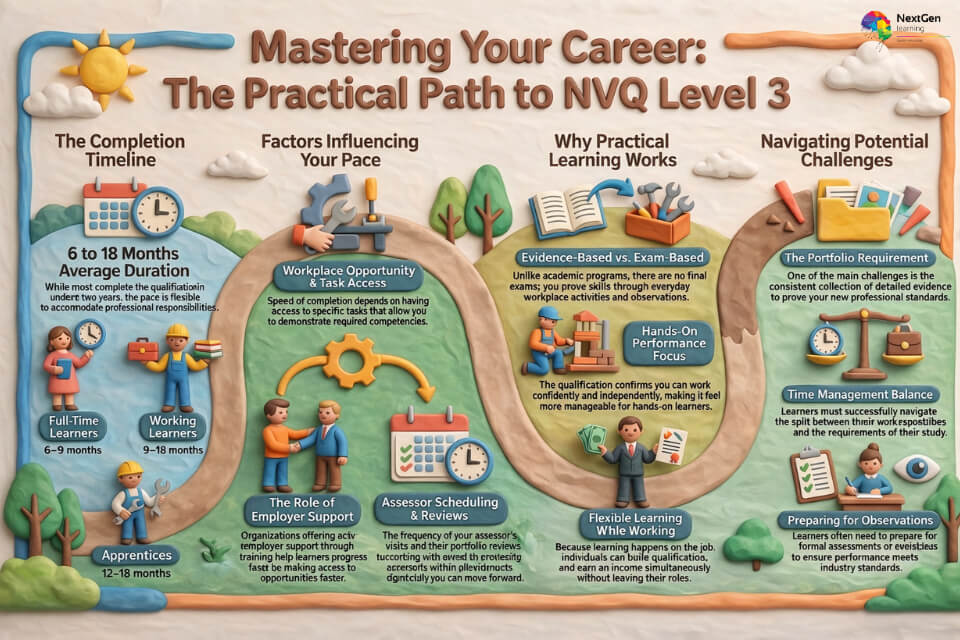
The time required to complete NVQ Level 3 can vary depending on several factors, including the industry, learning format and the learner’s work schedule. However, most people complete the qualification within 6 to 18 months. Because NVQs are designed to be flexible and work-based, learners usually progress at a pace that fits around their professional responsibilities.
Unlike traditional academic programmes, NVQ Level 3 does not follow a fixed classroom timetable. Instead, the qualification is completed through workplace tasks, evidence collection and assessments carried out by a qualified assessor. As a result, the completion time often depends on how quickly a learner can demonstrate the required competencies.
Typical Completion Timeframes
Although the duration may vary, most NVQ Level 3 learners fall within the following timeframes:
- Full-time learners: usually complete the qualification in 6 to 9 months.
- Working professionals: typically finish within 9 to 18 months while balancing employment.
- Apprenticeship programmes: often take 12 to 18 months, as the NVQ forms part of a structured training plan.
These timelines are flexible because NVQs focus on demonstrating real workplace skills rather than completing fixed classroom hours.
Factors That Affect Completion Time
Several factors can influence how quickly someone completes NVQ Level 3.
- Workplace opportunities: Learners need access to tasks that allow them to demonstrate the required skills.
- Employer support: Organisations that provide mentoring or structured training can help learners progress faster.
- Assessment scheduling: The frequency of assessor visits may affect how quickly evidence can be reviewed.
- Personal motivation: Consistently collecting evidence and completing assessments helps learners finish sooner.
Because of these variables, some learners may complete NVQ Level 3 faster, while others take longer depending on their circumstances.
Flexible Learning While Working
One of the biggest advantages of NVQ Level 3 is its flexibility. Since most learning happens within the workplace, many learners can study while maintaining full-time employment. This approach allows individuals to gain experience, earn an income and build qualifications simultaneously.
Consequently, NVQ Level 3 is often seen as a practical and accessible pathway for professionals who want to improve their skills without leaving their job or committing to full-time education.
Many learners wonder whether NVQ Level 3 is difficult to complete. In reality, the level of difficulty often depends on your work experience, motivation and ability to manage your time effectively. However, NVQ Level 3 is generally considered challenging but achievable, especially for individuals who already work in the relevant industry.
Unlike traditional academic qualifications that rely heavily on exams and theoretical study, NVQ Level 3 focuses on practical workplace performance. Therefore, learners are assessed based on how well they perform real tasks in their job role. This approach can make the qualification feel more manageable for people who prefer hands-on learning rather than written examinations.
Why NVQ Level 3 Can Feel Easier for Some Learners
Many individuals find NVQ Level 3 easier than academic qualifications because the assessment method is based on practical ability. Instead of memorising information for exams, learners demonstrate their competence through everyday workplace activities.
Some aspects that make NVQ Level 3 accessible include:
- Practical assessment methods rather than written exams
- Real workplace tasks used as evidence of skills
- Flexible learning schedules that fit around employment
- Continuous assessment instead of one final exam
Because of these factors, many learners feel more confident completing NVQ Level 3 if they already have experience in their field.
Challenges Learners May Face
Although NVQ Level 3 is practical, it still requires commitment and effort. Learners must consistently demonstrate their skills and collect evidence to prove they meet the required standards.
Common challenges may include:
- Managing time between work and study responsibilities
- Collecting detailed evidence for the portfolio
- Meeting professional performance standards
- Preparing for assessor observations and reviews
These challenges are normal, but with proper planning and support, most learners successfully complete the qualification.
Why NVQ Level 3 Is Designed to Be Achievable
NVQ qualifications are built around industry competency standards, which means they are designed to reflect real job performance rather than academic difficulty. If a learner can perform their role effectively in the workplace, they are usually capable of meeting the assessment criteria.
Therefore, NVQ Level 3 is not intended to be excessively difficult. Instead, it is designed to confirm that an individual can work confidently, independently and professionally within their chosen field.
Does NVQ Level 3 Expire?
One common concern learners have is whether NVQ Level 3 expires over time. Fortunately, the qualification itself does not expire. Once you successfully complete NVQ Level 3, it remains a valid and recognised qualification for the rest of your life.
Because NVQs are regulated qualifications within the UK education system, they represent a permanent record of the skills and competencies you demonstrated at the time of assessment. Therefore, employers will continue to recognise the qualification as proof that you achieved a professional standard of performance in your field.
Why NVQ Level 3 Remains Valid
NVQ qualifications are designed to certify that a learner has met industry competency standards. Once these standards have been demonstrated and assessed, the qualification becomes a permanent credential.
Key reasons why NVQ Level 3 does not expire include:
- It confirms professional competency achieved at the time of assessment
- It is regulated within the UK qualifications framework
- Employers recognise it as evidence of industry skills
- It remains part of your permanent education record
Because of this, your NVQ Level 3 continues to hold value when applying for jobs, promotions, or further training opportunities.
When Additional Training May Be Needed
Although the qualification itself never expires, industries often evolve as technologies, regulations and professional standards change. As a result, some sectors may require workers to update their knowledge through continuing professional development (CPD) or refresher training.
Situations where additional training might be recommended include:
- Changes in industry regulations or safety standards
- Introduction of new technologies or procedures
- Professional development requirements within certain industries
- Employer policies for ongoing training
In these cases, the additional training does not replace NVQ Level 3. Instead, it ensures that professionals remain up to date with current industry practices.
Maintaining Professional Competence
Many professionals continue building their skills after completing NVQ Level 3 by pursuing higher-level qualifications or specialised training. For example, some individuals progress to NVQ Level 4 or Level 5, while others complete industry certifications or management training programmes.
Therefore, even though NVQ Level 3 remains valid permanently, continuing education helps professionals stay competitive and advance their careers in evolving industries.
Frequently Asked Questions
Yes. NVQ Level 3 is academically equivalent to A Levels because both sit at Level 3 on the Regulated Qualifications Framework (RQF). However, NVQs focus on practical workplace skills, while A Levels emphasise academic study and exams.
Yes. NVQ Level 3 is a higher qualification than GCSEs. GCSEs are generally classified as Level 2 qualifications, whereas NVQ Level 3 sits one level above them in the UK qualification framework.
NVQ Level 3 can lead to various skilled roles depending on the industry. Common examples include:
- Senior Care Assistant
- Nursery Practitioner or Early Years Supervisor
- Construction Tradesperson or Site Supervisor
- Business Administration Team Leader
- Engineering Technician
- Hospitality or Retail Supervisor
Some Level 3 vocational qualifications carry UCAS tariff points, but not all NVQ Level 3 qualifications automatically translate into UCAS points. Universities may also consider relevant work experience and additional qualifications when assessing applications.
Yes, NVQ Level 3 can contribute to university entry in certain cases. Many learners progress through foundation degrees, access courses, HNC/HND qualifications or industry-related degree programmes.
Final Thoughts on NVQ Level 3 Equivalency
Understanding what NVQ Level 3 is equivalent to helps learners make informed decisions about their education and career paths. In the UK education system, NVQ Level 3 sits at Level 3 on the Regulated Qualifications Framework (RQF), which places it at the same academic level as A Levels, BTEC Nationals, T Levels and Level 3 Advanced Apprenticeships.
However, while these qualifications share the same level, they differ significantly in their learning approach. NVQ Level 3 focuses primarily on practical workplace competence, whereas qualifications such as A Levels emphasise theoretical study and exam-based learning. As a result, NVQ Level 3 is particularly valuable for individuals who want to develop hands-on industry skills while working in a real professional environment.
Another important advantage is the qualification’s flexibility. Many learners complete NVQ Level 3 while working, allowing them to gain recognised credentials without leaving employment. Consequently, it has become a popular pathway for school leavers, adult learners, apprentices and working professionals who want to strengthen their career prospects.
Moreover, NVQ Level 3 can serve as a stepping stone for further progression. Some individuals use it to move into supervisory roles, while others continue their education through higher vocational qualifications, foundation degrees, or university pathways. Because of its practical focus and strong employer recognition, NVQ Level 3 remains one of the most respected vocational qualifications in the UK.
Ultimately, NVQ Level 3 provides a balanced route that combines real-world experience, professional competence and recognised certification, making it an excellent option for individuals who want to build a strong and practical career foundation.

0 responses on "What Is NVQ Level 3 Equivalent To? UK Qualification Guide"