


Safeguarding in Sports Clubs: UK Coaches’ Guide
Safeguarding in sports clubs means protecting children and young people from harm while creating a safe, supportive environment for sport. Coaches, volunteers and club organisers share responsibility for following safeguarding policies, recognising possible abuse, maintaining appropriate boundaries and reporting concerns promptly. Effective safeguarding helps everyone participate with confidence and dignity.
Whether you coach a junior football team or volunteer at a swimming club, understanding your responsibilities makes everyday decisions easier. This guide explains what UK sports clubs should have in place and how to respond when something is wrong.
Table of Contents
What Is Safeguarding in Sport?
Safeguarding in sport involves protecting children’s safety, wellbeing and rights during sporting activities. It includes preventing harm, encouraging respectful behaviour and responding appropriately when concerns arise.
According to the NSPCC’s guidance on safeguarding in sport, safeguarding goes beyond responding to abuse. It also involves creating environments where children feel included, listened to and respected.
Child protection in sport is one part of safeguarding. It focuses specifically on children who are suffering, or are at risk of suffering, harm.
Safeguarding applies during training sessions, competitions, away matches and online interactions. Coaches should also respond appropriately to concerns about a child’s safety outside the club.
Who Is Responsible for Safeguarding in Sports Clubs?
Safeguarding is everyone’s responsibility, although individual roles differ.
Responsibilities of Coaches and Volunteers
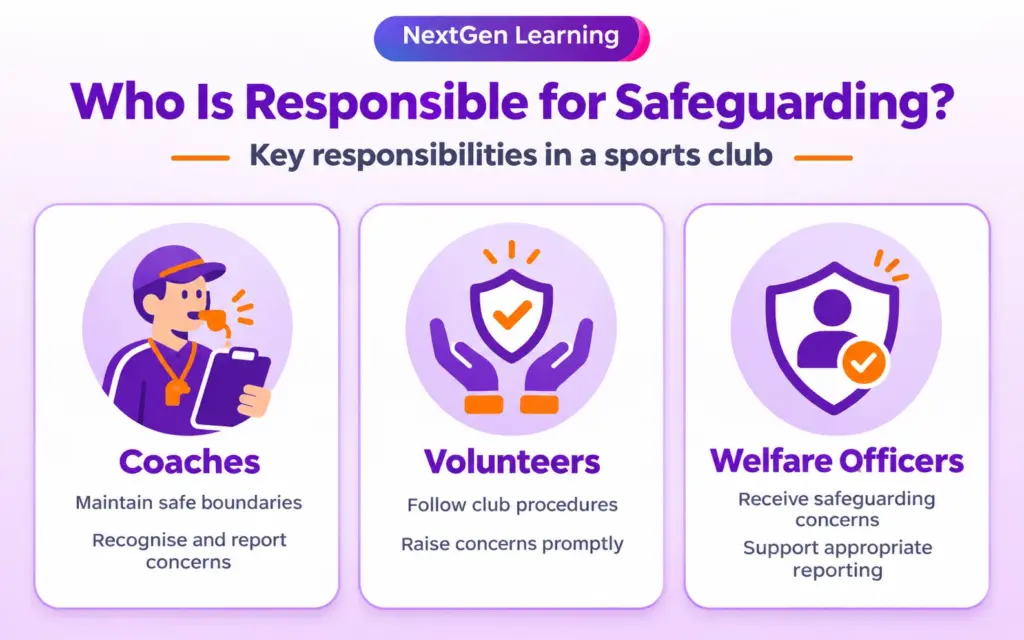
The safeguarding responsibilities of sports coaches include maintaining professional boundaries, supervising activities appropriately and reporting concerns.
| Role | Key Safeguarding Responsibilities |
|---|---|
| Coaches | Follow safe coaching practices, maintain boundaries, listen to children and report concerns. |
| Volunteers | Follow club procedures, recognise warning signs and raise concerns promptly. |
| Club welfare officers | Receive safeguarding concerns, support reporting procedures and help coordinate appropriate action. |
The Role of the Club Welfare Officer
A sports club welfare officer is usually the named contact for safeguarding matters. They help ensure concerns reach the appropriate people and that club procedures are followed.
Club committees and organisers also share responsibility for maintaining suitable safeguarding arrangements.
Some volunteers work across sporting and youth services, where responsibilities may differ. Understanding safeguarding responsibilities for youth workers can help clarify these differences.
What Should a Sports Club Safeguarding Policy Include?
A sports club safeguarding policy should explain how the organisation prevents harm, manages risks and responds to concerns.
An effective policy should cover:
- Safeguarding contacts: Who receives concerns and how to contact them.
- Codes of conduct: Expectations for coaches, volunteers, children and parents.
- Safer recruitment: Appropriate references, checks and recruitment procedures.
- Supervision: Safe arrangements for training, changing facilities and trips.
- Online safety: Rules for messaging, photography and sharing images.
- Reporting procedures: Recording information, maintaining confidentiality and escalating concerns.
The Department for Education’s safeguarding guidance for out-of-school settings provides relevant recommendations for activity providers in England. Other UK nations have their own safeguarding frameworks.
Putting Safeguarding Procedures into Practice
A written policy only helps when people understand how to apply it.
For example, a junior coach should know whether private messaging with young athletes is permitted and which communication channels the club expects.
Clubs should also establish clear rules for photography and filming in sports and activities, including consent, image sharing and camera use around changing facilities.
How Can Coaches Recognise Safeguarding Concerns?
Recognising abuse in sport involves noticing behaviour or situations that may indicate a child needs support.
Possible warning signs include:
- Unexplained injuries or repeated signs of distress.
- Bullying, humiliation or threatening behaviour.
- Inappropriate physical contact or boundary violations.
- Excessive private communication between adults and children.
- Noticeable changes in confidence, behaviour or participation.
- Concerns involving neglect, exploitation or inappropriate supervision.
These signs do not automatically prove abuse. Coaches should avoid assumptions while taking reasonable concerns seriously.
Examples of Safeguarding Concerns in Sport
Example 1: Humiliation during training
A coach repeatedly insults a young player after mistakes. The child becomes withdrawn and reluctant to attend. Another volunteer notices and reports the behaviour through the club’s safeguarding procedure.
Example 2: Inappropriate private messages
A volunteer discovers that an adult is sending repeated personal messages to an under-18 athlete outside approved communication channels.
Both situations require appropriate attention and reporting, not independent investigation.

How Should Safeguarding Concerns Be Reported in Sport?
Reporting safeguarding concerns in sport means passing relevant information to the appropriate safeguarding contact or statutory authority without unnecessary delay.
Five Steps to Respond to a Safeguarding Concern
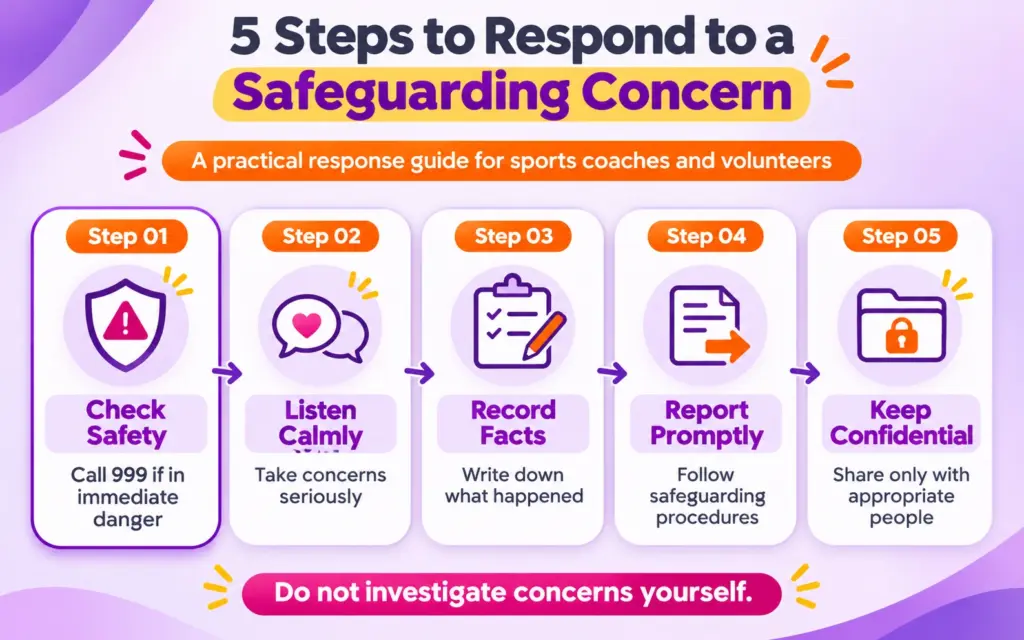
1. Check immediate safety. If a child is in immediate danger, call 999. Do not delay emergency action while seeking internal approval.
2. Listen calmly. If a child shares a concern, take them seriously. Avoid leading questions, remain supportive and never promise complete secrecy.
3. Record the facts. Write down what happened, when and where. Where possible, record the child’s own words. Keep observations separate from assumptions.
4. Report promptly. Contact the club welfare officer or designated safeguarding lead. Depending on the circumstances, concerns may also need referral to children’s social care or the police.
5. Maintain confidentiality. Share information only with appropriate people and follow safeguarding instructions. Do not confront the alleged abuser or investigate the matter yourself.
What if the Concern Involves the Welfare Officer?
If the concern involves the welfare officer, use an alternative reporting route, such as the national governing body’s safeguarding lead or relevant statutory services.
The NSPCC provides guidance on reporting safeguarding concerns, including concerns involving adults in sport and situations arising outside sporting activities.
You do not need proof of abuse before reporting a genuine concern. Your responsibility is to recognise, record and pass on relevant information.
Do Sports Coaches and Volunteers Need DBS Checks?
In England and Wales, eligibility for DBS checks depends on the coach’s specific duties, activities and how frequently they work with children.
An Enhanced DBS check may be available for eligible coaching roles. An Enhanced DBS check with children’s barred list information applies where the relevant regulated-activity conditions are met.
Official guidance on DBS checks for sports coaches explains that qualifying coaching activities carried out on more than three days within 30 days, or during certain overnight circumstances, can constitute regulated activity.
Importantly, the changes to regulated activity from September 2026 removed the supervision exemption for relevant activities involving children in England, Wales and Northern Ireland.
This means some supervised assistant coaches may now fall within regulated activity.
However, the change does not create a universal DBS requirement for every sports volunteer. Eligibility and legal obligations must be assessed according to the role.
In Scotland, PVG scheme requirements apply to people undertaking regulated roles. Northern Ireland uses AccessNI for relevant criminal record checks.
For more detailed information, guidance on DBS checks for volunteers in the UK can help clubs understand different checking arrangements.
What Safeguarding Training Do Sports Coaches Need?
Safeguarding training for sports coaches helps them recognise potential harm, maintain appropriate boundaries and understand reporting procedures.
Training expectations depend on the role, organisation and relevant sports governing body. Volunteers should check their club’s requirements rather than assuming one course meets every expectation.
For broader guidance, safeguarding training for volunteers can help explain different training needs and options.
NextGen Learning’s Child Protection and Safeguarding course offers CPD-accredited training covering abuse recognition, disclosures, reporting, risk assessment and record keeping.
After successful completion, learners can purchase an optional CPD certificate or a QLS-endorsed hardcopy certificate for an additional fee.
QLS endorsement relates to non-regulated training and does not make the course a regulated qualification. The course also does not replace any sport-specific qualification or mandatory safeguarding training required by a governing body.
Sports Club Safeguarding Checklist
Before coaching or volunteering, check that you can answer these questions:
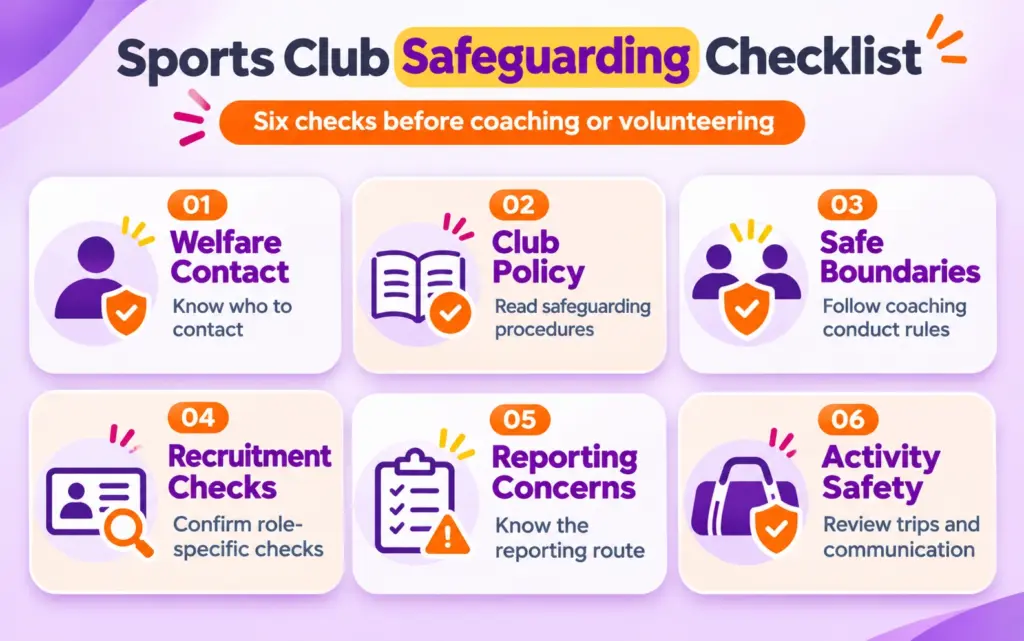
- Do I know who the club welfare officer is?
- Have I read the safeguarding policy and code of conduct?
- Do I understand appropriate coaching and communication boundaries?
- Have the necessary recruitment and safeguarding checks been assessed?
- Do I know how to record and report concerns?
- Are arrangements for trips, changing facilities and online communication clear?
If something is unclear, speak to the club’s safeguarding lead before taking on the relevant responsibility.
Conclusion
Effective safeguarding in sports clubs depends on everyday decisions, not paperwork alone. Coaches and volunteers help protect young athletes by following safe practices, listening carefully and raising concerns appropriately.
Clear policies, suitable training and shared responsibility help children enjoy sport in an environment where they feel safe, respected and supported.
Frequently Asked Questions
A named safeguarding lead is strongly recommended, and many governing bodies require one for affiliated clubs. Specific requirements depend on the organisation, sport and applicable rules.
Not automatically. DBS eligibility depends on activities undertaken, their frequency and relevant legal criteria. Scotland and Northern Ireland have different checking arrangements.
Yes. Report reasonable safeguarding concerns through appropriate procedures. You do not need to investigate or establish that abuse occurred before passing on information.
There is no single renewal interval covering every UK sports coaching role. Follow the relevant governing body’s requirements and your club’s training policy.
Yes. Safeguarding adults in sport includes recognising and responding to abuse or neglect, particularly involving adults with care and support needs. Adult safeguarding arrangements differ from child protection procedures.