





SEN Teaching Assistant Career Guide: Salary, Qualifications & Jobs UK
A SEN Teaching Assistant (Special Educational Needs Teaching Assistant) plays a vital role in helping children with additional learning needs succeed in school. Whether supporting pupils with autism, ADHD, dyslexia, speech and language difficulties or social, emotional and mental health (SEMH) needs, SEN TAs provide personalised support that helps every child participate, learn and build confidence in the classroom.
As inclusive education continues to grow across the UK, schools are increasingly looking for skilled SEN Teaching Assistants who can work closely with teachers, SENCOs and families to create positive learning experiences. Consequently, demand for qualified support staff has remained strong in mainstream schools, specialist settings and alternative education provisions, making this an attractive career for people who enjoy helping children reach their full potential.
The good news is that you do not always need previous classroom experience to get started. With the right training, practical skills and a genuine passion for supporting young people, you can begin a rewarding career in education. In this guide, you’ll discover what an SEN Teaching Assistant does, the qualifications employers look for, salary expectations, career progression opportunities and practical steps to secure your first role in the UK.
Table of Contents
What Is an SEN Teaching Assistant?

A Special Educational Needs (SEN) Teaching Assistant is an education support professional who helps children and young people with additional learning needs participate fully in school life. Working under the guidance of teachers and Special Educational Needs Coordinators (SENCOs), SEN Teaching Assistants provide tailored support that enables pupils to access lessons, develop confidence and achieve their individual learning goals.
Unlike a general Teaching Assistant, an SEN Teaching Assistant focuses on pupils who require extra support because of conditions such as autism spectrum disorder (ASD), attention deficit hyperactivity disorder (ADHD), dyslexia, speech and language difficulties, physical disabilities or social, emotional and mental health (SEMH) needs. Therefore, the role requires patience, adaptability and a good understanding of inclusive learning strategies.
As schools across the UK continue to promote inclusive education, SEN Teaching Assistants have become an essential part of the classroom. They help remove barriers to learning, encourage independence and create a positive environment where every child has the opportunity to succeed.
SEN Teaching Assistant vs General Teaching Assistant
Although both roles support teachers and pupils, there are several important differences in their focus, responsibilities and approach.
| General Teaching Assistant | SEN Teaching Assistant |
|---|---|
| 👥 Supports the whole class during lessons. | 🎯 Provides targeted support for pupils with additional needs. |
| 📚 Assists with general classroom activities. | 🧩 Implements personalised learning strategies and interventions. |
| 🏫 Works with pupils of mixed abilities. | 🌱 Focuses on children with SEND, including autism, ADHD and dyslexia. |
| ✏️ Helps prepare standard classroom resources. | 🛠️ Adapts learning materials to meet individual needs. |
| 🧑🏫 Supports learning under the teacher’s direction. | 🤝 Collaborates closely with teachers, SENCOs and, where appropriate, therapists or parents. |
Who Do SEN Teaching Assistants Support?
Depending on the school and role, an SEN Teaching Assistant may work with pupils who have:
- Autism Spectrum Disorder (ASD) and require structured routines or visual learning support.
- ADHD and benefit from strategies that improve focus and classroom engagement.
- Dyslexia or other specific learning difficulties affecting literacy or numeracy.
- Speech, language and communication needs (SLCN) that require adapted communication methods.
- Social, Emotional and Mental Health (SEMH) needs, including behavioural or emotional challenges.
- Physical or sensory disabilities that require additional classroom adjustments or accessibility support.
Importantly, every child has unique strengths and challenges. Consequently, an SEN Teaching Assistant tailors their approach to each pupil rather than applying the same strategy to everyone. This personalised support not only improves academic progress but also helps children build confidence, independence and positive relationships with their peers.
What Does an SEN Teaching Assistant Do?
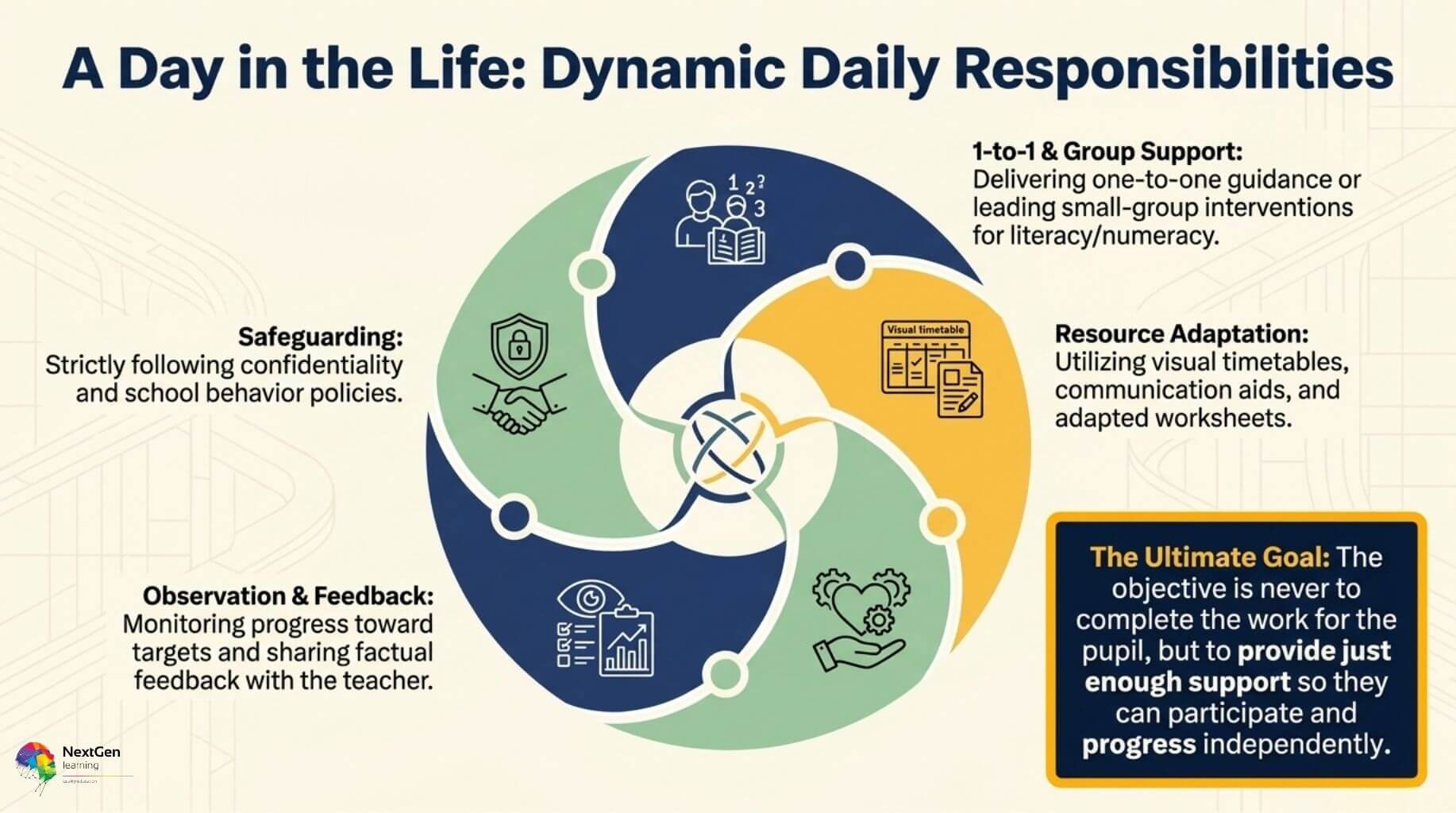
An SEN Teaching Assistant supports pupils who need additional help to access lessons, communicate effectively and take part in school life. However, the role involves more than helping with academic tasks. SEN TAs also support confidence, behaviour, emotional regulation and independence.
Daily duties vary depending on the pupil’s needs, age and school setting. For example, one SEN TA may support a child with autism in a mainstream classroom. Another may work with pupils who have complex needs in a specialist school. Therefore, flexibility remains one of the most important parts of the role.
Daily Responsibilities
An SEN Teaching Assistant may:
- Provide one-to-one support during lessons and classroom activities.
- Lead small-group interventions for literacy, numeracy or communication.
- Adapt worksheets, instructions and learning resources.
- Use visual timetables, prompts or communication aids.
- Support pupils with emotional regulation and positive behaviour.
- Encourage pupils to complete tasks independently.
- Observe progress and share useful feedback with the teacher.
- Help pupils move safely between lessons or activities when required.
- Follow safeguarding, confidentiality and school behaviour policies.
Importantly, the goal is not to complete work for the pupil. Instead, the SEN TA provides the right level of support so the learner can participate and make progress independently.
Supporting Individual Learning Plans and EHCPs
Some pupils receive support through an Education, Health and Care Plan, commonly known as an EHCP. This plan identifies the child’s needs, required support and agreed outcomes. Although teachers and SENCOs oversee the provision, SEN Teaching Assistants often help deliver the recommended classroom strategies.
For example, an EHCP may recommend:
- Breaking instructions into shorter steps.
- Providing regular movement or sensory breaks.
- Using visual communication resources.
- Practising speech, language or social interaction activities.
- Reducing distractions during focused learning tasks.
The SEN TA may also record observations about participation, behaviour and progress. As a result, teachers and SENCOs can review whether the support remains effective.
Working with Teachers, SENCOs and Parents
SEN Teaching Assistants work as part of a wider support team. They regularly communicate with classroom teachers and SENCOs to understand learning targets, discuss challenges and adjust support strategies.
They may also work alongside:
- Speech and language therapists
- Educational psychologists
- Occupational therapists
- Behaviour specialists
- Pastoral support teams
- Parents and carers
However, an SEN TA must always respect professional boundaries. They should share concerns through the correct school procedures rather than independently diagnosing a condition or promising a specific outcome.
Skills Every SEN Teaching Assistant Needs
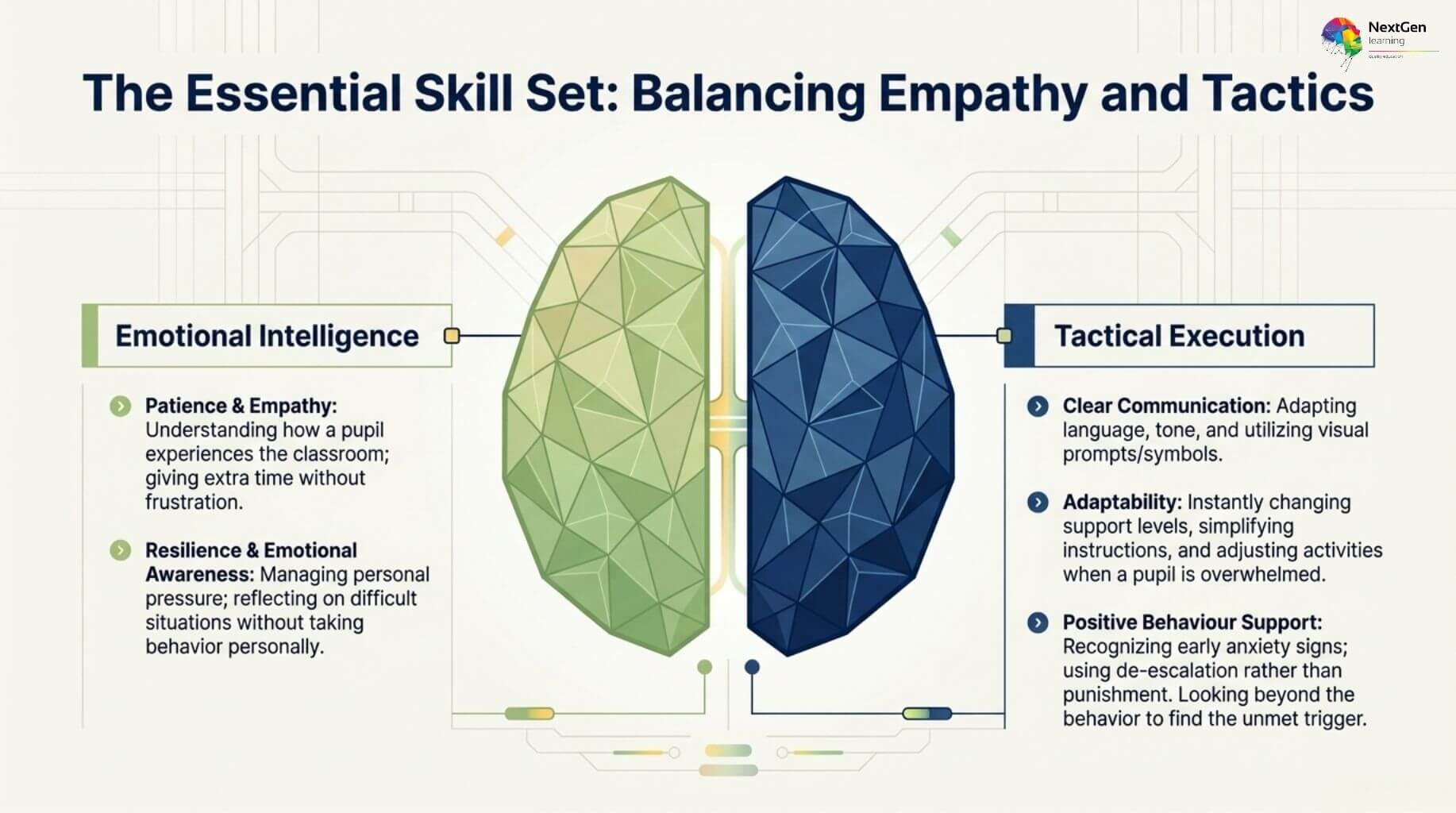
Qualifications can help you understand the role. However, your personal and practical skills determine how effectively you support pupils each day. SEN Teaching Assistants often work with children who communicate, learn or respond to situations in different ways. Therefore, they must remain calm, observant and flexible.
Patience and Empathy
Children with SEND may need extra time to understand instructions, complete tasks or manage emotions. As a result, an SEN Teaching Assistant must respond patiently rather than showing frustration.
Empathy is equally important. By understanding how a pupil may experience the classroom, the SEN TA can offer support that feels respectful and reassuring.
Clear Communication
SEN Teaching Assistants communicate with pupils, teachers, SENCOs, parents and other professionals. Therefore, they must explain information clearly and listen carefully.
Some pupils may use limited speech, communication aids, symbols or visual prompts. Consequently, the SEN TA may need to adapt their language, tone and communication style.
Adaptability
A strategy that works for one pupil may not work for another. Moreover, a pupil’s needs can change throughout the day.
Effective SEN TAs adapt by:
- Changing the level of support when a pupil becomes more independent.
- Simplifying instructions without reducing the learning objective.
- Adjusting activities when a pupil becomes overwhelmed.
- Using different resources to suit visual, practical or verbal learners.
- Responding calmly when routines or behaviour change unexpectedly.
Behaviour Support
Some pupils may struggle to regulate emotions or express their needs appropriately. Therefore, SEN Teaching Assistants need positive behaviour-support skills.
This may involve:
- Recognising early signs of anxiety or frustration.
- Using calm language and de-escalation techniques.
- Reinforcing positive behaviour consistently.
- Following the school’s behaviour and safeguarding policies.
- Avoiding confrontation or punishment-based responses.
Importantly, challenging behaviour often communicates an unmet need. As a result, the SEN TA should look beyond the behaviour and help identify possible triggers.
Observation and Record-Keeping
SEN Teaching Assistants often spend significant time working directly with individual pupils. Consequently, their observations can help teachers and SENCOs understand what is working.
They may record:
- How the pupil responded to an activity.
- Which prompts or resources improved participation.
- When difficulties or emotional changes occurred.
- What progress the pupil made towards a learning target.
However, records should remain factual, professional and confidential.
Teamwork and Professionalism
SEN support works best when staff communicate and follow a consistent approach. Therefore, SEN Teaching Assistants must cooperate with teachers, SENCOs and specialists.
Professional SEN TAs also:
- Respect confidentiality.
- Follow safeguarding procedures.
- Maintain appropriate boundaries.
- Accept feedback from senior staff.
- Complete ongoing training when required.
Resilience and Emotional Awareness
Supporting children with complex needs can feel highly rewarding. Nevertheless, the work can also be emotionally demanding.
Resilient SEN Teaching Assistants manage pressure, reflect on difficult situations and seek support when necessary. In addition, they avoid taking a pupil’s behaviour personally. This balanced approach helps them provide consistent support while protecting their own wellbeing.
Qualifications and Training for SEN Teaching Assistants

There is no single qualification required for every SEN Teaching Assistant role in the UK. Requirements vary between schools, local authorities and employers. However, many schools prefer candidates who hold a recognised teaching assistant qualification and understand safeguarding, child development and SEND support.
Practical experience also matters. Therefore, a relevant qualification works best when combined with volunteering, placement experience or previous work with children.
Do You Need Qualifications?
Some schools may recruit entry-level candidates without formal classroom qualifications, especially when they can demonstrate suitable experience and strong personal skills. Nevertheless, competition for SEN Teaching Assistant jobs can be high. Relevant training can therefore strengthen your application and help you feel more confident in the classroom.
Employers commonly look for:
- English and maths skills, often at GCSE grade 4/C or an equivalent level.
- Experience supporting children, young people or individuals with additional needs.
- Knowledge of safeguarding and child protection.
- Understanding of SEND, inclusive learning and positive behaviour support.
- Willingness to complete an enhanced Disclosure and Barring Service check.
- Ability to follow school policies and work under a teacher’s direction.
Level 2 vs Level 3 Teaching Assistant Qualifications
A Level 2 qualification can provide a useful starting point for beginners. It usually introduces classroom support, communication, child development and safeguarding. Therefore, it may suit people with limited school experience.
A Level 3 qualification offers more advanced knowledge and may better support progression into roles with greater responsibility.
| Level 2 Foundation Route | Level 3 Advanced Route |
|---|---|
| ✓ Introduces the foundations of classroom support. | ✓ Develops more advanced classroom support skills. |
| ✓ Suits beginners and career changers. | ✓ Suits candidates seeking stronger job prospects. |
| ✓ Covers basic safeguarding and child development. | ✓ Explores SEND, assessment and independent support in greater depth. |
| ✓ Supports entry-level teaching assistant applications. | ✓ May support progression towards senior TA or HLTA pathways. |
Importantly, course titles can look similar while offering different outcomes. Before enrolling, check whether the qualification is regulated, whether it requires a school placement and whether it matches the roles you plan to apply for.
SEN-Specific Training
General teaching assistant training provides a foundation. However, specialist SEN training can help candidates understand the needs they may encounter in mainstream and specialist settings.
Useful areas of study include:
- Autism awareness
- ADHD awareness
- Dyslexia support
- Speech and language development
- SEMH support
- Positive behaviour management
- Safeguarding children
- Makaton or alternative communication methods
Specialist training does not qualify someone to diagnose a condition. Instead, it helps them recognise support needs and apply appropriate classroom strategies under professional guidance.
Is a School Placement Necessary?
Some regulated teaching assistant qualifications require learners to demonstrate practical competence in a real school environment. In contrast, knowledge-based online courses may not include a placement.
A placement can improve employability because it allows you to:
- Practise supporting pupils in real lessons.
- Understand classroom routines and professional expectations.
- Collect evidence of practical competence.
- Build references from education professionals.
- Confirm whether the role suits your strengths and career goals.
Therefore, candidates with no previous school experience should strongly consider volunteering or choosing a course that includes practical assessment.
Additional Checks and Training
Before starting work, most schools require an enhanced DBS check. Employers may also request references, proof of identity and evidence of the right to work in the UK.
Once employed, you may complete further training in areas such as first aid, moving and handling, data protection, safeguarding updates or specific medical needs. Consequently, professional development continues throughout an SEN Teaching Assistant career.
SEN Teaching Assistant Salary in the UK

An SEN Teaching Assistant can typically earn between £19,000 and £27,000 per year, depending on experience, location and responsibilities. The National Careers Service currently lists £19,000 as a starter salary and £27,000 for experienced SEN Teaching Assistants. Typical working hours range from 24 to 40 hours per week during term time.
However, advertised salaries do not always equal the amount an employee receives. Many school-based roles are term-time only or part-time. Therefore, job adverts often show both a full-time equivalent salary and a lower actual salary based on contracted hours and working weeks.
For example, a current government-listed learning support role shows a full-time equivalent salary of around £25,989 to £26,403, while the actual part-time salary is £13,917. Consequently, applicants should check the contract carefully rather than judging a vacancy by its headline salary alone.
What Affects an SEN Teaching Assistant’s Pay?
Several factors can influence earnings:
- Experience: Experienced SEN TAs can apply for roles with greater responsibility and higher pay.
- Qualifications: A relevant Level 3 qualification may strengthen applications for more advanced positions.
- Location: London and other high-cost areas may offer higher salaries or regional allowances.
- Specialist skills: Autism, communication, behavioural or complex-needs experience can increase employability.
- Working pattern: Full-time, part-time and term-time contracts produce different actual salaries.
- School type: Local authority schools, academies, specialist schools and independent providers may use different pay structures.
- Additional duties: One-to-one support, personal care or medical responsibilities may attract a higher grade or allowance.
Some vacancies also include an SEN allowance. For instance, a recent Level 3 Teaching Assistant vacancy listed an additional SEN allowance of £1,722 on a full-time-equivalent basis. However, allowances vary by employer and may be reduced proportionately for part-time staff.
Understanding Term-Time Pay
Most SEN Teaching Assistants work during the school term rather than throughout the full calendar year. As a result, employers commonly calculate pay using the number of contracted weeks and hours, then spread the salary across 12 monthly payments.
Before accepting a position, check:
- The full-time equivalent salary
- The actual annual salary
- Weekly contracted hours
- The number of paid working weeks
- Whether holiday pay is included
- Any London weighting or SEN allowance
- Pension and other employment benefits
This comparison gives a more accurate picture of the role’s financial value.
Can SEN Teaching Assistants Earn More Than General TAs?
Experienced SEN Teaching Assistants may earn slightly more than general Teaching Assistants, particularly when they support pupils with complex needs or hold specialist responsibilities. The National Careers Service lists the experienced salary for a general Teaching Assistant at up to £26,000, compared with up to £27,000 for an SEN Teaching Assistant.
Nevertheless, the job title alone does not guarantee higher pay. The employer, grade, contracted hours and responsibilities ultimately determine the salary. Therefore, candidates should compare the complete employment package rather than relying only on the role title.
How to Become an SEN Teaching Assistant

You can enter this career through several routes. However, the strongest applications usually combine relevant training, practical experience and a clear understanding of SEND support.
1. Understand the Role
Before applying, learn how SEN Teaching Assistants support pupils in mainstream schools, specialist schools and alternative provision. In addition, familiarise yourself with safeguarding, inclusive learning, EHCPs and the role of the SENCO.
2. Build Relevant Knowledge
A teaching assistant qualification can strengthen your application, especially when you have limited classroom experience. For example, a Level 2 course may suit beginners, while a Level 3 qualification can support applications for more advanced roles.
You can also complete specialist training in:
- Autism support
- ADHD awareness
- Dyslexia support
- Behaviour management
- Safeguarding children
- Speech and language development
3. Gain Experience with Children
Schools value evidence that you can communicate calmly, follow instructions and support children responsibly. Therefore, volunteering can be extremely useful.
Possible routes include:
- Volunteer in a local school or nursery.
- Support children through a charity or community programme.
- Work in childcare, youth work or care services.
- Complete a school placement through your course.
- Apply for temporary roles through an education agency.
Even a short placement can help you understand classroom routines and gain a professional reference.
4. Prepare a Strong Application
Tailor your CV and supporting statement to each vacancy. Instead of only listing duties, explain how your experience matches the school’s needs.
Highlight examples where you have:
- Supported a child or vulnerable person.
- Managed challenging behaviour calmly.
- Adapted communication for different needs.
- Worked effectively within a team.
- Followed safeguarding or confidentiality procedures.
- Encouraged confidence and independence.
Importantly, use specific examples. This approach shows employers how you apply your skills in practice.
5. Complete Employment Checks
Schools normally complete safer recruitment checks before confirming employment. These may include an enhanced DBS check, identity checks, references and verification of your right to work in the UK.
You should also be ready to explain any gaps in employment and provide a complete work history.
6. Prepare for the Interview
SEN Teaching Assistant interviews often focus on safeguarding, behaviour, teamwork and practical classroom situations. Therefore, prepare examples using the situation, task, action and result method.
Common questions may include:
- How would you support a distressed pupil?
- What would you do if a child disclosed a safeguarding concern?
- How would you encourage independence?
- How would you respond to challenging behaviour?
- How would you work with the teacher and SENCO?
In addition, research the school’s SEND provision, values and behaviour policy before attending.
7. Continue Developing Your Skills
Your learning should continue after you secure a role. Schools may provide training in safeguarding, first aid, communication methods, medical needs or specialist interventions. Consequently, ongoing development can help you take on greater responsibility and progress towards senior SEN TA or HLTA roles.
Career Progression Opportunities for SEN Teaching Assistants

An SEN Teaching Assistant role can lead to several long-term career paths in education. Although many people remain in classroom support because they value direct work with pupils, others use the experience to move into specialist, senior or teaching roles.
Progression usually depends on practical experience, additional training and the level of responsibility you can manage confidently.
Senior SEN Teaching Assistant
With experience, you may progress into a senior SEN support role. In this position, you could support more complex cases, mentor newer staff or help coordinate interventions.
Typical responsibilities may include:
- Leading small-group learning or behaviour programmes.
- Supporting pupils with complex or multiple needs.
- Mentoring new Teaching Assistants.
- Recording and reviewing pupil progress.
- Working more closely with the SENCO and external specialists.
This route suits people who want greater responsibility while continuing to work directly with pupils.
Higher Level Teaching Assistant
Some SEN Teaching Assistants progress to Higher Level Teaching Assistant status. An HLTA may lead planned learning activities, cover classes for short periods and support teachers with assessment or lesson preparation.
However, HLTA responsibilities differ between schools. Therefore, candidates should review the job description carefully and complete any training required by the employer.
Specialist Support Roles
You may also specialise in a particular area of SEND. For example, schools often value staff with deeper knowledge of:
- Autism support
- Speech and language needs
- SEMH and behaviour support
- Dyslexia interventions
- Sensory support
- Physical or complex needs
Specialist experience can lead to roles such as Learning Mentor, Behaviour Support Assistant, Communication Support Worker or Specialist Teaching Assistant.
Progression into Teaching
An SEN Teaching Assistant role can provide valuable preparation for teacher training. It allows you to understand classroom management, safeguarding, curriculum delivery and the realities of supporting diverse learners.
Depending on your qualifications, you may later progress towards:
- Qualified Teacher Status
- A postgraduate teacher-training route
- An undergraduate teaching degree
- An apprenticeship-based teaching route
However, Teaching Assistant experience does not replace the academic and entry requirements for teacher training. Therefore, check the requirements of your chosen route before making a plan.
Other Education and Care Careers
The skills gained as an SEN TA can also support progression into related roles, including:
- Pastoral support
- Family support work
- Youth work
- Early years education
- Residential childcare
- Learning support in further education
- Education welfare
- Therapy assistant roles
Some careers, such as educational psychology, speech and language therapy or occupational therapy, require a relevant degree and professional training. Nevertheless, SEN classroom experience can provide useful insight before entering those pathways.
Building a Strong Progression Plan
A clear development plan can help you move forward more confidently. Consider the following steps:
- Identify the type of pupils or needs you most enjoy supporting.
- Ask for feedback from teachers and SENCOs.
- Complete targeted training rather than collecting unrelated certificates.
- Record examples of successful interventions and pupil progress.
- Take on additional responsibility gradually.
- Review the qualification requirements for your preferred next role.
Importantly, progression does not always mean leaving the classroom. For many professionals, becoming a highly skilled and experienced SEN Teaching Assistant is a rewarding long-term career in itself.
Frequently Asked Questions
Yes, some schools recruit entry-level candidates who demonstrate patience, communication skills and a genuine interest in supporting children. However, volunteering in a school, nursery or community setting can strengthen your application and help you understand classroom expectations.
A Level 2 qualification can support applications for entry-level roles. Nevertheless, many employers prefer Level 3 training for positions involving greater independence or specialist responsibilities. Always compare the course content with the requirements in current job descriptions.
Yes. Schools normally require an enhanced DBS check because the role involves regulated activity with children. Employers also complete identity, reference and safer-recruitment checks before confirming employment.
Yes. Many mainstream primary and secondary schools employ SEN Teaching Assistants to support pupils with additional needs. Roles are also available in specialist schools, nurseries, alternative provision and further education settings.
The job titles often overlap. However, an SEN Teaching Assistant usually focuses specifically on pupils with special educational needs and disabilities. A Learning Support Assistant may support a wider range of learners, depending on the school and job description.
It can be a rewarding long-term career for people who enjoy supporting children and adapting learning to individual needs. Moreover, experience can lead to senior SEN support, HLTA, pastoral, behaviour-support or teacher-training pathways.
Final Thoughts: Is Becoming an SEN Teaching Assistant Right for You?
A career as an SEN Teaching Assistant offers the opportunity to make a real difference in children’s lives while building a rewarding future in education. Although the role requires patience, adaptability and strong communication skills, it also provides excellent opportunities for professional growth.
You don’t always need previous classroom experience to get started. However, gaining relevant training, practical experience and a good understanding of SEND can improve your confidence and employment prospects.
With the right preparation, you can begin a fulfilling career that may lead to senior SEN support roles, HLTA positions or teacher training in the future.


0 responses on "SEN Teaching Assistant Career Guide: Salary, Qualifications & Jobs UK"