





5 Healthcare Trends in 2026 Every Nursing Assistant Should Know
In 2026, the social care sector and the wider NHS landscape are changing at a faster pace than ever before, and these changes are already reshaping everyday healthcare jobs across the UK. For a nursing assistant, understanding how care delivery, expectations, and workplace standards are evolving is no longer optional—it is essential for staying confident, compliant, and employable in modern health and social care settings.
At the same time, frontline roles are becoming more visible and more valued. Whether you work as a healthcare assistant, a care assistant, or a nursing assistant supporting clinical teams, the way care is planned, recorded, and delivered is shifting. Consequently, employers are increasingly looking for professionals who understand not only their duties, but also the wider direction of the social care sector.
Moreover, these changes are closely linked to training, progression, and long-term job security. As integrated care expands and standards rise, knowing which skills to strengthen—and which qualifications to pursue—can make a real difference to your career prospects.
Below are five key healthcare trends shaping care in 2026, explained in a practical and realistic way to support day-to-day practice, informed career planning, and confident progression within healthcare jobs.
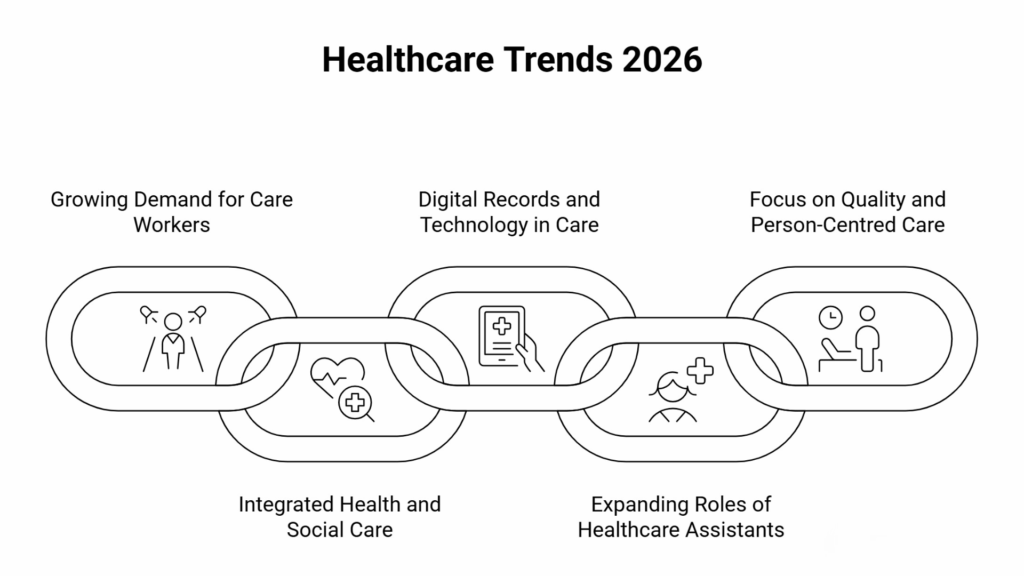
Table of Contents
The Social Care Sector Will Keep Growing, and Demand Will Stay High
First and foremost, the social care sector continues to expand because more people are living longer with complex needs. Consequently, demand is rising not only in residential care homes but also in domiciliary care and community services. As a result, healthcare jobs are increasingly available in settings that require strong practical skills and calm decision-making.
For a healthcare assistant or care assistant, this matters because employers are looking for people who can support independence as well as safety. For example, supporting mobility, nutrition, hydration, personal care, and meaningful routines is now viewed as essential—not “extra”. Likewise, for a nursing assistant, supporting clinical routines alongside personal care is becoming more common, especially in integrated services.
At the same time, providers in health and social care are being pushed to improve quality standards. Therefore, evidence-based practice, accurate documentation, and clear communication are more valuable than ever. In other words, the social care sector isn’t simply “busy”; it’s becoming more structured, more regulated, and more outcomes-focused.
What to do now:
- Build confidence with care planning and reporting, because it helps you stand out in healthcare jobs.
- Strengthen safeguarding awareness, because the social care sector depends on safe practice.
Healthcare Jobs Will Evolve Through Integrated Care and Community Support
Secondly, care is moving closer to home. In practice, that means more services are being delivered in community settings rather than solely in hospitals. Therefore, healthcare jobs are increasingly shaped by integrated care—where health and social teams work together to support one person, in one joined-up plan.
For a nursing assistant, this can mean collaborating more often with therapists, social workers, district nurses, and care coordinators. Meanwhile, a healthcare assistant may be supporting follow-up care after discharge, monitoring basic observations, and reporting changes quickly. Additionally, a care assistant may find they are involved in early prevention—helping reduce falls, supporting nutrition, and encouraging daily movement.
This integrated approach is a big shift for health and social care, because it rewards teamwork and consistency. Furthermore, it raises the importance of communication skills, because small details can prevent bigger problems later. Ultimately, the best outcomes in healthcare jobs often come from noticing changes early and sharing them clearly.
What to do now:
- Practise structured handovers (for example, simple SBAR-style updates), because they fit modern healthcare jobs.
- Keep your notes timely and factual, because integrated health and social care relies on good records.
Digital Records Are Reshaping the Social Care Sector
Thirdly, digital systems are no longer “coming soon”—they’re already here. Across the social care sector, providers are adopting digital care plans, eMAR, and electronic documentation. Similarly, in many healthcare jobs, electronic records and digital communication are standard. Consequently, being comfortable with basic digital tasks is now a genuine employability skill.
For a healthcare assistant, this may include recording observations electronically, updating care notes, or using digital prompts for routine tasks. For a nursing assistant, it can also involve documenting clinical support actions and escalating concerns through digital systems. Meanwhile, a care assistant may use apps to record visits, note changes, and communicate with supervisors.
However, the key point is that “digital” does not replace compassionate care. Instead, it should support safer, more consistent health and social care. For example, digital records can reduce missed information, highlight risks, and improve continuity. Nevertheless, digital tools also require responsibility. Therefore, confidentiality, GDPR awareness, and secure handling of information remain essential in the social care sector and across healthcare jobs.
What to do now:
- Improve confidence with digital note-taking, because it’s increasingly expected in healthcare jobs.
- Learn the “why” behind documentation, because it supports safe health and social care.
How Expanding Healthcare Jobs Are Changing Assistant Roles
Fourthly, role boundaries are becoming clearer—and, in many places, wider. In 2026, employers want frontline staff who can follow policies, meet standards, and work confidently within scope. As a result, healthcare assistant responsibilities are often expanding, and nursing assistant expectations are rising too.According to guidance from Skills for Care, workforce development and training are key priorities in the social care sector.
In many healthcare jobs, a healthcare assistant may be expected to support routine observations, assist with mobility and rehabilitation exercises, and contribute to person-centred care plans. Likewise, a nursing assistant may be expected to support clinical routines more frequently, while still providing excellent personal care. Meanwhile, the care assistant role remains crucial, particularly in the social care sector, because consistent personal support is the foundation of safe living.
Importantly, expansion does not mean doing unsafe tasks. Instead, it means being well-trained, supervised appropriately, and confident in what you can do. Therefore, learning pathways are becoming a major differentiator in healthcare jobs. In other words, two people may have the same title, but the person with stronger training and sharper practice will often progress faster in health and social care.
What to do now:
- Build role clarity: know your scope, know escalation routes, and document properly.
- Choose structured learning, because training is increasingly linked to progression in the social care sector.
Quality and Compliance Standards in the Social Care Sector
Finally, quality isn’t just a management word—it affects every shift. Across health and social care, quality frameworks increasingly focus on safety, dignity, outcomes, and experience. Consequently, the social care sector is paying even more attention to person-centred care and consistent standards.
For a care assistant, person-centred care may look like respecting routines, cultural preferences, communication styles, and independence. Similarly, a healthcare assistant may support dignity during personal care, while also ensuring accurate reporting and safe practice. For a nursing assistant, this can include noticing subtle changes, supporting comfort, and escalating concerns early.
Moreover, quality standards depend on everyday behaviours: hand hygiene, correct PPE, infection prevention, safeguarding, and clear documentation. Therefore, even “small” actions directly shape outcomes. As a result, healthcare jobs are increasingly looking for people who understand how quality is created on the frontline.
What to do now:
- Strengthen infection prevention knowledge, because it protects everyone in health and social care.
- Treat documentation as a care skill, because it supports safety across the social care sector.
Skills Needed to Succeed in Healthcare Jobs in 2026
Because these trends affect daily practice, it helps to build a simple skill plan. Firstly, focus on communication: clear updates, calm escalation, and respectful interactions. Secondly, develop confidence with documentation and digital systems, because modern healthcare jobs depend on them. Thirdly, deepen person-centred thinking, because that is the heart of health and social care. Additionally, refresh safeguarding and infection prevention knowledge, because these are non-negotiable in the social care sector.
If you’re a healthcare assistant, strengthening these skills can open doors to more responsibility. Likewise, if you’re a nursing assistant, these skills make clinical support safer and more confident. Meanwhile, if you’re a care assistant, these skills help you deliver consistent, high-quality support that families and providers value.
Training That Aligns With These Trends (Without the Hard Sell)
Of course, reading about trends is helpful; however, converting trends into career progress usually requires structured learning. In 2026, employers across healthcare jobs often prefer candidates who can show recognised training and a strong understanding of health and social care standards.
That’s exactly why many learners choose a qualification route that matches what employers need now:
- Level 3 Diploma in Health and Social Care
This supports broader progression in health and social care, especially if you want to understand quality, safeguarding, person-centred practice, and professional standards. Consequently, it can strengthen your confidence and credibility in the social care sector. - Level 3 Diploma in Nursing Assistant Complete Training
This is ideal if your goal is to grow within healthcare jobs that require stronger clinical support knowledge alongside excellent care practice. Moreover, it can help a nursing assistant and healthcare assistant build structured competence that employers recognise.
Importantly, the best choice depends on your current role and direction. For example, if you want broader leadership and care quality understanding, the Health and Social Care pathway can be powerful. On the other hand, if your focus is the clinical-side progression, the Nursing Assistant training route may fit better. Either way, planned learning helps you keep pace with changes in the social care sector and stay competitive in healthcare jobs.
Conclusion: Use 2026 Trends to Make Smarter Career Moves
To sum up, 2026 is shaping up to be a year of growth and change across the social care sector and the wider health and social care system. Meanwhile, healthcare jobs will increasingly reward staff who communicate well, document clearly, work confidently in integrated teams, and deliver person-centred care consistently.
Whether you’re a healthcare assistant, a nursing assistant, or a care assistant, the goal is the same: stay informed, build skills that match real workplace needs, and choose training that supports your next step. Consequently, you won’t just “keep up” with the future—you’ll be ready for it.
Frequently Asked Questions
In 2026, the social care sector in the UK is being shaped by several key trends. These include rising demand due to an ageing population, greater integration between health and social care services, increased use of digital records, and stronger expectations around quality and compliance. As a result, healthcare jobs are becoming more structured, with a stronger focus on person-centred care, safeguarding, and consistent documentation. For frontline staff, these trends mean more responsibility but also better career stability and progression opportunities.
Healthcare jobs in 2026 will increasingly involve working across integrated teams rather than in isolated roles. A nursing assistant may support more community-based care and collaborate closely with nurses, therapists, and social workers. Similarly, a care assistant is likely to play a larger role in supporting independence, early prevention, and daily wellbeing. Overall, expectations are rising, but so is recognition for skilled frontline staff within health and social care.
For a healthcare assistant, the most important skills in 2026 will include clear communication, confident documentation, safeguarding awareness, and strong person-centred care practices. In addition, basic digital skills are now essential, as many healthcare jobs rely on electronic records and digital care systems. Developing these skills helps healthcare assistants work safely, adapt to change, and progress within the social care sector.
Yes, training and recognised qualifications are becoming increasingly important for health and social care jobs. Employers in the social care sector often look for candidates who understand care standards, safeguarding, infection prevention, and professional responsibilities. For many people, a Level 3 qualification provides a strong foundation, helping both care assistants and nursing assistants demonstrate competence, confidence, and readiness for progression in healthcare jobs.
To prepare for future trends, a nursing assistant should focus on building core skills that match real workplace needs. This includes improving communication, keeping accurate records, understanding person-centred care, and staying confident with digital systems. Additionally, choosing structured learning that aligns with modern health and social care standards can help nursing assistants stay employable, adapt to change, and move forward confidently within the social care sector.


0 responses on "5 Healthcare Trends in 2026 Every Nursing Assistant Should Know"