





30 Tips for New Teachers: Practical Advice from Someone Who’s Been There
I still remember my first morning as a classroom teacher. I had spent weeks preparing. My displays were colour-coded, my seating plan was laminated, and my lesson starter was timed to the minute. By 9:15am, a student had knocked over a full water bottle onto my lesson plans, another had told me quite confidently that the previous teacher “never made them do this,” and I had forgotten the name of the child sitting directly in front of me despite having memorised the register the night before.
Nobody had warned me about the gap — the enormous, humbling gap — between knowing how to teach and actually doing it.
That gap is real. However, it is also temporary. After more than a decade in the classroom, I can tell you with complete confidence that it closes. Not all at once, and not without difficulty, but it closes. The teachers who grow fastest are not necessarily the most naturally talented. They are the ones who stayed curious, asked for help, reflected honestly, and kept showing up — even on the hard days.
This article exists because I wish I had found something like it in my first year. Not a list of vague reassurances. Not a collection of one-line quotes. But thirty genuinely useful, honest, experience-backed tips that cover the full reality of starting out — from classroom management and lesson planning to relationships, wellbeing, and becoming the professional you want to be.
These tips are not theoretical. They come from real classrooms, real students, and real moments of both failure and breakthrough. Some of them will feel obvious once you read them. Others will only make complete sense six months into your first year, when something goes wrong, and you suddenly remember you read this.
So, wherever you are in your journey — just about to start, already in your first term, or preparing to qualify — these 30 tips for new teachers are written for you.
Table of Contents
TIPS 1–8: CLASSROOM MANAGEMENT TIPS FOR NEW TEACHERS
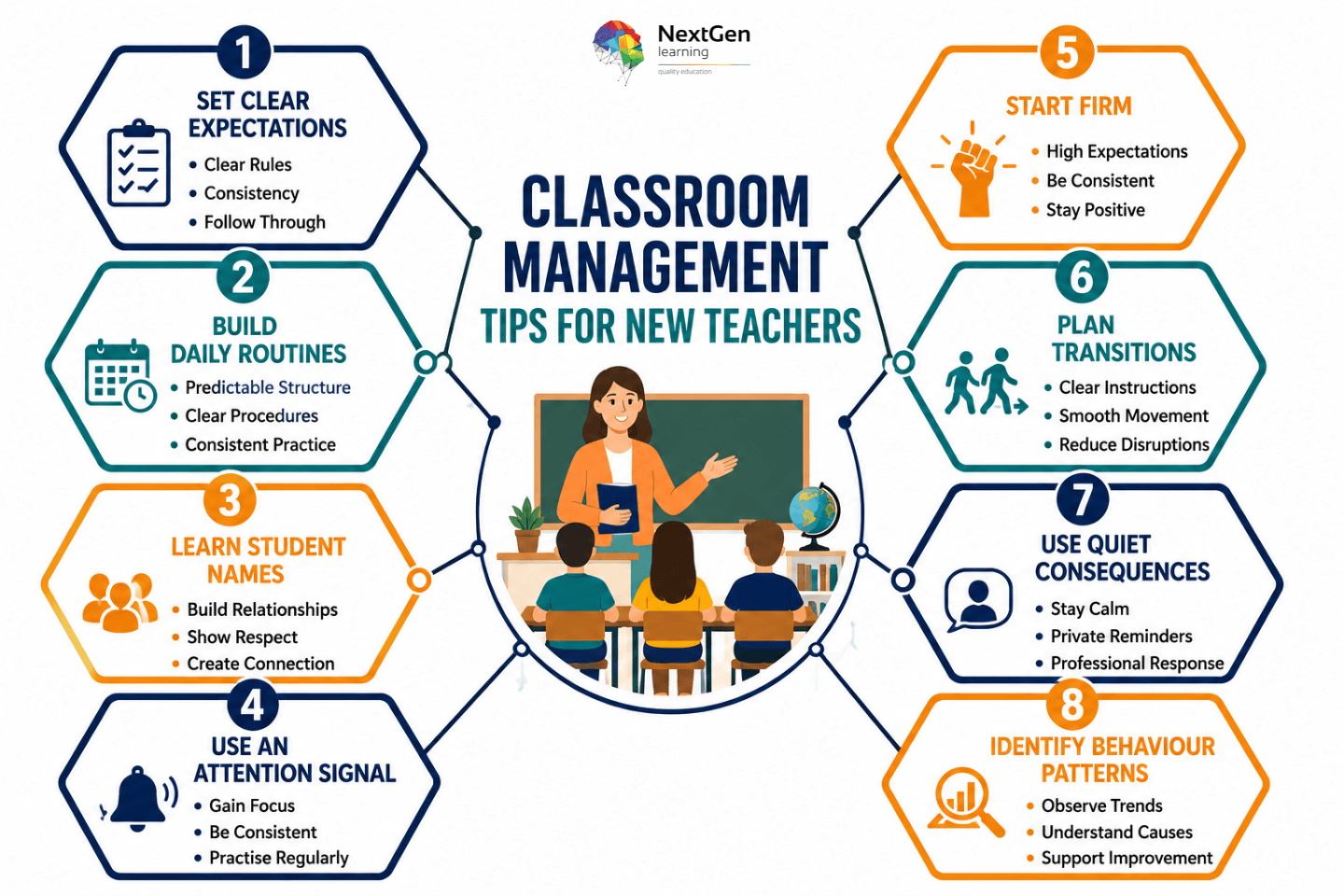
Classroom Management Tips for New Teachers
Classroom management is, without question, the area that new teachers find most challenging. It is also the area that teacher training programs prepare you for least. You can know your subject inside out, plan the most creative lesson imaginable, and still find yourself standing in front of a room that simply won’t settle. The good news is that effective classroom management is a skill — and like every skill, it improves with deliberate practice. The tips below come from hard experience, not theory.
Tip 1: Set Your Expectations on Day One — and Mean Them
Your first lesson with a new class is one of the most important you will ever teach. Not because of the content you deliver, but because of the tone you establish. Students — regardless of their age — are extraordinarily good at reading adults. They will test you, not necessarily out of defiance, but because they genuinely need to know where the boundaries are. Boundaries make children feel safe. That is the truth behind classroom management that nobody puts on a motivational poster.
On day one, make your expectations crystal clear. Explain exactly what you expect in terms of behaviour, effort, equipment, and respect — and explain the why behind each expectation. Students respond far better to rules they understand than to rules that feel arbitrary. Moreover, be consistent from the very first moment. If you say you will address a behaviour, address it. If you say there will be a consequence, follow through. The relationship between your words and your actions is the foundation of your authority. Lose that consistency early and it takes a long time to rebuild.
A practical tip: keep your expectations simple. Three to five clear expectations, displayed prominently, work far better than a long list of rules that nobody can remember.
Tip 2: Build Consistent Daily Routines That Students Can Predict
Routines are not about control. They are about creating the conditions in which learning can actually happen. When students know exactly what to do when they walk into your room, when they know how to collect resources, how to begin their work, and how the lesson will flow, their cognitive load drops. As a result, they focus more energy on learning and less on navigating uncertainty.
In my experience, the most powerful routines are the small ones. A silent starter activity on the board when students arrive. A consistent way of handing out and collecting books. A clear signal for when independent work begins. These tiny, repeatable structures compound over time into a classroom culture that runs itself — or very nearly does.
Importantly, routines take time to embed. Do not assume that because you explained a routine in week one, students will follow it perfectly in week three. Practise routines explicitly. Revisit them after holidays. Praise students when they follow them well. The investment pays enormous dividends by the second half of term.
Tip 3: Learn Your Students’ Names as Fast as Humanly Possible
This one sounds simple. However, it carries more weight than most new teachers realise. Knowing a student’s name — and using it correctly — is one of the most powerful relationship-building tools available to you. It signals that you see them as an individual, not just one of thirty faces. Conversely, repeatedly getting a name wrong, or defaulting to “you at the back,” immediately creates distance.
Use every strategy available to you. Study your register before the first lesson. Use a seating plan with photos if your school provides them. Play name games in those first sessions if your age group allows it. Write small name cards for desks in the first week. Ask students to correct your pronunciation if you are unsure — and mean it when you say you want to get it right.
Furthermore, pay attention to what students prefer to be called. Some students go by a shortened version of their name, a middle name, or a nickname. Honouring that preference costs you nothing and builds goodwill instantly.
Tip 4: Master Your Attention Signal — and Practise It Relentlessly
Every effective classroom has an attention signal — a clear, consistent cue that tells students to stop what they are doing, look at the teacher, and listen. Without one, every transition in your lesson becomes a negotiation. With one, you reclaim ten to fifteen minutes of learning time every single day.
Your signal can take many forms. A countdown from five. A clap pattern the class mirrors back. A raised hand. A specific phrase. A bell. The type of signal matters far less than the consistency with which you use it. Choose one signal and use it every time, without exception.
The critical mistake many new teachers make is introducing a signal but not practising it. Practise your signal deliberately in the first week — explain what it means, model what the response looks like, and actually run the class through it several times. Then use it consistently every time you need attention. Within a fortnight, it will be automatic. Within a month, the class will respond before you have even finished.
Tip 5: Start Firm — You Can Always Ease Up Later
This is perhaps the most important piece of classroom management advice I received as a new teacher, and it is the one I most wish I had followed immediately. In your first weeks, set your expectations at the higher end. Be structured. Be consistent. Be warm, but be clear.
Many new teachers make the mistake of starting loosely — allowing noise levels to creep up, letting minor disruptions slide, avoiding confrontation because they want students to like them. The problem is that once a class establishes a certain behavioural norm, shifting it upwards is enormously difficult. Students resist it. They feel the change as unfair. However, the reverse is completely straightforward. If you start firm and consistent, you can choose to relax certain expectations as trust builds. That flexibility feels like a reward to students. It strengthens the relationship.
Being firm does not mean being cold or unkind. You can hold high expectations with a smile. In fact, the most effective classroom managers I have observed are both the warmest and the most consistent people in the building. Warmth and firmness are not opposites — they work together.
Tip 6: Plan Your Transitions — They’re Where Behaviour Breaks Down
Ask any experienced teacher where behaviour is most likely to deteriorate, and the answer is almost always the same: transitions. The moment between one activity ending and the next beginning. The point at which students move from their seats to a group activity. The minute when one task finishes before the next instruction is clear.
Transitions are behaviour flashpoints because they create a brief vacuum — a moment of ambiguity in which students are unsure what to do. Therefore, plan every transition in your lesson as deliberately as you plan the activities themselves. Ask yourself: how will students move from this task to the next? What will they do if they finish early? What is the first thing I will say when I call the class back together?
Practically speaking, always give students a clear and specific instruction before a transition begins, not during it. “In thirty seconds, I’m going to ask you to put your pens down and turn to face the board” lands far better than “Right, everyone — pens down — no, I said pens down — can everyone just—” The former maintains your authority. The latter erodes it.
Tip 7: Have a Quiet Consequence System That Doesn’t Humiliate
Behaviour management is not about winning. It is about creating an environment where every student can learn. That distinction matters enormously when it comes to how you respond to low-level disruption. Public confrontation, raised voices, and sarcastic remarks might silence a student in the short term. However, they damage trust, invite defiance, and often escalate situations that could have been resolved quietly with a word and a look.
Build a consequence system that is calm, consistent, and private wherever possible. A quiet word beside a student’s desk is almost always more effective than a public reprimand. A brief, matter-of-fact reminder of the expectation — “I need you to focus on the task, please” — delivered without drama, achieves more than a lengthy classroom confrontation.
Equally important is knowing when something is beyond your immediate capacity to manage. Every school has a referral system for more serious behaviour. Use it without guilt. Escalating appropriately is not a failure — it is professional judgement.
Tip 8: Know the Difference Between a Bad Day and a Behaviour Pattern
Students have bad days. So do teachers. A student who is usually calm but is suddenly distracted and irritable might be dealing with something at home, something at break time, or simply a rough morning. A single incident rarely tells you the full story. Consequently, your response to behaviour should always account for context.
However, patterns are different. If the same student is consistently disruptive across multiple lessons, over multiple weeks, that is a signal that something more structured needs to happen. Keep brief notes. Talk to your form tutor, SENCO, or pastoral lead. Look at whether the behaviour occurs at particular times, in particular subjects, or with particular triggers. This kind of professional observation is the difference between reacting to behaviour and actually understanding it.
Moreover, always separate the behaviour from the student. A child can have a poor moment and still be a wonderful person. Holding on to frustration from one lesson and bringing it into the next is one of the fastest ways to damage a relationship that took weeks to build. Each lesson is a fresh start — for them, and for you.
TIPS 9–15: LESSON PLANNING TIPS FOR NEW TEACHERS
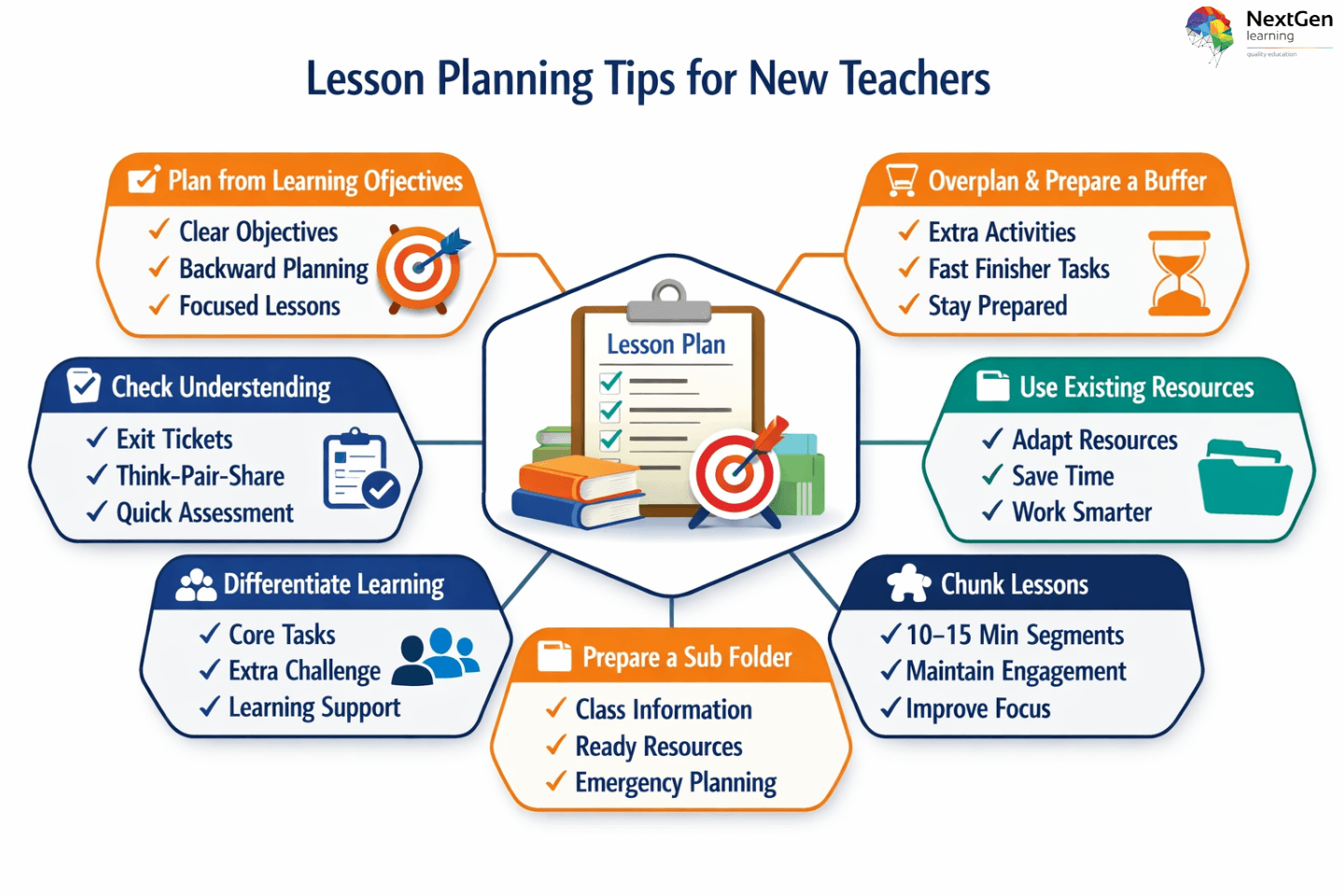
Lesson Planning Tips for New Teachers
Lesson planning is where many new teachers quietly lose hours of their lives. Sunday evenings disappear. Evenings after school stretch well past any reasonable hour. And yet, despite all that time spent, the lesson sometimes still doesn’t land the way you hoped. The problem is rarely effort. The problem is almost always approach. The tips in this section will help you plan smarter, not longer — and build lessons that actually work for the students sitting in front of you.
Tip 9: Plan Backwards from Your Learning Objective
This is the single most transformative shift you can make in how you approach lesson planning. Most new teachers plan forwards — they think about what activity they want to do, then work out what students might learn from it. Experienced teachers do the opposite. They start with a crystal clear learning objective and then design every activity, every question, and every resource to serve that objective.
Ask yourself one question before you plan anything else: what do I want students to know, understand, or be able to do by the end of this lesson that they couldn’t do at the start? Write that down in plain language. Then build your lesson around it. This approach — often called backward design — eliminates filler activities, keeps your planning focused, and makes it far easier to assess whether the lesson actually worked.
Furthermore, a clear learning objective gives you something to return to mid-lesson when things go sideways. When a discussion runs long or an activity takes twice as expected, you can make an informed decision about what to cut — because you know exactly what the non-negotiable outcome of the lesson is.
Tip 10: Overplan — and Give Yourself a “Fast Finisher” Buffer
In your first year, always plan more than you think you need. New teachers consistently underestimate how quickly some students will move through tasks and overestimate how long whole-class explanation will take. The result is a lesson that finishes ten minutes early — and those ten unplanned minutes are where behaviour problems are born.
Prepare a buffer activity for every lesson. It does not need to be elaborate. A related discussion question, a short retrieval task, a challenge problem, a reflection prompt — anything that connects meaningfully to the lesson content and can be deployed immediately when needed. Keep these buffer activities simple enough that they require no additional explanation or resources.
Importantly, overplanning does not mean rushing. Think of your buffer material as a safety net, not a race to the finish. You will not always use it. However, knowing it is there gives you confidence during the lesson — and confidence is something students notice and respond to. A teacher who seems in control of the room is, in large part, a teacher who has prepared for more than the minimum.
Tip 11: Use Existing Resources Before Building from Scratch
One of the most common and most avoidable mistakes new teachers make is trying to create everything themselves. It is completely understandable — you want your lessons to feel personal, you want students to see your effort, and you feel vaguely guilty about using someone else’s work. Let go of that guilt immediately.
Experienced teachers borrow, adapt, and share resources constantly. That is not laziness — it is professional efficiency. Your school almost certainly has a shared resource bank. Your department will have schemes of work, past worksheets, and presentation slides that have been tested in real classrooms with real students. Start there. Ask colleagues what they use. Look at what your school’s subscribed platforms offer before you spend three hours building something from scratch.
When you do use existing resources, adapt them to suit your class. Change an example to reflect your students’ interests. Adjust the difficulty level. Add a question that connects to something the class discussed last week. This takes twenty minutes rather than two hours and produces a resource that feels genuinely yours. Moreover, as your experience grows, you will naturally create more of your own materials — but in your first year, protecting your time and energy is a professional priority, not a compromise.
Tip 12: Chunk Your Lessons into 10–15 Minute Segments
Student attention is not a fixed resource that either exists or doesn’t. It is dynamic, it fluctuates, and it responds directly to how you structure your lessons. Research on cognitive load consistently shows that sustained attention drops significantly after fifteen to twenty minutes of a single activity. Consequently, a lesson structured as one long task is working against your students’ neurology, not with it.
Instead, design your lessons in segments. A typical well-structured lesson might move through a short retrieval starter, a period of direct instruction, a collaborative or independent practice task, a check for understanding, and a brief plenary reflection. None of these segments needs to be longer than ten to fifteen minutes. The variety of mode — listening, doing, discussing, reflecting — keeps engagement high and gives you natural moments to check in with the room.
This approach also makes differentiation significantly easier. When you build natural pauses into your lesson structure, you create opportunities to redirect struggling students, extend those who have finished, and gather information about where the class is before you move on. In short, chunked lessons give you more control, not less.
Tip 13: Build In Moments for Formative Assessment Every Lesson
Formative assessment is one of the most evidence-backed strategies in education. However, in many new teachers’ lessons, it is also one of the most neglected. The reason is understandable — when you are managing behaviour, keeping to time, and remembering all the content you need to cover, stopping to check understanding can feel like a luxury. It is not. It is a necessity.
If you are teaching without regularly checking what students actually understand, you are navigating blind. You might spend three lessons building on a concept that half the class has not yet grasped. You might reteach something students mastered two weeks ago. Formative assessment prevents both of these problems.
The good news is that effective formative assessment does not require elaborate tools or extra planning time. Consider these simple strategies that take two to three minutes each:
- Exit tickets: A single question students answer on a sticky note or scrap of paper as they leave. You read them in five minutes and know exactly where to start tomorrow.
- Think-pair-share: Students think independently, discuss with a partner, then share with the class. This reveals misconceptions quickly and gives quieter students a voice.
- Mini whiteboards or response cards: Students write or hold up answers simultaneously. You see every student’s response at once, not just the confident ones who raise their hand.
- Cold calling with wait time: Ask a question, give the class thirty seconds of thinking time, then choose who answers. This keeps every student engaged, not just those who volunteer.
Build at least one of these into every lesson. Over time, you will develop an instinct for reading the room — but in your first year, structured formative assessment keeps that instinct anchored to evidence.
Tip 14: Differentiate from the Start, Not as an Afterthought
Differentiation is one of those words that sounds complicated and is frequently overcomplicated in teacher training. Strip it back to its essential meaning and it is simply this: not every student in your class will access the same material in the same way at the same pace, and your planning should account for that reality.
This does not mean creating five different versions of every worksheet. That is neither sustainable nor, in most cases, necessary. Effective differentiation is often structural rather than material. It lives in the questions you ask, the support you offer, and the expectations you communicate.
Practically, consider building three levels of challenge into your tasks — a core activity that all students access, an extension that deepens or broadens the learning, and a scaffold or starting frame for students who need additional support. Think also about who you circulate to first when students work independently. In my experience, the students who most need your attention in those early minutes are not the ones waving their hand — they are the ones who have gone very quiet, staring at a blank page.
Furthermore, familiarise yourself early with the additional needs in your class. Read your students’ Education, Health and Care Plans or SEN support records before you plan, not after. Talk to your SENCO. Talk to your teaching assistant if you have one. The adjustments that make the biggest difference are usually small — additional processing time, a glossary of key terms, a visual prompt on the desk — but they require you to know who needs them.
Tip 15: Prepare a Sub Folder Before You Ever Need It
This tip will save you an enormous amount of stress at some point during your first year, and the moment you will be most grateful for it is the exact moment you are least able to think clearly — when you wake up ill at 6am and realise you need to call in absent.
A sub folder — sometimes called a cover folder — is a pre-prepared set of materials that any adult can walk into your classroom and deliver without knowing you, your class, or your subject in detail. It should include a clear class list with any key information about students with additional needs, a straightforward task or set of tasks that require minimal introduction, your seating plan, and a brief note on your classroom routines and expectations.
Update it at the start of each half term. Keep it somewhere obvious and accessible — not buried in your desk drawer. Tell your head of department or line manager where it is.
Beyond the practical value, building this folder forces you to do something genuinely useful: it makes you articulate your classroom in writing. Explaining your routines and expectations to a hypothetical stranger is an excellent way of identifying which ones are truly clear and which ones are, in reality, only held together by your physical presence in the room.
TIPS 16–21: RELATIONSHIP TIPS FOR NEW TEACHERS

Relationship Tips for New Teachers
If classroom management is the structure of effective teaching, relationships are the foundation it sits on. After more than a decade in the classroom, I can say with complete certainty that the quality of your relationships — with students, parents, colleagues, and support staff — determines more about your success and your happiness in this profession than almost anything else. You can have the most beautifully planned lesson in the world. However, if the students in front of you do not feel seen, respected, and safe, that lesson will struggle to land. Relationships are not a soft extra. They are the work.
Tip 16: Get to Know Your Students as People, Not Just Learners
Every student who walks into your classroom carries a world with them that you cannot see. Their home life, their friendships, their anxieties, their passions, their sense of humour, their history with school — all of it comes through the door with them every single morning. The teachers who connect most powerfully with their students are the ones who take a genuine interest in that invisible world.
This does not require grand gestures or elaborate activities. It requires consistent, small moments of genuine curiosity. Ask a student about the football match at the weekend. Remember that one of your quieter students is a brilliant artist and mention it when you see their sketchbook. Notice when a usually cheerful student seems flat and check in — quietly, without making it a performance.
In practical terms, simple tools can help you gather this information early. A short “getting to know you” questionnaire in the first week works well at almost every age. Ask students about their interests, how they learn best, what they find difficult, and what they are proud of. The answers will tell you more about how to teach that class than any data point you will receive from assessment results. Moreover, students notice when you remember what they told you. That act of remembering is, to many of them, the difference between a teacher who sees them and one who doesn’t.
Tip 17: Build Bridges with Parents Early — Not Just When There’s a Problem
The relationship between a teacher and a student’s family is one of the most underestimated factors in a child’s school experience. When that relationship is positive, it creates a powerful alliance. Parents who trust you will support your decisions, reinforce your messages at home, and give you the benefit of the doubt when things are difficult. When that relationship is absent or strained, even a minor issue can escalate into something far more complicated.
The mistake most new teachers make — and it is entirely understandable — is only contacting parents when there is a problem. As a result, the first interaction many parents have with you is a concern, a complaint, or a worry about their child. That sets a difficult tone for everything that follows.
Instead, make an effort to reach out positively and early. A brief message home to say that a student has made a great start, shown real effort, or contributed something valuable to a lesson costs you three minutes and builds enormous goodwill. Parents remember those moments. Furthermore, when you do need to have a harder conversation later in the year, you are having it with someone who already knows you care about their child — and that changes everything about how the conversation goes.
When difficult conversations with parents are necessary, keep three principles in mind. Stay calm and factual. Focus on the child’s needs rather than a list of complaints. And always end with a clear, shared next step. A conversation that ends with both sides knowing what happens next is a productive one, regardless of how it began.
Tip 18: Make Allies of the Support Staff — They Run the School
This is one of those tips that veteran teachers will nod at immediately and new teachers often discover too late. The people who make a school function on a daily basis are frequently not the ones with the most impressive job titles. They are the office administrators who know every process, every form, and every parent by name. They are the caretakers who can fix the projector you accidentally broke at 8:45am. They are the teaching assistants who know your most complex students better than anyone. They are the lunchtime supervisors who see what happens between your lessons.
Invest in these relationships from day one. Learn people’s names. Say good morning. Say thank you — specifically and genuinely, not as a reflex. Ask the office staff how things work before you assume. Ask the caretaker what you are and are not allowed to stick to the walls before you discover the answer the hard way.
Teaching assistants deserve particular attention here. If you have a TA working in your classroom, they are not an extra pair of hands to deploy wherever it is convenient. They are a professional with knowledge, skills, and insight that can transform outcomes for your students. Talk to them before lessons, not during. Share your planning. Ask for their observations. Listen when they tell you something about a student. A strong teacher-TA partnership is one of the most powerful tools available to you, and it is built on exactly the same thing as every other effective professional relationship — mutual respect.
Tip 19: Find Your Mentor and Actually Use Them
Every new teacher in their induction period is assigned a mentor. However, having a mentor and actually using a mentor are two very different things. Many new teachers, anxious not to appear incompetent or burdensome, hold back from asking for help. They sit with problems they could resolve in a ten-minute conversation. They rework the same lesson plan five times when a colleague could have pointed them to an existing resource in two minutes. That impulse toward self-sufficiency is understandable, but in your first year it costs you more than it saves.
Your mentor has almost certainly experienced every difficulty you are currently facing. They have had the lesson that completely fell apart. They have had the parent conversation that did not go as planned. They have felt overwhelmed by marking, exhausted by the pace, and uncertain about whether they were getting it right. Use their experience. Ask your questions. Bring your actual problems to your meetings rather than presenting a polished version of how things are going.
Beyond your assigned mentor, identify two or three other colleagues whose teaching you admire and whose judgement you trust. These do not need to be formal relationships. Sometimes the most valuable professional conversations happen in the staffroom over lunch, or in a quick five minutes after school. Build those connections deliberately. Observe those teachers when you can. The best professional development available to you in your first year is not a course or a conference — it is the person teaching next door.
Tip 20: Be the Moral Compass in Your Classroom
Students are watching you far more carefully than you realise. Not just for what you teach, but for how you behave. How you speak to the student who frustrates you. How you respond when you make a mistake. Whether you treat the quietest student with the same warmth as the most engaging one. Whether what you say and what you do are the same thing.
The values you model in your classroom become, over time, part of the culture of that classroom. If you model intellectual curiosity, students learn that it is acceptable — even desirable — to be curious. If you model calm in moments of difficulty, students learn that difficult moments do not require panic. If you model honesty — including saying “I don’t know, let me find out” when you genuinely don’t know — students learn that knowledge has limits and that admitting those limits is a sign of integrity, not weakness.
This responsibility can feel heavy, particularly in your first year when you are still developing your own professional identity. However, it is also one of the most rewarding aspects of the job. You do not need to be perfect. You need to be consistent, honest, and genuinely invested in the people in front of you. That is enough. In fact, for most students, that is more than enough — because not every adult in their lives manages it.
Tip 21: Handle Difficult Conversations with Students Calmly and Privately
At some point in your first year, you will need to have a difficult conversation with a student. Perhaps about their behaviour, their effort, something they said to a peer, or something you are worried about. How you handle these conversations will define your relationships far more than the easy, comfortable interactions ever will.
The single most important principle is this: wherever possible, have difficult conversations privately. A student who feels publicly called out will almost always become defensive, regardless of whether the feedback is fair. Their dignity is at stake in front of their peers, and protecting it becomes more important than hearing what you are saying. Take them aside. Speak quietly. Give them a moment to respond.
Approach these conversations with curiosity rather than judgement. Before you deliver your concern, ask a question. “I’ve noticed you seem frustrated today — is everything okay?” opens a conversation. “Why are you behaving like this?” closes one. You will not always get an honest answer, and that is fine. The act of asking communicates something important: that you see the student as a whole person, not just a behaviour to be managed.
Furthermore, always follow up. If you have had a hard conversation with a student, check in with them the next day — briefly, warmly, without referencing the previous interaction unless they do. This follow-up is the moment that cements the relationship rather than fractures it. It tells the student that yesterday happened, it is dealt with, and today is a fresh start. That message, delivered consistently, builds the kind of trust that makes even the most challenging students want to do better in your room.
TIPS 22–26: TEACHER WELLBEING TIPS FOR NEW TEACHERS
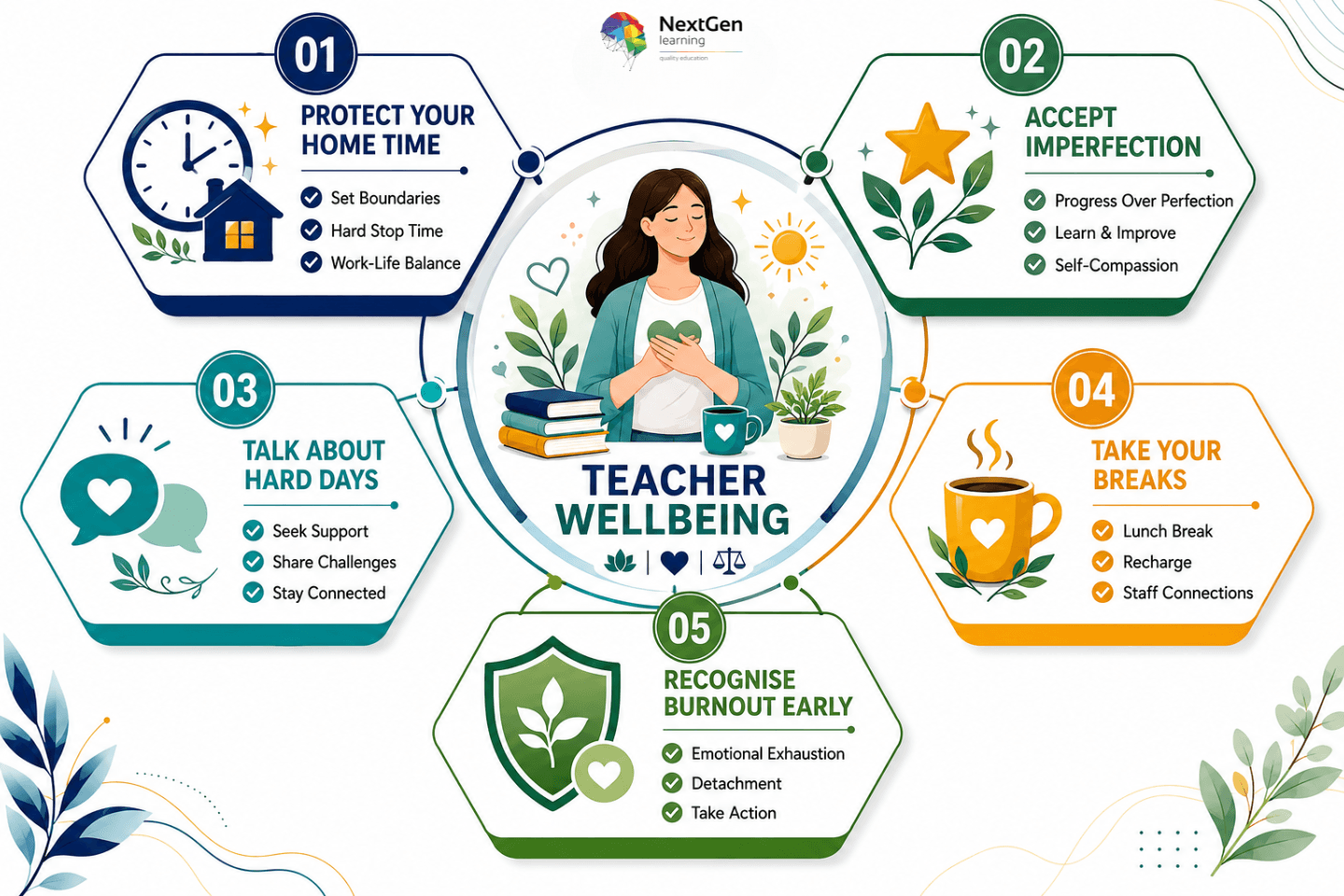
Teacher Wellbeing Tips for New Teachers
Nobody warns you about this part loudly enough. Teacher training programmes spend considerable time on pedagogy, curriculum, and classroom management. They spend far less time on what happens to you — the person doing the teaching — when the demands of the job begin to accumulate. And accumulate they do. The workload is real. The emotional weight is real. The exhaustion that hits you around week six of your first term is real. This section is not about making teaching sound frightening. It is about making sure you are still standing — and still enjoying this profession — not just at the end of your first year, but at the end of your career.
Tip 22: Protect Your Home Time — Set a Hard Stop
Teaching is one of those professions in which the work is never technically finished. There is always another lesson to plan, another set of books to mark, another email to respond to, another display to update. If you allow the job to expand into every available hour, it will — because the to-do list genuinely never reaches zero. Accepting that truth early is one of the most important things you can do for your long-term sustainability in this career.
Consequently, set a hard stop time and protect it as a professional boundary, not a personal indulgence. Decide what time you will leave school. Decide what time, if you do any work at home, you will stop. Write it down if that helps. Tell a trusted colleague so that someone else holds you accountable. Then stick to it — not perfectly, not every single day, but as a consistent default that you return to even when pressures push you away from it.
The quality of your teaching the following morning is directly connected to whether you slept, ate properly, and spent some time doing something that has nothing to do with school. Rest is not a reward for finishing your work. It is a prerequisite for doing your work well. The teachers who last in this profession — the ones who are still energised and effective ten, fifteen, twenty years in — are almost always the ones who learned early to treat their own time as something worth protecting.
In practical terms, consider batching your work rather than letting it bleed continuously across your evening. Mark for a defined period, then stop. Plan for a defined period, then stop. A focused ninety minutes is almost always more productive than four hours of distracted, guilty half-working. Moreover, it leaves you with an evening rather than a series of interrupted attempts at one.
Tip 23: Accept That You Will Not Be Perfect — and That’s Fine
Perfectionism is extraordinarily common among new teachers. You care deeply about your students. You want every lesson to be engaging, every piece of feedback to be meaningful, every interaction to be exactly right. That commitment is admirable — it is, in fact, one of the qualities that will make you a wonderful teacher over time. However, in your first year, perfectionism applied without mercy will exhaust you faster than almost anything else.
The lesson that does not go to plan is not evidence that you are failing. It is evidence that you are teaching — which is inherently unpredictable, complex, and responsive. Every experienced teacher you admire has delivered lessons that fell apart. They have given feedback that missed the mark. They have said the wrong thing in a difficult moment and had to go back and repair it. The difference between them and someone who burns out is not that they make fewer mistakes. It is that they treat mistakes as information rather than verdicts.
Therefore, give yourself the same compassion you would give a student who is learning something difficult and getting it wrong on the way to getting it right. Reflect on what happened. Work out what you would do differently. Then move forward. Holding onto every imperfect lesson like a personal failure is not reflection — it is self-punishment, and it serves nobody, least of all your students.
One specific mindset shift that helps enormously: measure your progress against your own starting point, not against the teacher down the corridor who has been doing this for fifteen years. You are not behind. You are at the beginning. Those are entirely different things.
Tip 24: Talk to Someone About the Hard Days
There will be hard days. Days when a lesson goes completely wrong, and you cannot work out why. Days when a student says something that stays with you long after the bell. Days when you sit in your car at the end of school and feel something between exhaustion and despair, wondering whether you are cut out for this.
Those days are normal. They are not a sign that you chose the wrong profession. They are a sign that you care, that you are engaged, and that you are doing something genuinely demanding. However, they become significantly more difficult when you carry them alone.
Find someone you can talk to honestly. Ideally, this is a colleague who understands the specific texture of a teaching day — the noise, the pace, the emotional labour, the particular frustration of a class that will not engage or a piece of work that took three hours and received a one-sentence response from a student. A fellow new teacher going through the same experiences can be invaluable here. So can a trusted mentor or a friend outside of education who simply listens without trying to fix everything.
What does not help, in my experience, is performing fine when you are not. Teaching culture can sometimes make vulnerability feel professionally risky — as though admitting difficulty means admitting inadequacy. That instinct is understandable but counterproductive. The teachers who grow fastest are almost always those who are most honest about what they find hard, because honesty is the first step toward getting better. Furthermore, modelling that honesty — in appropriate ways — also gives your students permission to be honest about their own struggles, which makes your classroom a safer place to learn.
Tip 25: Take Your Breaks. Every Single One.
This tip sounds so obvious that it barely seems worth including. And yet, in my first year of teaching, I regularly worked through lunch. I gave up my preparation periods to help students. I stayed in my classroom at break time to catch up on marking. I told myself I was being dedicated. In reality, I was depleting a resource — my own energy and mental clarity — that I needed to teach effectively in the afternoon.
Your breaks are not a gift from the timetable. They are a professional entitlement and a physiological necessity. Your brain needs downtime to consolidate, reset, and prepare for the next sustained period of high-demand work. When you consistently skip breaks, you accumulate a cognitive deficit that compounds across the week. By Friday afternoon, you are not just tired — you are running on empty in a way that affects your patience, your clarity of thinking, and your ability to respond well to the unexpected.
Therefore, take your lunch break. Leave your classroom. Eat actual food. Have a conversation that has nothing to do with students or planning. These fifteen or thirty minutes are not wasted time — they are an investment in the quality of everything that comes after them. Additionally, going to the staffroom regularly has an important secondary benefit: it builds the collegial relationships that sustain you through the harder parts of the year. The teachers who disappear into their classrooms at every break tend to feel more isolated. The ones who show up, even briefly, tend to feel more supported.
Tip 26: Recognise the Signs of Burnout Before They Take Hold
Teacher burnout is not a myth or an exaggeration. It is a documented, serious condition that ends careers prematurely and causes real harm to the people who experience it. The teaching profession has one of the highest burnout rates of any public sector role, and new teachers are particularly vulnerable — partly because the demands are highest when experience is lowest, and partly because the warning signs are easy to dismiss as simply being tired or having a hard week.
Burnout is different from exhaustion. Exhaustion recovers with rest. Burnout does not. It builds gradually, often over months, and is characterised by a specific combination of emotional depletion, increasing detachment from the work and the students, and a growing sense that nothing you do makes any difference. By the time many teachers recognise burnout in themselves, it has been developing quietly for a long time.
Consequently, pay attention to these early warning signs:
- You are finding it harder and harder to feel anything positive about going to work, even on good days
- You have stopped finding any moments of the job enjoyable or rewarding
- You feel persistently irritable with students or colleagues in ways that are out of character
- You are sleeping poorly despite being physically exhausted
- You feel a growing sense of detachment — as though you are going through the motions rather than genuinely teaching
- You have stopped talking about work with anyone because it feels pointless
If several of these resonate, take them seriously. Talk to your mentor, your GP, or a trusted colleague. Contact your union if you need support navigating workload concerns. Many schools also have access to employee assistance programmes with confidential counselling.
Moreover, prevention is always preferable to recovery. The tips in this section — protecting your time, accepting imperfection, talking honestly, taking breaks — are not just about feeling better day to day. They are the habits that keep burnout at a distance over the long term. Build them early, before you need them desperately, and they will serve you throughout your career.
TIPS 27–30: PROFESSIONAL GROWTH TIPS FOR NEW TEACHERS

Professional Growth Tips for New Teachers
The teachers who grow fastest in their first years are not necessarily the most naturally talented. They are the most intentional. They reflect on their practice regularly. They seek out feedback rather than avoiding it. They observe others with genuine curiosity rather than comparison. And crucially, they understand that becoming a great teacher is not a destination you arrive at — it is a direction you keep moving in. The four tips in this final section are about building the habits and mindsets that will compound over your entire career, not just your first year.
Tip 27: Reflect on Your Lessons — Briefly, But Consistently
Reflection is the engine of professional growth in teaching. Without it, experience simply accumulates. With it, experience becomes wisdom. The difference between a teacher who has taught for ten years and one who has merely repeated their first year ten times is almost always the quality and consistency of their reflection practice.
However, reflection does not need to be elaborate. In fact, for new teachers already managing an enormous cognitive and emotional load, overly complex reflection frameworks can become another source of anxiety rather than a genuine tool for growth. What works far better is a brief, consistent habit — something that takes five minutes rather than fifty.
At the end of each lesson, or at the end of each day, ask yourself three simple questions. What worked well and why? What did not work as well as I had hoped, and what might I do differently? What do I need to remember for next time? Write the answers down — even briefly, even in note form in the margin of your planning document. The act of writing forces clarity in a way that simply thinking does not.
Over time, patterns emerge. You begin to notice that certain types of task consistently engage a particular class. You notice that your explanations land better when you use a specific approach. You notice which transitions reliably produce disruption and start planning around them. None of this insight is available to you without reflection, because in the moment of teaching, everything moves too fast to fully process. Reflection is how you slow it down and learn from it.
Furthermore, make space to reflect on what goes right, not just what goes wrong. New teachers have a strong tendency to fixate on their mistakes and skim past their successes. However, understanding why a lesson worked brilliantly is just as valuable as understanding why one fell apart. If you only ever analyse failure, you develop a skewed picture of your own practice — and you deprive yourself of the confidence that comes from recognising genuine progress.
Tip 28: Observe Other Teachers as Often as You Can
There is no professional development resource more valuable, more immediately applicable, or more consistently underused by new teachers than the colleagues already working in the building around them. Watching an experienced teacher handle a complex class, deliver a challenging concept, or navigate a difficult moment in real time teaches you things that no book, course, or training day can replicate.
Make observing other teachers a priority from the very start of your career. Talk to your mentor or line manager about arranging observation time. Most schools have formal structures for this during induction, but do not wait to be timetabled in — proactively ask to spend time in other classrooms. The best teachers are almost always the most generous about being observed, because they remember what it felt like to be new and they know how much it helped them.
When you observe, do so with a specific focus rather than trying to take in everything at once. Choose one aspect of practice to pay close attention to — how the teacher manages transitions, how they respond to incorrect answers, how they use questioning, how they establish pace. A focused observation yields far richer learning than a general one.
Equally important is what happens after the observation. If at all possible, debrief with the teacher you observed. Ask them about the choices they made. Ask why they responded to that student the way they did. Ask what they would have done differently if the lesson had gone in another direction. These conversations reveal the thinking behind the teaching — and it is that thinking, more than the techniques themselves, that you are ultimately trying to develop.
Additionally, do not limit your observations to teachers in your own subject or year group. Watching a colleague teach a completely different subject or age range often reveals approaches that are entirely transferable to your own context. Some of the most useful things I ever learned about classroom questioning came from watching a colleague teach art. Some of my most effective behaviour management techniques came from observing a colleague in a reception class. Great teaching has principles that transcend subject and age, and cross-disciplinary observation helps you see them.
Tip 29: Invest in Your Own Professional Development
Your school will offer professional development. Attend it willingly, engage with it seriously, and extract whatever value you can from it — even when the session covers something you feel you already know. However, do not limit your professional learning to what your school provides. The most effective teachers are almost always people who take genuine ownership of their own development, driven by curiosity rather than obligation.
There has never been a better time to access high-quality professional learning independently. Education research is more accessible than it has ever been. Evidence-informed approaches to teaching and learning — rooted in cognitive science, retrieval practice, spaced learning, and metacognition — are widely available through blogs, podcasts, books, and online communities. You do not need to spend money you do not have. Much of the best professional learning available to teachers today is free.
Some practical starting points worth exploring as a new teacher include reading widely around the subjects that matter most in your current context. If classroom behaviour is your biggest challenge, read deeply about behaviour management — not just tips, but the underlying psychology of why students behave as they do. If your students are struggling with retention, read about how memory works and what the research says about spacing and retrieval. Understanding the why behind effective practice makes you a far more adaptable and confident teacher than simply following a list of strategies.
Beyond reading, consider connecting with the wider teaching community. Professional networks, both locally and online, connect you with educators facing exactly the same challenges you are facing. These communities — whether through subject associations, local teaching school alliances, or online platforms — offer peer support, shared resources, and the kind of honest professional conversation that reminds you that your experiences, however isolating they may feel at times, are widely shared.
However, a word of caution alongside all of this: in your first year, be selective. There is more professional development content available than any teacher could meaningfully absorb, and attempting to implement ten new strategies simultaneously helps nobody. Choose one or two areas of genuine priority, go deep rather than broad, and give yourself enough time to actually embed what you are learning before moving on to the next thing. Sustainable professional growth is incremental, not revolutionary.
Tip 30: Give Yourself Time — Great Teaching Is Built, Not Born
This is the tip I most wish someone had sat me down and said clearly, firmly, and kindly in my very first week. Not as a reassurance to soften the difficulty of the job. But as a genuine, evidence-based truth about how teaching expertise actually develops.
Great teachers are not born. They are built — slowly, iteratively, through thousands of lessons, hundreds of difficult moments, countless small adjustments, and a sustained commitment to getting better. The research on teacher development consistently shows that meaningful expertise takes years to develop. Not months. Years. And that is not a discouraging fact — it is a liberating one, if you let it be.
It means that the struggles of your first year are not evidence of inadequacy. They are the necessary raw material of eventual mastery. Every lesson that does not go to plan is a data point. Every difficult class is a crucible in which your skills are being tested and refined. Every uncomfortable conversation, every moment of self-doubt, every afternoon when you wonder whether you are good enough — these are not signs that you should not be here. They are signs that you are here, fully, doing something genuinely hard and genuinely important.
Give yourself the time that growth requires. Do not compare your chapter one to someone else’s chapter fifteen. Do not expect to be the teacher you want to be in year one, any more than you would expect a student to master a complex skill in their first lesson. Extend yourself the same patience, the same structured support, and the same belief in the possibility of progress that you extend to the students in front of you every day.
Moreover, pay attention to the moments — and there will be moments, even in the hardest weeks — when something works. When a student who has been struggling suddenly understands. When a class that has been difficult all term has a genuinely great lesson. When a parent tells you that their child came home talking about something you did. These moments are not accidents. They are the beginning of who you are becoming as a teacher. Notice them. Hold onto them. They are the evidence, accumulating quietly, that you are exactly where you are supposed to be.
Conclusion: Your First Year Is Just the Beginning
Teaching is not a job that you master and then maintain. It is a craft that deepens continuously — one that rewards curiosity, resilience, and the willingness to keep learning long after the formal training is finished. Your first year will be, in all likelihood, the hardest of your career. It will also be one of the most formative, most memorable, and most important.
The thirty tips in this guide cover the full landscape of what new teachers face — from the practical mechanics of classroom management and lesson planning to the less visible but equally important work of building relationships, protecting your wellbeing, and investing in your own growth. However, no list of tips, however comprehensive, can fully prepare you for the particular, irreplaceable experience of finding your own way in your own classroom with your own students.
What it can do is give you a head start. It can help you avoid some of the mistakes that cost new teachers time, confidence, and energy. It can remind you, on the days when everything feels difficult, that what you are experiencing is normal — and that on the other side of normal is something genuinely extraordinary.
The teachers who stay in this profession and thrive in it are not the ones who found it easy. They are the ones who found it meaningful enough to keep going. If you are reading this, there is a very good chance you are one of them.
So take a breath. Trust the process. And go teach.
Quick Reference: All 30 Tips for New Teachers

Classroom Management
- Set your expectations on day one — and mean them
- Build consistent daily routines that students can predict
- Learn your students’ names as fast as humanly possible
- Master your attention signal — and practise it relentlessly
- Start firm — you can always ease up later
- Plan your transitions — they’re where behaviour breaks down
- Have a quiet consequence system that doesn’t humiliate
- Know the difference between a bad day and a behaviour pattern
Lesson Planning
- Plan backwards from your learning objective
- Overplan — and give yourself a “fast finisher” buffer
- Use existing resources before building from scratch
- Chunk your lessons into 10–15 minute segments
- Build in moments for formative assessment every lesson
- Differentiate from the start, not as an afterthought
- Prepare a subfolder before you ever need it
Relationships
- Get to know your students as people, not just learners
- Build bridges with parents early — not just when there’s a problem
- Make allies of the support staff — they run the school
- Find your mentor and actually use them
- Be the moral compass in your classroom
- Handle difficult conversations with students calmly and privately
Wellbeing
- Protect your home time — set a hard stop
- Accept that you will not be perfect — and that’s fine
- Talk to someone about the hard days
- Take your breaks — every single one
- Recognise the signs of burnout before they take hold
Professional Growth
- Reflect on your lessons — briefly, but consistently
- Observe other teachers as often as you can
- Invest in your own professional development
- Give yourself time — great teaching is built, not born
Frequently Asked Questions
New teachers should focus on classroom management, lesson planning, relationship building, and wellbeing. Setting clear expectations, establishing routines, and building positive relationships with students can make the transition into teaching much smoother.
Effective classroom management starts with clear expectations, consistent routines, and a reliable attention signal. Moreover, addressing behaviour calmly and consistently helps create a positive learning environment where students feel safe and focused.
New teachers should plan thoroughly but focus on planning efficiently rather than spending excessive hours creating resources. Using existing materials, planning around clear learning objectives, and preparing extension activities can save significant time.
Strong relationships with students, parents, colleagues, and support staff contribute significantly to teaching success. When students feel respected and understood, they are more likely to engage positively and respond well in the classroom.
Protecting personal time, taking regular breaks, asking for support, and accepting that perfection is unrealistic can help prevent burnout. Additionally, recognising early warning signs and maintaining healthy work-life boundaries are essential for long-term success.
Consistent reflection, observing experienced colleagues, seeking feedback, and investing in professional development are some of the most effective ways to grow. Teaching expertise develops gradually through experience, learning, and continuous improvement.



0 responses on "30 Tips for New Teachers: Practical Advice from Someone Who's Been There"