





What Does an Internal Quality Assurer Actually Do?
An Internal Quality Assurer, often called an IQA, protects the fairness, consistency and reliability of assessment within a training organisation. Rather than assessing learners directly, an IQA monitors assessor practice, samples assessment decisions and checks that evidence meets the required standards.
However, the role involves much more than reviewing paperwork. IQAs also observe assessors, lead standardisation meetings, provide constructive feedback and track corrective actions. In addition, they maintain clear quality records and prepare evidence for external quality assurance.
Therefore, an effective IQA supports both compliance and continuous improvement. This guide explains what an Internal Quality Assurer actually does each day, how sampling works, which skills the role requires and which Level 4 IQA qualification may suit your responsibilities.
Table of Contents
What Is an Internal Quality Assurer?

An Internal Quality Assurer monitors how assessments are planned, delivered and recorded within a training organisation. Their main aim is to ensure that assessors apply the required standards fairly, consistently and accurately across all learners.
However, an IQA does not simply check whether paperwork is complete. Instead, they review the quality of assessment decisions, identify risks and support assessors to improve their practice. They may also check whether evidence is valid, authentic, current, sufficient and reliable.
In practice, an IQA helps the organisation to:
- Protect learners: Ensure that assessment decisions remain fair and consistent.
- Support assessors: Provide guidance, feedback and development opportunities.
- Maintain standards: Check that teams follow awarding-organisation requirements.
- Reduce risk: Identify weak evidence, inconsistent decisions or missing records.
- Improve quality: Recommend practical actions and monitor whether teams complete them.
Therefore, the IQA acts as the organisation’s internal quality checkpoint between assessors, managers and external quality assurers.
IQA, Assessor and EQA: What Is the Difference?
Assessors, IQAs and EQAs all support reliable assessment. However, each role focuses on a different level of quality control.
| Role | Main Focus | Typical Responsibility |
|---|---|---|
| Assessor | Learner evidence | Judges whether a learner has met the required standards |
| IQA | Assessment quality | Samples decisions and monitors assessor practice |
| EQA | Centre compliance | Reviews the organisation on behalf of an awarding body |
An assessor works directly with learners. In contrast, an IQA reviews whether assessors make fair, valid and consistent decisions. Meanwhile, an EQA checks whether the centre’s overall systems meet external requirements.
Therefore, the process usually works like this:
- Assessors assess learners: They collect evidence, make decisions and provide feedback.
- IQAs monitor assessors: They sample work, observe practice and support standardisation.
- EQAs review centres: They examine records, systems and quality controls externally.
As a result, an IQA acts as the internal link between daily assessment activity and external quality assurance.
What Does an IQA Do Day to Day?
An IQA’s daily work depends on the size of the organisation, the number of assessors and the qualifications being delivered. However, most IQAs divide their time between checking evidence, supporting assessors and maintaining quality records.
A typical day may include:
- Review sampling plans: Check which assessors, learners, units and assessment methods need attention.
- Sample learner portfolios: Review selected evidence and confirm whether assessment decisions meet the required standards.
- Observe assessors: Watch assessment practice and record strengths, risks and development needs.
- Provide feedback: Explain findings clearly and agree practical improvement actions.
- Lead standardisation: Help assessors interpret criteria consistently across the team.
- Track actions: Follow up previous concerns and resample evidence where necessary.
- Update quality records: Maintain reports, observation notes, sampling documents and action plans.
- Prepare for EQA: Organise evidence and respond to external quality-assurance requirements.
Therefore, IQA work combines analysis, communication and continuous improvement rather than paperwork alone.
The Eight Core Responsibilities of an IQA

An IQA follows a structured quality-assurance cycle. Therefore, each responsibility connects to the next and creates a clear audit trail.
1. Create an IQA Sampling Plan
The IQA decides which assessors, learners, units and assessment methods to review. Moreover, they consider risk, experience and previous concerns when planning coverage.
2. Sample Assessment Decisions
They review selected evidence to confirm that decisions are valid, fair and consistent. However, they do not usually check every learner portfolio.
3. Observe Assessor Practice
The IQA watches assessors carry out assessments, give feedback and communicate with learners. As a result, they can identify both good practice and development needs.
4. Lead Standardisation
They bring assessors together to compare evidence, discuss borderline decisions and agree how to interpret assessment criteria consistently.
5. Support Assessor Development
An IQA provides constructive feedback, recommends training and helps assessors maintain current occupational and assessment knowledge.
6. Track Corrective Actions
When problems arise, the IQA records the issue, agrees an action and sets a deadline. Afterwards, they resample evidence to confirm improvement.
7. Maintain Quality Records
They keep sampling reports, observation notes, action plans and standardisation records accurate and accessible.
8. Prepare for External Quality Assurance
Finally, the IQA organises evidence for EQA reviews and ensures that the centre responds to external actions within the required timescale.
How Does IQA Sampling Work?
IQA sampling checks a representative selection of assessment activity rather than every learner portfolio. The City & Guilds guidance on internal quality assurance explains that an effective sampling strategy should review assessor judgements at both interim and summative stages. Therefore, the IQA creates a plan that covers different assessors, learners, units, locations and assessment methods.
A strong sampling plan considers:
- Assessor experience: Review new or developing assessors more frequently.
- Risk level: Prioritise unusual decisions, previous concerns or complex qualifications.
- Assessment stage: Sample evidence during delivery as well as after final decisions.
- Assessment methods: Include observations, written work, discussions and portfolio evidence.
- Learner coverage: Check different achievement levels and support needs.
- Location and delivery mode: Include workplace, classroom, online and remote assessment where relevant.
Interim sampling allows the IQA to identify problems early. In contrast, summative sampling reviews completed assessment decisions. As a result, balanced sampling helps the organisation improve practice while maintaining reliable qualification standards.
What Happens When an IQA Finds a Problem?

Yes — the Level 3 Diploma Health and Social Care matches NVQ Level 3 in both level and recognition. Both qualifications sit at RQF Level 3, which places them at the same standard.
Although the qualification title differs, the outcome remains the same. Learners demonstrate competence, understanding, and professional readiness. Therefore, when you compare NVQ Level 3 with Level 3 Health and Social Care, you can confidently expect employers to treat them as equal in level.
How the Old and New Frameworks Compare
When an IQA identifies inconsistent decisions, weak evidence or missing records, they should act promptly. However, the aim is not simply to criticise the assessor. Instead, the IQA should protect learners, correct the risk and improve future practice.
The usual process includes:
- Record the issue: Describe the concern clearly and link it to the relevant assessment standard.
- Assess the risk: Decide whether the problem affects one learner, one assessor or the wider programme.
- Give feedback: Explain the issue constructively and provide practical guidance.
- Agree corrective action: Set clear tasks, responsibilities and deadlines.
- Resample evidence: Check whether the assessor has corrected the problem.
- Escalate serious concerns: Inform the Lead IQA or manager when the risk remains unresolved.
As a result, corrective action becomes part of continuous improvement rather than a one-off response.
What Skills Does an IQA Need?

An effective IQA needs strong technical knowledge and people skills. Therefore, the role suits professionals who can make fair decisions while supporting assessors constructively.
Key skills include:
- Analytical judgement: Review evidence and identify inconsistent assessment decisions.
- Clear communication: Explain findings, expectations and required actions.
- Constructive feedback: Help assessors improve without creating unnecessary conflict.
- Organisation: Manage sampling plans, deadlines, observations and quality records.
- Attention to detail: Identify missing evidence, weak documentation and compliance risks.
- Impartiality: Apply the same standards across assessors and learners.
- Report writing: Record findings clearly for managers and external quality assurers.
- Leadership: Guide standardisation, professional development and continuous improvement.
Moreover, IQAs must maintain current occupational knowledge and understand awarding-organisation requirements. As a result, continuing professional development remains essential throughout the role.
Which IQA Qualification Do You Need?
The right IQA qualification depends on whether you want theoretical knowledge, practical responsibility or a leadership role. Therefore, you should choose based on your duties rather than selecting the highest level automatically. Before enrolling, use the official qualifications database to check the qualification level, awarding organisation, qualification number and current approval status.
| Qualification Route | Best Suited To | Practical Evidence |
|---|---|---|
| Knowledge-only Award | Managers, assessors or learners who need IQA theory | Usually does not require full practitioner evidence |
| Practitioner IQA Award | Aspiring or practising Internal Quality Assurers | Requires genuine internal quality-assurance activity |
| Lead IQA Certificate | Professionals who manage IQA teams or quality systems | Requires practical leadership and quality-management evidence |
For most people who want to work as an IQA, the practitioner Award is the most suitable route. The GOV.UK Level 4 IQA qualification handbook confirms that the practitioner Award develops the knowledge and occupational competence needed to internally quality-assure assessment decisions. However, candidates usually need access to assessors, learner evidence and real sampling activity.
In contrast, the knowledge-only Award may suit someone who needs to understand IQA principles without carrying out the role. Meanwhile, the Lead IQA Certificate supports professionals who coordinate sampling, standardisation, compliance and team performance.
Where Do IQAs Work and How Can They Progress?
Internal Quality Assurers work wherever organisations deliver regulated or vocational qualifications. Therefore, opportunities exist across colleges, apprenticeship providers, private training centres, employers and specialist assessment organisations.
Common sectors include:
- Health and social care: Monitor assessment across care, support and clinical training programmes.
- Construction and engineering: Quality-assure practical workplace competence.
- Business and management: Review portfolios, professional discussions and workplace evidence.
- Education and training: Support tutors, assessors and curriculum teams.
- Hospitality and retail: Maintain consistent standards across multiple sites.
- Apprenticeships: Monitor assessment practice throughout programme delivery.
With experience, an IQA may progress into Senior IQA, Lead IQA, Quality Manager, Compliance Manager or External Quality Assurer roles. Moreover, some professionals work across several centres on a freelance or consultancy basis. However, progression usually depends on sector expertise, leadership skills and current knowledge of qualification requirements.
Common Misconceptions About the IQA Role
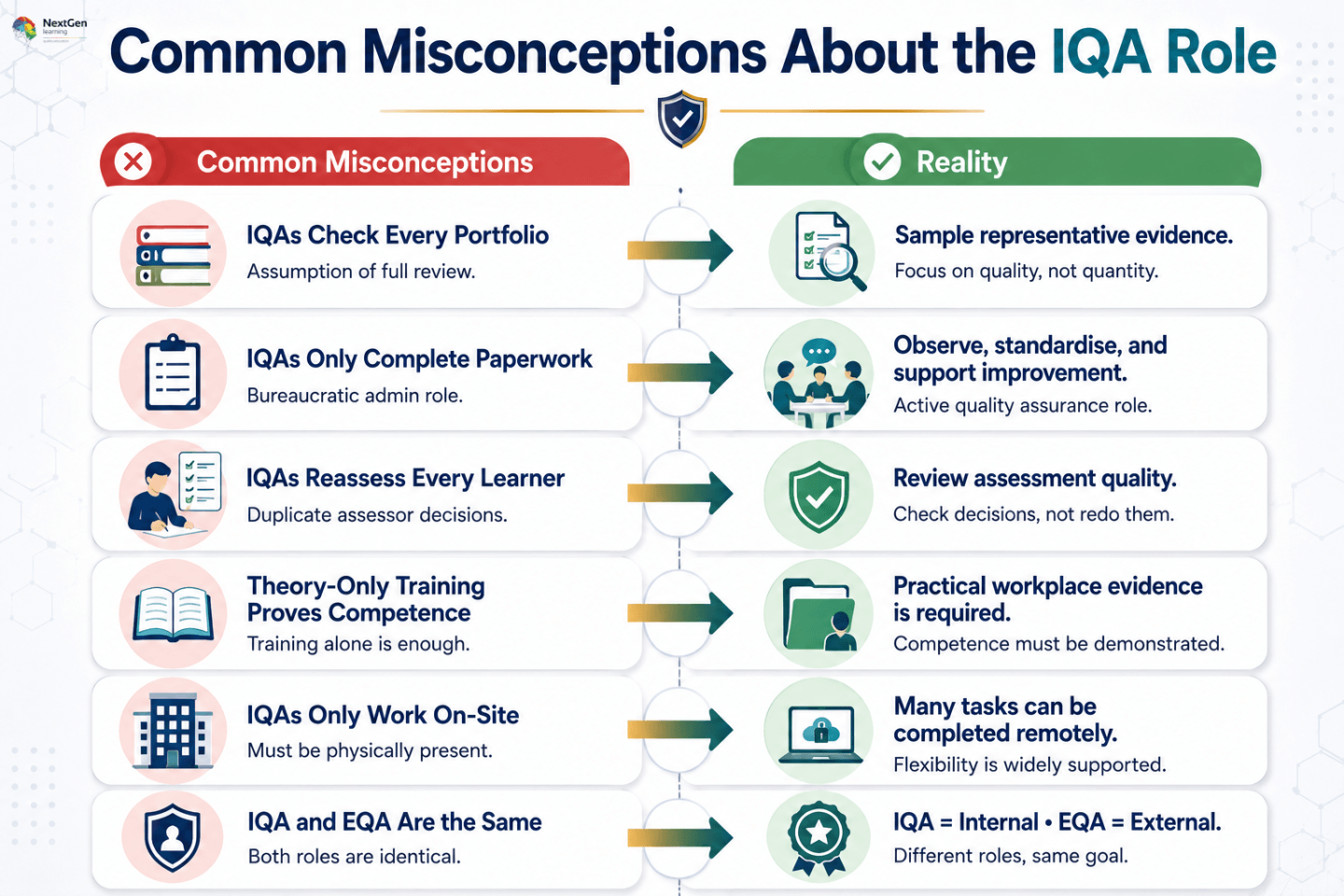
Several misconceptions can make the IQA role seem either simpler or broader than it really is. However, internal quality assurance follows a structured process with clear limits.
Common misconceptions include:
- IQAs check every portfolio: They usually sample representative evidence based on risk and coverage.
- IQAs only complete paperwork: They also observe assessors, lead standardisation and support improvement.
- IQAs reassess every learner: Their main role is to review assessment quality, not replace the assessor.
- Theory-only training proves competence: Practical IQA work normally requires real workplace evidence.
- IQAs only work on-site: Many tasks can happen remotely, although access to records, assessors and centre systems remains essential.
- IQA and EQA are the same: IQAs monitor quality internally, while EQAs review the centre externally.
Therefore, the role combines oversight, professional judgement and assessor development rather than simple administrative checking.
Frequently Asked Questions
Usually, no. Assessors make decisions about learner competence, while IQAs review the quality and consistency of those decisions. However, some professionals may hold both assessor and IQA responsibilities.
There is no single fixed frequency. Instead, sampling should reflect risk, assessor experience, qualification requirements and previous concerns. Therefore, new assessors or high-risk areas may need more frequent checks.
Yes, many IQA tasks can take place remotely, including portfolio sampling, record reviews and online standardisation. However, the IQA still needs secure access to assessors, learner evidence and centre systems.
Not always. However, assessment experience provides valuable knowledge of evidence, feedback and decision-making. Consequently, many employers prefer IQAs who understand practical assessment.
An IQA commonly keeps sampling plans, observation records, assessor feedback, standardisation minutes, action plans, risk records and evidence of completed corrective actions.
The practitioner Level 4 IQA Award broadly replaced V1. However, V1 holders may still need to demonstrate current knowledge, recent experience and continuing professional development.


0 responses on "What Does an Internal Quality Assurer Actually Do?"