




Children’s social care reviews the concern, assesses immediate risks and decides whether the child requires further assessment, family support or protective intervention.
What Happens After a Child Protection or Safeguarding Referral?
A delayed response to a safeguarding concern can leave a child exposed to further harm, even after the warning signs have been reported. Making a referral is an important first step, but what happens afterwards determines whether the child receives the right support and protection.
A child protection referral is a formal report of concerns about a child’s safety or welfare to local authority children’s social care. It allows professionals to assess risks, investigate suspected harm where necessary and decide what intervention is appropriate.
Understanding what safeguarding means helps teachers, childcare workers and safeguarding leads recognise why responsibility does not end when a concern is reported.
In this blog, you will learn what happens after a safeguarding referral, how decisions are made, how long assessments take and what professionals should do to keep children safe.
Key Takeaways
- Children’s social care should make an initial decision about a referral within one working day.
- Not every safeguarding referral leads to a formal child protection investigation.
- Section 17 assessments focus on children in need, while Section 47 enquiries concern suspected significant harm.
- Social workers, schools, police and healthcare professionals may work together to assess risks.
- Referral outcomes may include family support, child protection arrangements or no further statutory action.
- Designated Safeguarding Leads must continue monitoring concerns and follow up when necessary.
What Happens Immediately After a Safeguarding Referral?
Once a safeguarding referral reaches children’s social care, professionals review the information to determine whether the child needs immediate protection, further assessment or another form of support.
Under the Department for Education’s Working Together to Safeguard Children 2026, this response forms part of the local authority’s wider responsibility to safeguard children in England.
How Children’s Social Care Reviews the Referral
A social worker or relevant safeguarding professional considers the reported concerns, the child’s circumstances and any available history.
They may contact the person who made the referral, consult other agencies or request additional information to understand the situation.
Consider a pupil who repeatedly arrives at school hungry, appears exhausted and becomes distressed when discussing home life. If the school submits a referral, children’s social care may examine attendance records, previous concerns and information from relevant professionals.
One observation may not establish neglect, but several concerns together can indicate a pattern requiring further assessment.
Initial Risk Assessment and Decision-Making
The initial decision considers the seriousness of the concern and whether the child faces an immediate threat.
Where urgent danger is identified, protective action should not be delayed while routine assessments are completed. Emergency services should be contacted on 999 when a child is in immediate danger.
What Are the Stages of the Safeguarding Referral Process?
The safeguarding referral process is not identical for every child. However, a typical referral moves through several decisions that determine whether support or protection is needed.
| Stage | What Happens |
|---|---|
| Referral received | Children’s social care records and reviews the concern. |
| Initial screening | Professionals consider urgency, available evidence and the child’s needs. |
| Assessment | Further information is gathered where an assessment is required. |
| Decision | The local authority determines the appropriate support or protection response. |
| Follow-up | Relevant professionals implement decisions and monitor the child’s situation. |
Receiving and Assessing the Referral
The referral should contain factual information, including what was observed, when concerns arose and whether the child disclosed anything.
Clear records help social workers distinguish direct observations from assumptions and identify missing information.
Deciding on Support or Child Protection Action
Children’s social care may arrange family support, initiate a child in need assessment or begin child protection enquiries.
The decision depends on the child’s circumstances and the legal thresholds involved, rather than simply the number of concerns reported.
Recording Outcomes and Following Up
Once a decision is made, the referring professional should receive appropriate feedback, subject to information-sharing rules.
Where school staff remain worried about a child’s safety, they should not assume that the matter is resolved simply because the original referral has been processed.
What Happens During a Child Protection Assessment?
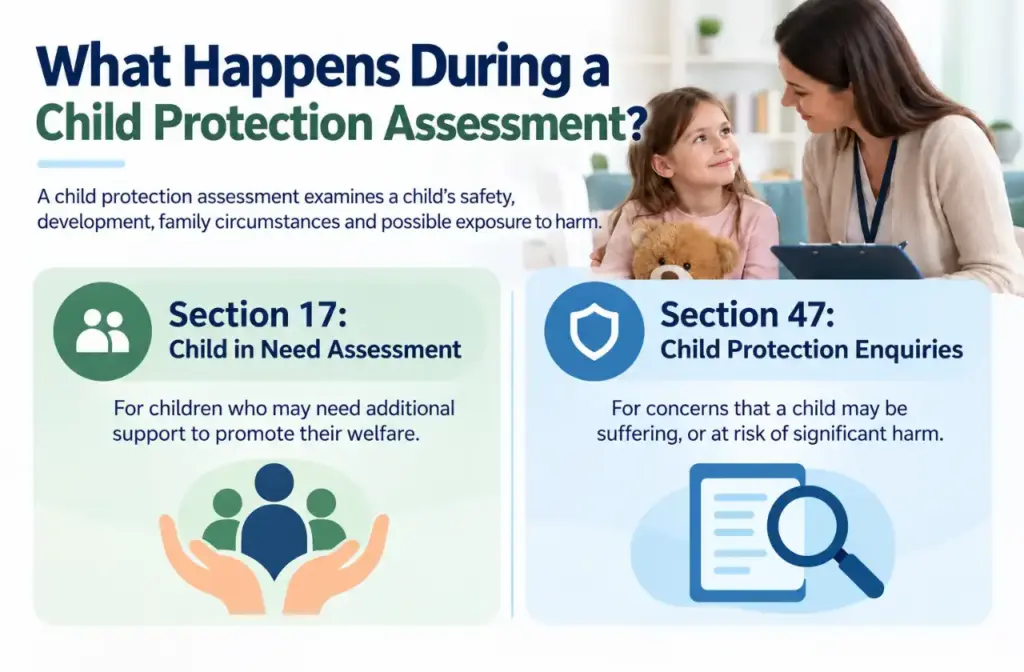
A child protection assessment examines a child’s safety, development, family circumstances and possible exposure to harm.
Two important legal provisions under the Children Act 1989 are Section 17 and Section 47.
Section 17: Child in Need Assessment
Under Section 17 of the Children Act 1989, local authorities have duties relating to safeguarding and promoting the welfare of children in need.
A child may need additional support because of disability, family difficulties, unmet developmental needs or other circumstances.
Assessment may lead to services that help the child and family address these difficulties.
Section 47: Child Protection Enquiries
Section 47 of the Children Act 1989 requires local authorities to make enquiries where there is reasonable cause to suspect that a child is suffering, or is likely to suffer, significant harm.
These enquiries may involve a strategy discussion between children’s social care, police and other relevant professionals.
The purpose is to establish whether protective action is required, not to assume that abuse has already been proven.
Who Is Involved After a Child Protection Referral?
Effective child protection depends on information being shared between professionals who understand different aspects of the child’s circumstances.
Children’s Social Care and the Designated Safeguarding Lead
Social workers coordinate statutory assessments, gather relevant information and determine appropriate next steps.
Within schools, the Designated Safeguarding Lead (DSL) provides safeguarding leadership, communicates concerns and helps ensure that the child’s welfare remains a priority.
Professionals seeking to strengthen these responsibilities can develop their knowledge through designated safeguarding lead training, covering safeguarding procedures and the DSL’s responsibilities.
Police, Healthcare Professionals and Other Agencies
Police may become involved when criminal offences are suspected or urgent protection is required. Healthcare professionals can contribute medical information, while education staff provide observations about attendance, behaviour and wellbeing.
The importance of multi-agency working in safeguarding lies in combining these perspectives. The NSPCC’s guidance on multi-agency working also stresses timely information sharing and professional curiosity.
What Are the Possible Outcomes of a Safeguarding Referral?
A safeguarding referral does not automatically lead to an investigation, a child protection plan or removal from the family.
Early Help, Family Support or No Further Statutory Action
Some families benefit from coordinated support without formal child protection intervention.
In other circumstances, children’s social care may determine that no further statutory action is necessary. Professionals should still consider whether support from other services would be beneficial.
Child Protection Conferences and Protection Plans
If Section 47 enquiries identify continuing concerns about significant harm, an initial child protection conference may be convened.
Relevant professionals examine the available information and consider whether the child requires a child protection plan.
Such a plan identifies risks, required actions, professional responsibilities and arrangements for reviewing progress.
How Long Does the Safeguarding Referral Process Take?
The safeguarding referral timeline depends on the seriousness and complexity of the concerns.
In England, children’s social care should normally make an initial decision within one working day of receiving a referral.
Where a statutory assessment is undertaken, it should generally be completed within 45 working days of the referral. Where Section 47 enquiries lead to an initial child protection conference, the conference should normally take place within 15 working days of the strategy discussion that initiated the enquiries.
These are different stages, not a single waiting period. Urgent safeguarding action must happen sooner when necessary.
The relevant expectations are set out in Working Together to Safeguard Children 2026.
What Should a DSL Do After Making a Safeguarding Referral?
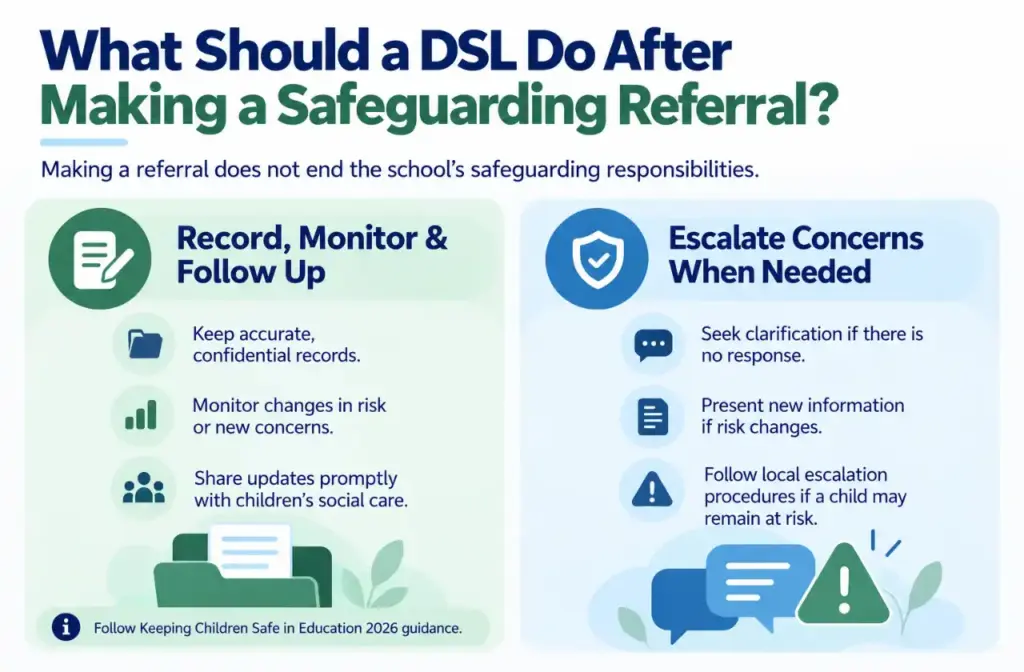
Submitting a referral does not end a school’s safeguarding responsibilities. The DSL must remain alert to changing circumstances and ensure that relevant information reaches the appropriate professionals.
Recording, Monitoring, and Following Up
The DSL should maintain accurate, confidential records of concerns, conversations, actions, and decisions.
A pupil’s worsening attendance, new disclosure, or unexplained injury may change the level of risk. These developments should be communicated promptly to children’s social care.
The Department for Education’s Keeping Children Safe in Education 2026 provides statutory safeguarding guidance for schools and colleges.
Escalating Concerns When Necessary
If children’s social care does not respond or the DSL believes the decision leaves a child at risk, further action may be needed.
This can include requesting clarification, presenting new information or following local professional escalation procedures.
Staff can strengthen their understanding of these responsibilities through Level 3 safeguarding training.
What Happens If a Safeguarding Referral Is Not Accepted?
A referral may be closed without statutory intervention because the information does not indicate that the relevant threshold has been met.
However, this does not mean the original concern was unimportant.
The DSL should clarify the decision, retain appropriate records, and consider whether another service can provide support. Where concerns persist or circumstances deteriorate, professionals should share updated information or make a further referral.
The Department for Education’s information-sharing guidance explains how relevant information can be shared lawfully to support children’s safety.
Conclusion
A child protection referral starts a decision-making process that may involve assessment, family support, multi-agency enquiries, or formal protection arrangements.
For education professionals, the essential responsibility is to recognize concerns, report them promptly, and remain involved where appropriate. Accurate records, timely communication, and continued professional vigilance help prevent safeguarding information from being overlooked.
To build confidence in managing referrals and supporting school safeguarding procedures, explore NextGen Learning’s Designated Safeguarding Lead (DSL) Training.
FAQs
The initial decision should normally be made within one working day. A statutory assessment should generally be completed within 45 working days, although urgent action may happen immediately.
Parents are generally involved where appropriate. However, informing them may be delayed or avoided if doing so could increase the risk to the child or compromise an investigation.
No. Children’s social care may decide that early help, family support, further assessment, or no additional statutory intervention is appropriate.
The referring professional should record the outcome, continue monitoring concerns where appropriate, and make another referral if new information indicates possible harm.

Designated Safeguarding Lead (DSL) Training
Certificate:
yes
Accreditation:
Safeguarding Lead (DSL) Training
Access:
Lifetime
0 responses on "What Happens After a Child Protection or Safeguarding Referral?"