



What Is a Cover Supervisor? Duties, Pay & Is It for You?
When a teacher is absent, the class still needs structure, clear instructions and someone who can keep pupils focused. That is where a cover supervisor comes in.
For people who enjoy working with young people, the job offers an opportunity to experience school life without immediately pursuing qualified teacher training. But it also brings responsibility: you may supervise unfamiliar classes, handle challenging behaviour and work to a changing timetable. Understanding everyday reality matters before applying.
Quick Answer: What Is a Cover Supervisor?
A cover supervisor is a school staff member who supervises pupils completing work set by an absent teacher. They maintain classroom behaviour, explain instructions and keep lessons organised. In UK schools, the role typically focuses on managing prepared activities rather than planning lessons or teaching new curriculum content.
What Is a Cover Supervisor?
Cover supervisors help schools continue planned learning when a teacher is away, often for a short period. They commonly work in secondary schools, where one person might supervise several subjects and year groups during a single day. Similar duties can arise in primary and special schools, although arrangements differ.
The central purpose is to keep pupils safe, settled and working on activities supplied by teaching staff. A cover supervisor usually follows the school’s established routines rather than taking over a teacher’s curriculum responsibilities.
The occupational description from Skills for Schools emphasises the distinction between supervising prepared exercises and active teaching, marking or lesson planning. Always read the particular vacancy: schools may combine cover duties with other support responsibilities.
What Does a Cover Supervisor Do?
Main Duties and Responsibilities
A cover supervisor job description typically involves the following tasks:
- Prepare for the class: Collect lesson instructions, locate resources, check seating plans and understand whom to contact for support.
- Take attendance: Follow the school’s registration process and report missing pupils appropriately.
- Introduce the assigned work: Explain the task, clarify deadlines and help pupils understand what is expected.
- Keep pupils on task: Monitor progress, reinforce expectations and encourage independent work.
- Manage behaviour: Apply the school’s policy consistently instead of making up sanctions.
- Respond to difficulties: Deal with routine questions and refer problems requiring specialist teaching or additional support.
- Hand over information: Report incidents, unfinished tasks or concerns through the school’s agreed channels.
The boundary matters. Answering a question about where to find an exercise is different from taking responsibility for planning new teaching or formally assessing learning. A school may ask for associated administrative or support tasks, but the role description should identify them clearly.
Behaviour Management and Safeguarding
A calm manner is useful, but successful classroom management also depends on preparation. Learning names where possible, following seating plans and giving short, clear instructions can help pupils understand the routine. When behaviour escalates, seek assistance through the school’s procedures rather than attempting to manage every situation alone.
Safeguarding is a separate professional responsibility. In England, Keeping Children Safe in Education 2026 is statutory guidance for schools and colleges. It requires staff to read Part One in full and follow their institution’s safeguarding policies. Staff should know how to report a concern to the designated safeguarding lead, without investigating it themselves.
Nextgen Learning’s article about designated safeguarding lead responsibilities provides further context on what happens after concerns are reported. Guidance and procedures in other UK nations differ, so check the rules relevant to your setting.
What Does a Typical Cover Supervisor Day Look Like?
The following is an illustrative example, not a description of one particular school.

Before the first lesson: You collect the day’s timetable and prepared activities. You check whether any pupils need specific arrangements, find the registration system and confirm how to summon another member of staff.
During lessons: A Year 8 English class completes a reading exercise. You explain the instructions, register attendance and circulate while pupils work. Two pupils become distracted, so you restate the expectations and use the school’s behaviour procedures. Later, you supervise a Year 10 geography class completing a prepared worksheet.
After lessons: You return collected work if required and report any incidents or unfinished tasks to the agreed contact.
The challenge is not mastering every subject. It is helping different groups work productively while recognising when a question or difficulty needs qualified teaching input.
For readers new to schools, Nextgen Learning’s Teaching Assistant Level 1, 2 and 3 course offers CPD-accredited introductory learning relevant to teaching assistant work. It is not a regulated cover supervisor qualification or a compulsory condition of employment.
How Much Does a Cover Supervisor Earn in the UK?
Cover supervisor pay depends on location, employer, experience, hours and contractual arrangements. Rather than relying on an unsupported national average, compare real advertisements and pay attention to the difference between the headline figure and what you would actually earn.
Cover Supervisor Salary and Term-Time Pay
Some schools advertise a full-time-equivalent (FTE) salary. This is the pay associated with their full-time employment basis, not necessarily the salary a term-time or part-time employee receives.
For example, Deer Park School in Southampton advertised a cover supervisor vacancy on 4 November 2026 at £28,696 FTE, but an actual annual salary of £21,199.24. The permanent post specified 32.6 hours weekly across 38 term-time weeks. Those details explain why the two amounts differ.
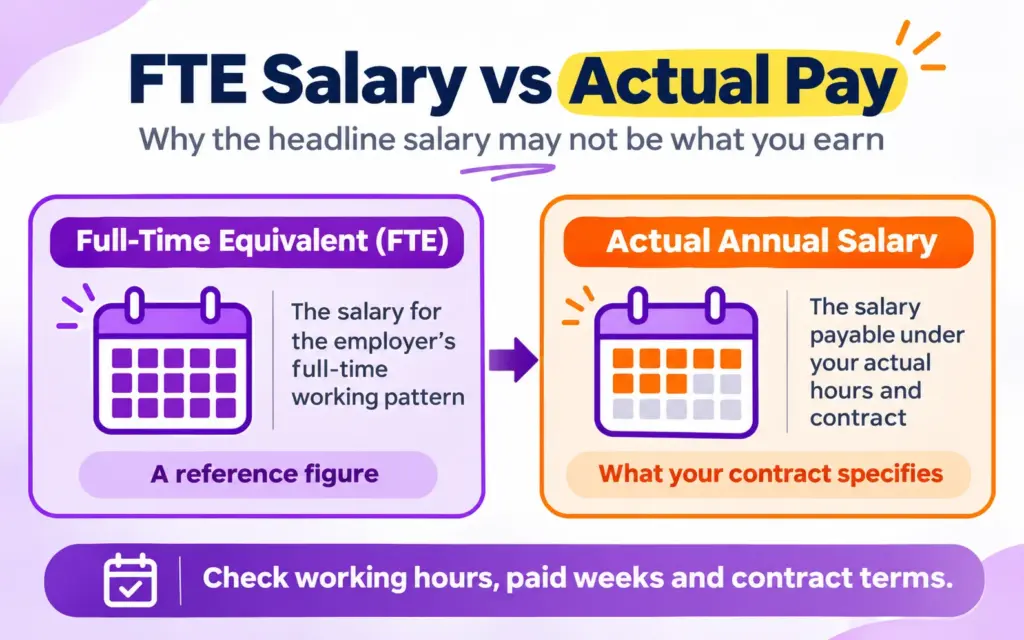
This is one verified employer example, not a UK salary average or a promise about other schools. Compare actual salary, weekly hours, working weeks and whether additional duties are expected. Two jobs showing similar FTE figures can produce quite different real earnings.
Permanent Pay, Supply Rates and Holidays
Permanent positions generally specify an annual salary and contractual hours. Supply cover supervision may instead be paid per booking or day, and the amount of available work can vary. A quoted day rate is therefore not a guaranteed annual income.
Holiday entitlement is also different from how salary is distributed. A term-time worker may receive annualised earnings in twelve monthly instalments without being paid extra for every school holiday. Agency and casual arrangements can operate differently. Ask the employer or agency how holiday entitlement, pay calculations and payment dates work before accepting an offer.
What Qualifications and Skills Do Cover Supervisors Need?
Do You Need a Degree, Level 3 Qualification or QTS?
There is no single degree or Qualified Teacher Status (QTS) requirement for every cover supervisor vacancy. Employers specify their own experience and qualification criteria. Some welcome applicants with transferable experience supervising young people; others prefer previous school employment or relevant qualifications.
Skills for Schools also says staff undertaking whole-class cover should be qualified and paid to at least Level 3. This is a professional recommendation, not a universal statutory entry condition for every applicant. Read the person specification carefully and distinguish what an employer requires from what a professional body recommends.
Experience in youth work, tutoring support, coaching or group activities may be useful. What matters in an application is showing how that experience relates to the actual duties, not simply listing previous job titles.
Which Skills and Training Can Help?
Strong cover supervisors combine several practical skills:
- Communication: Give instructions clearly and listen without allowing lengthy interruptions to disrupt the class.
- Organisation: Understand the timetable, resources and reporting process before pupils arrive.
- Consistency: Follow behaviour expectations fairly across different groups.
- Adaptability: Work with unfamiliar subjects, year groups and classroom routines.
- Judgement: Know when a matter is beyond your authority and needs another staff member.
Relevant learning can develop knowledge, but certificates have different purposes. Nextgen Learning’s Focus Awards Level 3 Award in Supporting Teaching and Learning in Schools (RQF) is presented as a regulated qualification covering school organisation, professional relationships, child development and safeguarding. It is distinct from CPD-accredited introductory training and does not guarantee a cover supervisor job.
Cover Supervisor vs Teaching Assistant: What's the Difference?
These roles work closely with pupils, but their usual emphasis differs:
| Role | Main focus | Typical responsibility |
|---|---|---|
| Cover supervisor | Whole-class supervision | Oversee prepared activities during teacher absence |
| Teaching assistant | Learning support | Support a teacher, individuals or smaller groups |
| Teacher | Teaching and assessment | Plan, deliver and evaluate learning |
Individual schools may combine duties differently. A one-to-one teaching assistant might spend much of the day supporting a particular pupil, whereas a cover supervisor often needs to establish expectations for an entire unfamiliar class.
If you enjoy sustained individual support, teaching assistant work could be more appealing. If you prefer organising whole-group activity and adapting quickly, cover supervision may suit you. Neither role is automatically a stepping stone to QTS.
Is Being a Cover Supervisor Right for You?
Advantages and Challenges
The role may offer experience of school life, opportunities to develop communication skills and exposure to different classes. It can also help you decide whether you enjoy an education workplace before committing to longer training.
On the other hand, unfamiliar pupils may test boundaries. Work may change at short notice, and temporary bookings can mean uncertain income. A prepared task might not suit every pupil, leaving you to seek help rather than improvise teaching outside your remit. These are reasons to ask good questions about induction and support, not reasons to dismiss the career.
Five Questions to Ask Yourself
- Can I give instructions confidently to a whole class without becoming confrontational?
- Could I manage routine disruption while following a school’s behaviour policy?
- Am I comfortable moving between unfamiliar subjects, year groups and rooms?
- Would the actual pay, contract and working pattern meet my needs?
- Will I follow safeguarding procedures and ask for help when a concern exceeds my role?
If you’re unsure, volunteering or gaining appropriate supervised practical experience with young people may help you test your interests.
How to Become a Cover Supervisor
A sensible application process begins with the vacancy, not a generic training promise.
- 1. Find relevant posts. Search schools and the Department for Education’s Teaching Vacancies service for roles matching your location and preferred hours.
- 2. Read person specifications. Compare responsibilities, qualifications, experience, induction and the actual salary offered.
- 3. Prepare evidence. Identify occasions when you supervised groups, communicated clearly, handled disagreement or followed safety procedures.
- 4. Address gaps. Consider experience or learning that helps with school routines and behaviour expectations; do not assume a certificate replaces selection checks.
- 5. Tailor your application. Match examples to the employer’s criteria and prepare to explain when you would seek support.
Safer recruitment may involve criminal record checks. The DBS guidance on working with children explains how eligibility for enhanced checks and barred-list information depends on duties and regulated activity. Follow the employer’s process rather than assuming every vacancy has identical requirements.
Ready to Apply for a Cover Supervisor Role?

Choose two or three realistic vacancies. Compare their person specifications, actual salaries, term-time arrangements and classroom responsibilities. Then select one and tailor your application around clear examples of relevant experience. If you identify a genuine knowledge gap, explore suitable learning before applying. Your application should demonstrate judgement and readiness, not just course certificates.
Can Cover Supervision Lead to Other Education Careers?
Cover supervision may help you develop skills useful in school support, pastoral work or later teacher training. However, progression depends on experience, job requirements and any formal qualifications needed.
Experienced staff interested in higher-level classroom support can review Nextgen Learning’s Focus Awards Level 4 Certificate for Higher Level Teaching Assistants (RQF), checking its entry and assessment requirements before enrolling. This is not an automatic route to appointment as an HLTA.
Teaching assistant apprenticeships are another possible career route, but they have their own employment and training conditions. If your aim is teaching, consult the Department for Education’s steps to become a teacher in England. Classroom experience by itself does not confer QTS.
Final Thoughts: Is Cover Supervision a Good Fit?
Cover supervisors help pupils continue working when teachers are absent, but the role demands preparation, judgement and confident communication. Before applying, compare actual pay, responsibilities and the support each school offers. A well-chosen vacancy and an application grounded in your experience are more useful starting points than assuming one training route suits everyone.
Cover Supervisor FAQs
Possibly. Some schools consider applicants without previous school employment if they can demonstrate relevant skills. Others specify classroom experience or qualifications. Check each vacancy rather than assuming there is a standard entry route.
Not universally. Cover supervision is different from employment as a qualified teacher, but schools set their own role requirements. QTS is not awarded through cover supervision.
Yes, supervising a whole class can be central to the job. Schools must provide appropriate arrangements, procedures and routes for seeking assistance. The supervisor should work within the responsibilities assigned to them.
It depends on the contract. Some term-time salaries are spread across twelve monthly payments; that does not mean additional holiday earnings. Agency arrangements and statutory holiday entitlements require separate consideration.
It can provide useful classroom experience and help you assess whether school work suits you. However, it is not a teacher-training qualification and does not award QTS. Check the recognised training routes separately.