





What Is El Niño? Meaning, Global Effects and Heatwave Safety Tips
El Niño is one of the world’s most important climate patterns. It begins in the tropical Pacific Ocean, yet its effects can influence weather far beyond that region. As a result, it can affect heatwaves, rainfall, drought, storms, food supply, water demand and public health.
In simple terms, El Niño happens when surface waters in the central and eastern Pacific become warmer than usual. However, it is not only an ocean event. It also changes wind patterns, air pressure and the way heat moves through the atmosphere. Therefore, even people living far from the Pacific may feel its effects through unusual weather.
In 2026, El Niño is again a major topic because global climate agencies are warning of a likely return of El Niño conditions. Importantly, this does not mean every country will experience the same weather. Some regions may face hotter and drier conditions, while others may see heavier rainfall or flooding.
This guide explains what El Niño means, how it works, why it matters and how it can affect heatwave risks. Moreover, it shares practical health and safety tips to help individuals, families, workers and organisations prepare for extreme heat with more confidence.
Table of Contents
What Is El Niño?
El Niño is the warm phase of the El Niño-Southern Oscillation, often called ENSO. It occurs when sea surface temperatures in the central and eastern equatorial Pacific rise above normal for a sustained period. Consequently, it can shift global weather patterns and make some climate extremes more likely.
- It usually develops every two to seven years.
- It often lasts around nine to twelve months.
- It can raise global temperatures and alter rainfall patterns.
- It can increase heat, drought or flood risk in different regions.
How Does El Niño Form?

Under normal conditions, trade winds push warm surface water westward across the tropical Pacific. This allows cooler water to rise near the coast of South America. However, during El Niño, those trade winds weaken. Consequently, warmer water spreads eastward and changes the usual ocean-atmosphere pattern.
This warming affects more than the sea. Air pressure changes across the Pacific, clouds and rainfall move, and global circulation patterns can shift. Therefore, El Niño is best understood as a linked ocean and atmosphere event, not a single patch of warm water.
Scientists monitor several indicators, including sea surface temperatures, subsurface heat, winds and pressure patterns. For example, WMO reported in June 2026 that warm ocean waters were fuelling developing El Niño conditions and that above-average temperatures were forecast nearly everywhere for June to August.
El Niño vs La Niña: What Is the Difference?

El Niño and La Niña are opposite phases of ENSO. However, they do not simply create opposite weather everywhere. Their impacts depend on the season, strength, location and interaction with other climate drivers.
Is El Niño Happening in 2026?
Current guidance points toward El Niño development in 2026. The World Meteorological Organization reported an 80% likelihood of El Niño during June to August 2026, with probabilities near or above 90% for continuation until at least November. In addition, NOAA’s Climate Prediction Center stated in May 2026 that El Niño was likely to emerge soon and continue through the Northern Hemisphere winter of 2026-27.
However, forecasts still include uncertainty. A strong El Niño does not guarantee severe impacts everywhere. Instead, it increases the chance of certain seasonal patterns. Therefore, local forecasts and national meteorological updates remain essential for planning.
What Are the Main Effects of El Niño?

Every El Niño event is different. Nevertheless, many events influence temperature, rainfall, storms, food systems and public services. Because the effects vary by region, the safest approach is to understand the broad risks and then check local guidance.
- Higher global temperatures: El Niño often adds warmth to an already warming climate system.
- Drought in some regions: Reduced rainfall can pressure crops, water supplies and energy systems.
- Heavy rainfall in others: Wetter conditions can raise flood, landslide and transport disruption risks.
- Changed storm patterns: El Niño can influence tropical cyclone activity in the Pacific and Atlantic basins.
- Pressure on health systems: Extreme heat can increase dehydration, heat exhaustion and heatstroke risk.
For example, WMO notes that El Niño is typically associated with wetter conditions in parts of southern South America, the southern United States, parts of the Horn of Africa and central Asia. In contrast, it often links with drier conditions in Central America, northern South America, the Caribbean, Australia, Indonesia and parts of southern Asia. However, local impacts can still differ within the same region.
How Can El Niño Affect Heatwaves and Health?

El Niño does not cause every heatwave. However, it can raise global temperatures and increase the chance of hotter-than-normal seasons in many areas. As a result, it can worsen heat stress when local weather, urban heat, poor ventilation or high humidity already make conditions dangerous.
This matters because heat affects the body quickly. When the body cannot cool itself properly, core temperature rises, sweating may become less effective and dehydration can develop. Consequently, people may experience dizziness, weakness, headache, nausea, confusion or collapse.
WHO explains that negative health impacts from heat are predictable and largely preventable when public health planning, preparedness and risk management are in place. Therefore, heatwave awareness is not only useful during extreme events. It also supports safer decisions at work, at home and while travelling.
Who Is Most at Risk During El Niño-Linked Heat Events?
Extreme heat can affect anyone. However, some people face higher risk because their bodies, working conditions or living environments make cooling harder. Therefore, heat safety plans should focus first on those who may need extra support.
- Older adults and young children need closer monitoring during hot weather.
- People with heart, kidney, respiratory or diabetic conditions should follow medical advice carefully.
- Outdoor workers should plan breaks, hydration and shaded rest areas before heat peaks.
- Pregnant people, people with disabilities and people taking certain medicines may need additional precautions.
- People in poorly ventilated homes or workplaces should identify cooler spaces in advance.
Importantly, risk also increases during travel, sport, festivals, construction work, delivery routes and farming tasks. In addition, indoor workers can face danger when kitchens, factories, warehouses or workshops become hot and poorly ventilated.
Heatwave Safety Tips During El Niño Conditions
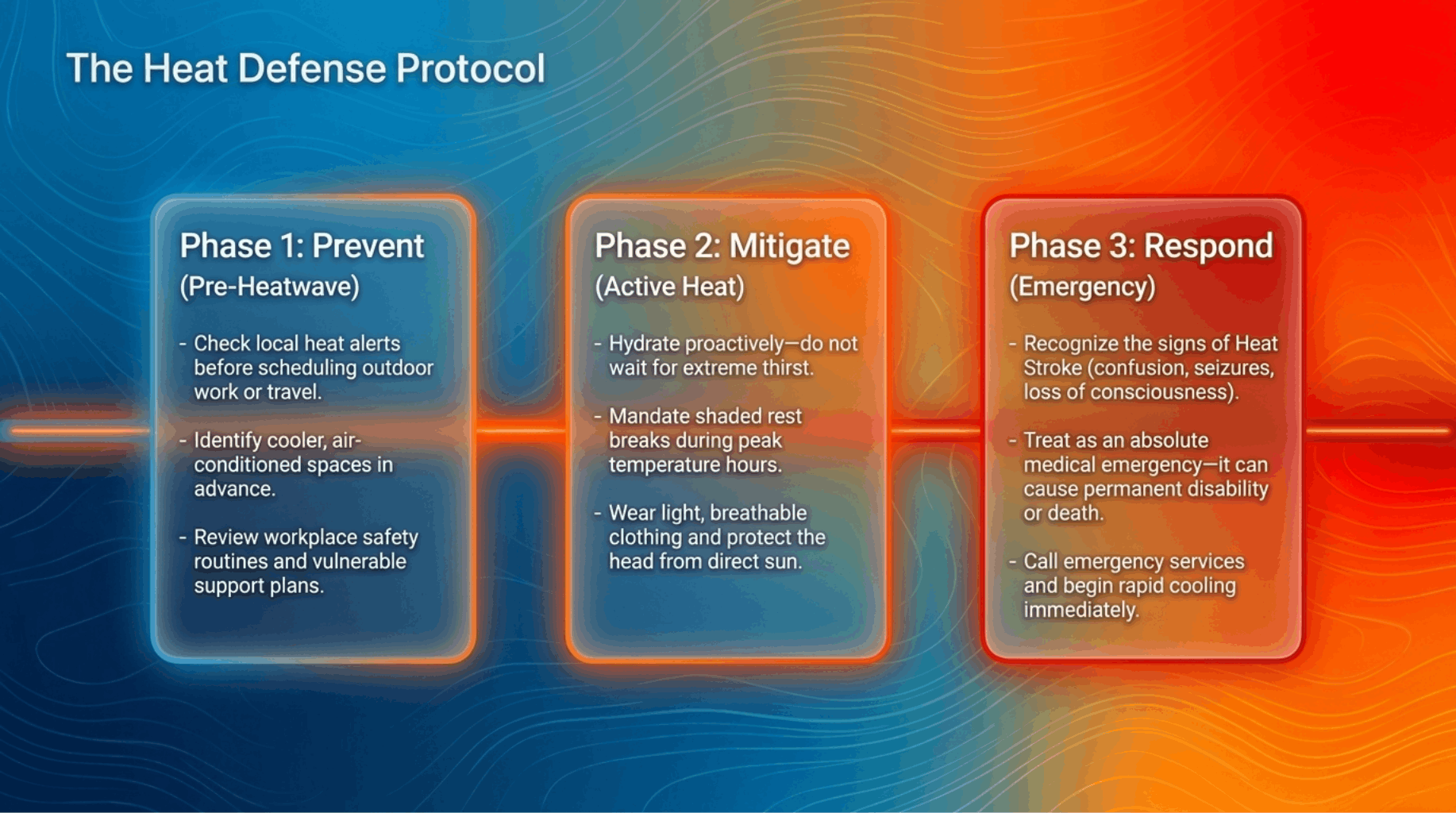
Preparedness works best when it starts before the hottest day arrives. Therefore, use El Niño forecasts as an early signal to review heat safety habits, workplace routines and support plans for vulnerable people.
- Drink water regularly, and do not wait until you feel very thirsty.
- Reduce heavy activity during the hottest part of the day whenever possible.
- Wear light, breathable clothing and protect your head from direct sun.
- Use shade, fans, cool showers or air-conditioned spaces to lower heat exposure.
- Check local heat alerts before outdoor work, travel or events.
- Keep an eye on older relatives, neighbours, children and people with health conditions.
- Plan safe rest breaks for outdoor or physically demanding work.
- Seek urgent help if someone shows confusion, loss of consciousness, seizures or very high body temperature.
CDC guidance describes heat stroke as the most serious heat-related illness. It can cause permanent disability or death without emergency treatment. Therefore, if heat stroke is suspected, call emergency services, move the person to a cooler area and begin rapid cooling while help is on the way.
Why Heatwave Awareness Training Matters
Climate information becomes more useful when people know how to act on it. El Niño forecasts may warn of higher heat risk, but individuals and teams still need clear steps for prevention, symptom recognition and response. Moreover, training can help people understand why hydration, rest breaks, clothing choices and environmental checks matter.
For readers who want structured learning, NextGen Learning offers the Heatwave: Health and Safety Tips course. The course covers how heat affects the body, prevention of heat stress, signs of heat-related illness, hydration awareness and safety measures in hot conditions. It is especially relevant for outdoor workers, employers, supervisors, health and safety learners, students and anyone exposed to hot environments.
This course mention fits naturally here because El Niño can increase the need for heat awareness. However, the bigger message is simple: when hot weather becomes more likely, preparation should become more practical.
FAQs About El Niño
El Niño often lasts around nine to twelve months. However, the timing and strength vary from one event to another.
No. El Niño does not directly cause every heatwave. However, it can increase global temperatures and make hotter conditions more likely in some regions.
El Niño is a natural climate pattern. However, climate change can amplify some impacts because a warmer ocean and atmosphere can add more heat and moisture to extreme weather events.
Impacts vary by event and season. However, parts of South America, North America, Africa, Asia, Australia, Indonesia and the Caribbean often monitor El Niño closely because rainfall, heat and drought patterns can shift.
Stay hydrated, reduce direct heat exposure, check local warnings and watch for symptoms such as dizziness, nausea, weakness, headache or confusion. Importantly, treat suspected heat stroke as a medical emergency.
Conclusion
El Niño is more than a climate science term. It is a major ocean-atmosphere pattern that can influence weather, health, infrastructure and daily life across the world. Therefore, understanding it helps people interpret forecasts with more confidence.
Although every El Niño event is different, the practical message remains consistent. Pay attention to local forecasts, prepare for hotter conditions where they are likely and take heat-related illness seriously. As a result, individuals, workplaces and communities can reduce risk before extreme heat becomes an emergency.
Reference
World Meteorological Organization – WMO: Prepare for El Niño: https://wmo.int/news/media-centre/wmo-prepare-el-nino
World Meteorological Organization – El Niño/La Niña Update (May 2026): https://wmo.int/resources/publication-series/el-ninola-nina-updates/el-ninola-nina-update-may-2026
World Health Organization – Heat and health fact sheet: https://www.who.int/news-room/fact-sheets/detail/climate-change-heat-and-health
CDC/NIOSH – Heat-related illnesses: https://www.cdc.gov/niosh/heat-stress/about/illnesses.html
NextGen Learning – Heatwave: Health and Safety Tips: https://nextgenlearning.org.uk/course/heatwave-health-and-safety-tips/
NOAA Climate Prediction Center – ENSO Diagnostic Discussion, 14 May 2026:
https://www.cpc.ncep.noaa.gov/products/analysis_monitoring/enso_advisory/ensodisc.shtml


0 responses on "What Is El Niño? Meaning, Global Effects and Heatwave Safety Tips"