




What Is Safeguarding Level 4? A UK Guide
Complex safeguarding concerns demand more than recognising abuse or following standard reporting procedures. Professionals must understand legal duties, assess serious risks and apply specialist knowledge when protecting vulnerable people.
Safeguarding Level 4 is an advanced level of safeguarding competence involving specialist knowledge, professional judgement and additional responsibility. It builds on earlier safeguarding levels and is particularly relevant to specialist practice in UK healthcare.
However, Level 4 does not represent a single, nationally regulated safeguarding qualification. Training standards and recognition depend on the professional sector and course provider.
In this blog, you will learn what Safeguarding Level 4 means, how it differs from other levels, what training covers and how to assess qualifications and certification in the UK.
Key Takeaways
- Safeguarding Level 4 represents advanced safeguarding competence, particularly within UK healthcare.
- Level 4 builds on the knowledge and skills developed through safeguarding Levels 1, 2 and 3.
- Training covers complex safeguarding concerns, legislation, risk assessment and professional judgement.
- The RCPCH’s 2025 intercollegiate framework defines Level 4 competencies for healthcare professionals working with children.
- A Safeguarding Level 4 CPD certificate is not automatically an Ofqual-regulated qualification.
- Training validity and refresher requirements depend on the applicable professional standards and employer policies.
Table of Contents
What Is Safeguarding Level 4?
What Safeguarding Level 4 Means in the UK
Safeguarding Level 4 describes an advanced stage of safeguarding knowledge and competence. It involves understanding complex protection concerns, applying specialist knowledge and supporting effective safeguarding decisions.
In healthcare, Level 4 has a defined meaning under the Royal College of Paediatrics and Child Health (RCPCH) intercollegiate competency framework. Other sectors may use different safeguarding training structures.
The Purpose of Advanced Safeguarding Training
Advanced safeguarding training develops the ability to interpret complicated safeguarding information and recognise risks that standard training may not address in sufficient depth.
Consider a healthcare professional reviewing concerns about a child experiencing unexplained injuries, school absence and parental substance misuse. Each concern requires attention, but understanding their combined significance demands specialist safeguarding knowledge.
Level 4 competence supports this deeper assessment of vulnerability, risk and potential harm.
Safeguarding Level 4 vs. a Regulated Level 4 Qualification
The word Level 4 can describe either a professional competency level or a qualification level within a regulated education system.
A safeguarding course labelled Level 4 does not automatically award a regulated Level 4 qualification. Learners must check the course’s awarding organisation, qualification status and certification details.
What Are the Different Levels of Safeguarding Training?
Safeguarding training levels describe increasing knowledge, competence and expectations. The RCPCH framework identifies five levels for healthcare staff involved in safeguarding children and young people.
Safeguarding Levels 1, 2 and 3 Explained
| Level | Main focus |
|---|---|
| Level 1 | Recognising safeguarding concerns |
| Level 2 | Responding appropriately to concerns |
| Level 3 | Applying safeguarding knowledge and expertise |
| Level 4 | Specialist safeguarding competence and additional responsibility |
| Level 5 | Strategic oversight and system-level response |
These descriptions reflect the healthcare competency framework rather than a universal system applying to every UK profession.
Safeguarding Level 3 vs. Level 4
The main difference between safeguarding Level 3 and Level 4 is the expected depth of expertise.
Level 3 focuses on identifying, assessing and responding to safeguarding concerns through informed professional practice. Level 4 adds specialist knowledge for interpreting complex concerns, providing expert input and addressing escalated safeguarding issues.
Learners building their knowledge can explore Level 3 Safeguarding Training (Children) before pursuing more advanced professional development.
Is Safeguarding Level 4 the Highest Level?
No. The RCPCH framework includes Level 5, which focuses on strategic safeguarding oversight and system-wide responses.
Level 4 concentrates on specialist expertise within healthcare organisations, while Level 5 addresses broader strategic responsibilities.
What Does Safeguarding Level 4 Training Cover?
Safeguarding Level 4 training generally explores advanced protection issues requiring detailed legal knowledge, critical judgement and an understanding of complex vulnerabilities.
Advanced Safeguarding Legislation and Guidance
Training may examine the Children Act 1989, Children Act 2004 and relevant statutory guidance.
Professionals must understand how legal requirements influence safeguarding decisions. In education settings in England, Keeping Children Safe in Education 2026 provides current statutory safeguarding guidance.
Complex Abuse, Neglect and Exploitation
Advanced courses may examine domestic abuse, sexual exploitation, emotional harm, neglect and overlapping vulnerabilities.
Understanding how several risk factors interact is particularly important when individual warning signs appear less serious in isolation.
Advanced Risk Assessment and Professional Judgement
Specialist safeguarding practice requires careful consideration of available evidence, uncertainty and potential harm.
Training may explore how professionals distinguish immediate danger from longer-term vulnerability and recognise when additional specialist assessment is necessary.
Confidentiality, Consent and Information Sharing
Safeguarding information often contains sensitive personal details. Professionals must understand when information can lawfully be shared to protect someone from harm.
The Information Commissioner’s Office confirms that UK GDPR does not prevent necessary and lawful safeguarding information sharing.
Consent is not always required when another appropriate lawful basis applies.
What Are the UK Standards for Safeguarding Level 4?
RCPCH Intercollegiate Safeguarding Competency Framework
The RCPCH published its updated intercollegiate safeguarding framework in November 2025.
It establishes competencies for healthcare staff safeguarding children and young people, including children in care.
The framework distinguishes professional competence from simply attending a training course.
Level 4 Safeguarding Competency Standards
Level 4 competencies extend beyond theoretical safeguarding knowledge.
They include specialist communication, interpreting complex risks, contributing to professional learning and applying evidence-based safeguarding knowledge.
The framework also emphasises reflective practice and awareness of the effects of trauma on children and young people.
Safeguarding Level 4 Standards Across UK Sectors
Safeguarding standards vary according to professional context.
Healthcare uses the intercollegiate competency framework, while schools in England follow statutory education safeguarding guidance.
England, Scotland, Wales and Northern Ireland also have different legal arrangements. Consequently, learners should not assume that one Level 4 course meets every sector’s requirements.
How Does Safeguarding Level 4 Training Work?
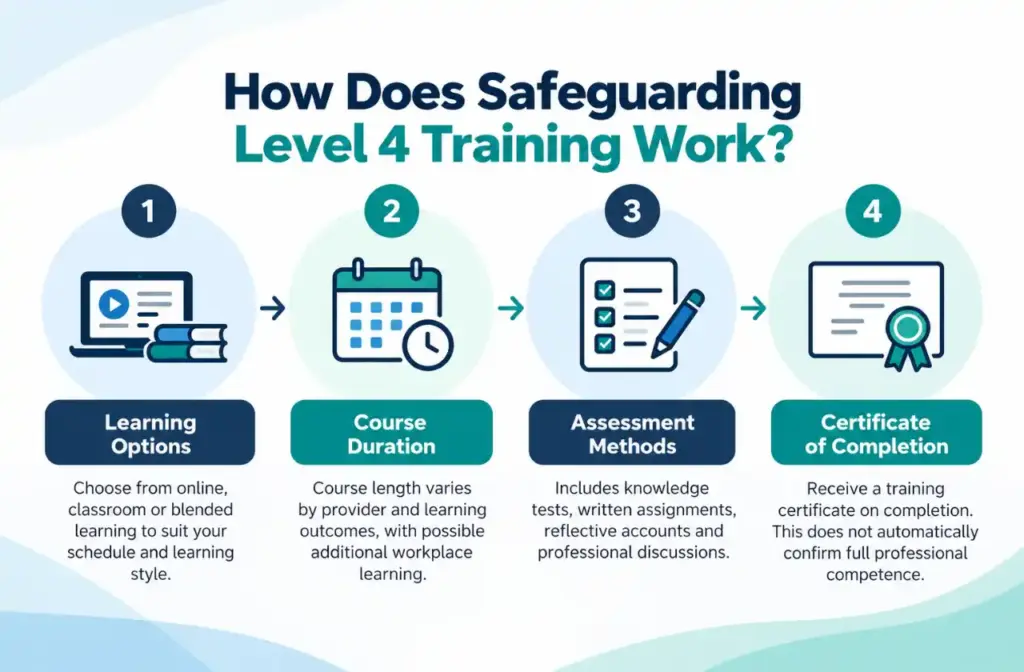
Online, Classroom and Blended Learning Options
Safeguarding Level 4 training may involve online learning, instructor-led sessions, workshops or blended programmes.
Online study offers flexibility, whereas facilitated learning can support discussion of complicated safeguarding situations and professional judgement.
Course Duration and Learning Requirements
There is no single nationally prescribed duration for every course advertised as Safeguarding Level 4.
Course length depends on the provider, intended learning outcomes and assessment requirements.
Professional competency development may also involve supervised practice and workplace learning beyond formal teaching sessions.
Assessments and Evidence of Learning
Assessment methods can include knowledge tests, written assignments, reflective accounts and professional discussions.
A multiple-choice assessment may confirm understanding of safeguarding principles, but it cannot necessarily establish the full competence expected of a specialist professional.
Completing the Training and Receiving a Certificate
A training certificate usually records successful course completion.
However, receiving a Safeguarding Level 4 certificate does not automatically confirm that every professional competency has been demonstrated. Employers may require additional evidence of applied knowledge.
Is Safeguarding Level 4 a Recognised Qualification in the UK?
CPD Certification vs. Ofqual-Regulated Qualifications
Continuing Professional Development (CPD) courses support professional learning, whereas regulated qualifications follow specified awarding and regulatory requirements.
The UK qualification levels guidance identifies regulated Level 4 qualifications such as Higher National Certificates and Level 4 diplomas.
A safeguarding CPD certificate using the term Level 4 is not necessarily equivalent to these qualifications.
How to Check Safeguarding Level 4 Accreditation
Learners can use the government’s Register of Regulated Qualifications to check qualifications regulated in England and Northern Ireland.
For other UK nations, relevant qualifications information is available through Qualifications Wales and Scottish qualification authorities.
Check the exact qualification title and awarding organisation rather than relying on promotional accreditation claims.
Employer and Professional Recognition of Certificates
Employers may accept CPD certificates as evidence of learning without treating them as regulated qualifications.
Recognition depends on workplace policies, professional expectations and whether the training matches the required competencies.
How Long Is Safeguarding Level 4 Training Valid?
Do Safeguarding Level 4 Certificates Expire?
There is no universal expiry date applying to every Safeguarding Level 4 certificate.
Some providers specify certificate validity periods, while employers may impose separate refresher requirements.
Refresher Training and Continuing Professional Development
The 2025 RCPCH framework recommends discussing Level 3, 4 and 5 safeguarding competencies during annual professional appraisals.
It also recommends considering safeguarding competence within relevant professional revalidation cycles, generally spanning three to five years. This does not mean all Level 4 certificates expire after that period.
Maintaining Level 4 Safeguarding Competence
Maintaining competence requires more than retaining a certificate.
Professionals should remain informed about legislative changes, emerging safeguarding risks and updated professional guidance. Reflective learning and relevant CPD help maintain current knowledge.
How to Choose a Safeguarding Level 4 Course
Checking Course Recognition and Accreditation
Start by identifying whether the course offers CPD certification, a regulated qualification or another form of training recognition.
Examine the awarding organisation and confirm whether the certificate meets your intended professional requirements.
Comparing Course Content and Assessment Methods
Compare the syllabus against relevant safeguarding competency standards.
Courses covering advanced risk assessment, legislation, professional judgement and specialist safeguarding concerns may offer a more suitable foundation for advanced learning.
Understanding Certificate and CPD Requirements
Before enrolling, check assessment conditions, certificate fees, refresher expectations and any workplace acceptance requirements.
If you want to strengthen your child protection knowledge first, explore Level 3 Safeguarding Training (Children). It provides relevant CPD learning, although it is not a substitute for role-specific Level 4 competency development.
Conclusion
Safeguarding Level 4 represents advanced safeguarding competence, particularly within specialist UK healthcare practice. It builds on earlier safeguarding levels through deeper knowledge, stronger professional judgement and an understanding of complex protection concerns.
However, Level 4 training certificates and regulated qualifications are not interchangeable. Learners should verify course recognition, competency coverage and refresher requirements before enrolling.
For foundational advanced child protection learning, consider Level 3 Safeguarding Training (Children) to develop your safeguarding knowledge.
Frequently Asked Questions
A Level 4 safeguarding course has no universal completion time. Duration varies by provider, delivery method and assessment requirements. Developing the full professional competencies may require additional workplace learning and experience beyond course completion.
Level 4 safeguarding refers to advanced safeguarding competence involving specialist knowledge and additional professional responsibility. The RCPCH healthcare framework defines Level 4 competencies for professionals involved in safeguarding children and young people.
Regulated Level 4 qualifications include Higher National Certificates, Certificates of Higher Education and certain Level 4 awards, certificates and diplomas. They are separate from professional safeguarding competency levels.
The 4Rs commonly refer to Recognise, Respond, Record and Refer. They describe identifying a safeguarding concern, responding appropriately, documenting relevant information and referring concerns through the proper channels.
The precise wording can vary between organisations. The Church of England’s safeguarding guidance uses this version.

0 responses on "What Is Safeguarding Level 4? A UK Guide"