




Clinical Coding Apprenticeship: How to Get One in 2026
A clinical coding apprenticeship could be your starting point for a healthcare career, even if you have never worked in a hospital. But where do you find genuine opportunities, what qualifications do you need, and how do you apply?
To get a clinical coding apprenticeship in 2026, search NHS and government apprenticeship vacancies, check the employer’s entry requirements, and submit a tailored application. Successful applicants undertake paid employment alongside structured training. England offers a Level 3 Clinical Coder apprenticeship, although individual employers set their own recruitment criteria.
Table of Contents
What Is a Clinical Coding Apprenticeship?
A clinical coding apprenticeship combines paid workplace experience with structured learning. Apprentices develop the skills to read patient records, interpret medical information and translate diagnoses and procedures into standardised classification codes.
These codes support healthcare reporting, service planning and accurate clinical information management.
Understanding the Level 3 Clinical Coder Apprenticeship
In England, the official Clinical Coder apprenticeship standard, known as ST0535, is a Level 3 programme. Level 3 is equivalent in qualification level to A-level study, although completing an apprenticeship does not automatically award A levels.
Apprentices work with experienced colleagues, develop technical skills and complete structured training and assessment.
Unlike a standalone online course, an apprenticeship involves an employer, paid employment and an approved training arrangement. Understanding this distinction is important when comparing different clinical coding opportunities.
The apprenticeship is particularly relevant to people who enjoy detail-focused work, interpreting information and following established procedures.
What Are the Clinical Coding Apprenticeship Requirements?
You do not necessarily need previous clinical coding experience to apply. However, eligibility depends on both government apprenticeship rules and the individual employer’s selection criteria.
Age, Education and Eligibility
Under the official apprenticeship eligibility requirements, applicants in England generally need to:
- Be aged 16 or over.
- Live in England.
- Not be in full-time education when starting the apprenticeship.
There is no general upper age limit, making apprenticeships a potential option for adult career changers.
The Clinical Coder standard allows employers to set their own entry requirements. Some may prefer Level 2 qualifications in English, mathematics and science, particularly biology.
However, the 2026 English and maths requirements for apprenticeships distinguish between age groups.
Apprentices aged 16–18 must achieve the required English and maths qualifications if they do not already hold accepted equivalents. For those aged 19 or over, English and maths study can be included where appropriate and agreed with the employer.
Always check the vacancy’s requirements rather than assuming every NHS trust uses the same criteria.
These rules concern England. Scotland, Wales and Northern Ireland operate different apprenticeship arrangements.
Can You Apply Without Clinical Coding Experience?
Yes. Some entry-level positions are designed for candidates who need workplace training.
Employers may value transferable skills such as:
- Attention to detail and accurate record-keeping.
- Confident written communication.
- Basic computer and numerical skills.
- Organisation and time management.
- Respect for confidential information.
- Willingness to learn unfamiliar terminology.
Experience in administration, customer service or healthcare support may provide useful examples, but it is not automatically essential.
For example, maintaining accurate customer records or handling confidential documents can demonstrate abilities relevant to clinical coding, even when the work takes place outside healthcare.
Where Can You Find Clinical Coding Apprenticeship Vacancies?
Finding the right opportunity requires more than searching for one job title.
Some employers advertise clinical coding apprenticeships directly. Others recruit trainee coders or offer broader healthcare administration apprenticeships that include coding-related responsibilities.
Search NHS Jobs and Government Apprenticeship Listings
Start with the official Find an Apprenticeship service, which allows applicants to search for opportunities in England.
You should also check NHS Jobs and individual NHS trust recruitment pages.
Try several search phrases:
- Clinical coding apprenticeship
- Clinical coder apprentice
- Trainee clinical coder
- Novice clinical coder
- HIMS apprentice
- Clinical coding administrator
Searching related job titles can uncover opportunities that a single keyword misses.
For broader guidance on finding entry-level positions and understanding recruitment expectations, read Nextgen Learning’s Clinical Coding Jobs UK guide.
When reviewing an advert, check its location, closing date, working hours, salary and essential qualifications. Some employers may require applicants to attend assessments or interviews in person.
If no suitable vacancies appear, check again periodically. Apprenticeship recruitment depends on individual employers’ staffing and training arrangements rather than a single nationwide application window.
How to Check Whether a Vacancy Is a Genuine Apprenticeship
A job offering training is not automatically an apprenticeship.
Look for references to an apprenticeship standard, training provider, structured learning programme and assessment arrangements.
If an advert describes a trainee clinical coder position without identifying an apprenticeship, check directly with the employer before assuming it follows the Level 3 standard.
This distinction can save confusion later when comparing qualifications and training outcomes.
How to Apply for a Clinical Coding Apprenticeship
Once you identify a suitable vacancy, your next task is to show the employer that you understand the role and can develop the skills it requires.
A strong application does not need exaggerated claims. Clear evidence of your abilities is more useful.
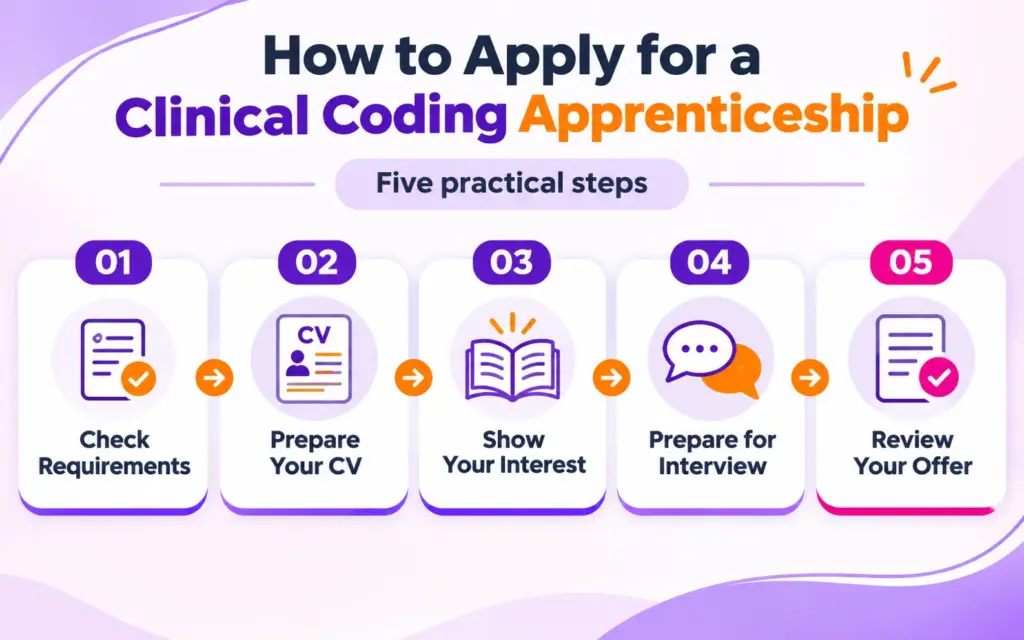
Step 1: Check the Vacancy Requirements
Read the job description and person specification carefully.
Separate essential requirements from desirable skills. An employer might require certain qualifications while listing healthcare administration experience as desirable.
Before applying, confirm:
- You meet the stated eligibility conditions.
- You can attend the workplace and scheduled training.
- You understand the salary and working arrangements.
- You can provide the requested qualifications or evidence.
- You can submit everything before the deadline.
If an important requirement is unclear, contact the recruiting organisation.
Step 2: Prepare Your CV and Supporting Statement
Your application should connect your experience to the employer’s requirements.
You may not have worked with clinical codes before, but you could have demonstrated accuracy while checking invoices, maintaining spreadsheets or managing customer records.
Use specific examples rather than simply stating that you are organised.
For instance, explain how you identified an error, corrected it and checked that the information was accurate.
In your supporting statement, describe why clinical coding interests you and what you understand about its role in healthcare.
Avoid copying generic personal statements. Employers need to understand your individual motivation and suitability.
Step 3: Show Your Interest in Clinical Coding
You do not need to become an expert before applying, but some introductory knowledge can help you discuss the role confidently.
Understand that clinical coders interpret documented healthcare information and apply classification rules. Familiarity with medical terminology, anatomy and record accuracy can also be useful.
For structured introductory study, Nextgen Learning’s Clinical Coding Course Online covers clinical terminology, coding classifications and healthcare documentation.
It is a CPD-accredited professional development course, not the regulated Level 3 apprenticeship itself. Completing it does not guarantee selection or replace employer-led training.
Step 4: Prepare for Assessments and Interviews
Recruitment processes vary between NHS employers.
You may be asked about your motivation, accuracy, communication skills or ability to manage unfamiliar information. Some employers also use practical screening exercises.
Prepare examples that demonstrate these abilities.
A possible interview question is:
“Tell us about a time you spotted an important mistake in a document or record. What did you do?”
A useful answer should explain the situation, your actions and the result.
You should also be comfortable explaining why confidentiality matters when handling healthcare information.
Practise answering clearly and naturally. You do not need to memorise complicated medical codes to demonstrate genuine interest.
Step 5: Review the Offer and Training Arrangements
If you receive an offer, check the employment terms carefully.
Confirm your salary, contracted hours, training schedule, workplace location and assessment responsibilities.
You should understand how your employer and training provider will support your learning, what time is allocated to training and who will supervise your development.
An apprenticeship is both a job and a learning commitment, so both parts matter.
Before accepting, ask how progress will be reviewed and who to contact if you need additional support during training.
What Will You Learn During a Clinical Coding Apprenticeship?
Clinical coding apprentices develop technical knowledge alongside professional workplace skills.
The training focuses on interpreting clinical documentation accurately, applying classification rules and communicating with colleagues when information needs clarification.

Clinical Coding Systems and Medical Records
Three important systems are worth recognising:
ICD-10 is used to classify diagnoses and health conditions. Understanding ICD-10 codes in UK healthcare provides useful background on how diagnostic information is organised.
OPCS-4 is used to classify procedures and interventions. The separate explanation of OPCS-4 procedure codes covers this system in more detail.
SNOMED CT is a structured clinical terminology used in electronic healthcare records. It serves a different purpose from ICD-10 and OPCS-4.
Apprentices also develop skills in reading patient records, recognising incomplete information, maintaining confidentiality and following established coding standards.
For readers interested in the documentation side of the role, Nextgen Learning’s Clinical Records and Coding Course introduces records management, clinical terminology and coding principles through independent online learning.
Apprenticeship Duration and Assessment
The current Skills England listing gives a typical training duration of 18 months, excluding the assessment period. Its occupational description also refers to a typical duration of 18–24 months.
Actual completion time depends on the apprenticeship arrangements and individual progress.
During training, apprentices develop competence through workplace activities and structured learning.
The programme includes end-point assessment to evaluate whether the apprentice has achieved the occupational standard.
Your employer and training provider should explain the specific assessment arrangements before and during the programme.
How Much Does a Clinical Coding Apprentice Earn in 2026?
Clinical coding apprenticeship pay depends on age, apprenticeship year and employer.
Under the 2026 National Minimum Wage rates for apprentices, the statutory apprentice rate from 1 April 2026 is £8.00 per hour.
This rate applies to apprentices who are either:
- Under 19.
- Aged 19 or over and in their first apprenticeship year.
Apprentices aged 19 or over who have completed their first year must receive at least the applicable age-related minimum wage.
For example, a 21-year-old apprentice who has completed their first year is entitled to the 2026 minimum rate of £12.71 per hour.
Employers can pay more than the statutory minimum.
NHS apprenticeship salaries should therefore be checked against individual adverts rather than estimated from a single national figure.
Also remember that the salary for a qualified clinical coder may differ from apprenticeship pay.
Clinical Coding Apprenticeship vs Trainee Clinical Coder
Not every entry-level clinical coding role follows the same training route.
Understanding the differences helps you choose vacancies that match your goals.
Which Entry Route Should You Consider?
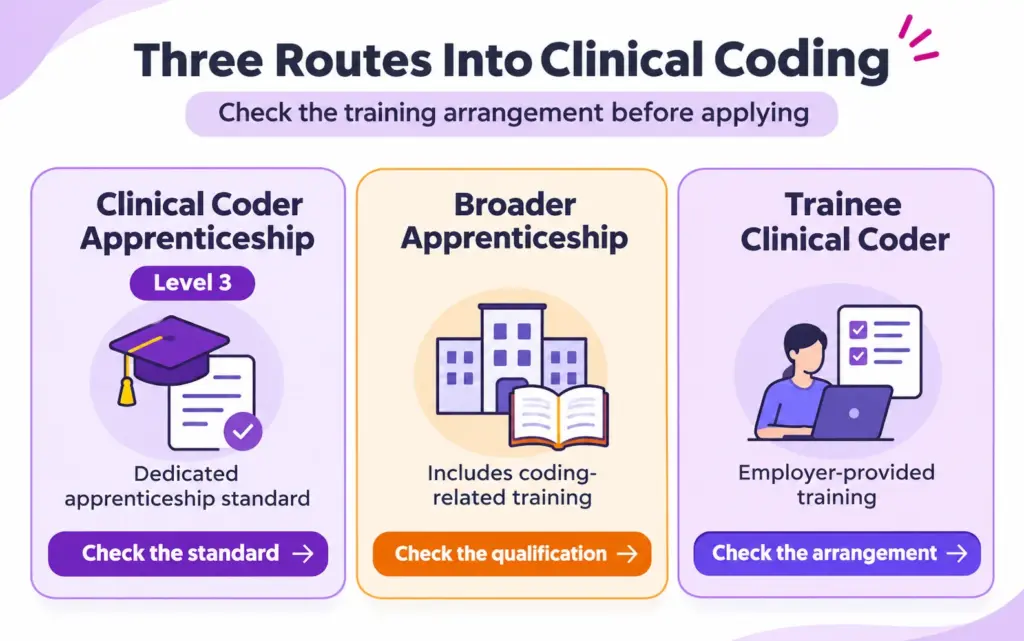
| Entry Route | What It Involves | What to Check |
|---|---|---|
| Level 3 Clinical Coder Apprenticeship | Paid employment combined with structured training under the dedicated occupational standard. | Apprenticeship standard, training provider and entry requirements. |
| Broader Apprenticeship with Embedded Coding | Training under another apprenticeship standard, with some clinical coding-related responsibilities. | The specific qualification or occupational standard followed by the programme. |
| Trainee Clinical Coder Position | Employment with clinical coding training, which may not form part of a formal apprenticeship. | Training arrangements, progression opportunities and assessment expectations. |
A dedicated apprenticeship provides a defined occupational training pathway.
A trainee position may offer valuable experience, but its structure and outcomes depend on the employer.
Some employers provide substantial training for novice clinical coders without using the formal apprenticeship route. Applicants should therefore compare the actual learning arrangements rather than assuming one job title always indicates a particular qualification.
None of these routes automatically guarantees progression into a particular NHS band or senior position.
Choose based on the advertised training, your circumstances and the skills you want to develop.
How Can You Prepare Before Applying?
You can make useful progress before an apprenticeship vacancy appears.
Start by building confidence in medical vocabulary. Learn common anatomical terms, abbreviations and the language used to describe conditions and procedures.
Nextgen Learning’s Medical Terminology Training covers body-system vocabulary, medical equipment and common abbreviations. It is an optional CPD-accredited learning resource rather than a formal apprenticeship entry requirement.
You can also practise checking documents for errors, using spreadsheets and writing clear professional messages.
These are manageable ways to develop confidence without trying to learn every clinical coding rule independently.
Your Next Step Towards a Clinical Coding Apprenticeship
Getting a clinical coding apprenticeship in 2026 starts with understanding the role, checking your eligibility and finding an employer offering suitable training.
You do not need to know everything about medical coding before applying. Focus on developing relevant skills, preparing convincing examples of your abilities and carefully reviewing each vacancy.
Keep an open mind about trainee positions and broader healthcare apprenticeships, but always check what training they actually provide.
Your most useful next step is to review current apprenticeship vacancies, compare their entry requirements and prepare an application that reflects your genuine strengths.
Frequently Asked Questions About Clinical Coding Apprenticeships
Yes. Some employers recruit beginners and provide structured workplace training. Previous healthcare experience may help, but it is not a universal requirement. Check each vacancy’s person specification and demonstrate relevant transferable skills.
No universal degree requirement is specified for the Level 3 Clinical Coder apprenticeship. Employers set their own selection criteria and may request particular school-level qualifications. A degree is not automatically necessary.
Yes. Apprenticeships in England are available to eligible adults as well as younger applicants. Your age, residency, education and circumstances must meet the relevant rules. Employers may also specify additional requirements.
Yes. A clinical coding apprenticeship involves paid employment alongside structured training. Apprentices must receive at least the applicable legal minimum wage, although employers may offer more. The actual salary depends on factors such as age, apprenticeship year and the employer’s advertised pay arrangements.
The Level 3 Clinical Coder apprenticeship standard currently lists a typical training duration of 18 months, excluding end-point assessment. The occupational description also refers to approximately 18–24 months. Your actual completion time will depend on the training arrangements and assessment schedule.
Not automatically. The National Clinical Coding Qualification (NCCQ) is a separate professional qualification recognised in UK clinical coding. NHS England’s guidance on the NCCQ identifies it as a national qualification managed and awarded by the Institute of Health Records and Information Management (IHRIM) in partnership with NHS England. Completing the Level 3 Clinical Coder apprenticeship does not automatically award the NCCQ.