



Working in Confined Spaces Training Course - Highlights
- 4.7/5
- Based on 34 enrolled learner reviews
Working in Confined Spaces Training: Online CPD Course
Working in confined spaces can involve risks that are difficult to recognise until conditions become dangerous. Therefore, anyone involved in planning, supervising or carrying out this type of work needs more than a simple definition of a confined space.
This Working in Confined Spaces Training course develops the knowledge needed to recognise hazards, consider legal responsibilities, assess risk and understand safer working arrangements. It also examines how better design can reduce exposure before moving into equipment, operating procedures and emergency planning.
HSE guidance states that confined-space entry should be avoided where reasonably practicable. If entry cannot be avoided, the work should follow an appropriate safe system, while suitable emergency arrangements must be planned beforehand.
Accordingly, this course teaches the principles behind safer working practices and risk control rather than presenting entry as the automatic solution.
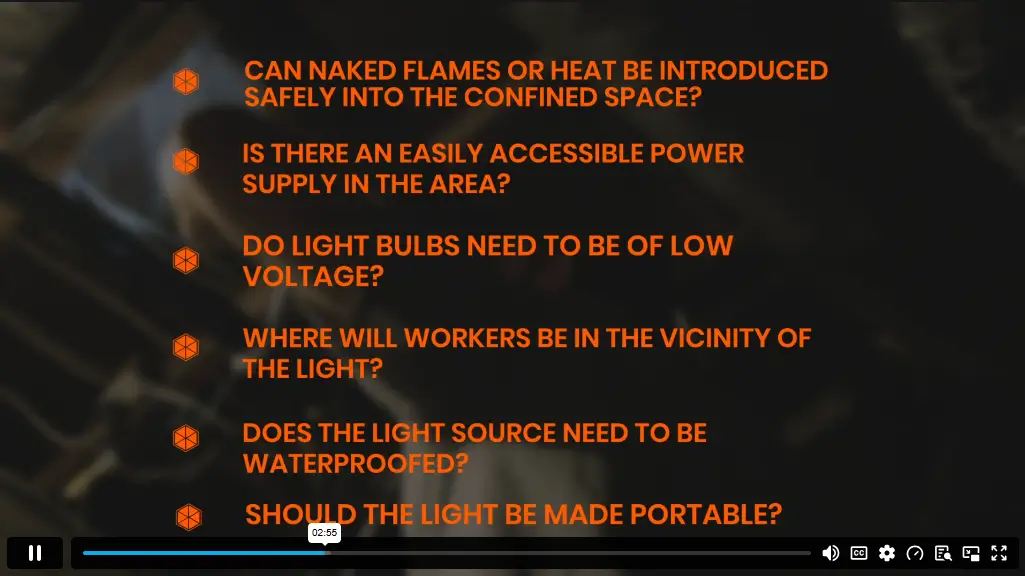
Exclusive Course Glimpse
What You Will Learn
By completing the course, you should be able to:
- Identify what may constitute confined-space working and recognise associated risks.
- Explain the main UK legal principles relevant to confined-space safety.
- Assess common confined-space hazards using structured risk-assessment principles.
- Evaluate how safer design and planning can reduce exposure to confined-space risks.
- Identify appropriate equipment and procedural considerations for safer work.
- Explain why planned emergency arrangements are essential before confined-space work begins.
- Apply the course principles when discussing or planning safer workplace procedures.
What Makes This Course Different?
The course follows the actual sequence in which confined-space safety should be considered rather than treating the subject as a list of hazards.
- Start with recognition: learn what confined-space working means before considering entry.
- Connect safety with legal responsibilities: explore why risk control and planning matter under UK requirements.
- Consider prevention through design: examine how better planning can reduce risk before work starts.
- Connect equipment with procedure: learn why equipment alone cannot replace an appropriate system of work.
- Finish with emergency planning: examine what must be considered when normal arrangements fail.
- Learn through instructor-taught video: study each topic on demand and revisit it through lifetime access.
Who Is This Course For?
This confined space training is particularly relevant to:
- Construction and maintenance workers who may encounter tanks, chambers, pits or similar spaces.
- Facilities and engineering staff who support inspection, maintenance or repair work.
- Supervisors and team leaders who need stronger awareness of hazards and safe-working principles.
- Health and safety staff developing broader knowledge of workplace risk control.
- Managers or employers who need a clearer understanding of confined-space responsibilities.
- Beginners entering safety-sensitive industries who want foundation knowledge before progressing to role-specific practical training.
Course Curriculum
Learn how confined spaces are identified and why an enclosed or substantially enclosed environment can create distinctive safety risks. This module establishes the concepts needed before assessing hazards or planning work.
Explore the main legal principles affecting confined-space work and why employers, supervisors and workers must take suitable precautions. The module connects legal responsibilities with safe planning and workplace decision-making.
Examine how hazards can be identified and evaluated before work begins. You will consider why conditions, work activities and foreseeable risks must be assessed rather than relying on assumptions.
Learn how design and planning decisions can reduce exposure to confined-space hazards. This module encourages a preventative approach by considering how risks may be reduced before someone needs to enter.
Explore why suitable equipment must be supported by appropriate procedures. You will examine the role of planned working methods in controlling risk and supporting safer confined-space operations.
Study the importance of preparing for emergencies before work begins. The module develops awareness of planned response arrangements and why improvised rescue attempts can expose additional people to danger.
How You Will Learn
The course is delivered through pre-recorded instructor-taught video, allowing you to study independently rather than attending scheduled live classes.
You can work through all six modules at your own pace and return to lessons whenever necessary because your course access is lifetime.
As a result, the format is particularly useful for learners who need to balance training with work commitments. However, online learning should be regarded as knowledge development. Where a job requires practical confined-space entry, equipment use or rescue activity, appropriate workplace and practical competence requirements must also be considered.
Certificate and Recognition
After completing the course, you will receive the supplied CPD Certificate and the training is described as having CPD Accreditation.
The certificate can provide evidence that you have completed structured continuing professional development in confined-space safety.
Career Relevance and Professional Application
Confined-space knowledge can support people working across construction, utilities, facilities management, engineering, maintenance, manufacturing and health and safety.
For example, understanding hazards, risk assessment and emergency planning may be useful when contributing to toolbox talks, reviewing work plans, supporting risk assessments or discussing safe-working arrangements.
However, completing this short CPD course does not by itself qualify someone as a confined-space entrant, rescue operative, entry controller or other competent specialist.
HSE emphasises that competence and training should reflect the hazards and tasks actually being undertaken. Safety-critical work may therefore require stronger competence assessment and practical training.
Entry Requirements
This is a beginner-level course, so no previous confined-space qualification or professional experience is required to enrol.
Because the training is delivered online, learners will need an internet-enabled device and sufficient English comprehension to follow workplace safety terminology and instructions.
If your employer requires practical confined-space entry training, check those workplace requirements separately before relying on an online CPD course.
Why Study This Course with NextGen Learning?
NextGen’s course combines a focused six-module syllabus with the flexibility of online learning.
You can:
- learn through instructor-taught video rather than relying only on written material;
- progress through the course at your own pace;
- revisit the training through lifetime access;
- build CPD evidence with the supplied CPD Certificate; and
- study the complete course for the stated price of £49.
Most importantly, the course follows a logical safety progression from recognition and legal duties through to assessment, prevention, procedures and emergency planning.
Order Your Certificate
To order your Certificate, we kindly invite you to visit the following link
Frequently Asked Questions
A confined space is not defined only by its size. HSE describes it as an enclosed or largely enclosed place where a reasonably foreseeable specified risk may arise, including risks from fire, explosion, hazardous atmospheres, asphyxiation or drowning. Tanks, silos, pits, pipes and sewers can be examples.
Employers must ensure workers receive suitable information, instruction, training and supervision for their work. For confined-space activities, the level of training needed depends on the work, hazards and employee competence. Therefore, there is no basis for assuming that one generic online certificate satisfies every confined-space role.
Yes. Knowledge-based confined-space training can be delivered effectively online, particularly for legal awareness, hazard recognition, risk assessment and procedures. However, workers who must enter confined spaces or operate specialist safety or rescue equipment may also require appropriate demonstrations, practical exercises, workplace instruction and competence assessment.
No. This course should be treated as CPD knowledge training rather than proof that you are practically competent for every confined-space environment. Your employer must determine the training and competence required for your work, equipment, site conditions and level of risk.
In Great Britain, the central legislation is the Confined Spaces Regulations 1997. The key principles include avoiding entry where possible, using a safe system of work when entry is unavoidable and preparing adequate emergency arrangements beforehand. Northern Ireland uses the Confined Spaces Regulations (Northern Ireland) 1999.
Hazards can include harmful fumes, reduced oxygen, fire, explosion, flooding, drowning and asphyxiation. Conditions can also change over time, so a space that previously appeared safe should not automatically be assumed to remain safe.
Yes. The supplied course specification states that learners receive a CPD Certificate and that the course has CPD Accreditation. The certificate demonstrates completion of continuing professional development; it should not be presented as a regulated practical confined-space qualification or occupational licence.
Build Safer Confined-Space Knowledge
If your work may bring you into contact with confined spaces, this course provides a structured starting point for understanding hazards, legal responsibilities, risk assessment, safer planning and emergency procedures.
Study through instructor-taught video at your own pace, revisit the material with lifetime access and build documented CPD learning.
Enrol today and begin your Working in Confined Spaces Training.
Course Curriculum
| Module 01: Understanding Confined Space Working | |||
| Understanding Confined Space Working | 00:10:00 | ||
| Module 02: UK Laws for Working in Confined Spaces | |||
| UK Laws for Working in Confined Spaces | 00:10:00 | ||
| Module 03: Risk Assessment of Confined Spaces | |||
| Risk Assessment of Confined Spaces | 00:11:00 | ||
| Module 04: Safety Through Better Design | |||
| Safety Through Better Design | 00:09:00 | ||
| Module 05: Using the Right Equipment and Procedures | |||
| Using the Right Equipment and Procedures | 00:09:00 | ||
| Module 06: Emergency Procedures for Confined Spaces | |||
| Emergency Procedures for Confined Spaces | 00:10:00 | ||
| Order Your Certificate | |||
| Order Your Certificate | 00:00:00 | ||
Related Courses
Excavation Work and Confined spaces
Property Development Diploma Level 5
Digital Electric Circuits & Intelligent Electrical Devices