


Popular Courses

Brand
Awarding body image

Overview of Clinical Audit Course

Effective clinical audit requires clear standards, reliable evidence, accurate data and a commitment to improvement. This Clinical Audit Course introduces the wider governance framework surrounding audit while explaining how clinical effectiveness supports evidence-based care. Learners will explore how healthcare organisations assess performance, protect confidential information and use digital systems responsibly. Moreover, the course examines legal, ethical and workplace safety considerations that influence audit activity. As a result, you can develop greater confidence when contributing to audit discussions, collecting information, recognising performance gaps or supporting improvement plans within healthcare settings.

By completing this course, you will be able to:

  • Explain the purpose and scope of clinical governance
  • Identify the seven pillars associated with clinical governance
  • Describe how clinical audit contributes to NHS quality improvement
  • Distinguish clinical audit from general monitoring and research
  • Identify appropriate evidence-based standards for an audit
  • Support the collection and organisation of audit information
  • Compare current practice against defined criteria
  • Recognise gaps between expected and actual performance
  • Contribute to action planning following audit findings
  • Understand the value of re-auditing after improvements
  • Protect confidential healthcare information during audit activity
  • Apply ethical and safety awareness within clinical environments

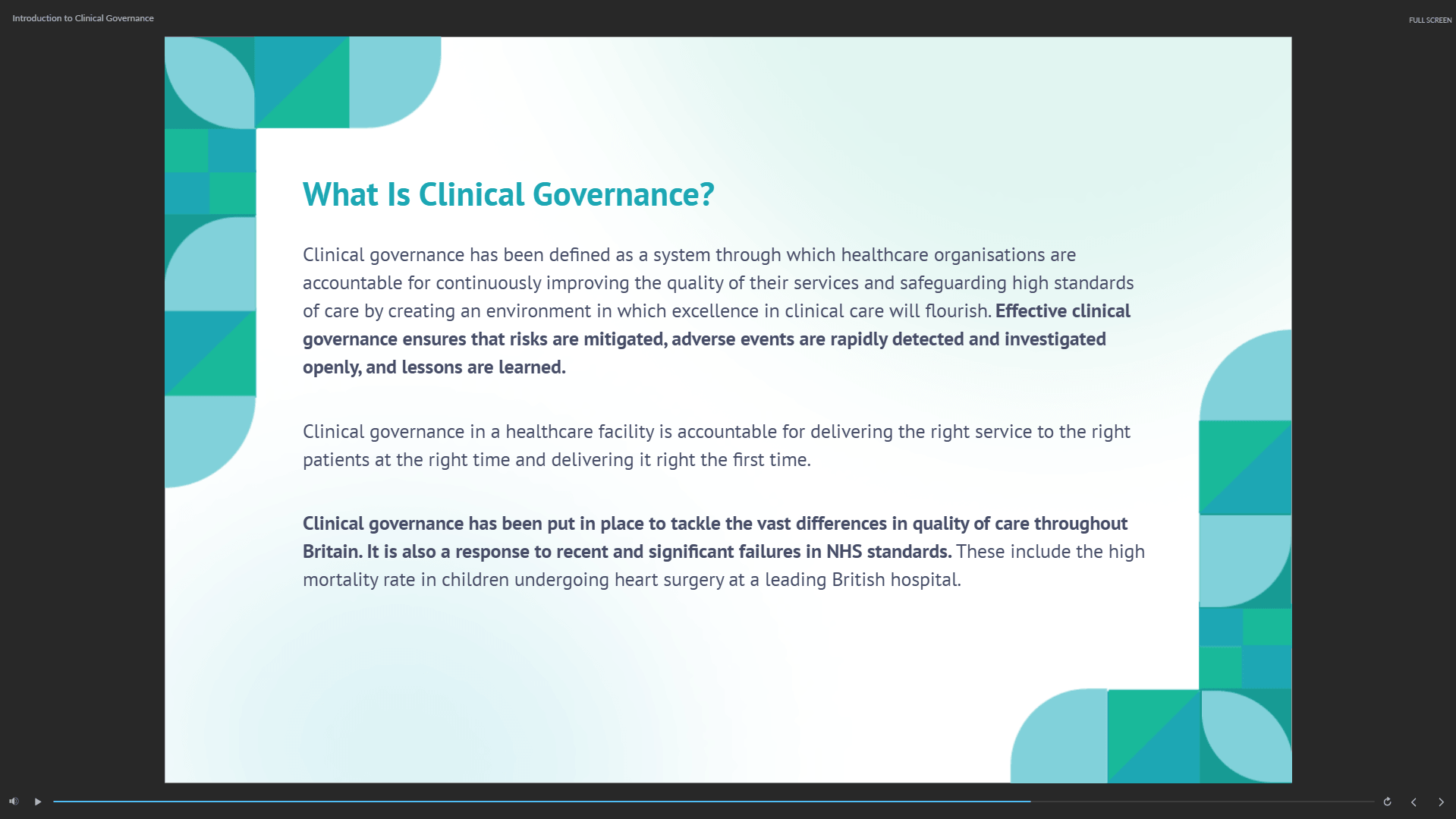
Exclusive Course Glimpse

Learning Outcomes

After completing this course, learners will confidently understand how to:

  • Explain the connection between governance, assurance and improvement
  • Recognise the role of audit in evaluating healthcare quality
  • Interpret the main stages of a clinical audit cycle
  • Understand how clinical effectiveness supports patient outcomes
  • Identify confidentiality risks involving healthcare records
  • Recognise the role of information technology in healthcare review
  • Explain key legal and ethical responsibilities
  • Support safe and organised audit-related activities

Why Choose This Clinical Audit Course?

This course combines audit knowledge with broader healthcare governance and professional responsibilities.

  • Practical subject coverage: Explore audit, effectiveness and improvement
  • Healthcare relevance: Build knowledge applicable across care settings
  • Governance foundation: Understand the wider framework supporting quality
  • Flexible online learning: Study around professional commitments
  • Step-by-step modules: Progress through each topic in a logical order
  • Professional development: Strengthen your healthcare quality knowledge
  • Confidentiality focus: Learn why secure information handling matters
  • UK sector awareness: Explore concepts used within NHS environments

Clinical audit is a cyclical process rather than a one-off inspection. Healthcare practice is measured against evidence-based criteria, improvements are introduced and services are then reviewed again to assess their effect.

Certificate of Achievement

  • CPD Accredited Certificate
  • Digital Certificate
  • Professional Recognition
  • CV and LinkedIn Enhancement
  • Proof of Professional Skills
Nextgen Certificate

Who Is This Course For?​

This course is suitable for:

  • Nurses and nursing associates
  • Healthcare assistants and support workers
  • Doctors and allied health professionals
  • Clinical audit and governance administrators
  • Practice managers and care-service managers
  • Healthcare quality-improvement staff
  • Medical records and information employees
  • Students pursuing healthcare careers

Career Opportunities in the UK

This Clinical Audit Course supports professional development for roles involving healthcare governance, records, management and quality improvement. However, many positions require clinical registration, relevant qualifications or practical experience in addition to introductory audit training.

Clinical Audit Officer

Clinical audit officers coordinate audit projects, collect data and help teams compare performance against agreed standards. They may prepare reports, monitor action plans and support re-audits to assess whether improvements have been sustained.

Average UK Salary: £26,000 – £42,000 per year

Clinical Governance Coordinator

Clinical governance coordinators support systems involving patient safety, audit, risk and service quality. They may organise meetings, maintain governance records and follow up on improvement actions across clinical teams.

Average UK Salary: £28,000 – £45,000 per year

Healthcare Quality Improvement Officer

Quality improvement officers help healthcare teams identify performance gaps and implement structured improvements. Their duties may involve analysing results, supporting improvement projects and communicating findings to stakeholders.

Average UK Salary: £28,000 – £48,000 per year

Health Service Manager

Health service managers run services within hospitals, GP practices and community settings. They may oversee staffing, budgets, performance targets and quality-improvement programmes.

Average UK Salary: £32,000 – £77,000 per year

GP Practice Manager

GP practice managers oversee the administrative and operational side of surgeries and health centres. Clinical audit knowledge can help them coordinate quality reviews, maintain records and support service improvement.

Average UK Salary: £35,000 – £65,000 per year

Health Records Clerk

Health records clerks maintain patient files and prepare accurate information for healthcare appointments. Their work supports audit reliability because reviewers depend on complete, secure and up-to-date clinical records.

Average UK Salary: £25,000 – £31,000 per year

Entry Requirements

  • No formal qualifications are required
  • Suitable for beginners and healthcare professionals
  • Basic written English is recommended
  • Internet access and a suitable digital device are required
  • An interest in clinical governance or healthcare quality is helpful

Order Your Certificate

To order your Certificate, we kindly invite you to visit the following link

Frequently Asked Questions -

A Clinical Audit Course explains how healthcare practice is measured against agreed standards. It explores data collection, performance comparison, improvement planning and re-auditing. Moreover, this programme connects clinical audit with governance, ethics and clinical effectiveness.

Clinical audit is a quality improvement process used to determine whether care meets evidence-based standards. It helps healthcare teams recognise good practice and identify areas requiring improvement. NHS England states that audits may take place nationally or locally in hospitals, trusts and GP practices.

A typical audit involves selecting a topic, setting standards, collecting data and comparing results. Teams then implement improvements before repeating the audit. Therefore, re-auditing is essential because it shows whether the changes have improved practice.

No, clinical audit and research serve different purposes. Research aims to create new knowledge, while audit measures existing care against established standards. However, both require careful planning, ethical awareness and responsible information handling.

The course is suitable for clinical staff, healthcare administrators, managers and governance employees. It may also benefit care professionals who contribute to quality checks or service reviews. No previous auditing qualification is required.

Yes, the curriculum includes confidentiality within medical environments. Learners examine why healthcare information must be protected during routine work and audit activities. Furthermore, responsible information handling supports patient trust and accurate governance processes.

Yes, the course is delivered online through structured learning modules. The supplied curriculum contains approximately three hours and thirty-four minutes of material. Consequently, learners can study around shifts, employment and personal commitments.

The course can build useful introductory knowledge for audit, governance and quality-improvement roles. However, employers may also require healthcare experience, data skills or specialist qualifications. Therefore, this training should support wider career development rather than act as a complete professional qualification.

Course Curriculum

Module 01: Introduction to Clinical Governance
Introduction to Clinical Governance 00:16:00
Module 02: The 7 Pillars of Clinical Governance
The 7 Pillars of Clinical Governance 00:14:00
Module 03: National Health Services
National Health Services 00:28:00
Module 04: Clinical Effectiveness: Part 1
Clinical Effectiveness Part 1 00:23:00
Module 05: Clinical Effectiveness: Part 2
Clinical Effectiveness Part 2 00:22:00
Module 06: Clinical Audit
Clinical Audit 00:33:00
Module 07: Confidentiality in a Medical Environment
Confidentiality in a Medical Environment 00:14:00
Module 08: Information Technology in Health Care
Information Technology in Health Care 00:14:00
Module 09: Legal aspects and Ethics
Legal aspects and Ethics 00:19:00
Module 10: Maintaining Workplace Safety
Maintaining Workplace Safety 00:22:00
Module 11: Covid-19 Awareness
Covid-19 Awareness 00:29:00
Assignment
Assignment – Clinical Governance & Audit 00:00:00
Order Your Certificate
Order Your Certificate 00:00:00

Related Courses

No course found

A product of

© 2026 NextGen Learning. All rights reserved

Home Search Cart Offers
Select your currency
GBP Pound sterling