

Popular Courses

Brand
Awarding body image

Online Pharmacology Course — Master Drug Science from Foundation to Clinical Practice

From the way a painkiller reaches your bloodstream to how chemotherapy targets tumour cells, pharmacology sits at the heart of modern medicine. This CPD-accredited online pharmacology course gives you a structured, expert-guided journey through the science of drugs — how they work, how they’re developed, and how they’re used safely in clinical and research settings. Whether you’re building towards a career in healthcare, pharmaceutical research, or regulatory affairs, this course gives you the knowledge and the credential to move forward with confidence.

Who This Course Is For

pharmacology career outcomes

This online pharmacology course is built for motivated learners who want a rigorous, accessible grounding in drug science — without needing a lab coat or a lecture hall.

This course is the right fit if you are:

  • A nurse, healthcare assistant, or allied health professional who wants to understand the medications you administer and advise on — and why they work the way they do
  • A student or graduate in biology, chemistry, or a health-related subject looking to build specialist knowledge before entering clinical or research roles
  • Someone working in pharmaceutical sales, regulatory affairs, or medical devices who needs deeper scientific grounding to do their job more effectively
  • A career changer exploring the life sciences sector and looking for a credible, flexible starting point
  • A healthcare manager or administrator who wants to better understand the clinical decisions being made around you
  • Anyone with a genuine curiosity about how medicines work — and the drive to learn it properly

No prior pharmacology qualification is required. A basic interest in biology or health science will help you get the most from the material.

What You'll Learn

By the end of this online pharmacology course, you will be able to:

  • Explain how drugs act on the body — including the mechanisms behind receptor binding, dose-response relationships, and drug-receptor interactions
  • Trace a drug’s journey through the body — from absorption and distribution to metabolism and excretion (ADME), and why this matters for safe prescribing
  • Understand the full drug development pipeline — from early-stage research and preclinical testing through to clinical trials, regulatory submission, and post-market surveillance
  • Apply pharmacological knowledge to specific body systems — including the nervous system, cardiovascular system, endocrine system, and immune response
  • Recognise how chemotherapy drugs work — and understand the clinical rationale behind different cancer treatment strategies
  • Identify toxic effects and adverse drug reactions — and understand the principles of pharmacovigilance and patient safety
  • Navigate the UK regulatory landscape — including the roles of the MHRA and how medicines are licensed and monitored in Britain
  • Use pharmacological principles in real professional contexts — whether in clinical practice, drug development, research, or regulatory work

Full Course Curriculum

The foundation of everything that follows. This module introduces the core concepts underpinning all drug science: pharmacodynamics (what drugs do to the body) and pharmacokinetics (what the body does to drugs). You’ll explore drug-receptor interactions, dose-response curves, bioavailability, and the ADME framework — absorption, distribution, metabolism, and excretion. By the end, you’ll have the scientific vocabulary and conceptual framework to understand every module that follows.


How does a molecule discovered in a laboratory become a licensed medicine on a pharmacy shelf? This module walks you through every stage of the drug development process — from target identification and preclinical research through Phase I, II, and III clinical trials to regulatory submission. You’ll learn how the MHRA (Medicines and Healthcare products Regulatory Agency) oversees drug approval in the UK, and how post-market pharmacovigilance keeps patients safe after a medicine launches.


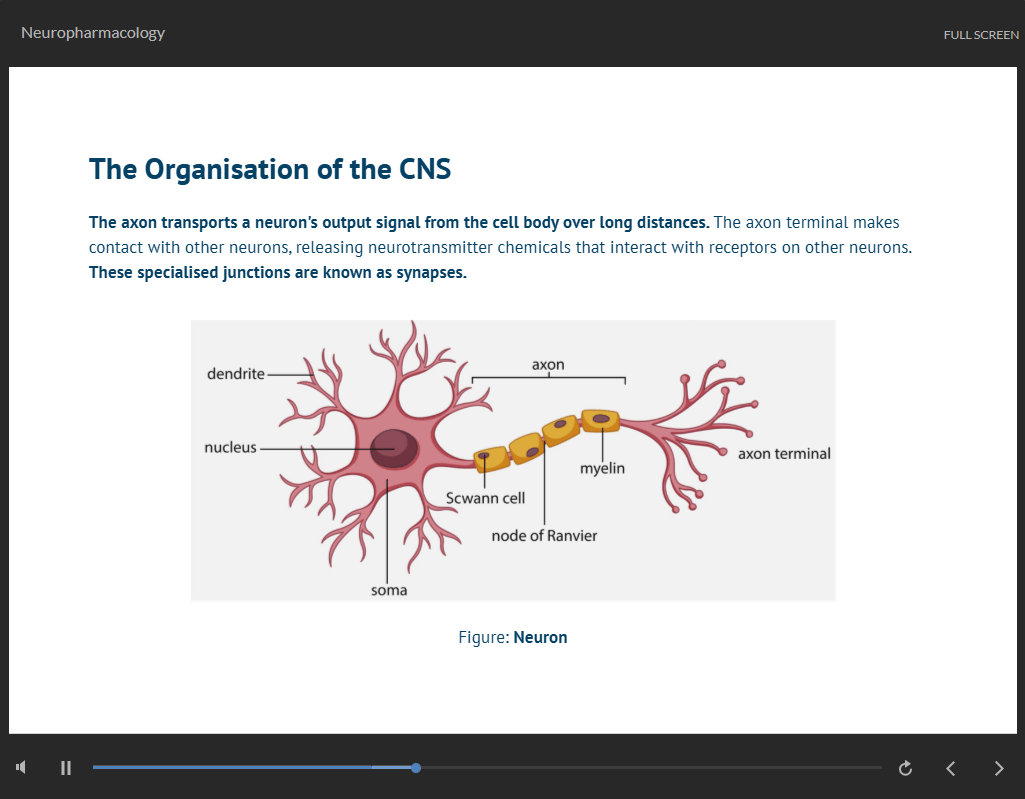
The brain is the most complex drug target in the human body. This module examines how drugs interact with the central and peripheral nervous systems — covering neurotransmitters, receptor subtypes, and the mechanisms behind drugs used in conditions such as depression, anxiety, epilepsy, Parkinson’s disease, and schizophrenia. You’ll also explore the pharmacology of anaesthetics and analgesics, and understand why drug development in neurology presents unique challenges.


Heart disease remains the leading cause of death in the UK. This module covers the pharmacological management of the major cardiovascular conditions — hypertension, heart failure, arrhythmias, and coronary artery disease. You’ll study how drug classes including beta-blockers, ACE inhibitors, statins, anticoagulants, and antiplatelets work at a molecular level, and how clinical evidence guides their use in practice.


Hormones regulate almost every function in the human body — and when they go wrong, the consequences are far-reaching. This module examines drugs that act on or mimic the endocrine system, including insulin and diabetes therapies, thyroid medications, corticosteroids, and hormonal contraceptives. You’ll explore how endocrine pharmacology underpins the management of some of the most prevalent conditions in the UK, including type 2 diabetes and hypothyroidism.


Cancer treatment is one of the most rapidly evolving areas of pharmacology. This module provides a clear-eyed introduction to the major classes of chemotherapeutic agents — alkylating agents, antimetabolites, topoisomerase inhibitors, and targeted biologics — explaining how each class works, what cancers it targets, and how clinicians balance therapeutic effect against toxicity. You’ll also explore the growing role of immunotherapy and precision medicine in oncology.


Inflammation is both a protective mechanism and, when dysregulated, a driver of chronic disease. This module covers the pharmacology of anti-inflammatory and immunomodulatory drugs — from NSAIDs and corticosteroids to disease-modifying antirheumatic drugs (DMARDs) and biologics used in conditions such as rheumatoid arthritis, Crohn’s disease, and asthma. You’ll also examine how vaccines work and the pharmacological principles behind immunosuppression in transplant medicine.


Every drug is a potential toxin — what separates medicine from poison is dose, context, and individual variation. This module introduces the principles of clinical toxicology, covering how the body responds to drug overdose, environmental toxins, and occupational chemical exposure. You’ll learn about the therapeutic index, lethal dose concepts, and the management of common poisoning presentations. This knowledge is directly relevant to pharmacovigilance, clinical practice, and regulatory safety assessment.

CPD Accreditation

This Pharmacology Course Online UK is accredited by the CPD Quality Standard, confirming that the course meets recognised UK benchmarks for continuing professional development. Upon successful completion of the course and assessment, learners are eligible to receive a CPD Quality Standard Certificate, which can be used to evidence ongoing learning and professional development.

Nextgen Certificate

Why Choose This Online Pharmacology Course?

There are dozens of online science courses available. Here is what makes this one worth your time and your investment.

Genuine curriculum depth. Each module goes beyond surface definitions. You’ll engage with mechanisms, clinical relevance, and real-world applications — not just terminology to memorise before an MCQ.

Structured for busy professionals. The course is fully self-paced with 12 months’ access. Study in the early morning before a shift, during a lunch break, or across weekends — the material works around your life, not the other way around.

CPD-accredited certification. On successful completion, you’ll receive a CPD-accredited certificate, recognised by employers and professional bodies across the UK as evidence of continuing professional development.

No prerequisites, no barriers. You don’t need an existing science degree to enrol. If you understand basic biology and have a genuine motivation to learn, this course is accessible to you.

Immediate, practical relevance. Whether you’re a nurse encountering complex drug regimens, a researcher entering clinical trials, or a professional moving into regulatory affairs, the knowledge in this course applies directly to the work in front of you.

Dedicated support. You’ll have access to one-to-one tutor support throughout your studies — so if a concept isn’t clicking, you’re not left to figure it out alone.

What Our Learners Say

Frequently Asked Questions About the Pharmacology Course

A pharmacology course explains how medicines work in the body, including drug actions, side effects, safety considerations, and regulation. This course focuses on foundational pharmacology knowledge for education and professional development rather than clinical or prescribing practice.

Yes. On successful completion of the assessment, you will receive a CPD-accredited certificate. CPD (Continuing Professional Development) accreditation is recognised by professional bodies and employers across the UK as formal evidence of ongoing learning and skills development.


No prior qualifications are required. The course is designed to be accessible to motivated learners from a range of backgrounds, including healthcare workers, career changers, and students. A general interest in biology or health science will help, but no formal science qualification is needed to enrol.


Pharmacology knowledge underpins a wide range of careers in the UK life sciences and healthcare sectors, including: clinical research assistant (£22,000–£29,000), pharmacovigilance officer (£25,000–£42,000), regulatory affairs associate (£29,000–£65,000), medical science liaison (£60,000–£80,000), and mental health nursing (£31,000–£47,000). This course provides foundational knowledge relevant to all of these roles.


The assessment consists of a multiple-choice questionnaire (MCQ). You need to score 60% or above to pass. Once you pass, you can order your CPD-accredited PDF certificate for £8.99 or a printed hard copy for £15.99. There is no time limit on the assessment, and you can retake it if needed.


The course is fully self-paced. Most learners complete all eight modules within 4 to 12 weeks, depending on their prior knowledge and the time they can dedicate each week. You have 12 months’ access from enrolment, giving you plenty of flexibility to study around work, family, or other commitments.


Pharmacokinetics is the study of how the body handles a drug — specifically how it is absorbed, distributed through the body, metabolised (chemically altered), and excreted. Pharmacodynamics is the study of what the drug does to the body — its mechanisms of action, receptor interactions, and effects at different doses. Both are covered in Module 01 of this course and are foundational to all subsequent pharmacology study.


Pharmacology focuses on how drugs work and affect the body, while pharmacy is a regulated profession involving dispensing medicines and patient care. This course focuses on pharmacology knowledge, not pharmacy practice.

Yes. The course is accessible to learners worldwide via any internet-connected device. The curriculum uses UK regulatory context (including MHRA guidance), which is particularly relevant to learners based in Britain, but the core pharmacological science is internationally applicable.

Ready to Begin Your Pharmacology Training?

If you’ve read this far, you already know this matters to you. Whether you’re aiming to deepen your clinical knowledge, accelerate a move into pharmaceutical research, or simply understand the science behind the medicines that shape modern healthcare — this course gives you the foundation to do it properly.

Eight rigorously structured modules. CPD-accredited certification. Expert support throughout. Study entirely online at whatever pace works for your life.

Enrol on the online pharmacology course today and take the first step towards a deeper, more confident understanding of drug science.

Order Your Certificate

To order your Certificate, we kindly invite you to visit the following link

Course Curriculum

Module 01: Fundamental Principles of Pharmacology
Fundamental Principles of Pharmacology 00:23:00
Module 02: Drug Development and Regulation
Drug Development and Regulation 00:15:00
Module 03: Neuropharmacology
Neuropharmacology 00:15:00
Module 04: Cardiovascular Pharmacology
Cardiovascular Pharmacology 00:20:00
Module 05: Endocrine Pharmacology
Endocrine Pharmacology 00:22:00
Module 06: Chemotherapy
Chemotherapy 00:19:00
Module 07: Inflammation and Immune Pharmacology
Inflammation and Immune Pharmacology 00:14:00
Module 08: Toxicology
Toxicology 00:17:00
Assignment
Assignment – Pharmacology 00:00:00
Order Your Certificate
Order Your Certificate 00:00:00

Related Courses

A product of

© 2026 NextGen Learning. All rights reserved

Home Search Cart Offers
Select your currency
GBP Pound sterling