




HRG Codes Explained: How NHS Payments Really Work
Every hospital admission leaves a trail of clinical information: diagnoses, procedures, patient characteristics and care delivered. But how does that information become useful for NHS costing and payments?
HRG codes are an important part of the answer. They organise healthcare activity into comparable groups, helping staff interpret resource use without treating every patient’s care as identical.
For anyone learning clinical coding, the key is to understand where coding ends, grouping begins and payment rules come into play. This article focuses on NHS England, whose payment arrangements are not necessarily the same as those elsewhere in the UK.
Table of Contents
What Are HRG Codes in the NHS?
HRG stands for Healthcare Resource Group. HRG codes identify groups of healthcare activity that are clinically meaningful and expected to require similar resources. They are derived from patient activity data, including relevant diagnoses and procedures. The NHS uses them for costing, comparisons, service analysis and applicable payment arrangements; they are not individual treatment bills.
NHS England’s HRG grouping guidance describes how activity from patient records is classified into these groups.
Why Does the NHS Use Healthcare Resource Groups?
Imagine two people receiving care for similar conditions. One needs a straightforward intervention; the other has additional documented health problems requiring more complex care. A useful classification must recognise meaningful differences in expected resource use while grouping broadly comparable activity together.
HRGs help the NHS:
- Analyse costs: Understand typical resource requirements for different types of activity.
- Compare services: Examine comparable care across hospitals and organisations.
- Plan capacity: Review patterns of healthcare activity and demand.
- Support payment: Identify currencies and prices where the applicable payment arrangements use HRGs.
The phrase resource group is deliberate. An HRG describes activity; it does not tell you exactly what one patient cost to treat or what a hospital will receive.
How Are HRG Codes Structured?
An HRG code contains five characters. The opening letters identify the clinical chapter and subchapter, the following numbers identify the group within that subchapter, and the final letter describes a relevant split.
Understanding the Five-Character HRG Format
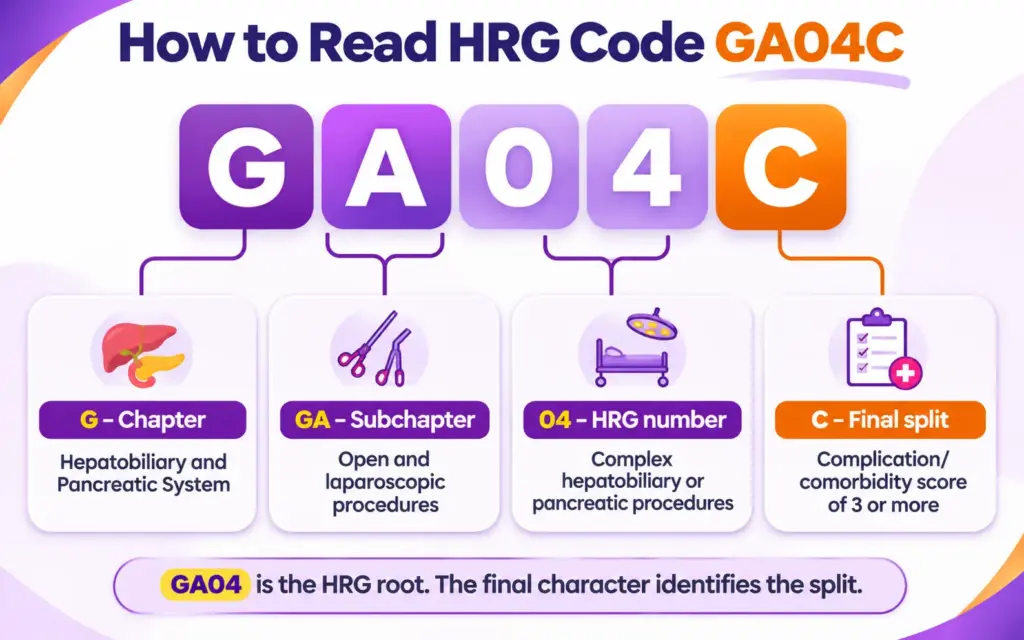
NHS England’s HRG design guidance gives GA04C as an official example:
| Code Element | Meaning |
|---|---|
| G | Hepatobiliary and Pancreatic System chapter |
| GA | Open and laparoscopic procedures subchapter |
| 04 | Complex hepatobiliary or pancreatic procedures group |
| C | Complication/comorbidity score of 3 or more |
The first four characters, GA04, form the HRG root. The final character represents the split associated with that particular group.
Depending on the design, splits may relate to complications, comorbidities, age or length of stay. Their interpretation is not uniform across all HRGs; a final Z indicates no split.
This code illustrates structure, not an automatic outcome for anyone undergoing a hepatobiliary procedure. An actual grouping result requires the appropriate coded record and grouping rules.
coding study
Clinical Coding: PCS 3M Workshop
For additional procedural coding study, explore this introductory online workshop from NextGen Learning.
View courseHow Do HRG Codes Work in Clinical Coding?
Clinical coders classify information recorded by healthcare professionals. Grouping software then uses the relevant data to determine HRGs. These are related but distinct tasks.
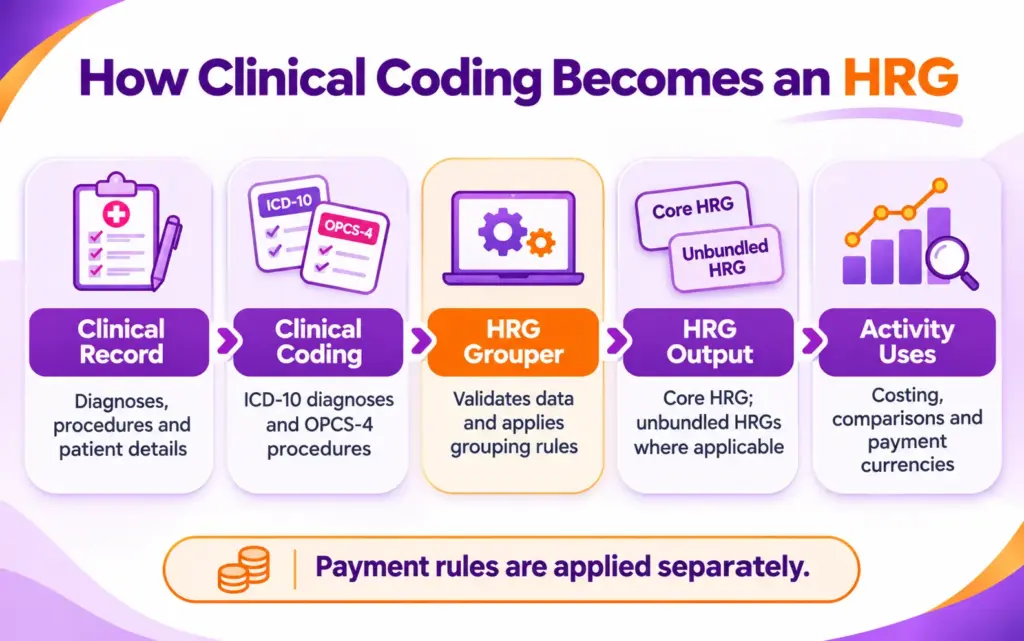
Step 1 — Document and Classify Diagnoses
Clinical records describe the reason for care and other relevant conditions. Coders use ICD-10 to classify diagnoses according to national standards, without inventing details that clinicians have not documented.
A main diagnosis may drive some types of grouping. In other cases, documented additional conditions influence the eventual split. Which details matter depends on the applicable design, not simply the number of diagnoses entered.
Our guide to ICD-10 codes in the UK explains that diagnosis classification in greater detail.
Step 2 — Classify Procedures with OPCS-4
Where relevant, coders assign OPCS-4 codes for recorded procedures and interventions. Unlike ICD-10, which concerns diagnoses, OPCS-4 describes what was done. Certain procedure codes can be particularly important in determining the grouping for an admitted patient episode or spell.
For a fuller explanation of the procedure classification, see OPCS procedure codes. An HRG is neither an ICD-10 diagnosis code nor an OPCS-4 procedure code: it is an output of grouping relevant activity information.
Step 3 — Apply Grouper Rules
The HRG Grouper checks the input, performs necessary preprocessing and applies classification rules. It may use procedures, diagnoses, age, length of stay and other required fields. Invalid or inconsistent information can prevent reliable grouping.
The Grouper identifies a core HRG for relevant activity. Some services can also generate unbundled HRGs, representing elements such as particular diagnostic imaging or other separately identified resource use. These additions do not automatically create separate payments. The NHS grouping reference manual explains the distinction.
Step 4 — Interpret the Result
Once grouped, the activity can be analysed for costing, comparisons and relevant payment currencies. A useful check is to ask three separate questions: Is the clinical classification correct? Was the appropriate grouper release used? Which payment rules apply to this activity?
A further distinction helps when reading hospital data:
Grouping can be performed at different activity levels, including a finished consultant episode or a hospital provider spell.
A spell represents a period of care under one provider and can contain more than one consultant episode. The correct unit matters because grouping inputs and outputs are not always identical across those levels.
Readers should therefore check whether an example refers to an episode, a spell or a separately identified care element. Otherwise, two reports may appear inconsistent even when they describe different units of activity.
This is relevant when interpreting an HRG figure alongside an activity report. The same principle applies when comparing hospitals: use matching definitions, years and grouping purposes before drawing conclusions about complexity or resources.
Keeping those questions separate prevents a misunderstanding: a technically valid HRG is not, by itself, a final payment decision.
HRG Codes Example: A Hospital Patient's Record
Consider a fictional adult admitted for a planned operation involving the liver or gallbladder. The surgical team records the clinical reason for the operation, the procedure performed and relevant additional conditions. Suppose the patient also has a documented chronic illness that needs consideration during their admission.

What matters for grouping is not the everyday label liver surgery, but the classified information and the precise rules that apply.
What Would the Grouper Need to Consider?
The clinical indication: The documented diagnosis gives the coder information for selecting the appropriate ICD-10 classification. A vague or incomplete diagnosis may require clarification rather than guesswork.
The operation performed: The operation note supports selection of the relevant OPCS-4 procedure classification. A more specific procedure description can matter because grouping rules distinguish between types of activity.
Additional conditions: A documented comorbidity may contribute to a complication/comorbidity score where that HRG design uses one. It does not necessarily change the group or split in every case.
Other required fields: Patient characteristics and activity details may also be relevant, depending on the grouper’s rules. The resulting core HRG may be accompanied by unbundled groups for qualifying care elements.
The official code GA04C demonstrates how a hepatobiliary HRG and a complication/comorbidity split can be represented. It is not a verified result for this fictional patient. Producing an actual HRG would require valid clinical codes, all required data and the correct grouper version.
That distinction is what makes careful records management useful. Even an apparently minor omission can alter the information available to a coder or grouper. Nextgen Learning’s Clinical Records and Coding course provides an introduction to documentation and coding concepts.
How Do HRG Codes Affect NHS Payments?
HRGs supply a common way to describe activity. Payment rules determine whether, and how, that classification affects money transferred to the provider. In England, the answer depends on the type of service and the applicable payment mechanism.
How HRGs Relate to NHS Payment Prices
The 2026/27 NHS Payment Scheme sets out the mechanisms used to pay for relevant healthcare services in England. Some activity uses published unit prices associated with defined payment currencies; HRGs can be part of identifying those currencies.
For many NHS provider relationships, aligned payment and incentive (API) arrangements combine an agreed fixed element with variable elements linked to specified activity. In simple terms, part of the arrangement provides a planned payment, while particular activity may affect the variable part under the scheme’s rules.
Low-volume activity (LVA) block payments apply to certain lower-value commissioner-provider relationships. Instead of treating each individual HRG as a separate bill, these arrangements use a block payment for the relevant activity. Other services may fall under activity-based payment rules or locally agreed arrangements.
The published scheme, contract and current price guidance must be consulted for a particular case. HRG classification alone cannot establish the payable amount.
HRG Classification, Cost, Price and Payment
| Concept | What It Tells You |
|---|---|
| HRG classification | Which resource-related group the activity belongs to |
| Actual cost | Resources and expenditure used in delivering care |
| Published unit price | Price associated with a defined currency where the scheme provides one |
| Provider payment | Amount determined under the applicable payment and contractual rules |
Two patients in the same HRG may incur different actual costs. Equally, a published unit price should not be assumed to equal the final amount received for each patient. The distinction is especially important when comparing hospital activity with financial reports.
Does Every HRG Produce a Separate NHS Payment?
No. Some activity sits within fixed or blended arrangements; other activity is subject to specific variable or activity-based rules. Even where an HRG informs a payment currency, adjustments or contractual provisions may also matter.
If inpatient casemix interests you, Clinical Coding Inpatient Training (DRG-ICD) introduces relevant coding concepts, although international DRG material is not interchangeable with UK HRG rules.
What Changed for HRG Grouping in 2026/27?
A current technical detail matters when interpreting this year’s grouping outputs: the planned 2026/27 HRG4+ Local Payment Grouper was postponed.
Why the 2025/26 Grouper Remains Relevant
NHS England’s 2026/27 Local Payment Grouper update confirms that a mapping table transforms OPCS-4.11 codes into suitable OPCS-4.10 equivalents for processing with the 2025/26 payment grouping logic. The SUS+ Autogrouper was updated in May 2026 to accept and translate the new procedure codes.
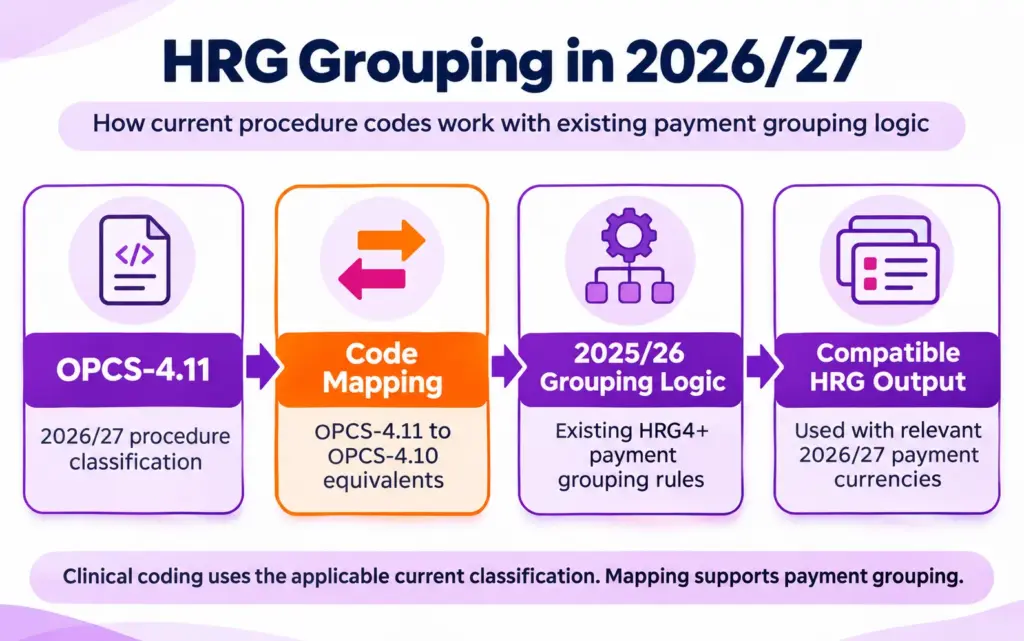
This is a compatibility arrangement for deriving HRGs that work with the published payment prices. It does not direct clinical coders to revert to OPCS-4.10. For applicable admitted-care episodes ending from 1 April 2026, the official guidance requires OPCS-4.11.
For analysts, the practical lesson is simple: record the financial year, grouper purpose and version, and check whether a code translation was applied. Comparing outputs without that context can produce misleading conclusions about activity or complexity.
Why Does Accurate Clinical Coding Matter for HRGs?
Good grouping relies on accurate, sufficiently detailed input. A missing significant procedure, incorrect diagnosis classification or inconsistent activity field may produce a different output or a validation problem.
How Errors Can Affect Classification
A clinical coder should not infer undocumented conditions simply to obtain a particular HRG. Instead, appropriate documentation queries and quality checks help ensure that the data reflects the actual record and applicable standards.
Clinical terminology is also different from classification. SNOMED CT in healthcare supports structured clinical concepts, while ICD-10 and OPCS-4 have their own classification roles. The relationship between these systems matters, but they do not substitute for one another.
Anyone building foundational knowledge can consider Nextgen Learning’s Clinical Coding Course Online, which introduces clinical coding topics rather than conferring NHS professional accreditation.
coding study
Clinical Coding: PCS 3M Workshop
For additional procedural coding study, explore this introductory online workshop from NextGen Learning.
View courseHow Can Beginners Learn More About HRG Coding?
Start with clinical records, diagnosis coding and procedure classification. Then practise distinguishing the coded patient activity from the output of a grouper.
When reading NHS examples, check the release year and remember that grouping and reimbursement are different analytical questions.
For additional procedural coding study, Nextgen Learning lists Clinical Coding: PCS 3M Workshop.
Its PCS-related content should not be mistaken for official NHS HRG Grouper training. Online courses may support introductory learning, but they are not automatically equivalent to NHS workplace training or professional accreditation.
Ultimately, understanding HRG codes means seeing how documentation supports meaningful classifications, how grouping reflects expected resource use, and why payment decisions require a further set of rules.
Those distinctions make NHS coding and finance information much easier to interpret responsibly.
Frequently Asked Questions About HRG Codes
Healthcare Resource Groups (HRGs) are used in NHS casemix classification, while Diagnosis Related Groups (DRGs) are used in other healthcare systems internationally. Both classify healthcare activity according to clinical and resource-related characteristics. However, their classification structures, grouping rules and payment applications differ, so their codes cannot be used interchangeably.
You can look up HRG information through the NHS HRG4+ Local Payment Grouper resources. These include reference documentation and Code to Group workbooks. Check the relevant financial year and grouper version, as costing and payment groupers may use different arrangements.
HRG4+ refers to the Healthcare Resource Group classification system used to organise clinically similar activity with comparable expected resource requirements. It includes grouping rules and classifications for different healthcare services. HRG4+ is not simply an annual software version; specific Grouper releases implement the relevant classification rules for a particular year and purpose.
Yes. HRGs are used for relevant outpatient services, emergency medicine, critical care and other healthcare activities, not just inpatient treatment. The grouping rules and required clinical information depend on the care setting. However, an HRG’s use for classification does not necessarily mean the activity receives a separate payment.
UZ01Z means “Data Invalid for Grouping”. It is generated when the HRG Grouper cannot classify a patient record into a valid clinical HRG because the submitted information fails relevant validation requirements. Possible causes include missing, invalid or inconsistent data. The underlying issue should be investigated and corrected where appropriate.
Yes. Some patient activity can produce a core HRG alongside one or more unbundled HRGs. These additional groups represent particular elements of care, such as qualifying diagnostic imaging or high-cost treatments. Their assignment depends on the applicable grouping rules, and they do not automatically generate separate payments.
No. The NHS Payment Scheme discussed in this article applies to England. Scotland, Wales and Northern Ireland have their own healthcare funding and payment arrangements. Although similar healthcare classifications may support data analysis, England’s HRG-based payment rules should not automatically be applied to services elsewhere in the UK.