




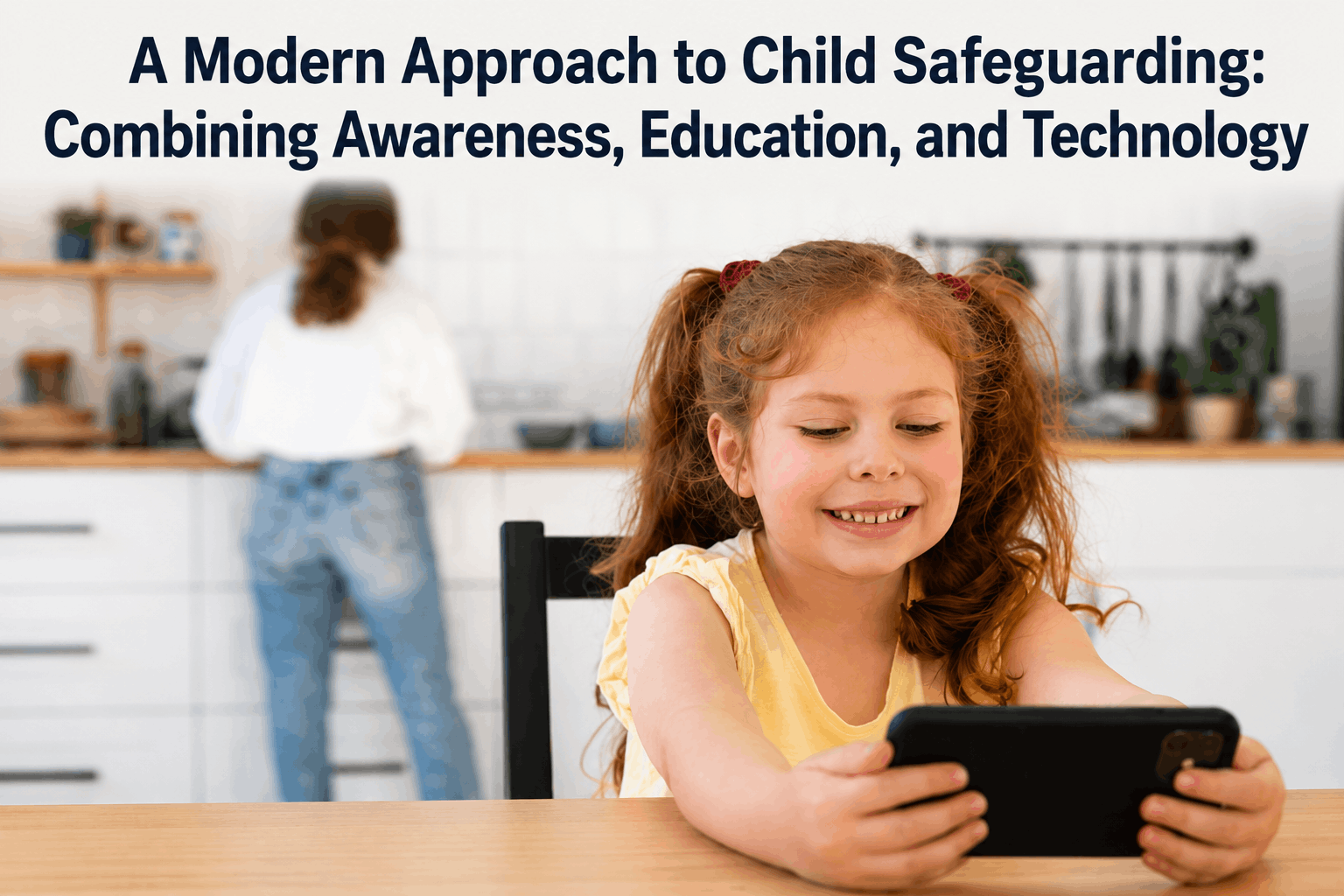
A Modern Approach to Child Safeguarding: Combining Awareness, Education, and Technology
Over the years, child safeguarding has focused on protecting kids from harm that exists within physical spaces. However, the risks children face today have changed. Since their world no longer exists only between home and school, online experiences have added complexity to child safeguarding.
That said, it does not mean parents panic every single time their kids pick up a phone. All it entails is that safeguarding needs to be more practical and layered now. Therefore, in this guide, I will break down the three layers that can help parents protect kids across physical and digital environments, i.e., awareness, education, and technology.
| Modern safeguarding layer | What it helps parents do |
|---|---|
| Awareness | Notice warning signs early on |
| Education | Teach children how to recognise harmful patterns |
| Technology | Add structure to child safeguarding through settings and rules |
Table of Contents
What a Modern Approach to Child Safeguarding Means
Traditionally, child safeguarding aimed to protect children from harm in physical environments where adults could more easily supervise them.
Therefore, in previous discourse, the emphasis remained on identifying any signs of abuse, neglect, exploitation, bullying, and emotional harm in a kid to ensure early intervention. While the approach is still important given the persistence of those risks, the environments children move through have changed significantly today and need to be taken into consideration.
Now, they exist not only in physical spaces but also on online platforms. Due to this, a modern approach to child safeguarding requires parents to consider the full environment of their kids and the risks that emerge from their digital habits.
Overall, modern safeguarding asks parents to think about:
- Where does their child spend time?
- What influences them?
- Which digital spaces do they use?
- How does their behaviour change after being online?
Why Online and Offline Risks Can No Longer Be Separated
Children no longer experience their online and offline lives separately. That is because what happens in a group chat can affect their sleep, while what they consume on social media can impact their confidence. Therefore, child safety is a monumental part of safeguarding.
Let me put it this way: with almost 96% of 3–17-year-olds going online, digital behaviour cannot be treated as something separate from emotional wellbeing and safety.
Today, cyberbullying can start in a private message, but the signs will appear offline. Likewise, pressure to share intimate images usually happens online, but the feeling of fear, shame, secrecy, and panic follows the kid into their offline life.
However, note that parents should not mistake this for a concern about how much time a child spends online. It has more to do with what changes are visible in a kid after that screen use.
The scale of the issue further reinforces why digital safety must be part of modern safeguarding. Research shows that 72% of children have experienced at least one cyber threat online. These threats can range from cyberbullying and online scams to inappropriate content and unwanted contact from strangers.
What makes these risks particularly challenging is that many of them leave no obvious physical evidence. A child may continue attending school and following their usual routine while quietly dealing with stress, fear, embarrassment, or pressure stemming from an online interaction. As a result, parents become aware of a problem only after emotional or behavioural changes start appearing.
At the same time, offline vulnerability can also increase online risk. For example, a lonely child may respond more eagerly to attention from strangers, and a child struggling with confidence may seek approval through likes and comments.
Therefore, parents should always watch out for patterns rather than only isolated incidents.
Awareness: Helping Adults Spot Concerns Early
Awareness is the first layer of safeguarding because children do not always explain what is happening. Some may be embarrassed, while others may fear punishment, which is why it is up to parents to watch for emotional, behavioural, social, and digital changes.
Given below are the warning signs that parents should not ignore at all:
- Emotional: Anxiety, sadness, anger, panic, or any other emotional highs
- Behavioural: Sleep disruption, appetite changes, avoidance of certain topics
- Social: Socially withdrawn, increased need for external validation and approval
- Digital: Hiding screens, deleting chats, secret accounts, repeated late-night use
Now, to observe these changes, the goal is not to catch a child out but rather to understand what they are doing and why they are doing it.
Overall, with the right awareness, you can easily identify if your child is in need, since 1 in every 30 kids is recorded as a child in need in England.
Education: Giving Children the Language to Speak Up
Awareness helps adults notice risk, but education helps children protect themselves before harm escalates.
To ensure their kids are well-educated, parents need to have simple and repeated conversations with them about privacy, consent, and other significant topics.
Rather than opting for a one-time lecture, parents must keep them engaged in short, regular conversations, as a result of which, they can better report any incidents that happen.
Some of the conversation starters I recommend to parents are:
- Who would you speak to if a group chat made you uncomfortable?
- Has anyone ever made you feel pressured to reply?
- Would you tell me if something online scared you?
However, it is also important that parents understand how to react if a child reports anything. Below are some of the common things they should avoid saying and their better alternatives.
| Do Not Say | Instead Try Saying |
|---|---|
| Why did you do that? | I am glad you told me, we can work through it now. |
| You are never using that app again. | Let’s decide the next step together. |
| You should have known better. | I am so sorry that happened. Can you tell me what made it hard for you to leave? |
| Give me your phone right now. | Let’s look at the safest way we can handle this. |
Technology: Using It as a Support Layer
Technology is the last layer that should only be introduced to support safeguarding rather than replacing other layers entirely. If used properly, technology can help parents create better digital routines for their children. However, if not done right, kids’ trust can be adversely damaged.
With this layer, parents can use privacy settings, screen-time limits, app permissions, content filters, reporting tools, and a parental monitoring app.
Here is what each of them does:
- Privacy settings limit who can get in touch with the kid
- Screen-time limits ensure that phone usage remains within rules for healthier routines
- App permissions control an app’s access to the phone’s camera, location, microphone, etc.
- Content filters block adult categories for the 40% of children who use fake ages to access restricted sites.
- Reporting tools help children report age-inappropriate content and users
- Monitoring apps help parents understand their children’s phone usage patterns when they are concerned.
Once used to collect specific insights or to implement a certain rule, parents can then discuss the observations and violations with the child.
Use Digital Tools for Existing Boundaries
Now, sometimes parents want to better understand what is happening during the child’s phone usage, particularly when they are exhibiting concerning signs.
For additional visibility, a solution along the lines of the Xnspy parental monitoring app can be used since it can offer remote insights into a child’s online activity. With screen time, screen recordings, social media activity monitoring, and message/call tracking, parents can identify patterns that may otherwise go unnoticed.
For example, if a child repeatedly becomes distressed upon hearing a notification ping, their activity logs on Xnspy can show what is causing the distress. With the problem identified, parents can then have an honest conversation with their kid and implement necessary boundaries.
Moreover, some remote controls, like app blocking and phone locking, within Xnspy can also help enforce screen limits and age-appropriate phone usage.
However, they must remember that the goal here is safeguarding, not aggressive oversight. The tools must never replace true communication and trust.
Common Mistakes to Avoid
| Mistake | Problem | Better Approach |
|---|---|---|
| Relying only on technology | Tools cannot explain context and can damage trust | Pair tools with real conversation |
| Reacting harshly | Children may hide the next problem | Start by thanking them for telling you |
| Having one online safety talk | Digital risks keep changing | Have short conversations often |
| Ignoring small changes | Patterns can build slowly | Track changes in behaviour |
| Assuming good children are safe | Any child can face issues online | Focus on supporting all kids |
Now, sometimes parents want to better understand what is happening during the child’s phone usage, particularly when they are exhibiting concerning signs.
For additional visibility, a solution along the lines of the Xnspy parental monitoring app can be used since it can offer remote insights into a child’s online activity. With screen time, screen recordings, social media activity monitoring, and message/call tracking, parents can identify patterns that may otherwise go unnoticed.
For example, if a child repeatedly becomes distressed upon hearing a notification ping, their activity logs on Xnspy can show what is causing the distress. With the problem identified, parents can then have an honest conversation with their kid and implement necessary boundaries.
Moreover, some remote controls, like app blocking and phone locking, within Xnspy can also help enforce screen limits and age-appropriate phone usage.
However, they must remember that the goal here is safeguarding, not aggressive oversight. The tools must never replace true communication and trust.
Conclusion
A modern approach to child safeguarding combines awareness, education, and technology in a way parents can actually use. While awareness helps adults notice changes and education gives children the confidence to ask for help, technology adds a layer of visibility to support parents.
However, the heart of safeguarding must always remain human. Every child needs an adult in their life who listens to them calmly and empathises with them. Therefore, only when parents combine open conversations with clear boundaries are children able to feel safer and be more vocal about any issues they face online.
Frequently Asked Questions
Parents should start talking about online safeguarding as soon as a child begins using internet-connected devices. In the beginning, the conversations do not need to be complex, but they should learn about private information and asking for help. Once they grow older, topics like grooming, cyberbullying, privacy settings, image-sharing, AI tools’ misuse, and online pressure can then be introduced.
If a child downright refuses to talk about their online activities, parents should not force the conversation on them immediately. Instead, they should wait for a calmer moment and then ask the kid open-ended questions to gauge how willing they are to open up. However, if over time, secrecy persists and their mood shifts become more pronounced, parents should look for patterns and consider seeking extra support.
Any online behaviour can be considered a safeguarding concern when it leads to repeated emotional and behavioural changes in a child. Some of the warning signs include repeated panic, secrecy around accounts, fearfulness without apparent cause, withdrawal from surroundings, and distress. Now, while a single incident may not mean danger, repeated patterns need closer attention.
Parents should document dates, behaviour changes, concerning messages, usernames, screenshots, app names, and anything the child says in their own words. However, they should avoid exaggerating the details since clear records can better explain the concerns.
Yes, even confident and responsible children can face online risks, like grooming, cyberbullying, peer pressure, harmful content, and exploitation. Parents must not base safeguarding only on whether a child seems sensible.
AUTHOR
Melinda Gastambide – X (Twitter)
Child Behaviour Analyst Specialising in Digital Behaviour
“Melinda Gastambide is a Child Behaviour Analyst with over 13 years of experience, specialising in the psychological impact of smartphones and social media on children. She holds a Board Certified Behaviour Analyst (BCBA) certification from BACB and is also a National Certified Counsellor (NCC) through NBCC.
Her work primarily focuses on understanding how everyday digital interactions shape emotional responses and long-term behavioural habits in young users. In her practice, Melinda assesses families and helps them interpret subtle shifts in their children’s online behaviour that may indicate deeper concerns, such as digital dependency, social comparison stress, online peer pressure, or exposure to inappropriate content.
Beyond assessments, she further contributes research-backed insights on screen time regulation, digital boundaries, cyber risk awareness, etc. Overall, Melinda’s goal is to help families build healthier, more transparent relationships with technology.”

0 responses on "A Modern Approach to Child Safeguarding: Combining Awareness, Education, and Technology"