





What Are the Key Safeguarding Laws in the UK?
Safeguarding failures can have serious legal consequences when organisations misunderstand their duties or follow outdated guidance. UK safeguarding laws establish legal responsibilities for protecting children and adults at risk from abuse, neglect, and harm.
These laws determine who must act, which protections apply and how organisations remain accountable. However, the requirements vary between England, Scotland, Wales and Northern Ireland.
In this blog, you will learn about the main safeguarding laws, statutory guidance, differences across the UK and the consequences of failing to meet legal requirements.
Key Takeaways
- The Children Act 1989 and Children Act 2004 underpin major child safeguarding duties in England and Wales.
- The Education Act 2002 establishes safeguarding responsibilities for schools and certain education bodies.
- The Care Act 2014 provides the main adult safeguarding framework in England.
- Statutory guidance explains how relevant organisations should fulfil their legal responsibilities.
- Scotland, Wales and Northern Ireland have distinct safeguarding legislation.
- Breaching safeguarding requirements can result in regulatory action, legal liability or professional sanctions.
Table of Contents
What Are the Main Safeguarding Laws in the UK?
Several Acts form the foundation of safeguarding legislation, with different provisions applying to children, adults and specific organisations.
Children Act 1989 and Children Act 2004
The Children Act 1989 establishes important duties concerning children’s welfare, including local authority responsibilities towards children in need and those at risk of significant harm.
The Children Act 2004 strengthened arrangements for cooperation between agencies. In England, subsequent amendments have developed the statutory safeguarding partnership arrangements.
Understanding what safeguarding means is useful, but professionals must also recognise which legal duties apply to their organisation.
Education Act 2002 and Children and Social Work Act 2017
Section 175 of the Education Act 2002 requires specified education bodies in England and Wales to make arrangements for safeguarding and promoting children’s welfare.
The Children and Social Work Act 2017 introduced reforms to local safeguarding arrangements in England, including changes to how safeguarding partners work together.
These provisions underpin cooperation between education, local authorities, health services and the police.
Care Act 2014 and Safeguarding Vulnerable Groups Act 2006
The Care Act 2014 sets out adult safeguarding duties in England. Section 42 requires local authorities to make, or arrange, enquiries when specified concerns arise about an adult with care and support needs.
The Safeguarding Vulnerable Groups Act 2006 establishes the barring framework designed to prevent unsuitable individuals from undertaking regulated activities involving children or vulnerable adults.
| Legislation | Main safeguarding purpose |
|---|---|
| Children Act 1989 | Children’s welfare and protection |
| Children Act 2004 | Agency cooperation and safeguarding arrangements |
| Education Act 2002 | Safeguarding duties in education |
| Children and Social Work Act 2017 | Safeguarding partnership reforms in England |
| Care Act 2014 | Adult safeguarding in England |
| Safeguarding Vulnerable Groups Act 2006 | Barring unsuitable individuals from regulated activity |
What Statutory Guidance Supports UK Safeguarding Laws?
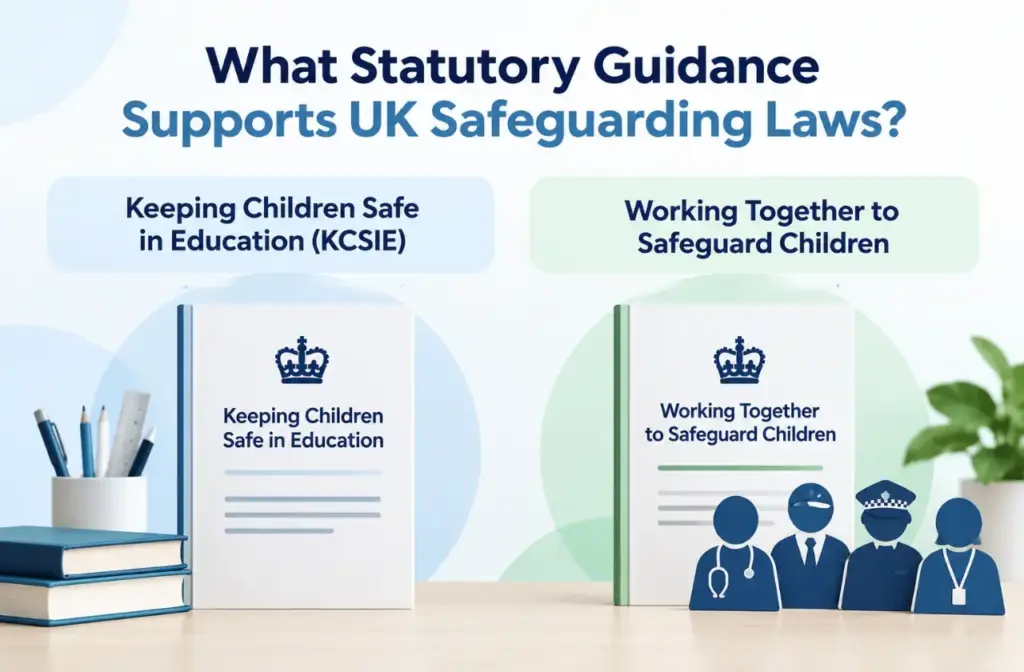
Legislation establishes legal duties, while statutory guidance explains how designated organisations and professionals should fulfil them.
Keeping Children Safe in Education (KCSIE)
Keeping Children Safe in Education 2026 sets out safeguarding and safer recruitment requirements for schools and colleges in England.
It addresses staff responsibilities, safeguarding policies, information sharing and appropriate recruitment checks.
The September 2026 version is currently in force.
Relevant [Level 3 safeguarding training] can help education professionals develop their understanding of these requirements.
Working Together to Safeguard Children
Working Together to Safeguard Children 2026 explains how organisations in England should coordinate to support and protect children.
It outlines expectations for safeguarding partners, local authorities and relevant agencies.
Understanding [multi-agency working in safeguarding] helps professionals recognise how these statutory arrangements connect different services.
For further professional development, explore Designated Safeguarding Lead (DSL) Training.
How Do Safeguarding Laws Differ Across the UK?
Safeguarding is a devolved responsibility, meaning each UK nation has its own legislative arrangements.
| Nation | Key legislation |
|---|---|
| England | Children Act 1989, Children Act 2004 and Care Act 2014 |
| Wales | Children Act 1989 and Social Services and Well-being (Wales) Act 2014 |
| Scotland | Children (Scotland) Act 1995 and Adult Support and Protection (Scotland) Act 2007 |
| Northern Ireland | Children (Northern Ireland) Order 1995 and relevant health and social care legislation |
Wales has specific statutory duties concerning adults and children at risk under its 2014 Act. Scotland operates separate child welfare and adult protection systems. Northern Ireland also has its own legislation and adult safeguarding policy arrangements.
Professionals should consult the legislation and guidance applicable to their location rather than assuming English requirements apply throughout the UK.
How Do Other UK Laws Affect Safeguarding?
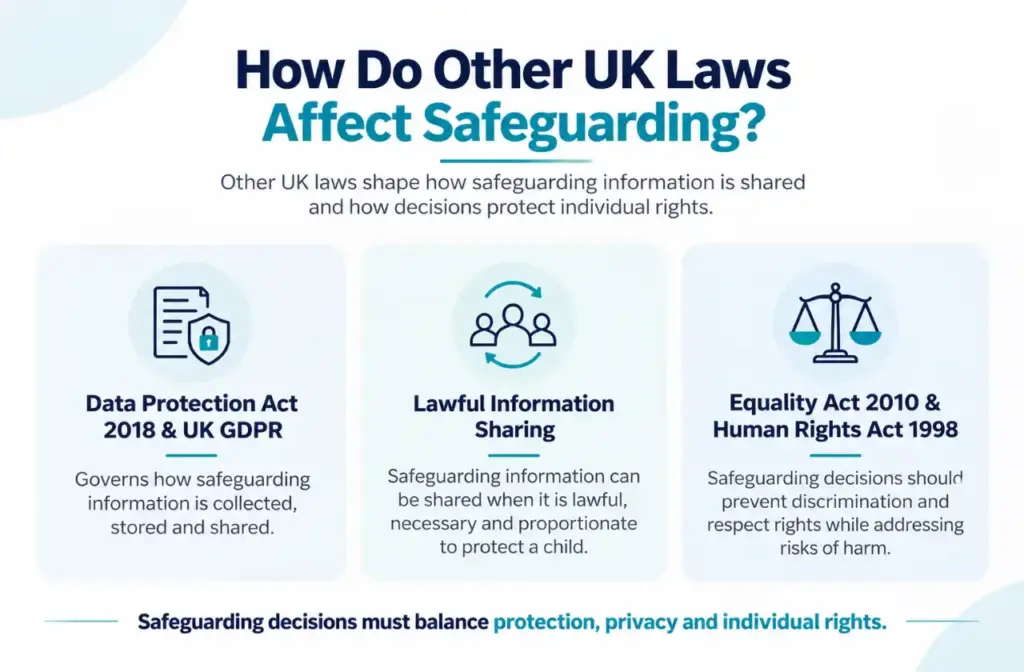
Safeguarding duties extend beyond legislation specifically addressing children and vulnerable adults.
Data Protection Act 2018 and UK GDPR
Data protection legislation governs how safeguarding information is collected, stored and shared.
Consider a school employee who withholds essential information about a child’s safety because they believe UK GDPR prohibits disclosure. This misunderstanding could delay necessary protection.
The Information Commissioner’s Office confirms that data protection law permits lawful, necessary and proportionate safeguarding information sharing.
Equality Act 2010 and Human Rights Act 1998
The Equality Act 2010 protects individuals against unlawful discrimination based on protected characteristics.
The Human Rights Act 1998 protects fundamental rights, including respect for private and family life and freedom from inhuman or degrading treatment.
These laws help ensure safeguarding decisions respect individual rights while addressing risks of harm.
What Happens If Safeguarding Laws Are Breached?
Breaching safeguarding requirements can lead to regulatory enforcement, professional sanctions or legal proceedings, depending on the circumstances.
A school that repeatedly fails to complete legally required recruitment checks could face regulatory scrutiny and enforcement.
Where failures cause harm, civil claims may arise. Criminal proceedings are possible when conduct constitutes a specific offence.
Understanding the Role and responsibilities of safeguarding leads helps organisations distinguish individual duties from wider institutional accountability.
Conclusion
Safeguarding laws establish essential legal responsibilities across education, healthcare and social care. Understanding the Children Act, Care Act and relevant statutory guidance helps professionals recognise which requirements apply to their work.
Because safeguarding legislation differs across the UK, organisations must follow their nation’s current legal requirements.
Strengthen your knowledge of safeguarding duties through Designated Safeguarding Lead (DSL) Training.
Frequently Asked Questions
There is no single safeguarding law covering every situation. The Children Act 1989 is central to child protection in England and Wales, while the Care Act 2014 governs key adult safeguarding duties in England.
The 1989 Act focuses on children’s welfare and local authority duties. The 2004 Act strengthened cooperation and safeguarding arrangements between agencies.
KCSIE is statutory guidance, not an Act of Parliament. Schools and colleges in England must comply with applicable legal duties and have regard to the guidance.
No. England, Scotland, Wales and Northern Ireland have different legislation and safeguarding arrangements.
Schools must meet applicable safeguarding duties, including maintaining appropriate policies, safer recruitment arrangements and staff safeguarding procedures. Requirements depend on the jurisdiction and type of institution.


0 responses on "What Are the Key Safeguarding Laws in the UK?"