



Safeguarding Training for Volunteers: What You Need and Where to Get It
Safeguarding training for volunteers helps people recognise abuse, respond to concerns and protect children or adults at risk. Not every volunteer needs the same training or certificate. Requirements depend on your role, organisation and relevant safeguarding rules. You can access suitable training through volunteer organisations, official free resources and independent online courses.
Whether you’re helping at a youth club, supporting a charity or coaching a children’s sports team, knowing how to respond when something seems wrong matters.
But how do you know which training is appropriate? And does completing an online safeguarding course meet your organisation’s expectations?
This guide explains what UK volunteers need to consider, where to find training and how to choose a course that fits their responsibilities.
Table of Contents
Do Volunteers Need Safeguarding Training?
Volunteers working with children or adults at risk will generally need safeguarding awareness appropriate to their responsibilities. However, there is no single UK-wide rule requiring everyone who volunteers to complete an identical safeguarding course.
The training you need depends on several factors:
- Who you work with, including children or adults who may be at risk of abuse.
- Whether your activities involve direct contact, supervision or personal support.
- The safeguarding risks associated with your responsibilities.
- Your organisation’s policies and applicable sector requirements.
- Whether you have additional safeguarding or leadership duties.
For example, someone supervising children’s activities may need child protection training covering abuse, professional boundaries and reporting procedures. A volunteer handling administrative tasks may have different training needs.
Under the Charity Commission’s safeguarding guidance, charities in England and Wales working with children or adults at risk should ensure staff and volunteers receive regular relevant training.
This is important guidance for charities, but it does not establish one compulsory qualification for every voluntary position.
When Might Training Be Required Before Volunteering?
An organisation may require you to complete safeguarding induction or training before undertaking particular activities.
For example, a youth organisation may require new volunteers to understand its child protection procedures before supervising group activities.
Schools, care services and sports organisations may have additional requirements based on their settings and applicable guidance.
Safeguarding arrangements also differ across England, Scotland, Wales and Northern Ireland. Rules for one nation should not automatically be applied throughout the UK.
Before starting, ask your volunteer coordinator what training is required, whether an existing certificate is accepted and when the training must be completed.
Charities also need to consider their wider safeguarding responsibilities, including charity safeguarding training, to ensure volunteers receive appropriate guidance and support.
What Safeguarding Training Is Suitable for Your Volunteer Role?
The right safeguarding course depends on what you actually do.
A volunteer supporting young children may need different knowledge from someone helping adults with care and support needs. Even within the same organisation, training expectations can vary.
Volunteering With Children and Young People
Child protection training is particularly relevant if you support activities involving people under 18.
This may include volunteering in:
- Youth clubs and community groups.
- Schools and educational activities.
- Children’s sports clubs.
- Holiday programmes.
- Charitable activities involving young people.
Training should explain how to recognise possible abuse or neglect, maintain appropriate boundaries, respond to disclosures and report concerns.
In England, Working Together to Safeguard Children 2026 provides statutory guidance on safeguarding arrangements, including the contribution of voluntary and community organisations.
Those supporting youth activities should also understand safeguarding for youth workers, particularly how to recognise concerns, maintain professional boundaries and follow reporting procedures.
Similarly, volunteers involved in coaching should be familiar with safeguarding in sports clubs, including their club’s child protection policies and the requirements of relevant sports governing bodies.
Supporting Adults at Risk
Volunteers supporting adults may need adult safeguarding training rather than child-focused training.
Relevant activities might include befriending services, community support, care-related assistance or helping adults experiencing particular vulnerabilities.
Appropriate training may address:
- Recognising abuse, neglect or exploitation.
- Respecting dignity, choices and personal boundaries.
- Understanding consent and confidentiality.
- Reporting concerns appropriately.
- Supporting adults without making decisions beyond your responsibilities.
An adult’s age or disability alone does not automatically establish that they meet the legal definition of an adult at risk under every UK safeguarding framework.
Training should reflect the relevant law, the person’s circumstances and your organisation’s procedures.
Community, Charity and Occasional Volunteer Roles
Not every volunteer works directly with children or adults at risk.
For example, helping with fundraising administration may involve different safeguarding risks from transporting children or providing one-to-one support.
However, volunteers should still know how to recognise concerns affecting people connected with their organisation.
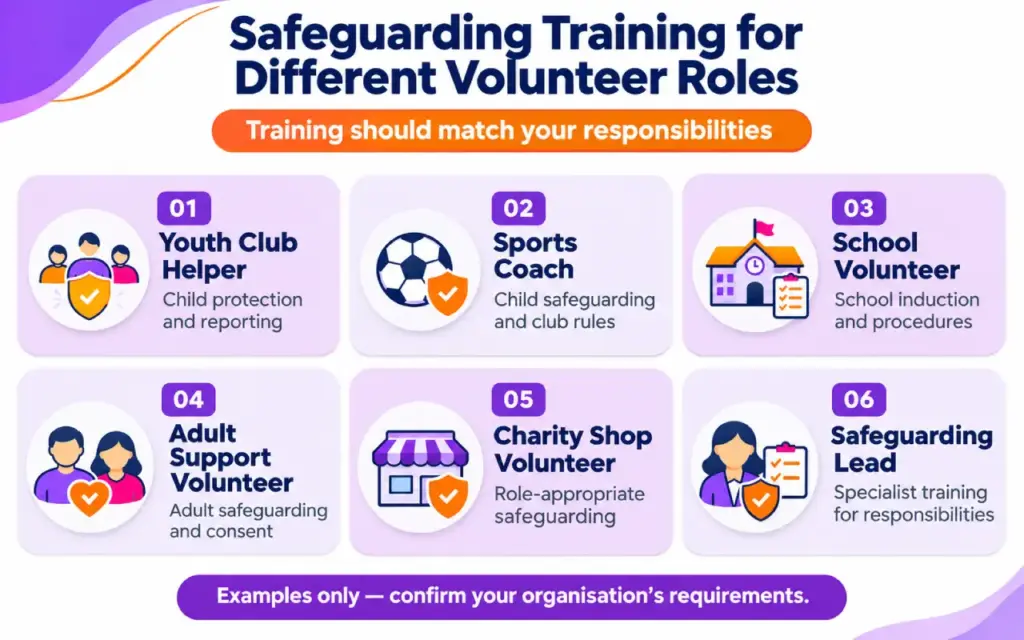
| Volunteer role | Main training considerations |
|---|---|
| Youth club helper | Child protection, professional boundaries and reporting concerns |
| Sports coach | Child safeguarding and relevant club or governing-body expectations |
| School volunteer | School safeguarding induction and role-specific procedures |
| Adult support volunteer | Adult safeguarding, consent and reporting arrangements |
| Charity shop volunteer | Organisational safeguarding awareness appropriate to duties |
| Volunteer safeguarding lead | Additional specialist training for assigned responsibilities |
These are illustrative examples, not universal legal training requirements.
What Does Basic Safeguarding Training Cover?
Basic safeguarding training introduces the knowledge needed to recognise possible harm and respond appropriately.
It should give volunteers the confidence to report concerns without expecting them to investigate allegations or determine whether abuse has occurred.
Recognising Abuse, Neglect and Safeguarding Concerns
Training commonly explains different forms of abuse, including physical, emotional and sexual abuse, neglect, and exploitation.
It may also address online harm, inappropriate relationships, discrimination and breaches of professional boundaries.
A concern might arise because someone discloses an experience, their behaviour changes or you witness something troubling.
One sign alone does not necessarily prove abuse. Volunteers should recognise warning signs, avoid assumptions and follow reporting procedures.
Responding to and Reporting a Concern
If someone tells you about possible abuse, your immediate response matters.

Good safeguarding practice includes:
- 1. Listen calmly. Give the person time to explain without blame.
- 2. Avoid leading questions. Do not investigate or pressure them for details.
- 3. Do not promise secrecy. Explain that information may need to be shared to protect someone.
- 4. Record factual information. Follow your organisation’s reporting and record-keeping arrangements.
- 5. Report promptly. Contact the designated safeguarding person or appropriate authority.
If someone faces immediate danger, contact emergency services. In the UK, call 999 for an emergency.
You do not need proof of abuse before raising a genuine concern.
Following Your Organisation’s Safeguarding Procedures
Online training provides general safeguarding knowledge, but volunteers also need to understand local procedures.
Before starting relevant duties, identify your safeguarding contact, reporting route, emergency arrangements and confidentiality expectations.
Organisations should maintain clear procedures for recognising and reporting concerns. The UK government’s guidance on reporting safeguarding concerns in a charity explains how to report concerns about the behaviour of charity employees or volunteers.
A clear safeguarding policy helps organisations establish consistent procedures for recognising, reporting and managing concerns. Understanding how to write a safeguarding policy is particularly useful for charity managers and volunteer coordinators responsible for developing these arrangements.
For volunteers, knowing how to follow the organisation’s procedures is more important than simply holding a training certificate.
Safeguarding Training Levels, Certificates and Refresher Courses
Course titles can make safeguarding training appear more standardised than it is.
You may encounter introductory, intermediate or advanced courses, alongside programmes described as Level 1, Level 2 or Level 3.
Understanding what these labels mean helps you avoid unsuitable training.
What Do Safeguarding Training Levels Mean?
There is no single safeguarding training level system that applies identically to every voluntary role across the UK.
Providers and sectors may use different terminology.
Introductory courses generally concentrate on recognising concerns, understanding responsibilities and reporting appropriately.
More advanced training may cover complex situations, safeguarding leadership, inter-agency working or specialist responsibilities.
However, a course labelled Level 3 does not automatically meet every organisation’s expectations for a designated safeguarding lead.
Always compare the actual curriculum with your role’s requirements.
What Does a Safeguarding Certificate Prove?
A safeguarding certificate generally provides evidence that you completed a particular training programme or assessment.
It does not automatically prove occupational competence, professional registration or compliance with every safeguarding requirement.
Common distinctions include:
- Certificate of completion: Evidence that a learner completed a course.
- CPD-related certificate: Evidence of continuing professional development associated with the training.
- QLS endorsement: Recognition associated with non-regulated learning provision; it is not equivalent to an Ofqual-regulated qualification.
- Regulated qualification: A qualification recognised within the relevant regulatory framework.
You can use the government’s regulated qualification search service to check applicable regulated qualifications.
The practical question is whether your volunteering organisation accepts the training for your responsibilities.
How Often Should Volunteers Refresh Their Training?
There is no universal renewal interval for all safeguarding certificates or volunteer positions.
Your organisation may set refresher expectations based on safeguarding risks, sector guidance and changes to procedures.
You may also need additional training when moving into a different role.
Check your organisation’s refresher policy rather than assuming every safeguarding certificate expires after a fixed period.
Where Can Volunteers Get Safeguarding Training?
Safeguarding courses for volunteers are available through organisations, government resources and independent training providers.
The best starting point is usually the organisation where you intend to volunteer.
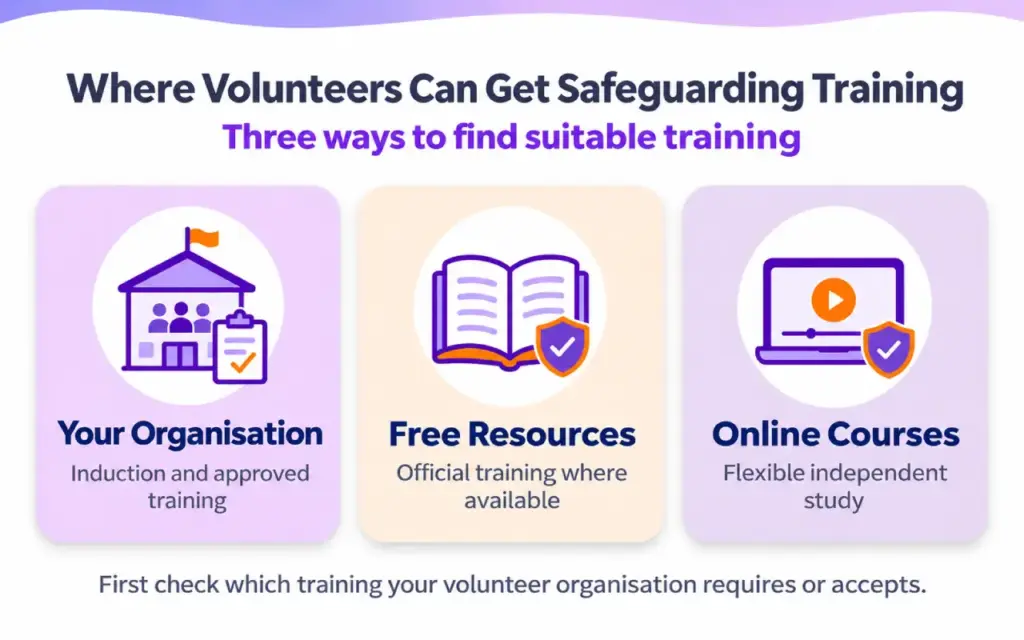
Training Provided by Your Volunteer Organisation
Many organisations arrange induction and safeguarding training for their volunteers.
This can be particularly useful because the training may explain local policies, reporting contacts and activities specific to the role.
Before paying for an independent course, ask:
- Does the organisation provide safeguarding training?
- Is there an approved training provider?
- Will an existing certificate be accepted?
- Is the training free or funded?
- Do I need additional practical induction?
Some organisations may require their own safeguarding training even when volunteers have completed similar courses elsewhere.
Checking first can prevent unnecessary expense and duplicated learning.
Free Safeguarding Training and Official Resources
Free safeguarding training is available for certain volunteering settings.
For example, the Department for Education offers free safeguarding e-learning for out-of-school settings in England.
The programme is designed for providers, staff and volunteers working in settings such as youth clubs, community activities, holiday clubs and sports training.
It includes six modules taking approximately one hour in total. Learners who successfully complete the assessment can receive a digital certificate.
This is a useful introductory option for relevant settings in England, although it may not cover every organisation’s training requirements.
Free resources are valuable for developing awareness, but suitability matters more than price.
Independent Online Safeguarding Courses
Online safeguarding training for volunteers offers another option, particularly when you want to study independently or strengthen your understanding before joining an organisation.
Self-paced courses can make it easier to fit training around employment, family responsibilities and volunteering commitments.
However, check that the course addresses the right safeguarding subject.
For volunteers working with children, Nextgen Learning’s Child Protection and Safeguarding course covers safeguarding principles, relevant laws and guidance, abuse, child sexual exploitation, disclosures, reporting, risk assessment and record keeping.
The course includes online assessments and lists volunteers among its intended learners.
It is a child-focused learning option, so volunteers needing specialist adult safeguarding training should check for a more appropriate programme.
How to Choose the Right Safeguarding Course
A course can sound relevant without meeting the expectations of your volunteering organisation.
Before enrolling, examine what it covers and how you will use the knowledge.
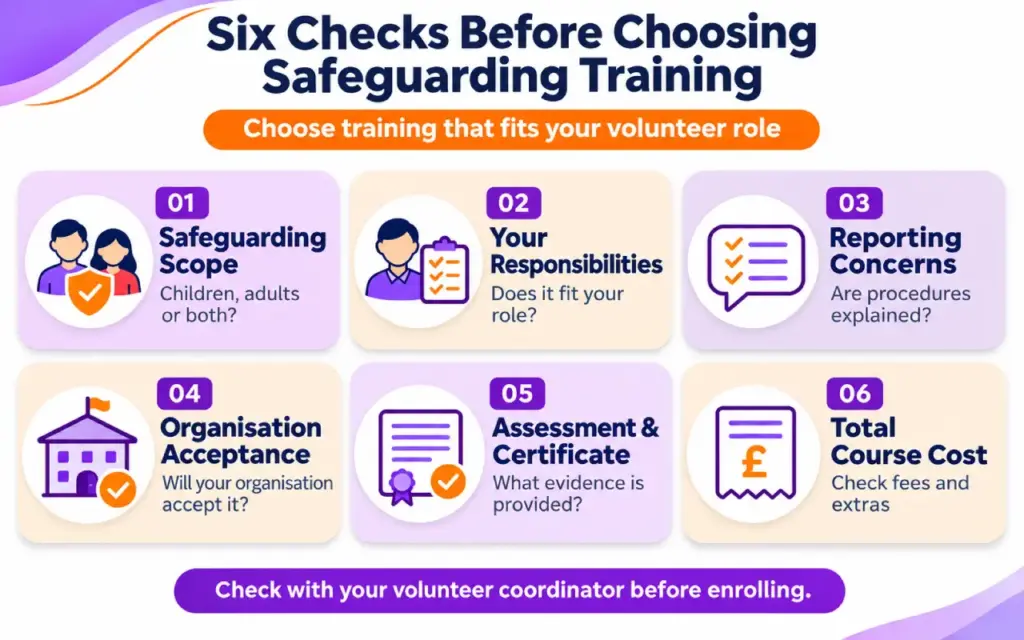
Check These Six Things Before Enrolling
- 1. Does the course cover the right group?
Check whether it focuses on children, adults at risk or both. These subjects involve different responsibilities and legal frameworks.
- 2. Does it suit your actual duties?
Introductory awareness may be appropriate for some positions, while safeguarding leads or people with specialist responsibilities may require additional training.
- 3. Does it explain how to report concerns?
Look for practical guidance on disclosures, reporting procedures, confidentiality and appropriate record keeping.
- 4. Will your organisation accept it?
Ask your volunteer coordinator before purchasing. A relevant course may not replace mandatory induction or training specified by the organisation.
- 5. What assessment and certificate are provided?
Check whether assessment is required, what completion evidence is available and whether any additional certificate costs apply.
- 6. What is the total cost?
Look beyond the advertised enrolment price. Check certificate fees, access conditions and any optional extras.
A suitable course should provide relevant knowledge and clear expectations, not simply an impressive-sounding title.
When Nextgen Learning’s Child Protection Course May Be Suitable
Nextgen Learning’s Child Protection and Safeguarding course is intended for learners seeking structured child safeguarding knowledge, including volunteers and carers.
It covers recognising abuse, responding to disclosures, reporting concerns and maintaining records. Learners can study online at their own pace and complete a mock examination and final examination.
The course page advertises CPD-related certification and an optional QLS-endorsed certificate. It identifies the QLS-endorsed provision as non-regulated, and certificates are available for additional fees.
Completing the course does not automatically qualify someone for a designated safeguarding role or replace an organisation’s specific requirements.
For volunteers seeking child protection awareness, it may be worth considering after confirming the training is suitable for their role.
Is Safeguarding Training the Same as a DBS Check?
No. Safeguarding training and Disclosure and Barring Service (DBS) checks serve different purposes.
Training helps volunteers recognise and respond to safeguarding concerns. DBS checks provide criminal record information, with different levels of checks available depending on legal eligibility.
Not every volunteer position requires or qualifies for the same DBS check.
From 1 September 2026, the supervision exemption was removed from the definition of regulated activity with children in England, Wales and Northern Ireland. This affects some roles involving activities such as teaching, training, caring for or supervising children.
However, the change does not mean every volunteer automatically requires a DBS check.
The DBS explains this distinction in its September 2026 supervision exemption guidance.
Organisations remain responsible for assessing roles against the applicable regulated-activity and barred-list criteria.
A safeguarding certificate cannot replace an appropriate DBS check, and a DBS certificate cannot replace safeguarding training.
Choosing Safeguarding Training That Fits Your Role
The most useful safeguarding training is training that matches your responsibilities and helps you respond appropriately when concerns arise.
Before choosing a course, speak with your volunteer coordinator. Confirm which safeguarding topics matter, whether previous training is accepted and what local procedures you must follow.
If your work involves children, appropriate child protection training can strengthen your understanding of abuse, disclosures and reporting. If you support adults at risk, choose training that addresses those responsibilities.
Your next step: Confirm your organisation’s expectations, review the course content and choose training that supports safe, responsible volunteering.
Frequently Asked Questions
No single UK-wide requirement makes the same safeguarding course mandatory for every volunteer. Training expectations depend on the role, organisation, activities and applicable laws or sector guidance. Volunteers working with children or adults at risk should expect relevant safeguarding arrangements and training.
Yes. Many safeguarding courses are available online, including self-paced programmes. However, your organisation may also require practical induction, local safeguarding procedures or training from an approved provider. Check acceptance before enrolling.
Yes. Some organisations provide free induction, while the Department for Education offers free safeguarding e-learning for relevant out-of-school settings in England. Availability and suitability depend on the volunteering role and setting.
Not every volunteer needs the same formal certificate. Some organisations require evidence of completed training, while others arrange their own induction. A certificate demonstrates completion of particular training but does not automatically establish professional competence or legal compliance.
There is no universal renewal period for all volunteer safeguarding courses. Your organisation may require regular refreshers based on its policies, sector guidance and your responsibilities. Check the applicable requirements rather than assuming a fixed certificate expiry date.
Not necessarily. Safeguarding training levels vary between providers and sectors. Many volunteers require introductory knowledge, while those with specialist or designated responsibilities may need more advanced training. Confirm the expected content and training level with your organisation.