





What Not to Say to Occupational Health UK | Safe Examples & Tips
Being referred to Occupational Health can feel worrying, especially when you do not know what the appointment means for your job. However, an Occupational Health assessment is not usually designed to catch you out. Instead, it helps your employer understand how your health affects your work and what support may help you do your role safely.
Even so, what you say matters. If you downplay your symptoms, exaggerate your difficulties, blame one person, or refuse all support too quickly, the final report may not reflect your real situation. As a result, your employer may make decisions based on incomplete or unclear information.
Therefore, the safest approach is to stay honest, calm and work-focused. You do not need to share every private detail. However, you should explain how your condition affects your duties, attendance, concentration, mobility, energy, or stress levels.
In this guide, you will learn what not to say to Occupational Health in the UK, what to say instead and how to prepare for the conversation. You will also see how to discuss reasonable adjustments, confidentiality, work-related stress and Occupational Health reports in a clear and confident way.
By the end, you should feel more prepared to answer questions without harming your chances of getting fair support at work.
Table of Contents
Quick Answer: What Should You Avoid Saying to Occupational Health?

You should avoid saying anything that minimises your condition, exaggerates your symptoms, blames one person, or blocks discussion about support. Instead, explain your situation clearly and focus on how your health affects your work.
Importantly, Occupational Health needs accurate information. Therefore, your answers should help the adviser understand your role, your symptoms, your limitations and the adjustments that may help you work safely.
Here are the main things you should avoid saying:
- “I’m fine; it’s nothing serious.”
This may make your condition seem less important than it is. - “I don’t need any adjustments.”
This can stop useful support from being considered. - “My manager is the whole problem.”
This may shift the focus away from your health and work needs. - “I can’t do anything at work.”
This can sound absolute, even when some duties may still be manageable. - “I don’t want anything shared with my employer.”
This can limit the adviser’s ability to recommend support. - “My colleague had the same issue.”
This may distract from your own symptoms, duties and needs.
A better approach is to use calm, factual language. For example, you could say:
“I can still do parts of my role. However, my symptoms affect certain tasks, such as long meetings, heavy workloads, standing for long periods, or working without regular breaks.”
This kind of answer works better because it connects your health to your job. As a result, Occupational Health can make clearer and more useful recommendations.
What Is Occupational Health and Why Have You Been Referred?
Occupational Health, often called OH, looks at how your health affects your ability to work. It does not replace your GP and it does not usually provide treatment. Instead, it gives work-related advice to help your employer make fair and informed decisions.
You may be referred to Occupational Health for several reasons. For example, your employer may need guidance if you have repeated sickness absence, a long-term condition, work-related stress, an injury, or difficulty carrying out parts of your role. In addition, they may ask OH for advice before planning a return to work after illness or surgery.
However, an Occupational Health referral does not automatically mean your job is at risk. In many cases, it means your employer needs professional advice before deciding what support may be suitable. Therefore, you should treat the appointment as a chance to explain your situation clearly.
Occupational Health may give advice on:
- Whether your health affects your work duties
- Whether adjustments could help you work safely
- Whether a phased return may support recovery
- Whether your workload, hours, equipment, or environment should change
- Whether further review may be needed later
Importantly, Occupational Health does not usually make the final employment decision. Your employer normally makes that decision after considering the OH report, your role, business needs and any legal duties. As a result, your words during the assessment can influence the quality of the advice your employer receives.
It also helps to know what Occupational Health can and cannot do.
Occupational Health can:
- Ask how your condition affects your work
- Recommend reasonable adjustments
- Comment on fitness for work
- Suggest temporary or long-term workplace support
- Advise on return-to-work planning
Occupational Health cannot usually:
- Force you to accept treatment
- Act as your personal GP
- Resolve a grievance or workplace dispute
- Guarantee a particular outcome
- Share unlimited personal medical details without proper consent
Therefore, the best approach is to stay focused on the link between your health and your job. Explain what you can do, what you struggle with and what may help.
What Not to Say to Occupational Health — and What to Say Instead

The aim of an Occupational Health assessment is not to catch you saying the wrong thing. However, certain phrases can create confusion or lead to an incomplete report. Therefore, you should avoid vague, defensive, or absolute statements.
A good answer should do three things. First, it should explain what is happening. Next, it should show how your health affects your work. Finally, it should help Occupational Health identify realistic support.
“I’m fine” or “It’s nothing serious”
You may say this because you want to appear strong or avoid making a fuss. However, it can work against you. If you say you are fine, Occupational Health may assume that your condition has little or no impact on your work.
Instead, explain the issue in a balanced way. You do not need to exaggerate. However, you should describe the real effect on your duties.
Say this instead:
- “I can manage some tasks, but my symptoms affect my concentration during longer periods of work.”
- “The issue varies from day to day, so I would like to explain what happens on more difficult days.”
- “I am still working, but certain duties make the symptoms worse.”
This wording gives a clearer picture. As a result, the adviser can understand both your abilities and your limits.
“I don’t need any adjustments”
Some employees reject adjustments because they worry about looking weak. Others think adjustments must be major changes. However, reasonable adjustments can be small, temporary, or highly specific.
For example, you may not need a complete change of role. Instead, you may need short breaks, adjusted hours, ergonomic equipment, reduced heavy lifting, or a phased return after sickness.
Say this instead:
- “I am managing at the moment. However, some adjustments may help me stay well and avoid further absence.”
- “I would like to discuss whether any temporary support could help.”
- “I am open to suggestions that would help me do my role safely.”
This approach shows that you want to work. In addition, it helps Occupational Health recommend practical support rather than assuming no support is needed.
“My manager is the problem”
Workplace relationships can affect stress, confidence and wellbeing. However, Occupational Health does not usually handle grievances or disciplinary issues. Therefore, blaming one person may distract from the health-related purpose of the appointment.
That does not mean you should hide workplace pressures. Instead, describe the work factors that affect your condition. Focus on workload, deadlines, communication, shift patterns, working hours, or unclear expectations.
Say this instead:
- “High workloads and tight deadlines increase my stress symptoms.”
- “I find last-minute changes difficult because they affect my anxiety and concentration.”
- “I would benefit from clearer priorities and more regular workload reviews.”
This keeps the conversation professional. Moreover, it gives Occupational Health something useful to assess and report.
“I can’t do anything at work”
If you are in pain, exhausted, or anxious, this may feel true in the moment. However, absolute statements can create risk. Occupational Health may interpret them as meaning you cannot perform the role at all.
Instead, separate the duties you can do from the duties you struggle with. This gives a more accurate picture and may protect your options.
Say this instead:
- “I can complete desk-based tasks, but I struggle with standing for long periods.”
- “I can work effectively in the morning, but symptoms worsen later in the day.”
- “I can manage core duties with breaks, but overtime makes my condition worse.”
This wording helps the adviser identify suitable adjustments. Consequently, the report may focus on keeping you in work safely rather than assuming you are unfit for all duties.
“I don’t want anything shared with my employer”
It is understandable to worry about privacy. However, if you block all information from being shared, your employer may not receive enough guidance to support you. Occupational Health usually does not need to share every medical detail. Instead, it can provide work-related recommendations.
A better approach is to ask how confidentiality works before giving consent. This helps you understand what may appear in the report and what can remain private.
Say this instead:
- “Can you explain what information will be included in the report?”
- “I am happy for work-related recommendations to be shared, but I want sensitive medical details kept private where possible.”
- “Can I review the report before it is sent to my employer?”
This shows that you are willing to cooperate. At the same time, it protects your privacy and helps you make an informed decision.
“My colleague had the same condition”
Comparing yourself with a colleague may seem useful. However, Occupational Health needs to assess your own condition, job role, symptoms and work environment. Two people with the same diagnosis may need very different support.
Instead, keep the focus on your own situation. Explain how the condition affects your tasks, performance, attendance, or safety.
Say this instead:
- “This is how the condition affects my role.”
- “These are the tasks that trigger or worsen my symptoms.”
- “These adjustments may help me work more consistently.”
This keeps the assessment personal and relevant. In addition, it avoids turning the conversation into a comparison with someone else’s case.
“It’s just stress”
Stress can have a serious effect on sleep, concentration, decision-making, communication and attendance. Therefore, you should not dismiss it as something minor. If stress is affecting your work, explain it clearly.
However, avoid making the discussion too broad. Instead, describe the work-related triggers and the impact on your duties.
Say this instead:
- “I am experiencing work-related stress it is affecting my sleep and concentration.”
- “The main triggers are workload pressure, unclear priorities and limited recovery time.”
- “I would like advice on adjustments that may help me manage this safely.”
This gives Occupational Health a clear route to recommend support. As a result, your employer can better understand what may reduce risk and help you remain effective at work.
How to Explain Your Health Condition Clearly During an Occupational Health Assessment
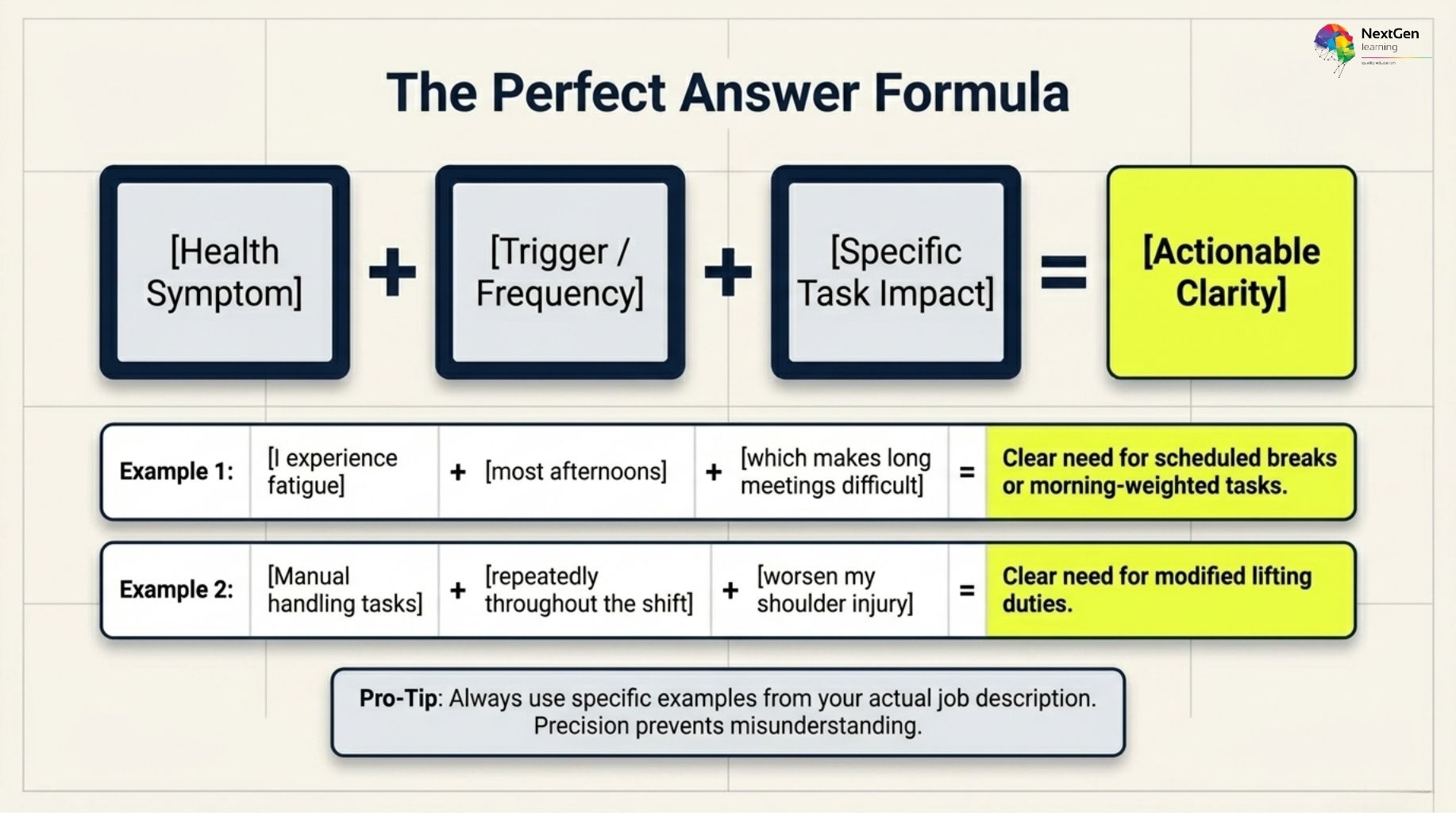
When you speak to Occupational Health, clarity matters more than perfect wording. You do not need to use medical language. However, you should explain your condition in a way that connects directly to your work.
A useful approach is to describe three things: what you experience, how often it happens and how it affects your duties. This helps the adviser understand the real impact of your condition. As a result, they can make recommendations that match your role rather than relying on assumptions.
For example, instead of saying, “I get tired,” explain what that means at work. You could say, “I experience fatigue most afternoons and it makes it harder to focus during long meetings or complete detailed reports.” This gives Occupational Health a clear link between your symptoms and your job.
Focus on work impact, not just symptoms
Occupational Health needs to understand how your health affects your work. Therefore, avoid giving only a list of symptoms. Instead, explain how those symptoms affect tasks, performance, attendance, safety, or communication.
You can structure your answer like this:
- State the health issue clearly
- Explain when it affects you most
- Describe which duties become harder
- Mention what helps or makes it worse
- Suggest support that may help you work safely
For instance, if you have back pain, do not only say, “My back hurts.” Instead, say, “My back pain gets worse when I sit for long periods, lift heavy items, or work without movement breaks.”
This answer gives the adviser useful detail. Moreover, it shows that you understand your role and want practical solutions.
Use specific examples from your role
Specific examples make your assessment stronger. They also reduce the risk of misunderstanding. Therefore, try to explain your condition using real work situations.
You might say:
- “Standing for more than two hours increases my pain.”
- “Tight deadlines make my anxiety symptoms worse.”
- “Long video calls affect my concentration and trigger headaches.”
- “Manual handling tasks worsen my shoulder injury.”
- “Late shifts affect my sleep and recovery.”
These examples help Occupational Health see the pattern. In addition, they make it easier to recommend adjustments such as breaks, equipment, altered duties, flexible hours, or a phased return.
Explain good days and bad days
Many health conditions fluctuate. You may feel able to work normally on some days, but struggle on others. However, if you only describe your best days, Occupational Health may underestimate your needs. In contrast, if you only describe your worst days, the report may make you seem less capable than you are.
A balanced answer works best. Explain what you can usually manage, then describe what happens during flare-ups or difficult periods.
For example:
“I can usually complete my normal duties. However, during flare-ups, I struggle with prolonged sitting, fast-paced tasks and overtime. Short breaks and adjusted deadlines would help me manage the condition more consistently.”
This type of answer sounds honest and reasonable. It also helps Occupational Health understand both your capacity and your risks.
Be honest without exaggerating
Honesty protects you. However, accuracy is just as important. If you exaggerate, the report may suggest that you cannot do your role at all. If you minimize the problem, the report may suggest that you need no support.
Therefore, describe your situation as clearly as possible. Use measured language and avoid dramatic or absolute phrases unless they are genuinely accurate.
Try to avoid:
- “I can never do that.”
- “I am always in pain.”
- “Nothing will help.”
- “I cannot cope with anything.”
Instead, use more precise wording:
- “I struggle with that task when symptoms are severe.”
- “Pain increases after long periods of sitting.”
- “Some adjustments may help me manage the role better.”
- “I need clearer priorities when workload pressure increases.”
This gives Occupational Health a fair picture of your situation. Consequently, the report is more likely to support realistic and useful workplace decisions.
What to Say If You Need Reasonable Adjustments at Work
If your health condition affects your ability to work, you can discuss reasonable adjustments during your Occupational Health assessment. However, you do not need to wait for the adviser to mention them first. You can explain what support may help and ask whether it would be suitable for your role.
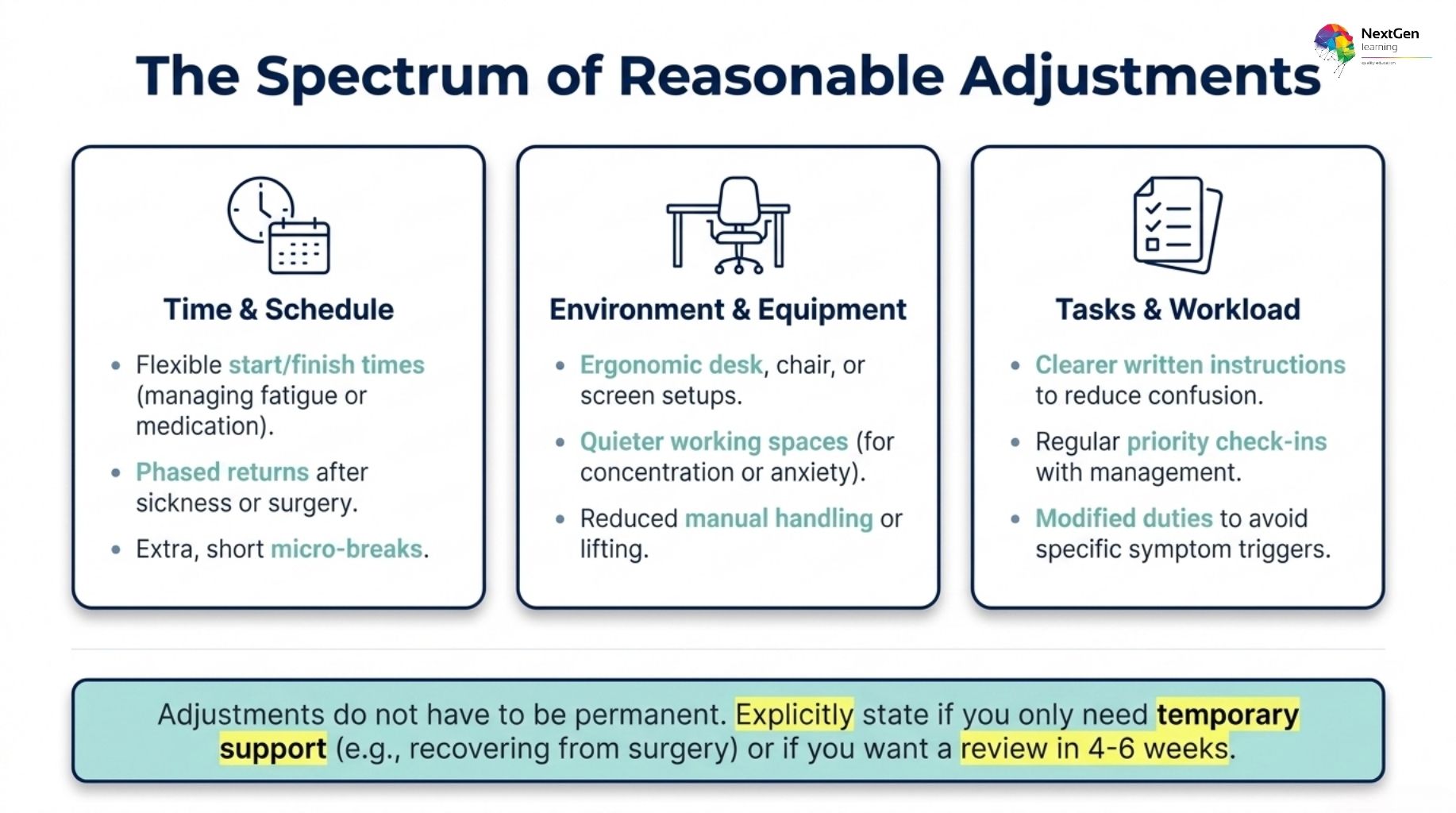
Reasonable adjustments are changes that reduce the disadvantage caused by a health condition or disability. In many cases, they are simple and realistic. For example, an adjustment may involve working hours, duties, equipment, breaks, workload, communication, or the way tasks are organised.
When discussing adjustments, avoid sounding as though you are refusing to work. Instead, show that you want to remain effective, safe and consistent at work. This helps Occupational Health understand that the adjustment is linked to performance, wellbeing and work sustainability.
Examples of reasonable adjustments
The right adjustment depends on your condition, job role, workplace and employer. Therefore, you should focus on what would help you manage your actual duties.
Common examples include:
- Flexible start and finish times to manage fatigue, medication, pain, sleep issues, or medical appointments
- A phased return to work after sickness absence, surgery, injury, or mental health-related leave
- Modified duties to reduce tasks that worsen symptoms or create safety risks
- Extra short breaks to manage pain, concentration, anxiety, or physical strain
- Ergonomic equipment such as an adjusted chair, keyboard, desk setup, or screen position
- Reduced manual handling if lifting, carrying, or repetitive movement worsens symptoms
- Quieter working space to support concentration, sensory needs, anxiety, or migraines
- Clear written instructions to reduce confusion, stress, or memory-related difficulties
- Regular workload check-ins to help manage pressure, priorities and deadlines
However, you should avoid asking for adjustments in vague terms. For instance, saying “I need less stress” may not give Occupational Health enough detail. Instead, explain what creates the pressure and what change would help.
A stronger phrase would be:
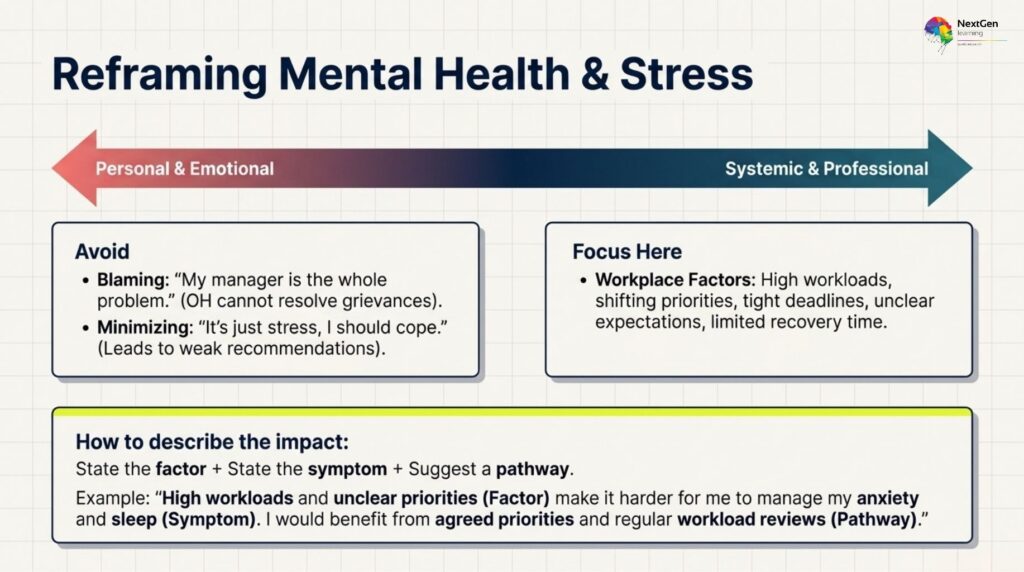
“High workloads and unclear priorities worsen my symptoms. Therefore, I would benefit from agreed priorities, regular workload reviews and clearer deadlines.”
Temporary vs long-term adjustments
Some adjustments may only be needed for a short period. Others may be needed long term. Therefore, it helps to explain whether your condition is temporary, ongoing, fluctuating, or likely to improve.
For example, if you are recovering from surgery, you may need temporary adjustments for a few weeks. However, if you have a long-term condition, you may need ongoing support that can be reviewed over time.
You could say:
- “I may only need this adjustment while I recover.”
- “My condition fluctuates, so support may need to change depending on symptoms.”
- “I can manage most duties, but I may need ongoing help with specific tasks.”
- “A review after four to six weeks would help check whether the adjustment is working.”
This shows flexibility. In addition, it helps your employer see that adjustments do not always need to be permanent or difficult to manage.
How to ask without sounding demanding
Some employees avoid asking for support because they worry about seeming difficult. However, asking for adjustments in a clear and reasonable way can show responsibility. It also helps Occupational Health understand what may prevent further absence or worsening symptoms.
Use calm, practical wording. For example:
“I want to continue working effectively. However, my current symptoms make some duties harder. I would like to discuss whether adjustments such as shorter meetings, regular breaks, or clearer priorities could help.”
This type of wording works well because it is balanced. It explains the problem, shows willingness to work and suggests practical options.
You can also ask Occupational Health direct questions, such as:
- “What adjustments would you recommend for my role?”
- “Could a phased return help me rebuild my normal duties safely?”
- “Would temporary changes be suitable while my symptoms improve?”
- “How should my employer review whether the adjustments are working?”
Ultimately, the goal is not to demand special treatment. Instead, the goal is to identify fair support that helps you work safely, consistently and productively.
What to Say About Stress, Anxiety, Depression, or Burnout
Mental health can be difficult to discuss at work. However, Occupational Health needs clear information if stress, anxiety, depression, or burnout is affecting your role. You do not need to share every personal detail. Instead, explain how your symptoms affect your work, attendance, concentration, energy, communication, or decision-making.
Avoid saying, “It’s just stress” or “I should be able to cope.” These phrases can make the issue sound minor, even when it is affecting your wellbeing and performance. In addition, they may stop Occupational Health from recommending support that could reduce pressure and prevent further absence.
A better approach is to describe the work impact in a calm and factual way. For example, you could say, “I am experiencing work-related stress and it is affecting my sleep, focus and ability to manage competing deadlines.” This gives the adviser a clearer picture without blaming anyone or overstating the issue.
How to describe work-related stress
When discussing stress, focus on the specific work factors that affect your symptoms. However, avoid turning the assessment into a complaint about one person. Occupational Health can give better advice when you explain workload, working patterns, deadlines, staffing pressure, unclear duties, or lack of recovery time.
You could say:
- “My workload has increased and I am struggling to manage competing priorities.”
- “Tight deadlines are affecting my sleep and concentration.”
- “I find it harder to focus when tasks change at short notice.”
- “Long hours are reducing my recovery time and worsening my symptoms.”
- “I would benefit from clearer priorities and regular workload reviews.”
This wording keeps the discussion professional. Moreover, it helps Occupational Health connect your symptoms to possible workplace adjustments.
How to avoid minimising mental health symptoms
Many employees minimise mental health symptoms because they fear judgement. However, downplaying the problem can lead to weak or inaccurate recommendations. Therefore, you should be honest about the effect your symptoms have on your work.
Instead of saying, “I’m just a bit anxious,” explain what anxiety does in your working day. For example, you might say, “My anxiety makes it harder to speak in unexpected meetings, handle urgent changes, or focus when several tasks arrive at once.”
Likewise, if depression affects your energy, motivation, or concentration, describe those effects clearly. You could say, “My symptoms make it harder to start complex tasks in the morning and I need clearer task priorities to stay on track.”
When to mention workload, deadlines, or management style
You should mention workload, deadlines, or communication issues if they affect your health. However, frame them as work factors rather than personal attacks. This matters because Occupational Health usually focuses on health and work, not blame.
Use balanced language such as:
- “The current workload is affecting my symptoms.”
- “Unclear priorities make it harder for me to manage anxiety.”
- “Frequent urgent requests increase pressure and reduce my ability to focus.”
- “I would benefit from agreed deadlines and clearer communication.”
- “Regular check-ins may help me manage workload before symptoms worsen.”
This approach shows that you want solutions. As a result, Occupational Health can recommend changes that support both your wellbeing and your ability to work.
Is Occupational Health Confidential?
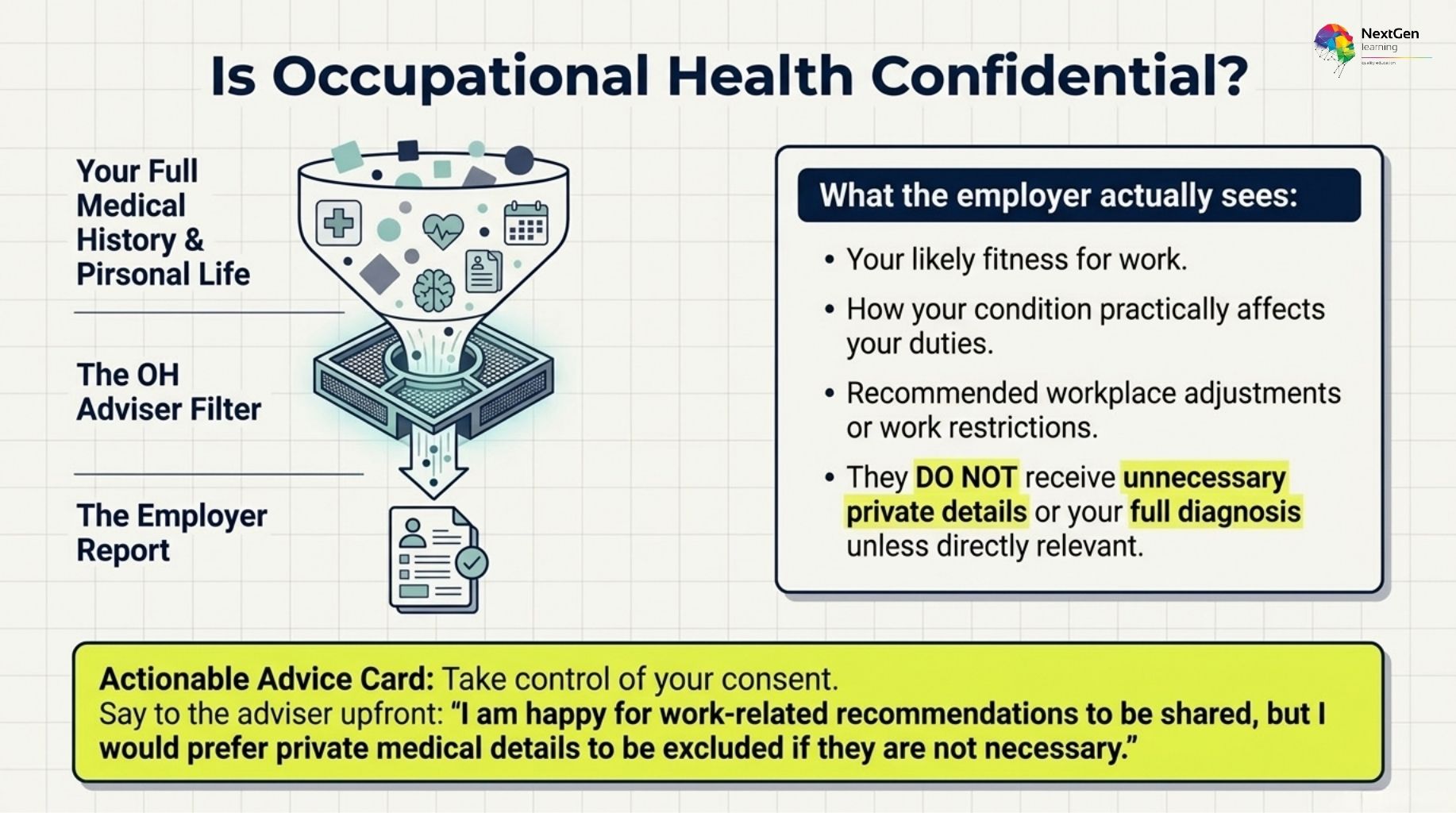
Yes, Occupational Health is confidential. However, confidentiality does not mean that nothing can ever be shared with your employer. Instead, it usually means that your private medical details should only be shared when there is a proper reason, a lawful basis and relevant consent or permission.
In most workplace cases, your employer does not need your full medical history. They need work-related advice. Therefore, an Occupational Health report should normally focus on how your health affects your job, whether you are fit for work and what adjustments may help.
For example, the report may say that you would benefit from flexible hours, reduced manual handling, a phased return, or regular workload reviews. However, it should not include unnecessary personal details that do not help your employer manage your work situation fairly.
ACAS explains that an employer can ask a worker to agree to an Occupational Health assessment and it also states that employers must get permission before asking for a doctor’s report about a worker’s health. In addition, the ICO explains that workers’ health information is sensitive personal information under UK data protection law.
What your employer usually receives
Your employer usually receives an Occupational Health report, not a full copy of everything you discussed. As a result, the report should focus on practical work-related recommendations.
It may include:
- Your likely fitness for work
- How your condition affects your duties
- Whether adjustments may help
- Whether a phased return may be suitable
- Whether further review may be needed
- Any work restrictions or risk concerns
However, the report should avoid unnecessary detail. For example, your employer may need to know that your condition affects concentration or mobility. However, they may not need your full diagnosis, private medical history, or personal family circumstances.
Consent and Occupational Health reports
Before an Occupational Health report goes to your employer, you should understand what will be shared and why. Therefore, it is sensible to ask about consent at the start of the appointment.
You can ask:
- “What information will appear in the report?”
- “Will I be able to review the report before it is sent?”
- “Who in the organisation will see the report?”
- “Can sensitive medical details be kept out if they are not needed?”
- “How will the report be used by my employer?”
These questions do not make you difficult. Instead, they show that you take the process seriously and want to protect your privacy while still allowing useful recommendations.
What information should stay private
Some information may be relevant to your health but not relevant to your employer. Therefore, you can ask Occupational Health to focus on the work impact rather than unnecessary personal details.
For example, you may want the report to explain that you need reduced workload pressure or flexible hours. However, you may not want it to include deeply personal background information if it does not affect your work.
A helpful phrase is:
“I am happy for work-related recommendations to be shared. However, I would prefer private medical details to be excluded unless they are necessary.”
This wording is clear and reasonable. Moreover, it allows Occupational Health to support your employer without exposing more information than needed.
What to Prepare Before an Occupational Health Appointment

Preparing before an Occupational Health appointment helps you explain your situation clearly. It also reduces the chance of forgetting important details when you feel nervous or under pressure. However, preparation does not mean rehearsing a perfect answer. Instead, it means bringing clear, honest information about how your health affects your work.
Before the appointment, think about your role, your symptoms and the tasks that have become harder. In addition, note what makes the condition worse and what helps you manage it. This gives Occupational Health a more accurate picture and helps them recommend support that fits your real working day.
Notes about your symptoms and work duties
It is helpful to write brief notes before the assessment. However, keep them focused on work. Occupational Health does not need every detail of your personal life unless it affects your ability to work safely or consistently.
You may want to note:
- Your main symptoms and when they usually happen
- The duties that make your symptoms worse
- The tasks you can still manage well
- Any recent sickness absence or reduced performance
- Medication side effects that affect work
- Workplace factors such as workload, shifts, equipment, or deadlines
- Support that has helped in the past
For example, instead of only writing “back pain,” write, “Back pain worsens after two hours of sitting and makes it harder to concentrate during afternoon tasks.” This is more useful because it links the symptom to your job.
Questions you may want to ask
You can ask questions during the appointment. In fact, asking clear questions can help you understand the process and protect your interests. Therefore, prepare a few questions before the meeting.
Useful questions include:
- “What information will be shared with my employer?”
- “Can I see the report before it is sent?”
- “What adjustments may help me continue working safely?”
- “Would a phased return or temporary change be suitable?”
- “How will my employer use this report?”
- “What should I do if my symptoms change?”
These questions show that you want to cooperate. Moreover, they help you leave the appointment with a better idea of what may happen next.
Documents that may help
You do not always need documents for an Occupational Health appointment. However, relevant information can help if it explains your condition, absence, restrictions, or treatment plan.
You may consider having:
- A fit note from your GP
- Letters from a consultant, therapist, or specialist
- A list of medication that affects work
- Recent return-to-work notes
- Details of previous adjustments
- Your job description or main duties
- A short timeline of symptoms, absence, or workplace difficulties
However, avoid sending unnecessary personal records if they do not relate to work. Instead, focus on information that helps Occupational Health understand what support you may need.
What Happens After the Occupational Health Report?

After your Occupational Health assessment, the adviser usually prepares a report for your employer. This report should focus on work-related matters, such as your fitness for work, possible adjustments, expected recovery and any restrictions that may affect your duties.
However, the report should not become a full record of your private medical history. Health information is highly sensitive, so employers must handle it carefully and have a proper reason for collecting or sharing it. The ICO explains that employers must identify a lawful basis and a special category condition before sharing workers’ health information.
Can you see the report?
In many cases, you can ask whether you will be able to see the report before it goes to your employer. Therefore, it is sensible to raise this during the assessment rather than waiting until later.
You could say:
- “Can I review the report before it is sent?”
- “Can you explain what will be included in the report?”
- “Will the report focus on work recommendations rather than private medical details?”
- “Who will receive a copy of the report?”
If your employer asks for a doctor’s medical report, ACAS says workers have rights, including the right to ask to see the report before it goes to the employer and to ask the doctor to correct anything inaccurate or misleading.
What if the report is inaccurate?
If the report contains incorrect details, you should act quickly. However, stay calm and focus on facts. Do not simply say, “This report is wrong.” Instead, explain which part is inaccurate and what correction is needed.
For example, you could say:
- “The report says I cannot do any desk work, but I can complete desk-based duties with breaks.”
- “The report refers to daily symptoms, but my symptoms fluctuate across the week.”
- “The report does not mention that prolonged standing worsens my condition.”
- “The suggested adjustment does not match my actual duties.”
This kind of response is specific and useful. Moreover, it helps Occupational Health, HR, or your manager understand the issue without turning the discussion into a dispute.
What if your employer ignores the recommendations?
Occupational Health normally gives advice, not final instructions. Therefore, your employer may consider the recommendations alongside operational needs, your role and legal duties. However, if the advice includes reasonable adjustments linked to a disability or health condition, your employer should consider them carefully.
If recommendations are not followed, ask for a clear explanation. You can also suggest alternatives if one adjustment is not workable.
You could say:
- “Can we discuss which recommendations can be implemented?”
- “If this adjustment is not possible, what alternative support could help?”
- “Can we agree a review date to check whether the support is working?”
- “Can you explain the reason this recommendation cannot be followed?”
This keeps the conversation constructive. As a result, you stay focused on solutions rather than conflict.
Common Mistakes Employees Make During Occupational Health Assessments
Many mistakes during an Occupational Health assessment happen because employees feel nervous. As a result, they either say too little, say too much, or focus on the wrong issue. However, the assessment works best when you give clear, honest and work-related information.
The key is to remember the purpose of the appointment. Occupational Health is not there to hear every workplace frustration or every private medical detail. Instead, the adviser needs to understand how your health affects your job and what may help you work safely.
Being too vague
Vague answers make it harder for Occupational Health to give useful advice. For example, saying “I’m struggling” may be true, but it does not explain what is happening at work. Therefore, the adviser may not know whether the issue relates to pain, fatigue, stress, concentration, mobility, workload, or attendance.
Instead of saying:
- “I’m finding work hard.”
- “I’m not coping well.”
- “Everything is difficult.”
Say something more specific:
- “I struggle most with long meetings because my concentration drops after about 30 minutes.”
- “My symptoms worsen during late shifts, so I find recovery difficult the next day.”
- “Heavy lifting increases my pain, especially when I have repeated manual tasks.”
Specific answers help the adviser identify patterns. Moreover, they make the final report more accurate and useful.
Over-sharing unrelated personal issues
It is natural to explain background context. However, too much unrelated detail can distract from the main purpose of the assessment. Occupational Health needs enough information to understand your work needs, but it does not usually need every private detail about your personal life.
For example, if family stress affects your sleep and concentration, mention the work impact. However, avoid spending most of the appointment on details that do not help the adviser assess your role.
A better approach is:
“My personal circumstances are affecting my sleep. As a result, I am finding early starts and high-pressure tasks harder to manage.”
This keeps the explanation relevant. In addition, it helps Occupational Health focus on possible workplace support.
Refusing to discuss adjustments
Some employees refuse adjustments because they fear being treated differently. However, adjustments are not a sign of failure. In many cases, they help employees stay in work, reduce absence and perform more consistently.
Avoid saying, “I don’t want any adjustments,” unless you have considered the options carefully. Instead, keep the conversation open.
You could say:
- “I am not sure what adjustments would help, but I am open to discussing options.”
- “I would like to understand whether temporary support could help me recover.”
- “I want to keep working, so I would welcome advice on safe adjustments.”
This shows cooperation. Consequently, the adviser can explore support without assuming you have rejected help.
Treating Occupational Health like a disciplinary meeting
An Occupational Health assessment is not the same as a disciplinary or grievance meeting. However, some employees approach it defensively because they worry about what the employer may do next. This can lead to guarded answers, anger, or refusal to engage.
Instead, treat the appointment as a health-and-work discussion. You can still protect your privacy and ask questions. However, you should also provide enough detail for the adviser to understand your situation.
FAQs About What Not to Say to Occupational Health
Occupational Health does not usually make employment decisions. Instead, it advises your employer about your fitness for work, possible adjustments, and workplace support. However, the report may influence decisions about absence, return to work, or capability.
You may refuse an Occupational Health assessment. However, your employer may then make decisions using the information already available. Therefore, ask why the referral was made and how the report will be used before deciding.
Yes, if stress affects your health or work, you should mention it clearly and professionally. Instead of saying “My job is stressful,” explain the impact.
For example:
- “High workload is affecting my sleep and concentration.”
- “Unclear priorities are worsening my anxiety.”
- “Regular workload reviews may help reduce pressure.”
Yes, you can discuss reasonable adjustments during the assessment. Explain how your condition affects your duties and what support may help you work safely and consistently.
Your employer should not normally see your full medical records. In most cases, they receive work-related advice, such as fitness for work and adjustment recommendations, rather than private medical details.
If you disagree with the report, stay calm and identify the specific issue. Explain what is inaccurate, incomplete, or unclear, then ask whether the report can be reviewed or corrected.
Final Thoughts: How to Speak to Occupational Health With Confidence
Speaking to Occupational Health can feel stressful, especially if you are worried about your job, your privacy, or how your employer may use the report. However, the best approach is not to hide information or overexplain every detail. Instead, focus on clear, honest and work-related communication.
You should avoid statements that minimise your condition, exaggerate your limitations, blame one person, or reject support too quickly. These phrases can lead to confusion and may result in a report that does not reflect your real needs. Therefore, it is better to explain how your health affects your duties, what tasks you can still manage and what adjustments may help.
The most useful Occupational Health conversations usually include:
- Clear examples of how symptoms affect work
- Honest details about good days and bad days
- A balanced explanation of what you can and cannot do
- Questions about confidentiality and consent
- Constructive suggestions for reasonable adjustments
- A calm focus on solutions rather than blame
Ultimately, Occupational Health is there to assess the connection between your health and your work. As a result, your words should help the adviser understand that connection clearly. When you prepare well and communicate carefully, you improve your chances of receiving fair, practical and appropriate workplace support.


0 responses on "What Not to Say to Occupational Health UK | Safe Examples & Tips"