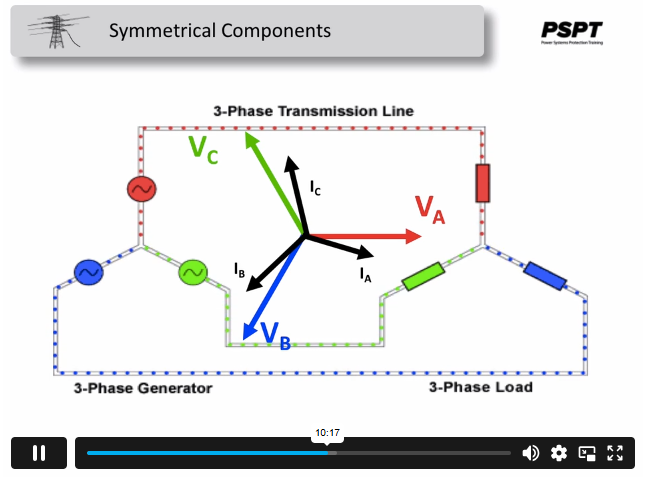
They split an unbalanced three-phase system into three balanced sets for easier analysis.
Overview Of Symmetrical Components for Three Phase Power Analysis Course
Many engineers and technical professionals struggle when analysing unbalanced three-phase power systems, not because the subject is beyond their ability, but rather because they lack a clear and structured analytical approach. As a result, without a systematic method, fault conditions and asymmetrical behaviours can appear complex. Consequently, this often leads to uncertainty in calculations and interpretations. In turn, professionals may rely on assumptions rather than confident, evidence-based analysis.
In professional practice, unbalanced conditions arise for example due to faults, unequal loads, and asymmetrical network configurations. However, when engineers are not fully equipped with the theory and application of symmetrical components, analysing these conditions becomes time-consuming and error-prone. Therefore, decision-making during fault analysis, protection studies, or system evaluations may feel uncertain or incomplete. Over time, this lack of structured understanding can affect both efficiency and confidence in professional settings.
To address this, the Symmetrical Components for Three Phase Power Analysis course closes this knowledge gap by providing a structured framework for understanding and applying symmetrical component theory within power systems analysis. Rather than focusing on memorisation alone, the course instead develops analytical clarity. As a result, learners are able to systematically break down complex three-phase problems into manageable components and apply solutions with confidence.
How This Course Helps You Develop Practical Analysis Skills
Firstly, understand how symmetrical components simplify unbalanced three-phase systems
Secondly, apply sequence component theory to real power system scenarios
Moreover, strengthen analytical confidence when evaluating faults and system behaviour
Additionally, improve accuracy in interpreting three-phase voltages and currents
Ultimately, develop a structured approach to power systems analysis problems
The Outcomes You Can Expect
By completing this course, you will gain a clearer and more systematic approach to three-phase power analysis. As a result, you will feel more confident interpreting unbalanced conditions and fault scenarios. Furthermore, the skills developed support practical engineering decisions. In the long term, this knowledge contributes to sustained professional growth and analytical confidence.
What You Will Learn in This Course
This course is designed to develop a clear, structured understanding of symmetrical components and their role in power systems analysis. Rather than focusing on isolated formulas, the learning outcomes instead emphasise analytical clarity, logical thinking, and professional application within three-phase power systems. As a result, learners gain a more coherent and practical understanding of the subject.
By progressing through the course, learners gradually build the ability to interpret unbalanced system behaviour systematically. Consequently, this supports stronger technical judgement, while reducing uncertainty during fault analysis. In turn, learners improve confidence when working with complex three-phase conditions in real engineering contexts.
By the end of this course, you will be able to:
- Firstly, understand the purpose and theory of symmetrical components in three-phase power systems
- Secondly, analyse unbalanced three-phase voltages and currents using sequence components
- Moreover, apply symmetrical component techniques within practical power systems analysis
- Additionally, interpret system behaviour during fault and abnormal operating conditions
- Ultimately, approach three-phase power analysis problems with a structured, methodical framework
Course Curriculum
- Module 01: Introduction
This module establishes the foundational context of three-phase power systems and their role in modern electrical networks. Learners gain clarity on why structured analytical methods are essential when dealing with unbalanced conditions in professional power systems analysis.
- Module 02: Symmetrical Components Overview
This module introduces the concept of symmetrical components as a systematic method for analysing unbalanced three-phase systems. It explains why this approach is central to fault analysis and how it simplifies complex power system behaviour.
- Module 03: The Components
Learners explore positive-sequence, negative-sequence, and zero-sequence components in detail. The module focuses on understanding the role of each component and how they represent different system conditions within practical power systems analysis.
- Module 04: The “a” Operator
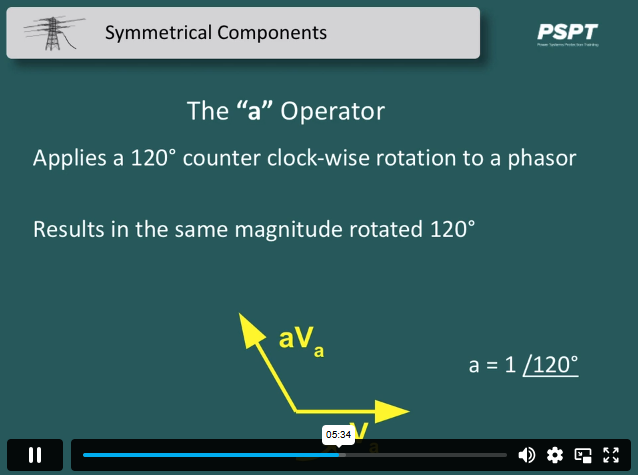
This module introduces the mathematical concept of the “a” operator and its importance in symmetrical component theory. Learners understand how phase rotation is represented mathematically and why this operator is critical for accurate sequence analysis.
- Module 05: Working with the a Operator
Building on the previous module, learners apply the “a” operator to real three-phase quantities. This module strengthens confidence in performing transformations and interpreting results correctly within symmetrical component calculations.
- Module 06: Synthesis Equations
This module focuses on synthesis equations used to reconstruct original phase quantities from sequence components. Learners develop a structured understanding of how analytical results translate back into real-world system values.
- Module 07: Problems & Solutions
The final module applies theory through worked problems and guided solutions. Learners practise analysing unbalanced systems step by step, reinforcing accuracy, confidence, and practical decision-making skills.
Certificate of Achievement
Upon successful completion of the course, learners will have developed a structured and practical understanding of symmetrical components within three-phase power analysis. The course completion reflects the learner’s ability to apply analytical methods logically and interpret unbalanced system behaviour with confidence.
This course focuses on skill development aligned with professional power systems analysis practices. The knowledge gained supports further technical learning and practical application in electrical engineering, utilities, and industrial power system environments.
Entry Requirements
This course has been structured to be accessible while maintaining professional and technical relevance. Learners do not need prior experience with symmetrical components, as the course introduces concepts progressively and explains analytical methods step by step.
To gain the maximum benefit from the course, learners should have:
- Basic electrical engineering knowledge, including AC circuit fundamentals
- Familiarity with three-phase power systems and common configurations
- Understanding of basic mathematics, including algebra and complex numbers
- An analytical approach to problem-solving and interpretation
Who Is This Course For?
This course is designed for individuals who work with, study, or support three-phase electrical power systems and who therefore want a clearer, more structured approach to analysis. In particular, it is suitable for those who need to understand unbalanced system behaviour and consistently apply analytical methods with confidence in professional settings.
Moreover, the course supports learners at different career stages, ranging from those strengthening foundational knowledge to professionals refining their analytical skills for real-world power systems analysis. As a result, learners can progress at a level appropriate to their experience while developing structured technical understanding.
This course is suitable for:
- Firstly, electrical engineers working with three-phase power systems
- Secondly, power system analysts involved in system evaluation and fault analysis
- Additionally, engineering students seeking structured understanding of symmetrical components
- Furthermore, technical professionals in industrial or utility environments
- Ultimately, engineers aiming to improve confidence in analytical decision-making
Why This Course Is Important
Modern electrical networks rely heavily on three-phase power systems, whereas reliability and accuracy in analysis directly affect system performance and safety. When unbalanced conditions occur, engineers must be able to interpret system behaviour quickly and correctly. However, without a structured analytical method, fault analysis and system evaluation can become uncertain and inefficient.
As a result, symmetrical components form a core analytical framework within power systems analysis, allowing complex unbalanced conditions to be simplified into manageable components. Therefore, this course is important because it bridges the gap between theoretical knowledge and professional application, enabling learners to approach three-phase analysis with clarity rather than approximation.
Consequently, by developing a systematic understanding of symmetrical components, learners strengthen their ability to make informed technical decisions. In turn, this supports improved system reliability, more accurate fault diagnosis, and greater confidence when working in professional electrical and power engineering environments.
Career Benefits and Outcomes
Developing a structured understanding of symmetrical components strengthens both technical confidence and professional credibility. In roles involving three-phase power systems, the ability to analyse unbalanced conditions accurately is a valued and practical skill.
This course supports career development by improving analytical capability rather than focusing on narrow task-based knowledge. Learners gain transferable skills that apply across power system analysis, fault investigation, and system evaluation roles.
Career and professional benefits include:
- Improved confidence when analysing unbalanced three-phase systems
- Stronger fault analysis and system interpretation skills
- Enhanced technical decision-making in professional environments
- Greater credibility in power systems and electrical engineering roles
- Practical analytical skills applicable across utilities, industry, and engineering projects
Order Your Certificate
To order your Certificate, we kindly invite you to visit the following link
FAQs – Symmetrical Components for Three Phase Power Analysis
They simplify unbalanced fault calculations into manageable equivalent circuits, explained clearly in this course.
Symmetrical representation makes analysing faults and unbalanced conditions much simpler.
Three-phase power is mainly calculated using the positive sequence component.
1.732 is √3, which relates line and phase values in balanced systems.
A balanced sequence component used to represent unbalanced three-phase systems.
A balanced three-phase fault affecting all phases equally.
Symmetrical components are balanced; unsymmetrical conditions are not.
It states that any unbalanced three-phase system can be resolved into symmetrical components.
Unequal phase voltages or currents caused by faults or unbalanced loads.
Course Curriculum
| Symmetrical Components for Three Phase Power Analysis | |||
| Module 01: Introduction | 00:09:00 | ||
| Module 02: Symmetrical Components Overview | 00:18:00 | ||
| Module 03: The Components | 00:03:00 | ||
| Module 04: The “a” Operator | 00:06:00 | ||
| Module 05: Working with the a Operator | 00:04:00 | ||
| Module 06: Synthesis Equations | 00:19:00 | ||
| Module 07: Problems & Solutions | 00:31:00 | ||
| Assignment | |||
| Assignment -Symmetrical Components for Three Phase Power Analysis | 00:00:00 | ||
| Order Your Certificate | |||
| Order Your Certificate | 00:00:00 | ||
Related Courses
AI for Marketing & Sales – Personalization & Automation
Creating Presentations with AI Tools
AI in Healthcare


All Courses for £49