



Safeguarding Policy Template for Small Organisations
A good safeguarding policy helps everyone in an organisation understand how to protect people, recognise concerns and respond appropriately. For small charities, community groups and volunteer-led organisations, it also provides a clear framework for everyday responsibilities.
Understanding what safeguarding means in practice can help small organisations establish clear responsibilities and reporting procedures.
This free safeguarding policy template for small organisations gives you a practical starting point. You can copy the sample wording, add your organisation’s details and adapt the procedures to the people and activities you support.
The template covers essential safeguarding responsibilities, reporting concerns, safer recruitment, confidentiality and policy reviews. Before adopting it, make sure the arrangements reflect your organisation’s activities, local safeguarding procedures and applicable UK requirements.
Table of Contents
Free Safeguarding Policy Template for Small Organisations
The following sample safeguarding policy is suitable as a starting point for small charities, community organisations and volunteer-led groups.
Copy the template into a Word document and replace the information in square brackets with your organisation’s details. Adapt each section to reflect your activities and safeguarding responsibilities.
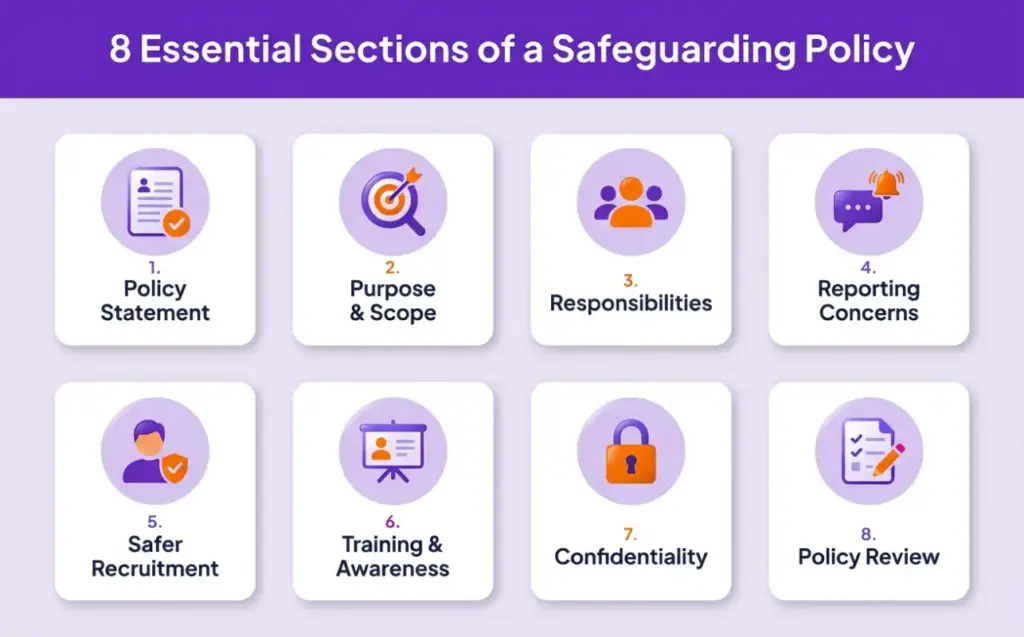
1. Organisation Details and Policy Statement
| Policy information | Details |
|---|---|
| Organisation name | [Organisation Name] |
| Policy owner | [Name or Position] |
| Safeguarding lead | [Name and Contact Details] |
| Deputy or alternative contact | [Name and Contact Details] |
| Approved by | [Trustees or Management Committee] |
| Approval date | [DD/MM/YYYY] |
| Next review date | [DD/MM/YYYY] |
Safeguarding Policy Statement
[Organisation Name] is committed to protecting the safety, wellbeing and dignity of everyone who participates in our activities or comes into contact with our organisation.
We aim to create an inclusive environment where people are treated respectfully, safeguarding concerns can be raised confidently and appropriate action is taken when necessary.
All trustees, employees, volunteers and relevant representatives are expected to understand and follow this policy.
2. Purpose and Scope
This policy explains how [Organisation Name] works to prevent harm, recognise safeguarding concerns and respond appropriately.
It applies to:
- Trustees, committee members, employees and volunteers.
- Children, young people and adults at risk who participate in our activities, where applicable.
- Contractors and other individuals acting on behalf of the organisation.
- Activities delivered in person, online or within community settings.
Our safeguarding arrangements reflect the activities we provide, the people we support and the risks associated with our work.
Organisations working with children should also maintain appropriate child protection procedures. The NSPCC’s guidance on writing safeguarding policies and procedures explains the importance of having clear arrangements for protecting children, separate from adult safeguarding procedures.
3. Safeguarding Responsibilities
Everyone involved with [Organisation Name] has a role in creating a safe and supportive environment.
Trustees or management committee
The governing body oversees safeguarding arrangements, reviews relevant risks and ensures appropriate policies and procedures are established and maintained.
Designated safeguarding lead
[Name or Position] receives safeguarding concerns, coordinates appropriate responses, maintains relevant records and arranges referrals to external agencies when necessary.
Organisations working in education settings may also find it useful to understand the responsibilities of a designated safeguarding lead.
Employees and volunteers
Employees and volunteers must follow safeguarding procedures, maintain professional boundaries and report concerns promptly through the agreed channels.
For charities in England and Wales, the Charity Commission’s safeguarding guidance explains trustees’ responsibilities for managing safeguarding risks and protecting people who come into contact with their organisation.
4. Recognising and Reporting Safeguarding Concerns
[Organisation Name] takes concerns about abuse, neglect, exploitation, discrimination and inappropriate behaviour seriously.
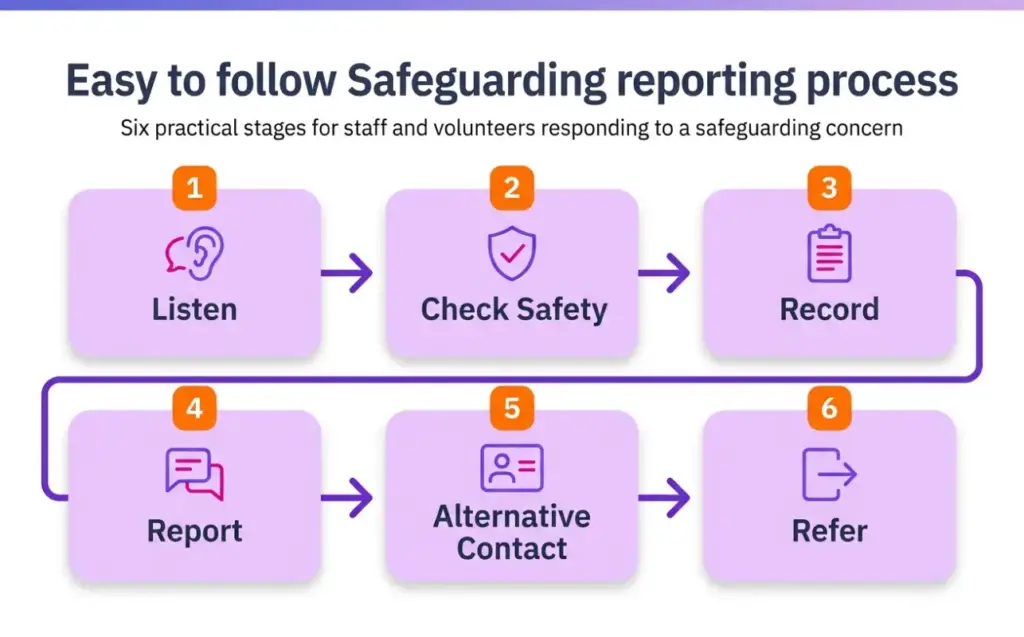
Anyone who becomes aware of a safeguarding concern should follow these procedures:
- Listen carefully. Remain calm, allow the person to speak and avoid asking leading questions.
- Consider immediate safety. If someone is in immediate danger, contact emergency services on 999.
- Record the concern. Note relevant facts, dates, observations and the person’s own words where possible.
- Report promptly. Contact [Safeguarding Lead’s Name] using [Contact Details].
- Use an alternative reporting route. If the concern involves the safeguarding lead, contact [Alternative Contact].
- Follow referral procedures. Concerns should be referred to the relevant external safeguarding agency when appropriate. Staff and volunteers may also contact statutory services directly where necessary.
Staff and volunteers should not investigate suspected abuse themselves. Information should be shared appropriately with those responsible for responding to safeguarding concerns.
For organisations working with children in England, Working Together to Safeguard Children 2026 provides statutory guidance on safeguarding responsibilities and multi-agency working.
Local Safeguarding Contacts
- Designated safeguarding lead: [Name and Contact Details]
- Alternative safeguarding contact: [Name and Contact Details]
- Local children’s services: [Contact Details]
- Local adult safeguarding service: [Contact Details]
- Emergency services: 999
These details should be completed and checked against the safeguarding arrangements relevant to your organisation.
5. Safer Recruitment and Codes of Conduct
[Organisation Name] aims to recruit suitable individuals and maintain clear expectations of professional behaviour.
Where relevant, we will:
- Assess the safeguarding risks associated with different roles.
- Carry out appropriate recruitment and reference checks.
- Arrange DBS checks where positions are eligible.
- Explain acceptable behaviour and professional boundaries.
- Provide suitable supervision and support.
- Respond appropriately to concerns about employees or volunteers.
Everyone representing the organisation must treat others respectfully, maintain appropriate boundaries and report behaviour that raises safeguarding concerns.
Recruitment checks and supervision arrangements will reflect the responsibilities and safeguarding risks associated with each role.
6. Safeguarding Training and Awareness
[Organisation Name] will support employees and volunteers in understanding the safeguarding responsibilities relevant to their activities.
Our arrangements include:
- Introducing safeguarding policies and reporting procedures during induction.
- Making safeguarding information accessible to staff and volunteers.
- Identifying appropriate training based on roles and responsibilities.
- Maintaining suitable training records.
- Refreshing safeguarding knowledge when responsibilities, risks or guidance change.
Volunteers should understand how to recognise and report safeguarding concerns before undertaking activities involving safeguarding responsibilities.
Choosing suitable training depends on each person’s responsibilities, so it helps to understand the safeguarding training volunteers may need for their roles.
The level of safeguarding training for volunteers should reflect the work they carry out, the people they support and the risks involved.
For those developing their understanding of child protection, NextGen Learning’s Child Protection and Safeguarding course provides CPD-accredited learning covering safeguarding principles, recognising abuse, responding to disclosures and reporting concerns. This can support the organisation’s wider safeguarding training arrangements.
7. Confidentiality and Record Keeping
[Organisation Name] will handle safeguarding information sensitively, securely and in accordance with applicable data protection requirements.
Safeguarding records must:
- Be accurate, factual and dated.
- Be stored securely with appropriate access controls.
- Be accessible only to authorised individuals.
- Be shared with relevant people or agencies when necessary and lawful.
- Be retained and disposed of according to applicable requirements.
Employees and volunteers must respect confidentiality while recognising that safeguarding concerns may require appropriate information sharing.
The Information Commissioner’s Office explains in its guidance on sharing safeguarding information that UK data protection law provides a framework for sharing personal information fairly and proportionately to protect children.
8. Policy Approval, Monitoring and Review
This policy will be reviewed by [Responsible Person or Committee] to ensure it remains suitable for our organisation.
Reviews will consider:
- Changes to organisational activities or safeguarding risks.
- Updates to relevant legislation or official guidance.
- Learning from safeguarding incidents.
- Changes in staff, volunteer roles or reporting arrangements.
- Feedback from people involved with the organisation.
For charities in England and Wales, the Charity Commission expects safeguarding policies and procedures to be reviewed whenever necessary, following serious incidents and at least annually.
Updated policies will be communicated to relevant staff, volunteers and other individuals.
Approved by: [Name or Committee]
Approval date: [DD/MM/YYYY]
Next review: [DD/MM/YYYY]
How to Adapt This Safeguarding Policy Template
A safeguarding policy becomes useful when it reflects the organisation’s actual activities, responsibilities and reporting arrangements.
Replace the Template Details
Start by completing the organisation’s name, safeguarding contacts, policy owner and review dates. Confirm that the reporting arrangements are practical and that relevant people understand their responsibilities.
Next, review the activities your organisation delivers. A community centre supporting older adults may need different safeguarding arrangements from a youth group organising weekend activities.
Consider the people involved, the settings in which activities take place and the safeguarding risks associated with each role.
Organisations developing their own document from scratch may find it helpful to follow the steps for writing a safeguarding policy, from identifying risks to establishing clear procedures.
Adjust the Policy to Your Organisation’s Activities
Different organisations need safeguarding arrangements that reflect their activities and the people they support.
Small charities: Trustees should consider the services provided, people supported, volunteer responsibilities and reporting procedures. Understanding which safeguarding training charity staff and volunteers need can help organisations put these arrangements into practice.
Youth groups: Organisations working with children should consider supervision, consent, online communication and child protection reporting. Understanding the safeguarding responsibilities of youth workers can help organisations establish clear expectations for staff and volunteers.
Sports clubs: Coaching, changing facilities, travel arrangements and physical activities may require additional safeguarding procedures. Understanding how safeguarding works in sports clubs can help organisers adapt their policies to coaching and sporting activities.
Safeguarding legislation and guidance differ across England, Scotland, Wales and Northern Ireland. Organisations should follow the requirements and local safeguarding arrangements relevant to their location and activities.
Checklist Before Approving Your Safeguarding Policy
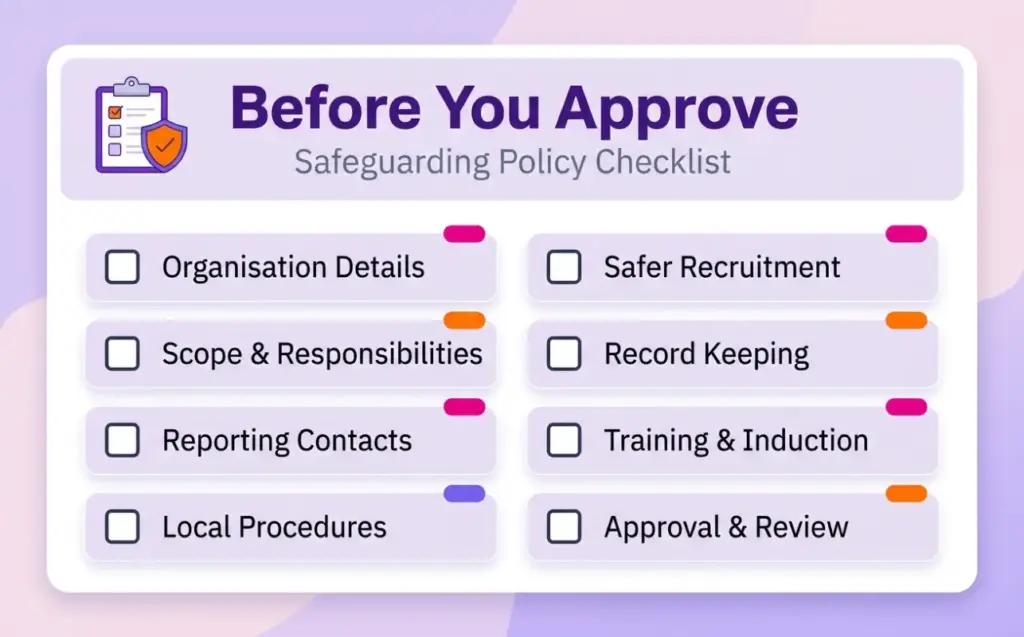
Before putting your safeguarding policy into practice, review the following points:
- The organisation’s details and safeguarding contacts are accurate.
- The policy covers relevant activities, participants, employees and volunteers.
- Safeguarding responsibilities are clearly assigned.
- Reporting procedures and alternative escalation routes are established.
- Relevant local safeguarding contacts have been confirmed.
- Recruitment and conduct arrangements reflect organisational risks.
- Confidentiality and record-keeping procedures are clear.
- Staff and volunteers know where to access the policy.
- Suitable safeguarding training arrangements are in place.
- The policy has been approved and its next review date recorded.
Once the policy is approved, share it with everyone who needs to follow it. Include safeguarding responsibilities in staff and volunteer induction, and provide opportunities to ask questions about reporting procedures.
Understanding what volunteer safeguarding courses cover and how long they take can help coordinators choose suitable learning for different roles.
Safeguarding Policy Template FAQs
Yes. Small charities can use this template as a starting point for developing their safeguarding arrangements. The wording should be adapted to the organisation’s activities, safeguarding risks, reporting procedures and relevant responsibilities.
Not exactly. Safeguarding covers wider arrangements for protecting people from harm, while child protection focuses specifically on protecting children from abuse and neglect. Organisations working with children should have appropriate child protection policies and procedures.
Review the policy whenever activities, safeguarding risks or relevant guidance change. The Charity Commission expects charities in England and Wales to review safeguarding policies and procedures at least annually and following serious incidents.
You can use an existing policy as a reference or starting point. However, the finished document should reflect your organisation’s own activities, responsibilities, safeguarding contacts and reporting procedures.
Training needs depend on the volunteer’s role, activities and level of safeguarding responsibility. Some volunteers may need introductory awareness, while others require more detailed knowledge relevant to the people they support.
Final Thoughts
A clear safeguarding policy helps small organisations establish consistent responsibilities and practical reporting arrangements.
Use this safeguarding policy template as a starting point, adapt it to your organisation’s activities and make sure employees and volunteers understand how to apply it.
Keeping the policy accessible, providing appropriate training and reviewing arrangements regularly will help safeguarding remain part of everyday organisational practice.